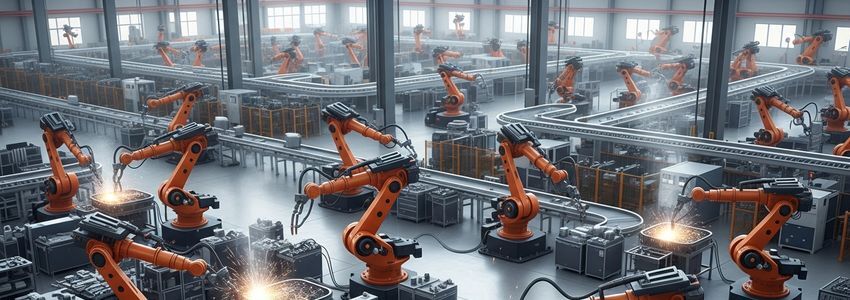
Industrial automation is no longer reserved for Fortune 500 manufacturers. Today, businesses of every size — from regional fabricators to mid-size distribution centers — are deploying robotic arms, automated guided vehicles (AGVs), collaborative robots (cobots), and smart conveyor systems to cut labor costs, boost throughput, and compete at scale. The challenge has always been the upfront price tag. A single industrial robot can cost $25,000 to $400,000 or more, making outright purchase a capital-intensive barrier for most small and mid-size businesses.
That is where leasing industrial robots and automation equipment changes everything. Instead of tying up capital in depreciating assets, businesses can access state-of-the-art robotics on a structured monthly payment that preserves cash flow and keeps technology current. This guide covers everything you need to know — from how robot leasing works to how to qualify, what it costs, and how Crestmont Capital helps you get funded fast.
In This Article
- What Is Industrial Robot Leasing?
- Types of Industrial Robots and Automation Equipment You Can Lease
- How Industrial Robot Leasing Works
- Key Benefits of Leasing vs. Buying
- By the Numbers: Industrial Automation Stats
- Leasing vs. Financing vs. Buying: Full Comparison
- Who Qualifies for Robot Leasing?
- How Crestmont Capital Helps
- Real-World Scenarios
- How to Get Started
- Frequently Asked Questions
What Is Industrial Robot Leasing?
Industrial robot leasing is a financing arrangement in which a business pays a fixed monthly fee to use robotic and automation equipment for a defined term — typically 24 to 72 months — without purchasing the equipment outright. At the end of the lease, the business can return the equipment, renew the lease at a reduced rate, or exercise a buyout option (commonly $1 or fair market value, depending on lease type).
Robot leasing follows the same foundational structure as any equipment lease. A lender or leasing company purchases the equipment from the manufacturer or distributor and then leases it to you. You make monthly payments and use the equipment as if you owned it — operating it, maintaining it, and integrating it into your production floor. The leasing company retains legal title during the lease term.
There are two primary lease structures relevant to industrial automation:
- Operating Lease (True Lease): Monthly payments are lower, equipment is returned at end of term, and the lease is typically treated as an operating expense. Best for businesses that want to upgrade equipment frequently.
- Finance Lease (Capital Lease): Payments are higher because you're building toward ownership. At end of term, you own the equipment outright (or pay a nominal buyout). Best for businesses that plan to keep equipment long-term.
Key Stat: According to the International Federation of Robotics, the global installed base of industrial robots exceeded 3.9 million units in 2023 — with small and mid-size manufacturers driving the fastest adoption growth. Access to flexible financing has been the primary accelerator.
Types of Industrial Robots and Automation Equipment You Can Lease
The range of leasable automation equipment is broader than most business owners realize. If it has a serial number and quantifiable residual value, it can typically be leased. Below are the most common categories financed through equipment leasing programs:
Articulated Robotic Arms
These multi-axis arms are the workhorses of industrial automation — used for welding, assembly, material handling, painting, and packaging. Leading brands include FANUC, KUKA, ABB, and Yaskawa. A six-axis articulated arm typically ranges from $30,000 to $150,000 depending on payload capacity and reach.
Collaborative Robots (Cobots)
Cobots are designed to work alongside human operators without safety caging. They're ideal for smaller production runs, quality inspection, machine tending, and kitting operations. Cobots from Universal Robots, Rethink Robotics, and Doosan typically range from $25,000 to $75,000.
Automated Guided Vehicles (AGVs) and Autonomous Mobile Robots (AMRs)
These floor-based systems automate material transport within warehouses, distribution centers, and manufacturing floors. Costs range from $20,000 for basic conveyor-following AGVs to $150,000+ for sophisticated AI-guided AMRs from companies like Fetch Robotics, Seegrid, and Locus Robotics.
CNC Machining Centers and Robotic Integration
Modern CNC machines are increasingly integrated with robotic load/unload systems. The combined cell — CNC machine plus robot arm — can exceed $500,000 but dramatically increases throughput per labor hour.
Vision Systems and AI Inspection Platforms
Machine vision cameras, sensor arrays, and AI-powered quality inspection platforms can be leased as standalone units or as part of a larger automation cell. These systems range from $15,000 to $200,000.
Conveyor and Sortation Systems
Industrial conveyor lines, belt sortation systems, and pick-and-place automation are heavily used in e-commerce fulfillment and food processing. These systems range from $50,000 for simple conveyor lines to millions for complex sortation installations — all leasable through structured commercial financing.
Welding Robots
Automated welding systems — including MIG, TIG, and laser welding robots — are among the most common automation investments for metal fabricators. A complete welding cell with robot, positioner, and controller typically costs $80,000 to $250,000.
Ready to Automate Your Operations?
Get flexible financing for industrial robots and automation equipment. No obligation — see your options in minutes.
Apply Now →How Industrial Robot Leasing Works
The leasing process for industrial automation follows a clear sequence. Understanding each step helps you move faster and negotiate better terms.
Quick Guide
How Industrial Robot Leasing Works - At a Glance
Get quotes from robot vendors or system integrators. Know the total project cost including installation and integration.
Submit your application with basic financials. Most lenders can provide same-day credit decisions for equipment up to $500K.
Review monthly payment, term, end-of-lease options, and any maintenance or insurance requirements.
The lender pays the vendor directly. Your robot is delivered, installed, and operational - often within 1-4 weeks of approval.
You make fixed monthly payments. The equipment produces revenue that typically exceeds the payment within months.
Key Benefits of Leasing vs. Buying Industrial Robots
The choice between leasing and buying automation equipment is one of the most strategic financial decisions a manufacturing or distribution business can make. Here is how leasing consistently wins for most growing companies:
Preserve Working Capital
A $150,000 robotic welding cell purchased outright consumes cash that could fund payroll, inventory, or marketing. Leasing the same system at $3,200/month keeps that $150,000 working inside the business. According to the Equipment Leasing and Finance Association (ELFA), over 80% of U.S. businesses use some form of equipment financing — and preserving liquidity is the top reason cited.
Access Cutting-Edge Technology
Robotics technology evolves rapidly. A robot purchased in 2020 may already be outdated compared to 2025 models offering AI-guided vision, collaborative safety, and faster cycle times. Leasing allows you to upgrade at end of term rather than sell and replace aging owned assets at a loss.
Predictable Budgeting
Fixed monthly lease payments make financial planning straightforward. Unlike owning equipment — which comes with unpredictable repair costs, maintenance spikes, and eventual replacement — leasing gives your finance team a consistent monthly expense line.
Potential Off-Balance-Sheet Treatment
Under certain operating lease structures (ASC 842 guidelines apply), lease obligations may be treated differently in financial reporting than loan obligations. Consult your CPA for how leasing affects your specific balance sheet and debt ratios.
Faster ROI
Because leasing reduces initial outlay, your return on investment timeline accelerates. A robot that eliminates two labor positions at $50,000/year each creates $100,000 in annual savings against a $40,000 annual lease payment — a positive cash-flow contribution of $60,000 per year from day one.
Industry Insight: The Boston Consulting Group projects that robot adoption will reduce manufacturing labor costs by 16% globally by 2025. Businesses that act now — through leasing — capture competitive advantage before competitors close the gap.
By the Numbers: Industrial Automation and Equipment Leasing
By the Numbers
Industrial Robot Leasing - Key Statistics
$25K+
Starting cost of entry-level industrial robots - leasable from ~$600/mo
3.9M+
Industrial robots operating globally as of 2023 (IFR)
80%
Of U.S. businesses use equipment financing to acquire assets (ELFA)
1-3 Yrs
Typical payback period for industrial robot deployments
Leasing vs. Financing vs. Buying: Full Comparison
Understanding the full spectrum of acquisition options helps you make the best decision for your business situation, cash position, and long-term technology strategy.
| Factor | Operating Lease | Equipment Loan | Cash Purchase |
|---|---|---|---|
| Upfront Cost | Low (1-2 payments) | Low to None | Full price required |
| Monthly Payment | Lower | Moderate to Higher | None |
| Ownership | No (option to buy at end) | Yes (after payoff) | Yes (immediate) |
| Technology Upgrade | Easy (at lease end) | Harder (must sell old) | Hardest (sunk cost) |
| Balance Sheet Impact | Minimal (operating expense) | Asset + Liability | Asset only |
| Approval Speed | Fast (1-3 days) | Fast (1-5 days) | N/A |
| Best For | Fast-moving tech; cash conservation | Long-life equipment; building equity | Cash-rich businesses; zero-debt preference |
Who Qualifies for Industrial Robot and Automation Equipment Leasing?
Qualification criteria for robot leasing are generally more flexible than traditional bank loans. Most lenders evaluate the following:
Time in Business
Most equipment leasing programs require a minimum of 2 years in business. Some lenders offer startup equipment programs for businesses under 2 years, though these typically require stronger personal credit and potentially a larger down payment.
Credit Profile
Business credit (PAYDEX, Experian Business) and personal credit (for owners with significant ownership stake) are both reviewed. Many leasing programs are accessible with credit scores as low as 620, though scores above 680 unlock better rates and terms. Crestmont Capital specializes in funding businesses across the full credit spectrum — including bad credit equipment financing.
Revenue and Cash Flow
Lenders want to see sufficient monthly revenue to service the lease payment. A general guideline: your monthly lease payment should not exceed 15-20% of average monthly gross revenue. For a business with $500,000/month in revenue, leasing a $2 million automation system at $40,000/month is feasible.
Industry and Equipment Type
Lenders are more comfortable with "soft-collateral" equipment (equipment that has broad resale markets) than with highly customized robotic systems that are difficult to repossess and resell. Standard robotic arms and AGVs from major brands are generally well-received. Highly custom integration cells may require additional documentation.
Project Documentation
Having vendor quotes, system integration proposals, and basic ROI projections ready accelerates approval. Lenders want to understand what you're buying and why it will generate returns that support repayment.
Good News for Established Businesses: Companies with 2+ years in business, solid revenue history, and reasonable credit can often get approved for industrial robot leasing within 24-48 hours through Crestmont Capital's streamlined application process. Larger transactions ($500K+) may take 3-7 business days for full underwriting.
How Crestmont Capital Helps You Lease Industrial Robots
Crestmont Capital is the #1-rated business lender in the United States — and our equipment leasing division specializes in high-value industrial and automation assets. Here is what sets us apart for businesses pursuing automation financing:
Access to Diverse Capital Sources
Unlike a single bank with fixed underwriting criteria, Crestmont works with an extensive network of lenders, credit funds, and leasing companies. This means we can shop your deal to multiple sources simultaneously and secure the best rate and structure for your specific situation.
Expertise in Industrial Equipment
Our team understands the residual value of industrial robots, the useful life of automation systems, and the ROI profile of automation investments. We can structure lease terms that align monthly payments with the cash flow the equipment generates.
Fast Approvals
Most businesses receive credit decisions within 24-48 hours. For transactions under $500,000, we often provide same-day approvals. Our streamlined application requires minimal documentation for established businesses.
Soft-Cost Coverage
Industrial robot leasing is not just about the hardware. Integration, installation, programming, training, and maintenance contracts are often major cost components. Crestmont can structure financing to cover soft costs alongside the equipment — giving you a true all-in solution.
Flexible Structures
Need deferred payments for the first 90 days while you get the system operational? Interested in a step-up payment structure that starts low and increases as your production ramps? We can customize lease structures to match your cash flow reality.
Whether you need manufacturing equipment financing, fabrication equipment financing, or a complete automation cell lease, Crestmont Capital has the expertise and capital to close your deal efficiently.
Ready to Get Your Robots Working for You?
Crestmont Capital finances industrial robots, cobots, AGVs, and complete automation cells. Get your custom quote today.
Get My Financing Quote →Real-World Scenarios: Industrial Robot Leasing in Action
To illustrate how robot leasing creates real financial advantages, here are six realistic business scenarios:
Scenario 1: Midwest Metal Fabricator Automates Welding
A 45-employee metal fabrication shop in Ohio needed to expand welding capacity without adding headcount. A robotic welding cell from FANUC (robot + positioner + controller) cost $185,000. The owner leased it over 60 months at $3,800/month. The cell replaced the equivalent of 2.5 welders at $55,000/year each - generating $137,500 in annual labor savings against $45,600 in annual lease payments. Net annual benefit: $91,900 in the first year alone.
Scenario 2: E-Commerce Fulfillment Center Adds AMRs
A regional e-commerce fulfillment center processing 12,000 orders per day needed to accelerate pick rates ahead of peak season. They leased six autonomous mobile robots (AMRs) from Locus Robotics at a total project cost of $420,000, financed over 48 months at $9,800/month. Pick rates increased 35%, allowing them to fulfill peak-season orders without hiring 40 additional temporary workers at $18/hour. ROI was captured within the first holiday season.
Scenario 3: Food Manufacturer Leases Packaging Robot
A snack food manufacturer in Texas was losing $800,000/year to packaging line downtime and inefficiency. A collaborative robot from Universal Robots integrated into the packaging line cost $95,000. Leased over 36 months at $3,100/month, the cobot reduced packaging defects by 78% and eliminated a full shift of manual labor. The $37,200 annual lease cost versus $120,000+ in labor savings delivered immediate positive returns.
Scenario 4: Automotive Supplier Upgrades Inspection Systems
A Tier 2 automotive supplier faced quality audit failures due to manual inspection limitations. They leased an AI-powered vision inspection system for $160,000 over 48 months at $3,900/month. The system caught defects that previously reached customers, eliminating $2.3 million in potential warranty liability. The $46,800 annual lease cost was negligible against the risk mitigation value.
Scenario 5: Pharmacy Automation for Independent Drugstore
An independent pharmacy chain with four locations leased robotic prescription dispensing systems totaling $320,000 over 60 months at $6,500/month. Dispensing errors dropped to near zero, pharmacist time was freed for clinical services, and throughput increased 60%. Annual lease cost of $78,000 was offset by revenue growth from expanded clinical offerings.
Scenario 6: Startup Manufacturer Uses Leasing to Compete
A 3-year-old precision parts manufacturer needed advanced CNC automation to win a contract requiring tolerances only achievable with robotic machine tending. They couldn't afford a $280,000 purchase. A lease-to-own arrangement at $6,200/month over 48 months made it possible. The contract they won was worth $1.2 million over two years - all enabled by access to equipment they couldn't otherwise afford.
How to Get Started
Complete our quick application at offers.crestmontcapital.com/apply-now - takes just a few minutes. Have your vendor quote or equipment spec ready.
A Crestmont Capital equipment finance advisor will review your automation project, structure your lease, and match you with the right capital source for your credit profile and deal size.
Receive approval often within 24-48 hours. Equipment is ordered, delivered, installed, and producing for your business - often within weeks.
Start Your Automation Journey Today
Don't let capital constraints hold back your production capacity. Crestmont Capital makes leasing industrial robots and automation equipment fast and straightforward.
Apply Now - It's Free →Frequently Asked Questions
What is the minimum credit score to lease industrial robots?
Most industrial equipment leasing programs work with personal credit scores as low as 620. For well-established businesses with strong revenue, some lenders prioritize cash flow over credit score. Higher credit scores (680+) unlock lower monthly payments and more flexible terms. Crestmont Capital works with businesses across the full credit spectrum.
How much does it cost to lease an industrial robot per month?
Monthly lease payments depend on the equipment cost, lease term, and your credit profile. As a rough guide: a $50,000 robot leased over 60 months typically runs $1,100-$1,400/month. A $150,000 robotic cell runs $3,000-$4,200/month. A $300,000 automation system runs $6,000-$8,500/month. Longer terms reduce monthly payments but increase total cost.
Can I lease a complete automation cell including installation?
Yes. Many equipment leasing programs allow "soft costs" — including installation, integration, programming, and training — to be bundled into the financed amount. This gives you a single monthly payment covering the entire project rather than funding hard and soft costs separately. Ask your Crestmont advisor to confirm soft cost coverage for your specific deal.
What is the difference between an operating lease and a finance lease for robots?
An operating lease (true lease) has lower monthly payments and returns the equipment at end of term - ideal for businesses wanting to upgrade frequently. A finance lease (capital lease) builds toward ownership with a $1 or fair-market-value buyout at end of term - best for businesses planning to keep the robot long-term. The accounting treatment also differs, so consult your CPA for the best structure for your balance sheet.
How long does it take to get approved for robot leasing?
For transactions under $500,000, many lenders provide same-day to 48-hour credit decisions. Larger transactions ($500K-$5M) typically take 3-7 business days for full underwriting review. Having a vendor quote, basic financials, and 3 months of bank statements ready significantly speeds up the process.
What happens at the end of an industrial robot lease?
At end of term, you typically have three options: (1) return the equipment to the leasing company, (2) renew the lease at a reduced rate for continued use, or (3) purchase the equipment at fair market value or a predetermined buyout price. Many businesses choose to upgrade to newer automation technology at lease end rather than buying aging equipment.
Can I lease robots if my business is less than 2 years old?
Yes, though options are more limited. Startup leasing programs typically require stronger personal credit (680+), a larger down payment (10-20%), or additional collateral. Some lenders will approve startups for equipment under $150,000 with strong personal guarantees. Crestmont Capital has startup equipment financing options - apply and a specialist will identify the best available programs for your situation.
Is leasing industrial robots better than buying for small businesses?
For most small and mid-size businesses, leasing is superior because it preserves capital, keeps technology current, and converts a large capital expense into a predictable operating expense. The exception is businesses that have significant cash reserves, plan to keep equipment for 10+ years, and prefer to build equity in assets. Your financial advisor and a Crestmont specialist can help model both scenarios for your specific situation.
What types of robots and automation systems can be leased?
Virtually any industrial automation equipment can be leased, including: articulated robot arms (FANUC, KUKA, ABB, Yaskawa), collaborative robots (cobots), autonomous mobile robots (AMRs), automated guided vehicles (AGVs), robotic welding cells, CNC machining centers with robot integration, conveyor and sortation systems, vision inspection platforms, and complete automation cells including integration. If it has a serial number and manufacturer documentation, it can typically be leased.
Do I need to insure leased industrial robots?
Yes. Nearly all equipment leases require the lessee (you) to maintain property insurance on the equipment for its full replacement value with the leasing company listed as loss payee. This protects the lender's asset in case of fire, theft, or accidental damage. Your existing business property policy can typically be extended to cover leased equipment - check with your insurance broker.
Can I negotiate the end-of-lease buyout price in advance?
Yes, in many cases. With a finance lease (capital lease), the buyout price is typically set at signing - either $1 (dollar-out lease) or a fixed percentage of original cost. With a true operating lease, buyout at fair market value is assessed at end of term. If long-term ownership is your goal, negotiate a predetermined buyout price when signing the lease rather than accepting fair market value uncertainty at end of term.
What is Robotics-as-a-Service (RaaS) and how does it differ from traditional leasing?
Robotics-as-a-Service (RaaS) is a subscription model where you pay per unit of output (e.g., per pick, per weld, per unit inspected) rather than a fixed monthly lease. RaaS includes hardware, software, maintenance, and support in one price. Traditional leasing involves fixed payments on a defined equipment schedule. RaaS can work well for variable-volume operations; traditional leasing typically offers lower total cost for consistent production volumes.
How do I calculate the ROI on leasing industrial automation equipment?
ROI calculation: (Annual savings from automation - Annual lease cost) / Annual lease cost x 100. For example: $120,000/year in labor savings minus $42,000/year in lease payments = $78,000 net annual benefit. $78,000 / $42,000 = 186% annual ROI. Include productivity gains, quality improvements, and reduced overtime in your savings figure for the most complete picture.
Can I get a deferred payment lease for robots while I complete installation?
Yes. Many lenders offer 60-90 day deferred payment options, allowing you to take delivery and complete installation without making payments until the equipment is operational. This structure is particularly valuable for complex robotic integration projects that may take 4-8 weeks to commission and bring to full production.
What is the typical lease term for industrial robots?
Industrial robot lease terms typically range from 24 to 72 months. The most common terms are 36, 48, and 60 months. Shorter terms (24-36 months) provide more flexibility to upgrade technology but carry higher monthly payments. Longer terms (60-72 months) reduce monthly payments but lock you in longer and increase total cost. Most manufacturers recommend lease terms no longer than the expected useful life of the technology cycle, which for many automation systems is 5-7 years.
Conclusion
Leasing industrial robots and automation equipment is one of the most financially sound strategies available to modern manufacturers, distributors, and processing businesses. Rather than depleting capital reserves on expensive hardware, smart operators use structured lease financing to deploy cutting-edge automation immediately, preserve cash flow, and position their businesses to compete aggressively in an increasingly automated economy.
The ROI case for industrial automation is clear and consistent across industries — from metal fabrication to food processing to pharmaceutical distribution. When the upfront cost barrier is removed through leasing, automation becomes accessible to businesses that previously considered it out of reach. Crestmont Capital specializes in exactly this type of equipment financing, delivering fast approvals, flexible structures, and access to capital across the credit spectrum.
Whether you are exploring your first robotic arm or planning a complete automation cell installation, the right financing partner makes all the difference. Apply today and let Crestmont Capital help you build the automated operation your business deserves.
Disclaimer: The information provided in this article is for general educational purposes only and is not financial, legal, or tax advice. Funding terms, qualifications, and product availability may vary and are subject to change without notice. Crestmont Capital does not guarantee approval, rates, or specific outcomes. For personalized information about your business funding options, contact our team directly.