Laser welding machines have moved from exotic specialty tools to mainstream production equipment for metal fabricators, manufacturers, auto shops, and custom fabrication businesses across the United States. With prices ranging from a few thousand dollars for a handheld unit to well over six figures for a fully automated cell, the right financing structure often determines how quickly a business can put this technology to work. This guide covers everything business owners need to know about laser welding machine financing: how it works, what machines qualify, realistic costs, how financing compares to leasing and cash purchases, and how to get funded fast.
In This Article
- What Is Laser Welding Machine Financing?
- Why Businesses Are Investing in Laser Welding Technology
- How Laser Welding Machine Financing Works
- Types of Laser Welding Machines You Can Finance
- Laser Welding Machine Price Guide
- Financing vs Leasing vs Paying Cash
- Who Qualifies for Financing?
- How Crestmont Capital Helps
- Real-World Scenarios
- FAQ
- How to Get Started
What Is Laser Welding Machine Financing?
Laser welding machine financing is a type of equipment financing that lets a business acquire a laser welding system without paying the full purchase price up front. A lender provides the capital to buy the machine, the business takes possession and starts using it immediately, and the balance is repaid in fixed monthly installments over an agreed term. In most structures the machine itself serves as collateral, which keeps approval requirements more flexible than unsecured borrowing and keeps rates lower than most general-purpose business loans.
Because the equipment secures the transaction, lenders focus heavily on the value and condition of the machine being purchased, alongside the business's revenue, time in business, and credit profile. That makes laser welding machine financing accessible to a wider range of businesses than many owners expect, including shops with thin credit files or owners with past credit challenges.
Financing is available for the full spectrum of laser welding equipment: handheld fiber laser welders, benchtop units, fully automated robotic laser welding cells, and the accessories that make them production-ready, such as wire feeders, chillers, fume extraction, and safety enclosures. Soft costs like delivery, installation, and operator training can frequently be rolled into the financed amount as well.
Why Businesses Are Investing in Laser Welding Technology
The business case for laser welding comes down to speed, quality, and labor economics. Understanding these benefits helps clarify why so many shops choose to finance the machine now rather than wait until they can pay cash.
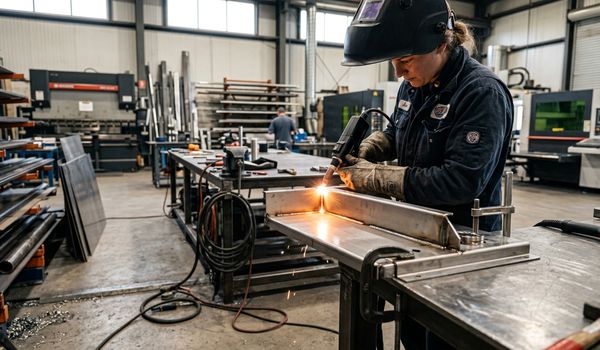
- Dramatically faster welds. A handheld laser welder can complete joints up to four times faster than traditional TIG welding on thin and medium-gauge material. Shops routinely report that work which took a full shift now takes a couple of hours.
- Lower skill barrier. TIG welding at production quality takes years to master. Operators can learn to produce clean, consistent laser welds in days, which matters enormously in a labor market where experienced welders are scarce and expensive.
- Minimal post-weld finishing. Laser welds are narrow, deep, and clean, with very little spatter and a small heat-affected zone. That means less grinding, less polishing, and less distortion on the finished part.
- Material versatility. Modern fiber laser welders handle stainless steel, carbon steel, aluminum, copper, brass, and dissimilar metal combinations that frustrate conventional processes.
- New revenue opportunities. The precision of laser welding opens doors to work many shops previously had to decline: thin-sheet fabrication, cosmetic weldments, battery and electrical components, medical and food-grade stainless work, and delicate repair jobs.
Demand signals support the investment case. Data from the U.S. Census Bureau M3 manufacturing survey continues to show robust orders for fabricated metal products, which keeps well-equipped shops booked and rewards capacity additions.
When a machine can pay for itself in months through faster throughput and expanded capabilities, delaying the purchase to save up cash has a real opportunity cost. Financing converts that future earning power into present-day capacity.
How Laser Welding Machine Financing Works
The mechanics of financing a laser welding machine are straightforward. While every lender structures deals a little differently, the process almost always follows the same five steps.
Step 1: Identify the Machine and Get a Quote
Start by selecting the specific equipment you want, whether that is a handheld laser welder from a distributor, a new automated cell from a manufacturer, or a used machine from a dealer or private seller. Obtain a formal quote or invoice, since lenders need the purchase price, make, model, and seller information to underwrite the deal.
Step 2: Apply With a Lender
Submit an application with basic business information: time in business, monthly revenue, ownership details, and the equipment quote. Applications for equipment financing are typically short, and many lenders issue decisions within one business day for transactions under six figures.
Step 3: Review Your Approval and Terms
The lender presents an offer covering the financed amount, term length, monthly payment, and any down payment requirement. Terms for laser welding equipment commonly run 24 to 72 months. Read the structure carefully: a true equipment loan builds ownership from day one, while some agreements are structured as leases with a purchase option at the end.
Step 4: Documents and Funding
Once you accept terms, you sign the financing agreement and the lender pays the equipment seller directly. Funding on straightforward deals often happens within 24 to 72 hours of approval, which is one of the biggest advantages of equipment financing over slower credit products.
Step 5: Take Delivery and Put the Machine to Work
The machine ships to your facility, you install it, and it starts generating revenue while you make fixed monthly payments. At the end of the term on a loan structure, you own the machine free and clear.
Ready to Add Laser Welding Capacity?
Get fast, flexible equipment financing from the #1 business lender in the U.S. No obligation, apply in minutes.
Apply Now →Types of Laser Welding Machines You Can Finance
Laser welding equipment spans a wide range of price points and capability levels. Lenders that understand this equipment category will finance virtually all of it, from entry-level handheld units to fully automated production cells.
Handheld Fiber Laser Welders
Handheld laser welders are the breakout category driving most of the current demand. These units pair a compact fiber laser source, typically 1,000 to 3,000 watts, with a lightweight welding gun the operator aims by hand. They excel at thin to medium-gauge stainless, carbon steel, and aluminum, and many models also cut and clean with the same gun. A handheld laser welder is often the first laser purchase a fab shop makes, and their relatively low price point makes them the easiest machines to finance with fast approvals.
Benchtop and Enclosed Laser Welders
Benchtop and Class 1 enclosed laser welders serve jewelers, dental labs, medical device shops, mold repair operations, and electronics manufacturers that need precise, low-heat welds on small parts. The enclosed design contains the laser for safe operation without a dedicated laser safety officer in many jurisdictions, which makes them popular with smaller facilities.
Automated and Robotic Laser Welding Cells
At the high end, automated laser welding cells integrate a high-power fiber laser with a robotic arm, positioners, vision systems, and safety enclosures for repeatable, lights-out production welding. These systems run well into six figures but deliver the lowest cost per weld at volume. If you are also evaluating robotic automation more broadly, our guide to robotic welding cell financing covers that equipment category in depth.
Multi-Function Laser Systems
A growing share of the market combines welding, cutting, and cleaning in a single platform. These 3-in-1 systems let a shop replace or supplement a plasma table, a TIG station, and chemical cleaning processes with one machine, which strengthens the return-on-investment case lenders like to see.
Accessories and Support Equipment
Most lenders will package essential add-ons into the same financing agreement: water chillers, wire feeders, fume extraction systems, laser safety glasses and curtains, protective enclosures, and spare nozzles and lenses. Rolling accessories into the financed amount preserves cash and gets the machine production-ready on day one.
Key Stat: According to the U.S. Small Business Administration Office of Advocacy, small businesses make up 99.9 percent of all U.S. firms and employ nearly half of the private-sector workforce. Access to modern production equipment like laser welders is one of the clearest ways small fabricators close the productivity gap with much larger competitors.
Laser Welding Machine Price Guide: What to Expect
The laser welding machine price spectrum is wide, and knowing realistic ranges helps you size your financing request correctly. Here is what businesses are actually paying in the current market.
Handheld Laser Welders: $3,000 to $15,000
Entry-level handheld units from overseas manufacturers start around $3,000 to $5,000 for 1,000 to 1,500 watt models. Mid-tier machines with better build quality, domestic support, and 2,000 to 3,000 watt sources typically run $6,000 to $15,000. Premium handheld systems from established industrial brands can exceed $20,000 but include stronger warranties, training, and service networks.
Benchtop and Enclosed Units: $15,000 to $80,000
Precision benchtop welders for jewelry, medical, and mold repair work generally run $15,000 to $50,000 depending on laser type and power. Fully enclosed Class 1 systems with programmable motion and vision alignment push toward $80,000.
Automated Laser Welding Cells: $150,000 to $500,000+
A robotic laser welding cell with a 4 to 6 kilowatt fiber laser, robot, positioner, and Class 1 enclosure typically starts near $150,000. Multi-station cells with seam tracking, automated fixturing, and integrated quality monitoring can exceed $500,000. At this level, structured financing or leasing is the norm rather than the exception.
What Drives the Price
- Laser power: Wattage is the single biggest price driver. More power means thicker material capability and faster travel speeds.
- Brand and support: Domestic support, training, and warranty depth add cost but reduce downtime risk.
- Automation level: Manual, semi-automated, and fully automated configurations sit at very different price points.
- New vs used: Quality used laser welders trade at 30 to 50 percent discounts from new, and used equipment financing is readily available for machines with documented service histories.
When evaluating the laser welder cost for your operation, look beyond the sticker price to total cost of ownership: consumables like nozzles and protective lenses are modest, electricity use is lower than comparable arc processes, and labor savings usually dominate the equation. A machine that lets one operator do the work of three TIG welders pays for itself quickly even at a premium purchase price.
By the Numbers
Laser Welding Machine Financing - Key Figures
$3K-$15K
Typical price range for handheld laser welders
4x
Faster welding speeds vs traditional TIG on thin material
99.9%
Share of U.S. businesses classified as small businesses (SBA)
24-72h
Typical funding window after approval with Crestmont Capital
Financing vs Leasing vs Paying Cash
Businesses acquiring a laser welding machine generally choose among three paths: an equipment loan, an equipment lease, or an outright cash purchase. Each has a legitimate place, and the right answer depends on your cash position, how long you plan to keep the machine, and how fast the technology in your segment is evolving.
| Factor | Equipment Loan (Financing) | Equipment Lease | Cash Purchase |
|---|---|---|---|
| Upfront cost | Low to none; 0-20% down is common | Lowest; usually first and last payment | Full purchase price immediately |
| Ownership | You own it; lender holds a lien until payoff | Lessor owns it during term; buyout option at end | Immediate full ownership |
| Monthly payment | Fixed; slightly higher than lease | Fixed; usually the lowest of the three | None |
| Total cost over time | Moderate; price plus interest | Highest if you buy out at the end | Lowest in dollars, highest in opportunity cost |
| Best for | Machines you will run 5+ years | Fast-evolving tech or short-term needs | Cash-rich buyers of stable technology |
For most small and mid-size shops, an equipment loan hits the sweet spot: you build equity in a productive asset, the payment is predictable, and the machine's revenue contribution typically exceeds the monthly payment within the first few months. Leasing makes sense when you expect to upgrade within three years or when you want the lowest possible monthly outlay. Paying cash preserves the most profit over time but ties up working capital that could fund inventory, payroll, or marketing, and it delays the purchase while you save. Our overview of equipment financing explains loan structures in more detail, and businesses weighing lease structures can review equipment leasing options as well.
Who Qualifies for Laser Welding Machine Financing?
Qualification standards for equipment financing are more flexible than most business owners assume, because the machine itself secures the deal. Here is what lenders typically look for.
Time in Business
Most programs want at least six months to two years of operating history. Established shops get the best terms, but newer businesses with strong revenue or industry experience can still qualify, sometimes with a modest down payment.
Revenue and Cash Flow
Lenders want to see that your monthly revenue comfortably covers the proposed payment plus existing obligations. A common guideline is that total debt payments should stay well under half of monthly gross revenue. Bank statements from the last three to six months usually tell this story. Owners who want to compare government-backed options can review the SBA loan programs, though those typically involve longer timelines and heavier documentation than direct equipment financing.
Credit Profile
Credit requirements vary widely. Premium rates go to borrowers with scores above 680, but approvals happen across the credit spectrum. Shops with challenged credit can often still finance a laser welding machine by accepting a larger down payment, a shorter term, or a slightly higher rate. If credit is a concern, review our page on bad credit equipment financing before assuming you will be declined.
The Equipment Itself
Because the machine is the collateral, its age, condition, brand, and resale value matter. New machines from recognized brands get the smoothest approvals and longest terms. Used machines are very financeable, though lenders may cap the term or ask for more detail on condition and service history.
Pro Tip: Ask the seller for a formal written quote before you apply, even for a used machine. Applications submitted with a complete equipment quote, including make, model, year, and serial number when available, move through underwriting noticeably faster than applications with a rough price estimate.
How Crestmont Capital Helps
Crestmont Capital is the #1 business lender in the U.S., and equipment financing is one of our core specialties. We fund laser welding machines for fabricators, manufacturers, repair shops, and industrial businesses across the country, from $5,000 handheld units to seven-figure automated production cells.
What sets our equipment financing apart:
- Fast decisions. Most applications receive a decision within one business day, and straightforward deals fund within 24 to 72 hours of approval.
- Flexible structures. Loans and leases from 24 to 72 months, with down payments as low as zero for qualified borrowers.
- New and used equipment. We finance new machines from any manufacturer or distributor, plus used equipment from dealers and private sellers through our used equipment financing programs.
- Soft costs included. Delivery, installation, training, and accessories can be rolled into the financed amount.
- Full credit spectrum. We work with excellent credit, challenged credit, and everything in between.
Shops modernizing a broader fabrication operation often pair a laser welder with other equipment in a single financing package. Our fabrication equipment financing programs cover press brakes, plasma tables, shears, and ironworkers, and our CNC machine financing programs handle mills, lathes, and machining centers. If you are comparing equipment categories before committing, our published guide to welding equipment financing walks through the full range of welding systems we fund.
Get Your Laser Welder Funded This Week
One short application, a decision in about a day, and funding in as little as 24 hours after approval.
Apply Now →Real-World Scenarios: How Businesses Use Laser Welder Financing
Abstract benefits only go so far. Here are five realistic scenarios showing how different businesses put financed laser welding equipment to work.
Scenario 1: The Job Shop Replacing TIG Bottlenecks
A 12-person metal fabrication shop in Ohio was turning away stainless countertop and rail work because its two TIG welders were booked solid. The owner financed a $9,500 handheld laser welder with no money down over 48 months, landing a payment around $250 per month. One existing operator now handles the thin-gauge stainless queue in roughly a quarter of the time, and the shop added an estimated $18,000 per month in previously declined work.
Scenario 2: The Auto Restoration Shop Adding Aluminum Capability
A specialty auto restoration business in Texas kept losing custom panel and intake work to competitors because TIG welding thin aluminum was slow and distortion-prone. A financed 2,000-watt handheld laser welder let a single technician produce clean aluminum welds with minimal finishing. The machine paid for itself within five months through higher-margin custom work alone.
Scenario 3: The Food Equipment Manufacturer Scaling Production
A manufacturer of commercial kitchen equipment needed to double output of stainless steel enclosures without doubling its welding crew. It financed two automated laser welding stations for $240,000 over 60 months, with installation and training rolled into the agreement. Weld cycle times dropped by more than half, and the consistency of automated welds cut rework rates to near zero.
Scenario 4: The Mobile Repair Business Buying Used
A two-person industrial repair company found a one-year-old handheld laser welder from a dealer at 40 percent off new pricing. Because the machine was used, the buyers assumed financing would be difficult. Instead, they were approved within a day with 10 percent down and a 36-month term, and the machine's portability let them add on-site weld repair services that now account for a third of company revenue.
Scenario 5: The Startup Fabricator With Limited History
A first-time business owner with 15 years of welding experience opened his own shop but had only eight months of operating history. By putting 15 percent down on a $7,000 handheld unit and showing strong early revenue, he secured financing that most banks would have declined. The laser welder became the shop's primary production tool and its main competitive differentiator against older local shops.
Frequently Asked Questions
What is laser welding machine financing? +
Laser welding machine financing is an equipment loan or lease that covers the purchase price of a laser welding system so you can acquire the machine without paying cash up front. The business makes fixed monthly payments over a set term, typically 24 to 72 months, and the machine itself serves as collateral. At the end of a loan structure, you own the equipment outright.
How much does a laser welding machine cost? +
Prices vary widely by type and power. Handheld laser welders generally run $3,000 to $15,000, benchtop and enclosed precision units range from $15,000 to $80,000, and fully automated robotic laser welding cells start near $150,000 and can exceed $500,000. Laser power, brand support, automation level, and new versus used condition are the main price drivers.
Can I finance a used laser welding machine? +
Yes. Used laser welding equipment is very financeable, including machines purchased from dealers and private sellers. Lenders will typically ask for details on the machine's age, hours, condition, and service history, and may offer slightly shorter terms than on new equipment. Quality used machines at 30 to 50 percent discounts from new pricing can deliver excellent returns.
What credit score do I need to finance a laser welder? +
There is no single cutoff score. Borrowers with scores above 680 generally receive the best rates and lowest down payments, but approvals happen across the credit spectrum because the equipment secures the transaction. Applicants with challenged credit can often qualify with a larger down payment or a shorter term.
How fast can I get funded? +
Straightforward equipment financing deals move quickly. Most applications receive a decision within one business day, and funding commonly occurs within 24 to 72 hours after approval. Having a complete written equipment quote ready when you apply is the single best way to keep the process fast.
Do I need a down payment? +
Not always. Qualified borrowers with established businesses and solid credit can often finance 100 percent of the purchase price with zero down. Newer businesses or applicants with credit challenges may be asked for 10 to 20 percent down. A down payment reduces the monthly payment and can improve approval odds.
Can accessories and soft costs be included in the financing? +
Yes, in most cases. Chillers, wire feeders, fume extraction, safety enclosures, and spare consumables can be packaged into the same agreement. Soft costs such as delivery, installation, and operator training can frequently be rolled in as well, which preserves your cash for operating expenses.
Is it better to lease or finance a laser welding machine? +
It depends on how long you plan to keep the machine. Financing through an equipment loan is usually best for machines you will run for five years or more, because you build ownership and the total cost is lower. Leasing offers the lowest monthly payment and makes sense if you expect to upgrade within three years or want maximum flexibility.
Can a new business qualify for laser welder financing? +
Yes, though options narrow with less operating history. Most programs prefer at least six months to two years in business. Newer businesses can strengthen their applications with a down payment, strong early revenue, relevant owner experience, and a complete equipment quote.
What loan terms are available? +
Terms for laser welding equipment commonly run 24 to 72 months. Longer terms lower the monthly payment but increase total interest paid. Many buyers choose a term that matches the machine's expected payback period, which for a productive laser welder is often 12 to 36 months.
Can I pay off my equipment financing early? +
Most equipment loans allow early payoff, though some agreements include prepayment conditions. Ask about the payoff calculation before signing. Paying early can save meaningful interest, especially on longer terms, once the machine's revenue contribution has covered your initial costs.
Will a monthly payment hurt my cash flow? +
A properly structured payment should improve cash flow, not strain it. Because a laser welder typically increases throughput and reduces labor hours per job, the machine's monthly revenue contribution usually exceeds its payment within the first few months. Lenders size approvals to keep payments comfortable relative to your revenue.
What if I have bad credit? +
Bad credit does not automatically disqualify you. Equipment financing is secured by the machine, so lenders can approve borrowers that unsecured lenders would decline. Expect a larger down payment or a higher rate, and consider applying through a lender that explicitly works with challenged credit profiles.
Can I finance multiple machines or a full equipment package at once? +
Yes. Bundling multiple machines, accessories, and soft costs into a single financing agreement is common and often simplifies approval. Shops frequently pair a laser welder with complementary equipment such as press brakes, plasma tables, or CNC machines in one package.
How do I apply for laser welding machine financing? +
Gather a written quote for the machine you want, then complete a short application with your basic business information, time in business, and revenue. Most lenders return a decision within about one business day. With Crestmont Capital, the entire process starts with a simple online application that takes just a few minutes.
Put Laser Speed in Your Shop
Join thousands of business owners who fund equipment through Crestmont Capital. Apply in minutes, decide in about a day.
Apply Now →How to Get Started
Complete our quick application at offers.crestmontcapital.com/apply-now - it takes just a few minutes.
A Crestmont Capital advisor will review your equipment quote and match you with the right financing structure for your business.
Receive your funds and put your new laser welding machine to work, often within days of approval.
Conclusion: Financing Puts Laser Welding Within Reach
Laser welding technology has crossed the threshold from specialty equipment to essential production tool for shops that want to weld faster, cleaner, and with a smaller skilled-labor footprint. With handheld units starting under $10,000 and financing structures that can require little or no money down, there has never been a more accessible time to add this capability.
The businesses winning work today are the ones investing in productive capacity while their competitors wait. A financed laser welding machine starts generating returns from the first week it arrives: faster cycle times, new material capabilities, higher-margin jobs, and capacity that scales without hiring. Whether you need a single handheld unit or a fully automated production cell, laser welding machine financing converts a large capital decision into a predictable monthly payment that the equipment itself can cover.
Crestmont Capital has funded thousands of equipment purchases for American businesses, and our team understands welding and fabrication equipment specifically. If you are ready to compare options, start with the quick online application, or reach out to discuss the right structure for your shop. Explore more about our equipment financing programs and see why more business owners choose Crestmont Capital than any other lender in the country.
Disclaimer: The information provided in this article is for general educational purposes only and is not financial, legal, or tax advice. Funding terms, qualifications, and product availability may vary and are subject to change without notice. Crestmont Capital does not guarantee approval, rates, or specific outcomes. For personalized information about your business funding options, contact our team directly.

Allan Garfinkle
Allan Garfinkle is the Chief Revenue Officer at Crestmont Capital, where he has spent more than a decade leading revenue strategy, business development, and operational growth. With 28 years of experience building and advising startups and small businesses, Allan has helped more than 10,000 business owners navigate financing decisions, growth opportunities, and changing economic conditions. He earned a Bachelor of Science in Economics and an MBA with a concentration in Finance from Northeastern University, as well as a Juris Doctor from New England Law, where his studies focused on contracts and business law. His writing draws on extensive practical experience in small-business lending, equipment financing, business credit, and commercial finance.