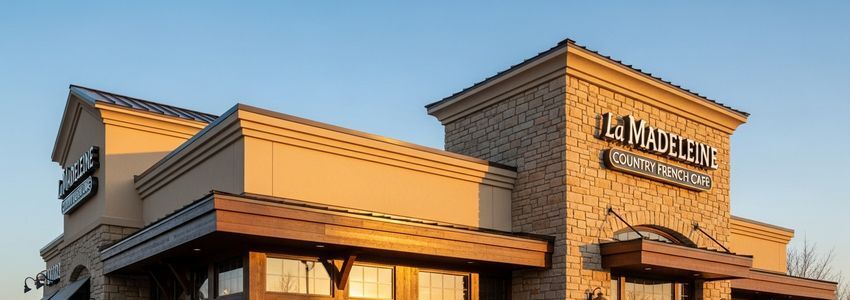
La Madeleine Country French Cafe has carved out a beloved niche in the American dining landscape, offering a warm, bistro-style experience that feels like stepping into a French countryside kitchen. With its signature dishes like tomato basil soup, quiches, crepes, and rotisserie chicken, La Madeleine has built a loyal following across the Sun Belt states and beyond. If you are considering joining this distinctive brand as a franchisee, understanding how to finance your investment is the critical first step toward making your bakery-cafe dream a reality.
Franchise financing for a La Madeleine location is not a one-size-fits-all proposition. Initial investment requirements range from roughly $476,000 to over $1.1 million depending on size, location, and build-out needs. That is a substantial capital commitment that most prospective owners will need to fund through a combination of personal equity, SBA loans, conventional financing, and equipment-specific lending. This guide breaks down every financing option available to you, explains the qualification requirements, and shows you how to position your application for the strongest possible outcome.
In This Article
- La Madeleine Franchise Overview and Costs
- Financing Options for La Madeleine Franchisees
- SBA Loans: The Most Popular Path
- Equipment Financing for Your Cafe
- Business Lines of Credit for Working Capital
- Financing Options with Less-Than-Perfect Credit
- Understanding the FDD Before You Borrow
- How to Qualify for Franchise Financing
- The Loan Application Process Explained
- Building Financial Projections Lenders Trust
- Financing Multiple La Madeleine Locations
- Comparing La Madeleine Franchise Lenders
- Common Financing Mistakes to Avoid
- La Madeleine Investment Snapshot
- Next Steps to Secure Your Franchise Loan
- Frequently Asked Questions
La Madeleine Franchise Overview and Costs
La Madeleine Country French Cafe was founded in Dallas, Texas in 1983 by Patrick Esquerre, a French entrepreneur who brought authentic French country cooking to American diners. Today the brand operates over 80 locations primarily in Texas, Louisiana, Tennessee, Georgia, and the Mid-Atlantic region. La Madeleine is owned by the Groupe Le Duff, a major international restaurant group headquartered in Rennes, France.
The brand occupies a distinct position in the fast casual dining segment - it is more elevated than typical quick-service restaurants but more accessible and consistent than full-service bistros. This positioning creates strong average unit volumes and a loyal repeat customer base that translates into predictable cash flow for franchise owners.
La Madeleine Franchise Investment Range
According to La Madeleine's Franchise Disclosure Document (FDD), the estimated initial investment for a new La Madeleine franchise location falls in these ranges:
- Initial Franchise Fee: $40,000
- Real Estate and Build-Out: $200,000 - $600,000 (depending on size and condition of space)
- Equipment Package: $150,000 - $250,000
- Furniture, Fixtures, and Decor: $40,000 - $80,000
- Initial Inventory: $15,000 - $25,000
- Technology and POS Systems: $20,000 - $35,000
- Training Expenses: $10,000 - $20,000
- Opening Marketing: $15,000 - $30,000
- Working Capital (3 months): $50,000 - $100,000
- Total Estimated Investment: $476,000 - $1,100,000+
Important Note: These figures are estimates based on publicly available FDD information and industry data. La Madeleine's actual FDD figures may vary. Always review the most current FDD with a qualified franchise attorney before making any financial commitments.
Ongoing Fees to Factor Into Projections
Beyond the initial investment, franchisees must budget for ongoing royalties and fees:
- Royalty Fee: Approximately 5% of gross sales
- Marketing/Advertising Fund: Approximately 2% of gross sales
- Local Marketing Requirement: Additional local advertising spend typically required
These ongoing fees affect your debt service coverage ratio (DSCR), which lenders use to determine how much they are willing to lend. Building royalty and advertising fees into your pro forma financial model from day one is essential for accurate loan sizing.
Ready to Finance Your La Madeleine Franchise?
Crestmont Capital specializes in franchise business loans with fast approvals and competitive rates. Get pre-qualified in minutes with no impact to your credit score.
Apply for Franchise Financing NowFinancing Options for La Madeleine Franchisees
Prospective La Madeleine franchisees have access to a broad spectrum of financing tools. The best approach typically involves layering multiple funding sources to achieve the optimal combination of loan amount, interest rate, repayment term, and monthly payment. Here is a comprehensive overview of your options.
1. SBA 7(a) Loans
The Small Business Administration's 7(a) loan program is the most commonly used financing vehicle for franchise purchases. Loans up to $5 million are available with repayment terms up to 10 years for working capital and 25 years for real estate. The government guarantee (up to 85% for loans under $150K and 75% for larger loans) reduces lender risk, which translates to better rates and terms for borrowers.
2. SBA 504 Loans
The SBA 504 program is specifically designed for major fixed asset purchases - ideal for financing restaurant real estate or large equipment packages. A 504 loan typically combines a conventional first mortgage (50% of project cost), a Certified Development Company (CDC) second mortgage (40%), and borrower equity (10%). Interest rates on the CDC portion are typically below-market fixed rates.
3. Conventional Bank Loans
Traditional bank financing through a commercial lender offers competitive rates for well-qualified borrowers. Banks typically require 20-30% down payment, strong personal credit (680+), and verifiable restaurant industry experience. Processing times are slower than alternative lenders but rates can be significantly lower.
4. Equipment Financing
Your commercial kitchen equipment, POS systems, refrigeration, and baking equipment can be financed separately through equipment-specific lenders. Equipment loans use the equipment itself as collateral, which typically means lower rates and relaxed qualification requirements compared to unsecured lending.
5. Alternative Business Loans
Online lenders and alternative financing companies offer faster funding (often within 48-72 hours) with more flexible qualification requirements. The trade-off is higher interest rates and shorter repayment terms. Best suited for franchisees who need to bridge financing gaps or fund working capital shortfalls.
6. ROBS (Rollover for Business Startups)
If you have a 401(k), IRA, or other qualified retirement account, a ROBS arrangement allows you to invest those funds in your franchise without early withdrawal penalties or taxes. While complex to set up, ROBS can provide significant equity capital that improves your debt-to-equity ratio and makes you a more attractive borrower for additional financing.
SBA Loans: The Most Popular Path for La Madeleine Franchisees
SBA-backed financing dominates franchise lending for good reason. The combination of longer repayment terms, lower down payments, and competitive rates creates lower monthly payments that improve cash flow during the critical early years of operation. According to the Small Business Administration, franchises with established brand names and proven systems have historically strong approval rates for 7(a) loans.
SBA Loan Requirements for Restaurant Franchises
To qualify for SBA financing for your La Madeleine franchise, you will generally need:
- Personal Credit Score: 680 or higher (some lenders accept 650+)
- Down Payment/Equity Injection: 10-30% of total project cost
- Net Worth: Typically equal to or greater than the loan amount
- Liquidity After Close: Minimum 10% of loan amount in accessible funds
- Industry Experience: Prior restaurant or food service management experience strongly preferred
- Business Plan: Comprehensive plan with financial projections for 3-5 years
- Personal Financial Statement: SBA Form 413
La Madeleine must be on the SBA Franchise Registry for streamlined approval processing. Most established franchise brands are included, which eliminates the need for lenders to review the franchise agreement independently and speeds up the loan process significantly.
SBA Loan Timeline for Franchise Financing
A typical SBA 7(a) loan for a restaurant franchise takes 45-90 days from application to funding. This timeline breaks down roughly as follows:
- Pre-qualification and document gathering: 1-2 weeks
- Lender underwriting and credit decision: 2-4 weeks
- SBA review and approval: 1-3 weeks
- Closing and funding: 1-2 weeks
Starting the financing process early in your franchise agreement negotiations gives you the most flexibility. Many La Madeleine development agreements have site selection and development timelines that require confirmed financing before construction can begin.
Pro Tip: Working with a lender experienced in franchise financing can cut 2-4 weeks off the SBA loan timeline. Specialists understand the franchise disclosure document, franchise agreement review, and SBA Franchise Registry requirements that can trip up generalist lenders.
Equipment Financing for Your La Madeleine Cafe
Commercial kitchen equipment represents a substantial portion of your La Madeleine startup costs - typically $150,000 to $250,000. Financing this equipment separately through an equipment loan or lease has several strategic advantages:
- Equipment serves as its own collateral, reducing what you need to pledge from your SBA loan
- Equipment financing approval is often faster and simpler than SBA processing
- Separating equipment costs from the primary loan can reduce your SBA loan amount and lower the required equity injection
- Some equipment lenders offer 100% financing (no down payment) for franchisees with strong credit
Equipment Typically Financed for La Madeleine Franchises
The La Madeleine concept relies on specialized equipment for its authentic French country menu. Items commonly financed include:
- Commercial convection ovens and deck ovens for baking
- Rotisserie equipment for signature chicken dishes
- Commercial refrigerators, freezers, and walk-in units
- Food preparation equipment (mixers, slicers, processors)
- Crepe stations and specialty cooking equipment
- Beverage equipment (coffee systems, espresso machines)
- POS and technology systems
- Furniture, fixtures, and dining room equipment
Equipment Financing Terms
Equipment loans for restaurant franchise startups typically come with these parameters:
- Loan Amount: Up to 100% of equipment cost
- Repayment Term: 2-7 years (aligned with useful life of equipment)
- Interest Rate: 6-15% depending on creditworthiness
- Down Payment: 0-20%
- Approval Time: 24-72 hours for straightforward applications
Get Equipment Financing for Your La Madeleine
Crestmont Capital offers fast equipment financing with competitive rates. Our franchise specialists can help you structure the right combination of equipment loans and SBA funding to minimize your out-of-pocket costs.
Get Equipment Financing RatesBusiness Lines of Credit for Working Capital
Even with robust SBA and equipment financing in place, La Madeleine franchisees benefit enormously from having a business line of credit available for working capital needs. The first 6-18 months of restaurant operation involve significant cash flow variability as you build your customer base, optimize staffing, and navigate seasonal fluctuations.
How a Business Line of Credit Helps Franchise Owners
A revolving line of credit provides flexible access to capital that you draw against only when needed:
- Cover payroll during slow weeks or seasonal downturns
- Purchase additional inventory before peak periods (holidays, catering events)
- Bridge gaps between accounts receivable and accounts payable
- Fund unexpected equipment repairs or replacements
- Support marketing campaigns to drive traffic to a new location
Most lenders recommend securing a line of credit before you actually need it. Applying when your business is performing well (rather than during a cash flow crunch) results in better terms and higher credit limits. The U.S. Census Bureau's Annual Business Survey data consistently shows that businesses with pre-established credit lines have higher survival rates than those seeking emergency financing.
Business Line of Credit Qualification Requirements
- Minimum 6 months in business (some lenders require 12 months)
- Personal credit score 600+ (better terms above 680)
- Annual revenue of $100,000+ (typically)
- No recent bankruptcies or major derogatory marks
Financing Options for La Madeleine Franchisees with Less-Than-Perfect Credit
While SBA loans and conventional financing require strong personal credit, franchisees with credit scores below 680 still have viable paths to financing. Bad credit business loans for franchise owners include:
Revenue-Based Financing
Once your La Madeleine location is generating revenue, revenue-based lenders can advance capital against your future sales. Repayment is calculated as a percentage of daily or weekly revenue, making payments naturally flexible with business performance. No minimum credit score requirements for many providers.
Merchant Cash Advances
Similar to revenue-based financing, merchant cash advances (MCAs) provide lump-sum capital repaid through a percentage of daily credit card receipts. Higher cost than SBA loans, but accessible for borrowers who cannot qualify for traditional financing.
Collateral-Based Loans
If you own real estate, vehicles, or other valuable assets, asset-based lending allows you to use those assets as collateral for business financing regardless of credit score. Interest rates are typically lower than unsecured bad credit options.
Credit Improvement Strategies
If your credit score is below 650, consider these steps before applying for franchise financing:
- Dispute any inaccurate negative items on your credit reports
- Pay down existing revolving credit balances to below 30% utilization
- Avoid opening new credit accounts in the 12 months before applying
- Ensure all current accounts are current with no recent late payments
- Build business credit through net-30 trade accounts and a business credit card
Understanding the FDD Before You Borrow
La Madeleine is required by federal law to provide you with its Franchise Disclosure Document (FDD) at least 14 days before you sign any agreement or pay any fee. The FDD is a goldmine of financial information that will directly inform your financing strategy. Key sections to review with your financing in mind include:
Item 7 - Estimated Initial Investment
This is the franchisor's own estimate of startup costs, broken down by category. Compare these figures to your actual quotes from contractors and vendors - real costs often differ from FDD estimates based on your specific market and location.
Item 19 - Financial Performance Representations
Not all franchisors provide Item 19 data, but when they do, it gives you validated information about average unit volumes, gross sales, and sometimes profit margins. This data forms the foundation of the financial projections lenders will scrutinize.
Item 21 - Financial Statements
Three years of audited franchisor financial statements tell you whether La Madeleine as a company is financially healthy. Lenders review this section carefully - a financially distressed franchisor could indicate systemic problems that affect franchisee viability.
Legal Guidance Required: Always review the FDD with a qualified franchise attorney before signing anything. An experienced franchise lawyer can identify problematic clauses, negotiate modifications, and ensure your financing structure aligns with the franchise agreement terms.
How to Qualify for La Madeleine Franchise Financing
Lenders evaluate franchise loan applications through multiple lenses. Understanding what they look for - and how to position your application - dramatically improves your approval odds and the terms you receive.
The Five Cs of Franchise Credit Analysis
1. Character - Your personal credit history, financial management track record, and reputation in the business community. Lenders check your credit reports, public records, and business references.
2. Capacity - Your ability to repay the loan from projected business cash flow. Lenders calculate Debt Service Coverage Ratio (DSCR) - typically requiring 1.25x or higher (meaning the business generates $1.25 in cash flow for every $1.00 in debt payments).
3. Capital - Your equity contribution to the project. The more skin you have in the game, the more confidence lenders have in your commitment and the lower their risk exposure.
4. Collateral - Assets that can secure the loan in the event of default. For La Madeleine franchises, collateral typically includes restaurant equipment, leasehold improvements, business assets, and personal assets.
5. Conditions - The economic environment, industry conditions, and specific terms of the franchise itself. Lenders evaluate whether the La Madeleine brand and market location support the financial projections.
Strengthening Your Franchise Loan Application
These factors materially improve your qualification prospects:
- Restaurant or food service management experience (especially multi-unit operations)
- Strong personal liquidity (cash reserves of 20-30% of total investment)
- Personal credit score above 700
- Existing successful business ownership history
- Prime real estate location with strong demographic data
- Commitment letter from La Madeleine corporate approving your franchise
- Detailed business plan with conservative financial projections
The Loan Application Process for La Madeleine Franchisees
Understanding the loan application process before you begin saves time and reduces stress. Here is a step-by-step walkthrough of what to expect when applying for franchise business loans.
Step 1: Pre-Qualification
Most lenders offer a soft-pull pre-qualification that gives you an indication of your likely loan terms without affecting your credit score. Provide basic information about the franchise investment amount, your credit score, industry experience, and liquid assets.
Step 2: Formal Application and Document Submission
A complete franchise loan application typically requires:
- Personal financial statements (last 3 years of tax returns and current P&L)
- Business plan with financial projections
- La Madeleine franchise agreement or letter of intent
- Franchise Disclosure Document (FDD)
- Real estate lease or purchase agreement (if available)
- Contractor bids for build-out costs
- Equipment quotes or specifications
- Resume highlighting relevant business and industry experience
Step 3: Underwriting
Lender underwriters review your application against their credit policy requirements. For SBA loans, an additional SBA review layer adds time but unlocks better terms. Common underwriting questions focus on: How does the projected cash flow compare to debt service? What happens to the business if sales underperform projections by 20%? Is the franchisee's equity contribution sufficient?
Step 4: Commitment and Closing
Upon approval, you receive a loan commitment letter outlining all terms. Review this carefully with your attorney before accepting. Closing involves signing loan documents, satisfying any conditions (insurance, title work, etc.), and funding.
Building Financial Projections Lenders Trust
The financial projections you include in your business plan are one of the most scrutinized elements of your loan application. Lenders look for projections that are reasonable, well-supported, and demonstrate conservative assumptions. According to Forbes business advisors, overly optimistic projections are one of the most common reasons franchise loan applications are declined - lenders want to see that you have stress-tested your numbers.
Building a Credible Pro Forma
Your La Madeleine financial projections should include:
- Revenue projections: Based on FDD Item 19 data, comparable store sales, and demographic analysis of your specific location. Build in a ramp-up period of 3-6 months with below-average sales.
- COGS (Cost of Goods Sold): La Madeleine's food and beverage cost percentage. For bakery-cafe concepts, food cost typically runs 28-34% of sales.
- Labor costs: Including manager salary, hourly wages, and employer payroll taxes. Labor in full-service restaurant formats often runs 30-38% of sales.
- Occupancy costs: Rent, utilities, common area maintenance, and property taxes.
- Royalties and fees: Ongoing franchise fees that must be paid regardless of profitability.
- Debt service: Monthly principal and interest payments on all loans.
Financing Multiple La Madeleine Locations
Many franchise investors aspire to own multiple units of a successful concept like La Madeleine. Multi-unit development agreements often require the franchisee to open a specified number of locations on a set schedule. Financing a portfolio of La Madeleine restaurants requires careful financial planning.
Multi-Unit Financing Strategies
Once your first La Madeleine location is established and generating consistent positive cash flow (typically 12-24 months of operation), options for financing additional units expand:
- Cross-collateralization: Using equity in your existing restaurant to partially secure financing for the next location
- Portfolio lending: Some lenders offer portfolio loan programs for multi-unit operators with demonstrated track records
- Real estate equity: If your first location owns its real estate, a commercial real estate loan can provide capital for new unit development
- Retained earnings: Reinvesting profits from existing units reduces the external financing needed for expansion
The CNBC franchise performance data consistently shows that multi-unit operators achieve better unit economics through operational efficiencies, bulk purchasing, and shared administrative overhead. This improved profitability profile makes them more attractive borrowers for expansion financing.
Comparing La Madeleine Franchise Lenders
Not all franchise lenders are created equal. When evaluating financing options for your La Madeleine investment, compare these key variables:
Interest Rate vs. Total Cost of Capital
A lower interest rate is not always the best loan if it comes with higher fees. Compare the Annual Percentage Rate (APR), which includes origination fees, closing costs, and ongoing fees, to get an apples-to-apples comparison.
Repayment Term
Longer terms mean lower monthly payments but more total interest paid. For a capital-intensive startup like a La Madeleine franchise, maximizing repayment term (within SBA guidelines) preserves cash flow during the critical early operating period.
Prepayment Penalties
SBA loans have prepayment penalties for the first three years on loans with terms over 15 years. Conventional loans may have different structures. Understanding prepayment rules matters if you plan to refinance or sell the business.
Funding Speed
If your franchise agreement has a hard opening deadline, funding speed becomes a critical factor. SBA loans take 45-90 days; conventional bank loans 30-60 days; alternative lenders 1-5 days.
Lender Expertise in Franchise Lending
Lenders with dedicated franchise lending divisions understand the unique aspects of restaurant franchise financing - they know how to read FDDs, understand standard franchise agreement provisions, and have established relationships with the SBA franchise registry process.
Compare La Madeleine Franchise Loan Rates
Crestmont Capital works with dozens of lenders to find you the best franchise financing rates. One application gets you multiple competing offers from our network of franchise-specialized lenders.
Compare Franchise Loan RatesCommon Financing Mistakes La Madeleine Franchisees Should Avoid
Learning from the mistakes of other franchise borrowers can save you significant time, money, and stress. These are the most common financing errors franchise applicants make:
1. Underestimating Working Capital Needs
New restaurant operators consistently underestimate how much working capital they need. Build at minimum 3-6 months of operating expenses into your startup capital plan. The first year of a new franchise is financially volatile - a capital cushion is not optional, it is essential.
2. Applying Too Close to Planned Opening Date
SBA loan processing takes 45-90 days from application to funding. If you need funding by a specific date, start the application process 4-5 months in advance to allow for unexpected delays.
3. Overstating Revenue Projections
Lenders are experienced at spotting inflated projections. Build your model conservatively - if you can get a loan approved on conservative numbers, you will be in far better shape during the actual ramp-up period.
4. Neglecting Credit Preparation
Many prospective franchisees discover credit issues only after applying for financing. Pull your own credit reports from all three bureaus at least 6 months before you plan to apply, and address any issues proactively.
5. Ignoring Ongoing Fees in Cash Flow Models
Royalties, advertising fees, local marketing requirements, insurance, and other ongoing costs must all be factored into your debt service coverage calculation. Forgetting these items understates your true operating costs and overstates your debt service capacity.
6. Not Consulting a Franchise Attorney
The franchise agreement contains provisions that directly affect your financing options - transfer restrictions, remodeling requirements, and technology upgrade mandates all have financial implications. An experienced franchise attorney helps you understand these obligations before you commit.
La Madeleine Franchise Investment Snapshot
La Madeleine Franchise Financing at a Glance
*Figures are estimates based on publicly available FDD data and industry sources. Verify current FDD for exact figures.
La Madeleine Franchise Financing vs. Other Restaurant Franchises
Understanding how La Madeleine's investment requirements compare to similar fast casual concepts helps you benchmark your financing needs and evaluate whether the brand fits your financial profile.
La Madeleine sits in a moderate investment tier among fast casual franchise concepts. The total investment range is comparable to upscale sandwich concepts and better-burger brands, but lower than large-footprint polished casual dining franchises. The brand's established reputation and loyal customer base in its core markets (Texas, Louisiana, Tennessee) provide a degree of risk mitigation that lenders may view favorably when underwriting loans.
For additional perspective on franchise financing, our recent posts on the Tropical Smoothie Cafe franchise loan and Halal Guys franchise loan walk through similar financing structures for comparable investment ranges.
Small Business Administration Resources for La Madeleine Franchisees
The SBA provides extensive free resources for prospective franchise owners. Key programs and resources include:
- SCORE Mentorship: Free small business mentoring from retired executives, many with food service and franchise experience
- Small Business Development Centers (SBDCs): Free and low-cost consulting, including help preparing loan applications and financial projections
- SBA Learning Center: Free online courses covering business plan development, financial management, and franchise operations
- SBA Franchise Registry: Confirms whether La Madeleine's franchise agreement meets SBA requirements for streamlined processing
According to SBA data, franchise businesses have historically lower default rates on SBA loans compared to non-franchise small businesses, reflecting the value of an established brand system, training program, and ongoing support structure.
How Crestmont Capital Helps La Madeleine Franchisees
Crestmont Capital specializes in franchise business financing, working with prospective restaurant franchise owners at every stage of the funding process. Our franchise lending team includes specialists who understand the unique dynamics of restaurant franchise financing - from FDD review to equipment loans to multi-unit portfolio lending.
Our small business loan programs for restaurant franchisees include:
- SBA 7(a) loans up to $5 million with terms up to 10-25 years
- Equipment financing for full kitchen packages
- Business lines of credit for working capital
- Conventional business term loans
- Alternative financing for borrowers with credit challenges
We work with a network of franchise-specialized lenders to find you the most competitive rates and terms available given your specific financial profile. Our pre-qualification process takes less than 5 minutes and does not affect your credit score.
Tax Considerations for La Madeleine Franchise Investors
While this guide focuses on financing rather than tax planning, it is worth noting that several aspects of your La Madeleine investment have significant tax implications that interact with your financing structure:
- Section 179 Deduction: Allows immediate expensing of qualifying business equipment purchases up to $1.16 million (2023 limit), which can significantly reduce your first-year tax liability
- Bonus Depreciation: An additional accelerated depreciation allowance that works alongside Section 179
- Start-Up Cost Amortization: Franchise fees and other pre-opening expenses can be amortized over 15 years with the first $5,000 potentially deductible in year one
- Interest Deduction: Business loan interest is generally tax-deductible as a business expense
Work with a CPA experienced in restaurant franchise taxation to optimize your tax position alongside your financing strategy. The interaction between accelerated depreciation and loan amortization schedules can significantly affect your net cash flow position, especially in years 1-3.
Next Steps to Secure Your La Madeleine Franchise Loan
Your La Madeleine Financing Roadmap
- Pull your credit reports - Check all three bureaus (Equifax, Experian, TransUnion) and dispute any errors. Allow 6 months before applying if you need to improve your score.
- Assess your liquid assets - Determine exactly how much you can contribute as equity. Most franchise lenders require 20-30% down.
- Contact La Madeleine franchising - Request the FDD and begin the franchisee approval process. Having a franchise commitment letter strengthens your loan application.
- Build your business plan and projections - Work with a financial advisor or SBDC counselor to create conservative, well-supported financial projections.
- Get pre-qualified with franchise lenders - Apply with a franchise-specialized lender to understand your financing options before you need to commit to a site or timeline.
- Engage a franchise attorney - Have an experienced franchise lawyer review your FDD and franchise agreement before signing anything.
- Secure your location - With financing pre-approval in hand, negotiate your lease or purchase agreement with the confidence of a committed capital source.
Frequently Asked Questions
How much does it cost to open a La Madeleine franchise?
The estimated initial investment for a La Madeleine franchise ranges from approximately $476,000 to over $1,100,000, including the $40,000 franchise fee, real estate/build-out costs, equipment, inventory, working capital, and other startup expenses. Actual costs vary significantly based on location, market, and the specific site selected.
Can I use an SBA loan to finance a La Madeleine franchise?
Yes. SBA 7(a) loans are a primary financing vehicle for La Madeleine franchisees. These loans offer up to $5 million, repayment terms up to 10-25 years, and lower down payment requirements (typically 10-20%) compared to conventional loans. La Madeleine's franchise system must be eligible on the SBA Franchise Registry for streamlined approval processing.
What credit score do I need to get a La Madeleine franchise loan?
Most SBA lenders require a minimum personal credit score of 650-680 for franchise loans. Conventional bank loans typically require 700+. Alternative lenders and equipment financing may be available with scores as low as 580-600. The higher your credit score, the better your interest rate and loan terms will be.
How much money do I need to invest personally to open a La Madeleine?
Most lenders require franchisees to contribute 20-30% of the total project cost as equity. For a $700,000 project, that means $140,000 to $210,000 of personal capital. La Madeleine may have its own net worth and liquidity requirements for franchisee approval that you should confirm directly with the franchisor.
How long does it take to get approved for a franchise loan?
SBA loans typically take 45-90 days from application to funding. Conventional bank loans take 30-60 days. Alternative lenders can fund in as little as 24-72 hours. Plan to start the financing process 4-5 months before your planned opening date to allow for unexpected delays.
Do I need restaurant experience to qualify for a La Madeleine franchise loan?
Restaurant industry experience is not legally required to apply for financing, but it significantly improves your approval odds and loan terms. Lenders view prior food service management, franchise ownership, or multi-unit restaurant experience as a major risk-reduction factor. If you lack direct restaurant experience, having a strong management team with relevant backgrounds can partially compensate.
Can I finance the La Madeleine franchise fee with a loan?
The $40,000 initial franchise fee can typically be included in a broader SBA loan that covers the entire project cost. However, some lenders may require that the franchise fee be paid from personal funds as part of the equity injection requirement. Confirm this requirement with your specific lender during the pre-qualification process.
What collateral do lenders require for La Madeleine franchise loans?
For SBA loans, collateral requirements include all available business assets (equipment, leasehold improvements, business assets) and, when business assets do not fully secure the loan, personal assets including real estate, vehicles, and investment accounts. SBA lenders are prohibited from declining loans solely on the basis of insufficient collateral if the borrower otherwise qualifies.
Is La Madeleine a good franchise investment?
This guide cannot provide investment advice. The best way to evaluate La Madeleine as a franchise investment is to review the FDD carefully with a franchise attorney, speak with existing La Madeleine franchisees (the FDD includes their contact information), work with a financial advisor to model realistic scenarios, and conduct thorough due diligence on your target market. La Madeleine's strong brand identity and loyal customer base in its core markets are positive indicators, but franchise success ultimately depends on many factors including your execution, location, and local market conditions.
Can I get a La Madeleine franchise loan with bad credit?
Borrowers with credit scores below 650 may face challenges qualifying for SBA loans but have alternative options including asset-based lending, revenue-based financing, collateral loans, and equipment financing. Working to improve your credit score before applying (even 6-12 months of focused credit improvement can make a significant difference) is the most effective strategy for accessing better financing terms.
What is the La Madeleine royalty fee?
Based on publicly available information, La Madeleine charges approximately 5% of gross sales as an ongoing royalty fee, plus approximately 2% for the national advertising/marketing fund. You may also be required to spend additional funds on local marketing. These fees must be factored into your financial projections and debt service coverage calculations.
How do I build financial projections for a La Madeleine franchise loan application?
Build your projections from the bottom up using: (1) FDD Item 19 data (if provided) for average unit volume benchmarks, (2) demographic and traffic analysis of your specific location, (3) comparable restaurant performance data for your market, and (4) detailed expense modeling that includes all franchise fees, labor, food costs, occupancy, and debt service. Use conservative assumptions and stress-test the model at 80% and 90% of projected revenue. SBDCs and SCORE mentors can help you build a lender-ready financial model at no cost.
Can I finance a La Madeleine franchise through the franchisor?
La Madeleine does not typically provide direct financing to franchisees. However, the franchisor may maintain a list of preferred lenders who have experience financing La Madeleine locations and understand the brand's systems and economics. Ask your La Madeleine franchise development representative about preferred lender relationships during the discovery process.
What happens to my franchise loan if the business fails?
If your La Madeleine franchise fails and you cannot repay the loan, the lender will pursue collection actions that may include seizing business collateral, enforcing personal guarantees (which could put your personal assets at risk), and reporting the default to credit bureaus. SBA loans also carry the risk of the government guarantee claim, which does not eliminate your personal liability. Having a realistic assessment of the risks before you borrow - and adequate insurance coverage during operations - is essential.
Should I use a ROBS to fund part of my La Madeleine franchise?
A Rollover for Business Startups (ROBS) can be a powerful tool for franchisees with substantial retirement accounts. By investing retirement funds in your business through a C-corporation structure, you can access significant equity capital without early withdrawal penalties or taxes. ROBS arrangements are legal but complex - they require specialized ERISA attorneys and third-party administrators, and they carry ongoing compliance requirements. Consult with a ROBS specialist alongside your tax advisor and franchise attorney to determine if this strategy is appropriate for your situation.
Conclusion: Financing Your La Madeleine Franchise Successfully
Financing a La Madeleine Country French Cafe franchise is a multi-faceted process that rewards early preparation, conservative financial planning, and working with specialists who understand the franchise financing landscape. The investment required - ranging from $476,000 to over $1.1 million - is significant, but La Madeleine's established brand, proven concept, and loyal customer base in its core markets provide a foundation for the financial performance projections that lenders need to see.
The most successful La Madeleine franchise financing outcomes share common characteristics: franchisees who start the financing process early (4-6 months before they need funds), maintain strong personal credit, bring meaningful equity to the table (typically 20-30% of total project cost), build conservative but credible financial projections, and work with lenders who specialize in franchise restaurant financing.
Whether you are pursuing an SBA 7(a) loan for the full project cost, layering equipment financing with an SBA loan to optimize your structure, or evaluating alternative financing options because of credit challenges, the resources and expertise exist to help you find the right financing path for your La Madeleine franchise investment.
Ready to take the next step? Crestmont Capital's franchise lending specialists can help you navigate the financing process from pre-qualification to closing. Our network of franchise-specialized lenders covers SBA loans, equipment financing, business lines of credit, and alternative funding solutions - giving you the best chance of securing optimal financing for your La Madeleine franchise.
Start Your La Madeleine Franchise Financing Today
Get pre-qualified in minutes. No impact to your credit score. Competitive rates from our network of franchise-specialized lenders.
Apply for La Madeleine Franchise FinancingDisclaimer: This article is for general educational purposes only and is not financial, legal, or tax advice. La Madeleine franchise costs and requirements are based on publicly available information and estimates; actual figures may differ. Always review the current Franchise Disclosure Document with qualified legal and financial professionals before making any investment decisions. Loan products, terms, and availability are subject to lender qualification requirements and may change without notice.

Allan Garfinkle
Allan Garfinkle is the Chief Revenue Officer at Crestmont Capital, where he has spent more than a decade leading revenue strategy, business development, and operational growth. With 28 years of experience building and advising startups and small businesses, Allan has helped more than 10,000 business owners navigate financing decisions, growth opportunities, and changing economic conditions. He earned a Bachelor of Science in Economics and an MBA with a concentration in Finance from Northeastern University, as well as a Juris Doctor from New England Law, where his studies focused on contracts and business law. His writing draws on extensive practical experience in small-business lending, equipment financing, business credit, and commercial finance.