
 (800) 949-0401
Helicopter Financing: The Complete Guide for Business Owners
In This Article
For many businesses, a helicopter isn't a luxury- it's a mission-critical asset that generates substantial revenue. Imagine an aerial tour company offering breathtaking views of a city skyline, a farmer precisely spraying crops to maximize yield, or an emergency medical service (EMS) team airlifting a patient to a trauma center. In each scenario, the helicopter is the engine of the operation, enabling services that would be impossible to provide from the ground. These powerful machines are transforming industries from agriculture and tourism to law enforcement and film production, opening up new opportunities for growth and efficiency.
However, the significant upfront cost of a helicopter- ranging from a few hundred thousand to several million dollars- can be a major barrier to entry for many business owners. This is where helicopter financing becomes an essential tool. Instead of depleting capital reserves or tying up cash flow, financing allows you to acquire the aircraft you need to expand your services, take on larger contracts, and elevate your business to new heights. It transforms a prohibitive capital expense into a manageable monthly payment that aligns with your operational budget and revenue streams.
This comprehensive guide will walk you through every aspect of helicopter financing. We'll explore the different types of loans and leases available, break down qualification requirements, and provide actionable tips to help you secure the funding you need. Whether you're looking to purchase your first Robinson R44 for flight training or add a heavy-lift Sikorsky to your fleet for utility work, understanding the financing landscape is the first step toward getting your business off the ground.
Ready to Finance Your Helicopter?
Crestmont Capital offers fast, flexible financing for aircraft and specialized commercial equipment. Get a decision in as little as 24 hours.
Apply for Helicopter FinancingWhat Is Helicopter Financing?
Helicopter financing is a specialized form of equipment financing designed specifically for the acquisition of new or used rotary-wing aircraft by businesses. It functions similarly to a commercial vehicle loan, but with unique considerations due to the high value, complexity, and regulatory requirements associated with aviation assets. Instead of paying the full purchase price upfront, a business can secure a helicopter loan or lease from a lender like Crestmont Capital, allowing them to spread the cost over a set period through regular payments.
This type of financing is crucial because helicopters are significant capital investments. A light training helicopter might cost $300,000, while a sophisticated twin-engine model used for medical transport or offshore work can easily exceed $5 million. Helicopter financing makes these essential tools accessible to a wider range of businesses, from small tour operators to large-scale agricultural enterprises. The financing agreement typically uses the helicopter itself as collateral, which secures the loan for the lender and can often lead to more favorable terms for the borrower.
There are two primary structures for acquiring a helicopter through financing: a loan and a lease.
- Helicopter Loan: A business helicopter loan is a straightforward financing agreement where the lender provides the funds to purchase the aircraft. The business owner makes principal and interest payments over a predetermined term, and at the end of the term, they own the helicopter outright. This is the preferred option for businesses that plan to use the aircraft for a long time and want to build equity in the asset.
- Helicopter Lease Financing: Leasing involves paying a monthly fee to use the helicopter for a specific period. At the end of the lease term, the business typically has several options: purchase the aircraft at a predetermined price, renew the lease, or return the helicopter to the lessor. Leasing often results in lower monthly payments and can be a good choice for businesses that want to upgrade their fleet regularly or prefer not to have a long-term asset on their balance sheet.
The choice between a loan and a lease depends on your business's financial strategy, cash flow, and long-term goals. A commercial helicopter financing specialist can help you analyze the pros and cons of each to determine the best path for your specific needs. Loan amounts can vary dramatically, from as little as $100,000 for an older, used model to well over $10 million for a new, state-of-the-art heavy-lift helicopter.
Did You Know?
Financing a used helicopter can be a smart financial move. A well-maintained, pre-owned aircraft can offer significant cost savings-sometimes 50% or more compared to a new model-while still providing years of reliable service. Lenders often have specific age and flight-hour limits for used helicopters they will finance, so it's important to work with a lender experienced in the pre-owned aviation market.
Types of Helicopters You Can Finance
The helicopter market is diverse, with aircraft designed for a wide range of specific tasks. Lenders with aviation expertise, like Crestmont Capital, can finance virtually any type of commercial helicopter. Understanding the different categories can help you identify the right aircraft for your business needs and budget. Here are some of the most common types of helicopters you can finance:
Light Single-Engine Helicopters
These are often the entry point for many businesses due to their lower acquisition and operational costs. They are versatile, reliable, and ideal for tasks that don't require heavy lifting or long-range capabilities. They typically seat 2-4 people.
- Common Models: Robinson R22, Robinson R44, Bell 505 Jet Ranger X, Guimbal Cabri G2
- Primary Uses: Flight training, aerial photography, private transport, sightseeing tours, traffic reporting.
- Estimated Price Range: $150,000 (used R22) to $1.5 million (new Bell 505).
Light Twin-Engine Helicopters
Offering the safety and performance benefits of a second engine, light twin-engine helicopters are a step up in capability. They are often required for over-water operations or flying in congested urban areas. They provide an extra layer of redundancy, making them a popular choice for emergency services and corporate transport.
- Common Models: Airbus H135, Bell 429, Leonardo AW109
- Primary Uses: Emergency Medical Services (EMS), law enforcement, corporate transport, offshore transport.
- Estimated Price Range: $1.5 million to $7 million.
Medium-Weight Helicopters
This category strikes a balance between performance, cabin size, and operating cost. These helicopters can carry more passengers or heavier loads than their lighter counterparts and are used across a wide spectrum of industries. They can be configured for various missions, from utility work to VIP transport.
- Common Models: Bell 206 LongRanger, Airbus H125 (formerly AS350 AStar), Bell 407
- Primary Uses: Utility line inspection, charter services, electronic news gathering (ENG), tourism, search and rescue.
- Estimated Price Range: $800,000 (used Bell 206) to $4 million (new H125).
Heavy-Lift Helicopters
These are the workhorses of the skies, designed to lift substantial external loads or carry a large number of passengers. They are essential for industries like construction, logging, and offshore oil and gas exploration, where moving heavy equipment or personnel to remote locations is a daily requirement.
- Common Models: Sikorsky S-76, Sikorsky S-92, Bell 412, Leonardo AW139
- Primary Uses: Offshore oil and gas crew transport, heavy construction (HVAC placement), firefighting, disaster relief, logging.
- Estimated Price Range: $5 million to $20+ million.
Specialized Helicopters
Many helicopters are purpose-built or modified for specific industries. Financing for these specialized assets requires a lender who understands their unique value and operational context.
- Medical/EMS Helicopters: These are essentially flying emergency rooms, equipped with life-support systems, stretchers, and specialized medical gear. They are often light-twin models like the Airbus H145 or Leonardo AW119.
- Agricultural Spray Helicopters: Models like the Bell 206 or Robinson R44 are often outfitted with spray booms and tanks for crop dusting, seeding, and pest control. Their agility allows for precise application that ground vehicles can't match.
Helicopter Financing: By the Numbers
$200K-$5M+
Typical helicopter purchase price range
5-20 yrs
Common loan terms for helicopter financing
10-20%
Typical down payment required
24 hrs
How fast Crestmont can pre-approve your loan
Helicopter Financing Options
When it comes to securing a business helicopter loan, you have several avenues to explore. Each financing option has its own structure, benefits, and ideal use case. Choosing the right one depends on your company's financial health, long-term strategy, and how you plan to use the aircraft. Here's a breakdown of the most common helicopter financing options:
Equipment Loans
An equipment loan is the most traditional form of financing. A lender provides a lump sum to purchase the helicopter, and you repay the loan, plus interest, over a set term. The helicopter itself serves as the collateral for the loan. This is a great option for businesses that want to own the asset outright and build equity. Ownership also provides potential tax benefits through depreciation.
- Best for: Businesses with strong credit and established revenue who plan to use the helicopter for many years.
- Pros: Full ownership at the end of the term, potential tax advantages (consult a tax advisor), no restrictions on flight hours.
- Cons: Higher monthly payments compared to leasing, requires a down payment.
At Crestmont Capital, we specialize in equipment financing for high-value assets like helicopters, offering competitive rates and flexible terms tailored to your business's cash flow.
Equipment Leasing
Helicopter lease financing allows you to use an aircraft for a set period in exchange for regular monthly payments. It's similar to renting but for a longer term (typically 2-7 years). There are two main types of leases:
- Operating Lease: This is a true lease where you use the helicopter for a fraction of its useful life. Payments are lower, and at the end of the term, you can return the aircraft, renew the lease, or purchase it at its fair market value. This is ideal for businesses that want to maintain a modern fleet without the commitment of ownership.
- Capital Lease (or Finance Lease): This structure is more like a loan. The lease term covers the majority of the helicopter's economic life, and at the end, you typically have a bargain purchase option (often for $1). For accounting purposes, it's treated as a purchase.
- Best for: Businesses that want lower monthly payments, need to preserve capital, or wish to upgrade their aircraft every few years.
- Pros: Lower upfront costs, predictable monthly expenses, avoids the risks of asset depreciation.
- Cons: No equity is built, potential restrictions on usage (e.g., annual flight hour limits), higher total cost over time if you decide to purchase.
SBA Loans
The U.S. Small Business Administration (SBA) guarantees a portion of loans made by partner lenders, reducing the lender's risk. This can make it easier for small businesses to qualify for financing and often results in favorable terms, such as longer repayment periods and lower down payments. The two most common programs for asset acquisition are:
- SBA 7(a) Loan: This is the SBA's most popular loan program. Funds can be used for a variety of business purposes, including the purchase of major equipment like a helicopter. Terms can extend up to 25 years for real estate and equipment.
- SBA 504 Loan: This program is specifically for financing fixed assets, such as heavy equipment and real estate. It involves two lenders- a bank or credit union and a Certified Development Company (CDC)- to provide long-term, fixed-rate financing.
While the application process for SBA loans can be more intensive, the favorable terms make them an excellent option for qualifying businesses. Crestmont Capital is an experienced SBA lender and can guide you through the process.
Operating Lines of Credit
While not used to purchase the helicopter itself, a business line of credit is a crucial financing tool for helicopter owners. This revolving credit line can be used to cover the significant operational costs associated with aircraft ownership, including fuel, insurance, maintenance, hangar fees, and pilot salaries. Having a line of credit provides the flexibility to manage fluctuating expenses and ensure your helicopter remains airworthy and operational without disrupting your primary cash flow.
How to Qualify for a Helicopter Loan
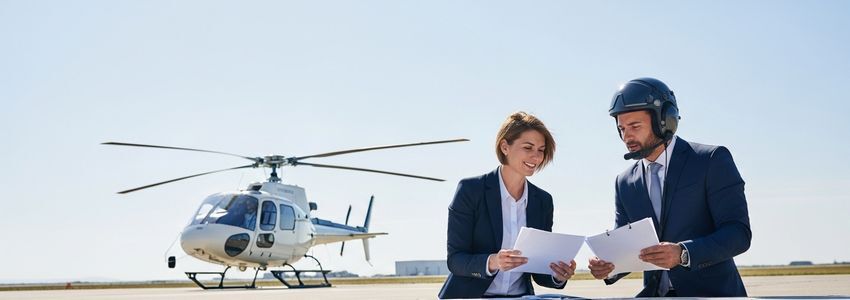
Securing financing for a high-value asset like a helicopter involves a thorough underwriting process. Lenders need to be confident in both your business's ability to repay the loan and the value of the aircraft itself. While specific requirements vary by lender, here are the key factors that will be evaluated when you apply for commercial helicopter financing.
Credit Score
Your personal and business credit scores are a primary indicator of your financial responsibility. Lenders will look for a strong history of on-time payments and responsible credit management. While some programs exist for businesses with less-than-perfect credit, a higher score will unlock the best rates and terms.
- Minimum Recommended: A personal credit score of 620 is often the minimum threshold.
- Good to Excellent: A score of 680 or higher will make you a more attractive candidate and give you access to more competitive financing options.
If your credit is a concern, there are still options. Lenders may offer bad credit business loans, which might come with higher interest rates or require a larger down payment to offset the increased risk.
Time in Business
Lenders prefer to work with established businesses that have a proven track record of generating revenue and managing operations. Most traditional lenders require a minimum of two years in business. This history demonstrates stability and reduces the perceived risk of default. Startups may find it more challenging to secure financing but can sometimes qualify by presenting a very strong business plan, having significant industry experience, or providing a substantial down payment.
Annual Revenue
Your business's annual revenue is a direct measure of its ability to handle the monthly loan payments. Lenders will analyze your financial statements-including profit and loss statements and balance sheets-to assess your cash flow. They need to see that your business generates enough income to comfortably cover the new debt obligation in addition to all other existing expenses. A strong, consistent revenue stream is a critical component of a successful application.
Aviation Licenses and Certifications
Unlike financing a truck or a piece of construction equipment, financing a helicopter involves specific regulatory requirements. Lenders will need to verify that you or your intended pilots hold the necessary FAA (Federal Aviation Administration) certifications to operate the specific type of helicopter you intend to purchase. This includes a commercial pilot license with a rotorcraft rating. For certain operations, like charter services, you will also need to provide your FAA Part 135 certificate.
Aircraft Inspection and Appraisal
Since the helicopter serves as collateral, the lender needs to confirm its value and condition. A pre-purchase inspection and a formal appraisal conducted by a certified, independent appraiser are almost always required. The inspection will check the airframe, engine, components, and maintenance logs to ensure the aircraft is airworthy and its value is accurately represented. The appraisal establishes the fair market value, which the lender will use to determine the maximum loan amount.
FAA Registration
The lender will place a lien on the helicopter, which must be officially recorded with the FAA. This process involves ensuring the aircraft has a clear title and properly registering the lender's security interest. This protects the lender's investment in the event of a loan default. Your financing partner will guide you through the necessary paperwork to ensure compliance with all FAA.gov regulations.
Rates, Terms, and Costs
Understanding the full financial picture of a helicopter loan is essential for effective business planning. The total cost of financing goes beyond the sticker price of the aircraft. It includes interest rates, loan terms, down payments, and other associated fees. Here’s a detailed look at what you can expect.
Interest Rates
The interest rate is the percentage the lender charges for providing the funds. It is one of the most significant factors determining your monthly payment and the total cost of the loan. Rates for helicopter financing can vary widely based on several factors:
- Your Credit Profile: Businesses with excellent credit (700+) and a strong financial history will qualify for the lowest rates.
- Loan Term: Longer terms may sometimes have slightly higher rates than shorter terms.
- Aircraft Age and Value: Financing for a new helicopter may come with a more competitive rate than for an older, used model.
- Economic Conditions: Prevailing market interest rates set by the Federal Reserve also influence lending rates.
Generally, you can expect interest rates for a commercial helicopter loan to range from 6% to 18%. Working with a lender that has strong relationships in the aviation industry can help you secure the most competitive rate available.
Loan Terms
The loan term is the length of time you have to repay the loan. For helicopter financing, terms are typically longer than for standard business vehicles due to the high value and long useful life of the asset. Common loan terms range from 5 to 20 years.
- Shorter Term (5-7 years): Results in higher monthly payments but lower total interest paid over the life of the loan. You build equity faster.
- Longer Term (10-20 years): Leads to lower, more manageable monthly payments, which can be beneficial for cash flow. However, you will pay more in total interest.
The ideal term depends on your business's financial strategy. Some businesses prioritize low monthly payments to maximize cash flow, while others prefer to pay off the debt quickly to minimize interest costs.
Down Payment
A down payment is the portion of the helicopter's purchase price that you pay upfront. Lenders almost always require a down payment for high-value assets as it demonstrates your commitment and reduces their risk. A typical down payment for helicopter financing is between 10% and 20% of the purchase price. For example, on a $1 million helicopter, you should be prepared to pay $100,000 to $200,000 out of pocket. A larger down payment can help you secure a lower interest rate and reduce your monthly payment.
Fees and Other Costs
Beyond the principal and interest, there are other costs to consider:
- Origination Fees: Some lenders charge a fee to process and underwrite the loan, typically a small percentage of the total loan amount.
- Appraisal and Inspection Fees: You will be responsible for the cost of the mandatory pre-purchase inspection and appraisal, which can range from a few thousand to several thousand dollars depending on the complexity of the aircraft.
- Legal and Title Fees: Costs associated with registering the aircraft and recording the lender's lien with the FAA.
For government-backed loans like those from the SBA.gov, there may be additional guarantee fees.
Don't Forget Aviation Insurance
Lenders will require you to carry comprehensive aviation insurance for the full term of the loan. This includes both hull insurance (to cover damage to the helicopter itself) and liability insurance (to cover injury or property damage). The lender must be listed as the loss payee on the policy. Insurance costs can be substantial, so it's crucial to budget for this significant ongoing operational expense.
Compare Helicopter Financing Options
Get competitive rates from Crestmont Capital. Our specialists work with aviation businesses of all sizes to find the right financing structure.
Get Your Rate TodayIndustries That Use Helicopter Financing
Helicopters are versatile tools that provide unique capabilities across a multitude of sectors. For many businesses in these industries, acquiring a helicopter through financing is a strategic investment that unlocks new revenue streams and operational efficiencies. Here are some of the key industries that rely on commercial helicopter financing.
Tourism and Sightseeing Charters
From flying over the Grand Canyon to showcasing city skylines, helicopter tours offer a premium experience that tourists are willing to pay for. Financing allows tour operators to purchase reliable and comfortable aircraft like the Robinson R44 or Airbus H125 to provide unforgettable aerial adventures and grow their business.
Emergency Medical Services (EMS)
In the world of emergency medicine, time is critical. EMS helicopters, often called "air ambulances," are equipped to transport patients from accident scenes or remote areas to hospitals far faster than ground transport. Hospitals and private medical transport companies use financing to acquire medically-equipped twin-engine helicopters like the Bell 429 to save lives.
Agricultural Operations
Helicopters are invaluable in modern agriculture for tasks like crop dusting, seeding, and livestock monitoring. Their ability to fly low and slow allows for precise application of fertilizers or pesticides, reducing waste and environmental impact. A business helicopter loan helps farmers and agricultural service companies finance specialized aircraft to improve crop yields and manage vast areas of land efficiently.
News and Media
Electronic News Gathering (ENG) helicopters provide a bird's-eye view of breaking news, traffic congestion, and major events. Media outlets finance helicopters equipped with high-definition cameras and broadcasting equipment to deliver compelling, live coverage that keeps their audiences informed.
Film and Television Production
Hollywood and production companies rely on helicopters for breathtaking aerial shots that add cinematic scope to movies and commercials. Financing allows them to acquire or lease aircraft outfitted with sophisticated camera gimbal systems, such as the Shotover or Cineflex, to capture stunning, stable footage.
Utility and Infrastructure Inspection
Maintaining power lines, pipelines, and wind turbines that stretch across remote terrain is a logistical challenge. Utility companies use helicopter financing to acquire aircraft that allow crews to inspect and repair infrastructure safely and efficiently, minimizing downtime and preventing costly outages.
Search and Rescue Operations
Private and government-contracted organizations use helicopters for critical search and rescue missions in mountains, forests, and over water. Financing enables them to obtain aircraft equipped with hoists, searchlights, and infrared cameras to locate and extract individuals in distress.
Offshore Oil and Gas
The offshore energy sector depends on heavy-lift helicopters to transport crews and equipment to and from oil rigs and platforms far from shore. Companies like Sikorsky and Bell produce robust helicopters specifically for this demanding environment, and financing is essential for acquiring these multi-million dollar assets. This trend is highlighted in industry reports, with a recent Forbes article noting the post-pandemic recovery and growth in the offshore helicopter market.
Law Enforcement Agencies
Police departments and government agencies use helicopters for surveillance, suspect pursuit, and aerial support. While often funded through municipal budgets, specialized financing programs are available to help agencies acquire the aircraft they need to enhance public safety.
The Application Process
Navigating the helicopter financing application process can seem daunting, but working with an experienced lender simplifies it into a series of clear, manageable steps. At Crestmont Capital, we pride ourselves on providing fast business loans with a streamlined process. Here is a typical walkthrough of what to expect from pre-qualification to funding.
Step 1: Pre-Qualification
The first step is to determine if you are a good candidate for financing and for how much you might qualify. This usually involves a simple online application or a conversation with a financing specialist. You'll provide basic information about your business, your credit, the type of helicopter you're interested in, and the desired loan amount. The lender will perform a soft credit pull (which doesn't affect your score) and provide a preliminary assessment, giving you a clear idea of your potential loan options.
Step 2: Documentation Gathering
Once you're pre-qualified and ready to move forward, you'll need to submit a more detailed application and provide supporting documentation. This allows the underwriters to conduct a thorough review of your financial health. Be prepared to provide:
- Business Financials: Typically 2-3 years of business tax returns, profit and loss statements, and balance sheets.
- Personal Financials: Personal tax returns for all principal owners (usually 20% or more ownership).
- Bank Statements: 3-6 months of recent business bank statements to verify cash flow.
- Aircraft Specifications: A detailed spec sheet for the helicopter you intend to purchase, including make, model, year, and flight hours.
- FAA Certifications: Copies of pilot licenses and any operational certificates (e.g., Part 135).
Having these documents organized and ready will significantly speed up the process. For more information on aircraft-specific financing, see our complete aircraft financing guide.
Step 3: Underwriting and Approval
During the underwriting stage, the lender's team will meticulously review your entire application package. They will analyze your credit history, assess your business's cash flow and profitability, and evaluate the collateral (the helicopter). This is also when the formal aircraft appraisal and inspection will be ordered and reviewed. The underwriter's goal is to confirm that you have the financial capacity to repay the loan and that the helicopter's value supports the loan amount. Upon successful review, you will receive a formal loan approval with specific rates and terms.
Step 4: Closing and Funding
After you accept the loan offer, the closing process begins. The lender will prepare the official loan documents for your signature. These documents will outline all the terms of the financing agreement, including the payment schedule, interest rate, and your obligations. Once the documents are signed and all closing conditions (like proof of insurance) are met, the lender will disburse the funds directly to the seller of the helicopter.
Step 5: Aircraft Title and Lien Placement
The final step is to handle the FAA paperwork. The title of the helicopter will be transferred to your business's name, and the lender will file a lien with the FAA. This officially records their security interest in the aircraft. The lender or a third-party title company will manage this process to ensure everything is filed correctly, protecting both you and the lender. Once this is complete, you are ready to take possession of your helicopter and put it to work.
Tips to Get Approved for Helicopter Financing
A helicopter financing application is a significant request, and presenting yourself as a low-risk, well-prepared borrower is key to a swift approval. By taking a few proactive steps, you can greatly increase your chances of securing the best possible terms. Here are some expert tips to help you get approved.
1. Strengthen Your Credit Score
Before you even start looking for a helicopter, review your personal and business credit reports. A higher credit score is the single most effective way to secure lower interest rates. Pay down outstanding balances, dispute any errors on your report, and ensure a consistent history of on-time payments. Even a small increase in your score can save you thousands of dollars in interest over the life of the loan.
2. Develop a Strong Business Plan
Lenders want to see more than just good financials; they want to understand your vision. Prepare a detailed business plan that clearly outlines how the helicopter will be used to generate revenue. Include projected income, operational costs, target markets, and a clear return on investment (ROI) analysis. This demonstrates that you have a sound strategy and that the aircraft is a prudent investment, not just a purchase.
3. Get the Aircraft Professionally Appraised
While the lender will require their own appraisal, getting a preliminary appraisal from a reputable firm can be a smart move. It gives you a realistic understanding of the aircraft's market value before you enter negotiations and shows the lender that you are a serious, informed buyer. This proactive step can streamline the underwriting process and prevent surprises later on.
4. Work with an Aviation-Experienced Lender
Helicopter financing is a niche market. Don't waste time with lenders who primarily handle car loans or mortgages. Partner with a financing company like Crestmont Capital that has a dedicated team with experience in aviation. They understand the unique aspects of aircraft value, FAA regulations, and the operational realities of your industry. This expertise is invaluable in structuring the right loan and navigating the complexities of the transaction. Their experience with various small business loans for specialized equipment is a major asset.
5. Have Your FAA Documentation in Order
Ensure all your certifications are current and readily available. This includes pilot licenses, medical certificates, and any operational certificates required for your business (like FAA Part 135 for charter services). Having this paperwork organized and ready to submit shows professionalism and preparedness, assuring the lender that you are legally qualified to operate the asset they are financing.
6. Consider a Larger Down Payment
If you can afford it, offering a down payment larger than the minimum requirement (e.g., 25% instead of 15%) can significantly strengthen your application. A larger down payment reduces the lender's risk, lowers your loan-to-value (LTV) ratio, and demonstrates your financial stability. In return, you may be rewarded with a lower interest rate and more flexible terms.








