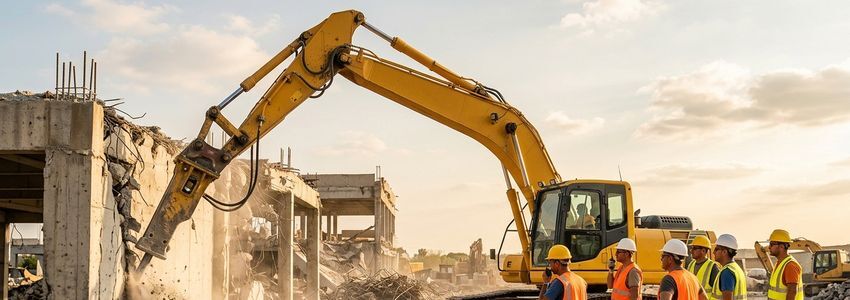
Excavator attachment financing gives demolition and construction contractors a way to acquire hydraulic hammers, breakers, thumbs, shears, grapples, and other specialized attachments without draining working capital. Instead of paying cash upfront for equipment that can cost anywhere from a few thousand dollars to well over six figures, contractors spread the cost over manageable monthly payments while the attachment starts generating revenue immediately.
For demolition companies in particular, the right attachment often determines whether a job can be bid on at all. A hydraulic breaker turns a standard excavator into a concrete-crushing machine. A demolition shear lets a crew cut through steel beams and rebar cleanly. A grapple attachment makes debris sorting and material handling dramatically faster. Without financing, many small and mid-sized contractors simply cannot afford to keep pace with larger competitors who own a full arsenal of attachments.
In This Article
What Is Excavator Attachment Financing?
Excavator attachment financing is a type of equipment financing specifically structured to help contractors purchase add-on tools that connect to an excavator's arm, replacing or supplementing the standard bucket. Common financed attachments include hydraulic hammers and breakers, demolition shears, thumbs, grapples, augers, compactor plates, and multi-purpose buckets.
Unlike financing an entire excavator, attachment financing typically involves smaller loan amounts, often ranging from $5,000 for a basic thumb attachment to $150,000 or more for a heavy-duty demolition shear or high-flow hydraulic breaker built for a large excavator. Because the equipment itself often secures the loan, approval can move faster and require less documentation than an unsecured business loan.
This type of financing falls under the broader umbrella of construction equipment financing, but attachments carry their own considerations. They wear out faster in demolition work, they depreciate differently than the base machine, and contractors often need to add or swap attachments as job requirements change throughout the year.
Key Stat: According to the U.S. Small Business Administration, financing options like the SBA 504 loan program are specifically designed to help small businesses acquire long-life machinery and equipment, with useful-life requirements of at least 10 years for eligible assets.
Key Benefits of Excavator Attachment Financing
Contractors choose to finance attachments rather than pay cash for several practical reasons tied directly to how demolition and construction businesses operate day to day.
- Preserve working capital. Cash stays available for payroll, fuel, insurance, and unexpected repairs instead of being tied up in a single tool.
- Match payments to revenue. An attachment financed over 36 to 60 months can be paid off using the income it helps generate on active jobs.
- Bid on bigger jobs sooner. Owning a hydraulic breaker or demolition shear opens up contract opportunities that require specific capabilities you may not currently have in-house.
- Fast approval on smaller amounts. Attachment loans are often smaller-ticket than full machine purchases, which can mean quicker underwriting and funding timelines.
- Flexible terms for used equipment. Many lenders, including Crestmont Capital, will finance both new and used attachments, which widens the range of affordable options.
- Tax planning flexibility. Structuring a purchase as a loan versus a lease can affect depreciation and expense treatment, giving business owners options to discuss with their accountant.
Ready to Add the Right Attachment to Your Fleet?
Get fast, flexible financing from the #1 business lender in the U.S. No obligation, apply in minutes.
Apply Now →How Excavator Attachment Financing Works
The process for financing an excavator attachment is similar to financing any other piece of business equipment, but a few steps are worth understanding before you start shopping for hammers, breakers, or shears.
- Identify the attachment and get a quote. Most contractors already know which brand and model fits their excavator's carrier class and hydraulic flow requirements before applying.
- Submit a financing application. Lenders typically ask for basic business information, time in business, and sometimes recent bank statements or financial statements for larger amounts.
- Receive approval and terms. Approval on smaller attachment purchases can happen within a day or two, with terms outlining the rate, monthly payment, and repayment length.
- Sign documents and fund the vendor. Once approved, the lender pays the equipment vendor directly or reimburses you if you already purchased the attachment.
- Put the attachment to work. The attachment starts generating revenue on jobs immediately while you make fixed monthly payments over the agreed term.
Pro Tip: Get a written quote from the equipment vendor before applying. Lenders can often move faster when the specific make, model, and price are already documented, rather than issuing a pre-approval for a general amount.
Types of Excavator Attachments You Can Finance
Nearly any attachment that bolts onto an excavator's arm can be financed as equipment, provided it has resale value and a documented purchase price. The most commonly financed categories include the following.
| Attachment Type | Primary Use | Typical Price Range |
|---|---|---|
| Hydraulic Hammer / Breaker | Concrete and rock demolition | $8,000 - $60,000+ |
| Demolition Shear | Cutting steel beams, rebar, structural elements | $25,000 - $150,000+ |
| Grapple | Sorting and moving debris, logs, scrap | $5,000 - $30,000 |
| Thumb Attachment | Grabbing irregular material with the standard bucket | $1,500 - $8,000 |
| Compactor Plate | Soil and gravel compaction on site prep jobs | $6,000 - $25,000 |
| Auger | Drilling holes for fence posts, footings, utility work | $3,000 - $15,000 |
Prices vary widely by carrier class. An attachment built for a mini excavator costs a fraction of one designed for a 40-ton machine used on heavy demolition sites. Lenders typically size the financing to the invoice price of the specific attachment and carrier compatibility rather than a flat industry rate.
Carrier compatibility deserves special attention before you finance anything. Hydraulic hammers and shears are rated for specific weight classes and flow rates, and mismatching an attachment to your carrier excavator can damage both the tool and the machine. Reputable dealers will confirm compatibility based on your excavator's operating weight, hydraulic flow (measured in gallons per minute), and pressure rating before finalizing a quote. Bring this information into the financing conversation early so the lender is quoting the correct total project cost, including any adapter plates, hoses, or couplers needed for a proper fit.
Attachment condition also affects both price and financing terms. New attachments carry manufacturer warranties, typically one to two years, which can make lenders more comfortable extending longer repayment terms. Used attachments, especially hammers with wear parts like tool bits and bushings, should be inspected closely, since remaining service life directly affects resale value and, in turn, how a lender structures the loan-to-value ratio.
By the Numbers
Demolition and Equipment Financing at a Glance
$11B+
Estimated size of the U.S. demolition and wrecking market
54%
Share of equipment acquisitions expected to be financed rather than paid in cash
81%
Recent average approval rate reported for small-ticket equipment financing
10,600+
Demolition companies registered across the U.S.
The Application Process, Step by Step
Understanding what happens on the lender's side of an application can help set expectations and speed up the process. While every lender's exact workflow differs slightly, most excavator attachment financing applications move through the same core stages.
Initial application and equipment details. You submit basic business information, including legal business name, time in business, and the specific attachment being financed. Providing the vendor's quote or invoice at this stage, rather than after approval, typically shortens the timeline by a day or more.
Underwriting review. The lender reviews business credit, personal credit of the guarantor (for smaller businesses, an owner's personal credit is almost always considered), and cash flow indicators such as recent bank statements. For attachment financing specifically, underwriters also weigh the resale value of the equipment itself, since it typically serves as collateral.
Terms presentation. Once approved, you receive a term sheet outlining the interest rate or factor rate, monthly payment, total repayment term, and any fees. This is the point to ask questions about prepayment penalties, whether the loan reports to business credit bureaus, and what happens if you want to add a second attachment later.
Documentation and funding. After accepting terms, you sign the financing agreement, and the lender either pays the equipment vendor directly or reimburses you if the purchase already took place. Funding for smaller attachment amounts can happen within 24 to 48 hours of signed documents.
Ongoing servicing. Once funded, you make scheduled payments, typically monthly, through the term of the loan. Some lenders offer autopay discounts or flexible payment date adjustments to align with seasonal cash flow, which is worth asking about for demolition businesses with uneven year-round revenue.
Who This Financing Is Best For
Excavator attachment financing tends to make the most sense for a specific set of contractors and situations, rather than every equipment purchase scenario.
- Demolition contractors expanding capability beyond a standard bucket into hammers, shears, and grapples for structural teardown work.
- Site prep and grading companies that need compactors or augers to take on a wider range of project types.
- Scrap and recycling operations that rely on grapples and shears to process material efficiently.
- Growing excavation businesses that already own a carrier machine but need to add specialty tools to win new contract types.
- Contractors replacing worn attachments where a hammer or shear has reached the end of its service life mid-season and cannot wait for a full cash purchase cycle.
It is generally a poor fit for businesses that only occasionally need a specialty attachment for a single job. In those cases, renting from an equipment rental yard is usually more cost-effective than committing to a multi-year financing term.
Key Stat: California, Texas, and Florida together account for roughly 30% of all registered demolition companies in the United States, reflecting where attachment demand is heaviest.
Financing vs. Leasing vs. Renting an Excavator Attachment
Contractors have three main paths to putting a new attachment to work: financing (a loan that ends in ownership), leasing (structured payments with an end-of-term option), and renting (short-term use with no ownership path). Each fits a different business situation.
| Factor | Financing | Leasing | Renting |
|---|---|---|---|
| Ownership at end of term | Yes | Optional buyout | No |
| Best for | Frequent, ongoing use | Preserving cash flow, uncertain long-term need | One-off or seasonal jobs |
| Monthly cost | Moderate, builds equity | Often lower per month | Highest cost over time if used often |
| Maintenance responsibility | Owner | Often owner, varies by lessor | Rental company |
For contractors using an attachment on the majority of their jobs, financing typically wins out financially over the long run because monthly payments build toward ownership rather than disappearing entirely, the way rental payments do. For occasional or highly specialized one-time jobs, renting still makes more sense.
A useful way to think through the decision is utilization rate. If you expect to use a hydraulic breaker or shear on more than roughly 40% of your jobs over the coming year, the math generally favors financing or leasing over renting, since rental rates on specialty attachments add up quickly across multiple projects. Below that utilization threshold, renting keeps you from carrying a fixed monthly obligation during slower stretches.
It is also worth factoring in opportunity cost. Every time a rental attachment isn't available when you need it, whether due to another customer having it out or a rental yard being out of stock of the specific model, you risk delaying a job or turning down work altogether. Contractors who bid on demolition and structural work regularly often find that owning core attachments removes this scheduling risk entirely, which is difficult to quantify but real in terms of client relationships and repeat business.
How Crestmont Capital Helps
Crestmont Capital works with demolition and construction contractors across the country to structure financing for excavator attachments, whether new or used, standalone or bundled with a full excavating equipment financing package. Our application process is built for speed, with decisions often available within one business day on smaller attachment purchases.
We also offer used equipment financing for contractors who want to buy a pre-owned hammer, shear, or grapple from a dealer or private seller rather than paying full price for new. If your credit history has some blemishes, our bad credit equipment financing options are designed specifically for business owners who have been turned down elsewhere.
If you already own the carrier excavator and simply need to add capability, read our companion guide on excavator financing for a broader look at financing the base machine itself. Demolition contractors expanding their overall equipment fleet may also find our demolition business loans guide useful for financing needs beyond attachments, including trucks, dumpsters, and working capital.
Bid on Bigger Demolition Jobs
Finance the hammer, shear, or grapple you need to expand your capabilities. Fast approvals, flexible terms.
Apply Now →Real-World Scenarios
Scenario 1: The growing demolition contractor. A five-year-old demolition company in Texas was regularly losing bids on interior structural demolition jobs because they only owned a standard bucket. Financing a mid-size demolition shear for roughly $45,000 over 48 months let them bid on and win two commercial teardown contracts within the first quarter, more than covering the monthly payment.
Scenario 2: The site prep company adding capacity. A grading and site prep business needed a compactor plate attachment to take on a municipal road base project with a tight deadline. Financing the $18,000 attachment allowed them to start the job within a week instead of waiting to save cash, and the completed contract paid for the equipment within the season.
Scenario 3: Replacing a worn hydraulic breaker mid-project. A concrete demolition contractor had a breaker fail partway through a warehouse teardown. Financing a replacement unit, purchased used through a dealer, let the crew get back to work in under 48 hours rather than losing the job to downtime.
Scenario 4: The scrap yard operator upgrading a grapple. A scrap metal recycling operation financed a heavy-duty grapple attachment to speed up sorting and loading. The improved throughput let them process roughly 20% more material per day, directly increasing revenue against the fixed monthly payment.
Scenario 5: The startup demolition crew building a fleet. A newer demolition business with limited time in business but a signed contract used attachment financing, alongside a broader equipment package, to acquire a shear and a thumb attachment simultaneously, allowing them to fulfill the contract terms without a large upfront cash outlay.
Common Mistakes to Avoid
Contractors financing an excavator attachment for the first time sometimes run into avoidable problems. Knowing what to watch for ahead of time can save both money and downtime.
- Skipping the compatibility check. Financing an attachment before confirming it matches your carrier's hydraulic flow and weight class can result in a tool that underperforms or damages the machine.
- Underestimating total cost. Adapter plates, hoses, couplers, and delivery fees can add several thousand dollars to a quoted attachment price. Get an all-in number before applying.
- Choosing the longest term without checking total cost. A longer term lowers the monthly payment but increases the total interest paid. Compare total cost across a couple of term lengths before signing.
- Not asking about early payoff terms. If cash flow allows you to pay off the attachment ahead of schedule, confirm whether the loan carries a prepayment penalty.
- Financing more attachment than the job requires. A heavy-duty shear rated for large-scale commercial demolition may be overkill, and overpriced, for a business that primarily handles smaller residential or light commercial teardown work.
Next Steps
Confirm the make, model, and price for the attachment you need before applying.
Submit basic business details through Crestmont Capital's application in minutes.
Get a clear breakdown of rate, monthly payment, and repayment length before committing.
Start bidding on jobs that require your new capability right away.
Frequently Asked Questions
What is excavator attachment financing?
Excavator attachment financing is a business loan or equipment financing product used specifically to purchase add-on tools for an excavator, such as hydraulic hammers, breakers, shears, grapples, thumbs, augers, or compactor plates. Payments are spread over a set term instead of paying the full purchase price upfront.
What types of excavator attachments can be financed?
Most lenders will finance hydraulic hammers and breakers, demolition shears, grapples, thumbs, augers, compactor plates, and multi-purpose buckets, as long as the attachment has a documented purchase price and retains resale value.
How does excavator attachment financing work?
You apply with basic business information and a quote for the attachment, receive approval and terms, then the lender funds the vendor directly or reimburses you. You make fixed monthly payments over an agreed term, typically 24 to 60 months, until the attachment is paid off.
What credit score do I need to qualify?
Requirements vary by lender and loan amount, but many equipment financing programs consider applicants with fair to good credit. Business owners with lower scores may still qualify through bad credit equipment financing programs designed for that situation.
Can I finance used excavator attachments?
Yes. Many lenders, including Crestmont Capital, finance both new and used attachments purchased from dealers or private sellers, which can significantly lower the entry cost compared to buying new.
What is the difference between financing and leasing an attachment?
Financing results in ownership once the loan is paid off. Leasing typically offers lower monthly payments but requires a decision at the end of the term about whether to buy the attachment outright, renew, or return it.
How much do excavator attachments typically cost?
Prices range widely based on carrier size and attachment type. A basic thumb attachment can cost as little as $1,500, while a heavy-duty demolition shear built for a large excavator can exceed $150,000.
What are typical financing terms and rates?
Terms commonly range from 24 to 60 months depending on the attachment's expected useful life and the loan amount. Rates depend on credit profile, time in business, and the size of the loan, and are best confirmed with a direct quote.
How long does approval take?
Smaller attachment financing requests can often be approved within one to two business days when documentation is complete. Larger or more complex requests may take longer.
Can startups or newer demolition companies qualify?
Newer businesses can sometimes qualify, particularly when there is a signed contract or job lined up that demonstrates the ability to repay. Requirements vary and it is worth discussing your specific situation directly with a lender.
What documents are needed to apply?
Typical requirements include a completed application, a vendor quote or invoice for the attachment, and basic business information. Larger loan amounts may require recent bank statements or financial statements.
Can I finance multiple attachments in one loan?
Yes, many lenders allow bundling multiple attachments, or an attachment plus the carrier excavator, into a single financing agreement, which can simplify payments and sometimes improve overall terms.
What happens if I want to upgrade my attachment later?
Once an attachment is paid off, it can typically be sold or traded toward a newer or larger model. Some contractors also refinance or take out new financing for an upgraded attachment while phasing out the older one.
Is a down payment required?
Down payment requirements vary by lender, loan amount, and credit profile. Some programs offer no down payment options, while others may require a percentage of the purchase price upfront.
How does excavator attachment financing compare to renting?
Renting makes sense for occasional or one-off jobs where ownership isn't necessary. Financing generally becomes more cost-effective once an attachment is used regularly, since payments build toward ownership rather than being a recurring expense with nothing to show for it afterward.
Don't Let a Missing Attachment Cost You the Job
Crestmont Capital can help you finance the hammer, shear, grapple, or thumb attachment your crew needs today.
Apply Now →Conclusion
Excavator attachment financing lets demolition and construction contractors add capability without a large upfront cash outlay, whether that means a hydraulic breaker for concrete work, a demolition shear for structural teardown, or a grapple for debris handling. With demolition and construction spending continuing to grow nationally, having the right attachment on hand can be the difference between winning a contract and watching it go to a better-equipped competitor.
Crestmont Capital works with contractors at every stage, from established demolition firms adding a second hammer to newer businesses financing their first shear alongside a carrier excavator. If you are ready to explore excavator attachment financing for your business, our team can walk you through options built around your specific equipment needs and timeline.
Disclaimer: The information provided in this article is for general educational purposes only and is not financial, legal, or tax advice. Funding terms, qualifications, and product availability may vary and are subject to change without notice. Crestmont Capital does not guarantee approval, rates, or specific outcomes. For personalized information about your business funding options, contact our team directly.