In This Article
- What Are Equipment Loans for Back-Office Automation?
- Key Benefits of Financing Back-Office Automation
- Types of Back-Office Automation Equipment You Can Finance
- How Equipment Loans Work for Automation
- Who Qualifies for Back-Office Automation Equipment Loans?
- How Crestmont Capital Helps Businesses Finance Automation
- Real-World Scenarios: Businesses Financing Back-Office Automation
- Comparing Equipment Loans to Other Financing Options
- How to Get Started with Back-Office Automation Financing
- Frequently Asked Questions
- Conclusion
What Are Equipment Loans for Back-Office Automation?
An equipment loan for back-office automation is a specific type of business financing designed to fund the purchase of technology, hardware, and software that streamlines administrative functions. These functions include tasks like accounting, human resources, data entry, document management, and customer relationship management (CRM). Unlike a general business loan, this financing is tied directly to the assets being acquired. The core principle of an Equipment Financing agreement is straightforward. A lender, like Crestmont Capital, provides a business with up to 100% of the funds needed to purchase specific automation tools. In return, the business makes regular payments over a predetermined term. A key feature of this loan is that the equipment itself typically serves as collateral. This secured structure often makes it easier for businesses to qualify for funding compared to unsecured loans, as it reduces the risk for the lender. Once the loan is fully repaid, the business owns the equipment outright, allowing it to continue benefiting from the technology for years to come. This financing solution empowers companies of all sizes to adopt modern operational tools without the burden of a large, upfront capital expenditure. It transforms a major purchase into a manageable monthly operating expense, aligning the cost of the equipment with the value it generates over time.Key Benefits of Financing Back-Office Automation
Investing in back-office automation through equipment financing offers significant strategic advantages. These benefits extend beyond simple cost savings and can fundamentally improve how a business operates.Preserve Working Capital
The most immediate benefit is the preservation of cash flow. Instead of draining liquid capital on a large technology purchase, businesses can use an equipment loan to acquire necessary tools while keeping their cash on hand for other critical needs like payroll, inventory, or marketing. This financial flexibility is crucial for managing day-to-day operations and seizing unexpected growth opportunities.Industry Insight: According to Forbes, businesses that adopt automation report an average productivity increase of 20-30%, making the investment case for back-office automation compelling for growing companies.
Gain a Competitive Edge
Automation allows businesses to operate more efficiently and accurately than their competitors. According to a report by Forbes, companies that embrace automation often see significant improvements in productivity and customer service. By financing these tools, even small and mid-sized businesses can access enterprise-level technology, leveling the playing field and enhancing their market position.Improve Operational Efficiency
Back-office automation reduces the time employees spend on repetitive, manual tasks. This frees them up to focus on higher-value activities such as strategic planning, customer engagement, and innovation. The result is a more productive workforce, faster processing times for tasks like invoicing and payroll, and a smoother overall workflow.Key Stat: A study by McKinsey & Company found that up to 45% of the activities individuals are paid to perform can be automated by adapting currently demonstrated technologies.
Reduce Human Error
Manual data entry and administrative processes are prone to human error, which can lead to costly mistakes in accounting, compliance, and customer records. Automated systems perform these tasks with precision and consistency, minimizing the risk of errors and ensuring greater data integrity across the organization.Enhance Scalability
As a business grows, its administrative workload increases exponentially. Manual back-office processes can quickly become bottlenecks, hindering expansion. Automated systems are designed to scale, handling a growing volume of transactions and data without a proportional increase in headcount or resources. Financing this technology allows a business to build a foundation for future growth.Predictable Budgeting
Equipment loans come with fixed monthly payments over a set term. This predictability makes it easy for businesses to budget and forecast their expenses accurately. There are no surprise costs, allowing for better long-term financial planning and stability.Ready to Finance Your Back-Office Automation?
Get fast, flexible equipment financing from the #1 business lender in the U.S. No obligation - apply in minutes.
Apply Now →Types of Back-Office Automation Equipment You Can Finance
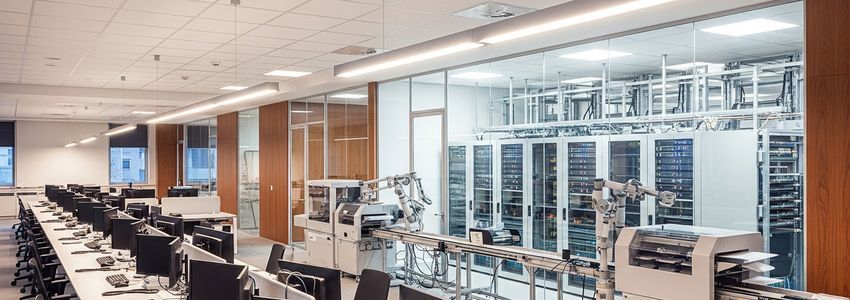
Equipment loans for back-office automation are versatile and can be used to finance a wide range of tangible and intangible assets. This includes both the hardware that powers operations and the software that manages them. Here are some common types of equipment and technology that businesses finance:- Hardware and IT Infrastructure:
- High-performance servers for data storage and processing
- Network hardware, including routers, switches, and firewalls
- Desktop computers, laptops, and workstations for employees
- Advanced document scanners and digital archiving systems
- VoIP phone systems and communication hardware
- Enterprise Software Suites:
- Enterprise Resource Planning (ERP) systems that integrate core business processes
- Customer Relationship Management (CRM) software like Salesforce or HubSpot
- Accounting and financial management software like QuickBooks Enterprise or NetSuite
- Human Resources Information Systems (HRIS) for payroll, benefits, and employee management
- Specialized Automation Tools:
- Robotic Process Automation (RPA) software to automate repetitive digital tasks
- Document management systems (DMS) for digitizing and organizing files
- Business intelligence (BI) and data analytics platforms
- Project management and collaboration software
How Equipment Loans Work for Automation
The process of securing an equipment loan for automation technology is designed to be efficient, allowing businesses to acquire necessary tools quickly. While specifics can vary by lender, the general steps are consistent and focus on a streamlined experience.Step 1: Application
The process begins with a simple application. Most modern lenders, including Crestmont Capital, offer an online application that can be completed in minutes. You will provide basic information about your business, such as its legal name, time in business, annual revenue, and details about the equipment you intend to purchase.Step 2: Documentation and Review
After submitting the application, the lender will review your business's financial health. This may involve a review of your business credit profile and, in some cases, bank statements or financial records. Because the equipment serves as collateral, the qualification criteria are often more flexible than for other types of Small Business Loans.Step 3: Approval and Term Sheet
Once your application is reviewed, the lender will issue an approval and a term sheet. This document outlines the proposed loan amount, interest rate, repayment term (e.g., 24, 36, or 60 months), and the fixed monthly payment. This is your opportunity to review the offer and ensure it aligns with your business's budget and financial goals.Step 4: Funding and Equipment Purchase
Upon accepting the terms, the lender finalizes the loan documents. The funding process is then initiated. Typically, the lender pays the equipment vendor directly on your behalf. This simplifies the transaction, as you do not need to handle the large payment yourself. Once the vendor is paid, the equipment is delivered and installed, and you can begin using it immediately. Your repayment schedule begins shortly after.How Back-Office Equipment Financing Works - At a Glance
Apply Online
5-minute application with basic business info.
Get Approved
Fast decisions, often within 24-48 hours.
Choose Your Equipment
Select the automation tools your business needs.
Get Funded
Equipment delivered or paid for, you begin operations.
Who Qualifies for Back-Office Automation Equipment Loans?
Lenders evaluate several factors to determine a business's eligibility for an equipment loan. While requirements differ, most lenders look for a healthy and established business with a clear ability to repay the loan. At Crestmont Capital, we work with a wide range of businesses, but here are the general qualification standards in the industry.Time in Business
Most lenders prefer to work with businesses that have been in operation for a minimum period, typically one to two years. This track record demonstrates stability and a history of generating revenue. However, some programs are available for newer businesses, especially those with strong credit and financials.Business Credit Score
A solid business credit score indicates a history of responsible financial management. While a high score is beneficial, equipment financing is often accessible to businesses with less-than-perfect credit because the loan is secured by the asset itself. Lenders may place more weight on recent payment history and overall financial health.Annual Revenue
Lenders need to see that your business generates sufficient revenue to comfortably handle the monthly loan payments. A minimum annual revenue threshold is common, often starting around $100,000 to $250,000, but this varies significantly depending on the lender and the size of the loan requested.Industry and Equipment Type
The industry your business operates in and the type of equipment being financed can also play a role. Lenders are familiar with the value and lifespan of common automation technologies, which can influence their lending decisions. Most mainstream industries, from manufacturing and healthcare to professional services and retail, are eligible for this type of financing.Did You Know? According to the U.S. Census Bureau, small businesses make up 99.9% of all U.S. businesses, and many are actively seeking financing to invest in technology to remain competitive.
SBA Resource: The U.S. Small Business Administration offers guidance on equipment financing options and encourages small businesses to explore funding for technology upgrades that improve operational efficiency.

How Crestmont Capital Helps Businesses Finance Automation
Choosing the right lending partner is as important as choosing the right automation technology. As the #1 rated business lender in the U.S., Crestmont Capital provides a financing experience tailored to the needs of modern businesses seeking to upgrade their operations.Fast and Simple Process
We understand that time is critical in business. Our application process is entirely digital and takes just a few minutes to complete. We provide some of the fastest approval times in the industry, often delivering decisions within hours. This speed ensures you can acquire and implement your new automation equipment without unnecessary delays. We are a leading provider of Fast Business Loans for a reason.High Approval Rates
Our lending model is designed to support a broad spectrum of businesses. Because our equipment loans are secured by the asset, we can approve applications that traditional banks might decline. We look at the complete picture of your business's health, not just a single credit score, which results in industry-leading approval rates.Flexible and Customized Terms
Every business has unique financial circumstances. We work with you to structure a loan that fits your budget and cash flow. With flexible repayment terms ranging from 12 to 72 months and competitive rates, we can create a financing plan that aligns with your long-term goals and makes your technology investment affordable.Dedicated Financing Specialists
When you partner with Crestmont Capital, you are assigned a dedicated financing specialist. This expert will guide you through the entire process, from application to funding, answering your questions and ensuring a smooth experience. Our specialists understand the value of automation equipment and can help you secure the best possible terms for your specific needs.Upgrade Your Operations with Crestmont Capital
Experience the difference of working with a top-rated lender. Finance your back-office automation with speed and confidence.
Get Your Free Quote →Real-World Scenarios: Businesses Financing Back-Office Automation
To better understand the practical application of these loans, consider how different types of businesses leverage them to improve their back-office functions.Scenario 1: A Growing Logistics Company
A mid-sized logistics company was struggling with manual invoicing and dispatch coordination. The process was slow, error-prone, and required three full-time employees. They used an equipment loan of $75,000 to finance a new Transportation Management System (TMS) and integrated accounting software.- Result: The new system automated 90% of their invoicing and optimized dispatch routes. They reduced their billing cycle by ten days, significantly improving cash flow, and reallocated two administrative staff members to customer service roles, boosting client satisfaction.
Scenario 2: A Multi-Location Healthcare Clinic
A healthcare provider with five clinic locations needed to centralize patient records and billing. They were using outdated, separate systems at each location, leading to compliance risks and administrative inefficiencies. They secured a $150,000 equipment loan to purchase a modern Electronic Health Record (EHR) system and the necessary servers.- Result: The unified EHR system streamlined patient scheduling, billing, and records management across all locations. It improved data security, ensured HIPAA compliance, and reduced administrative overhead by 25%, allowing them to invest more in patient care.
Scenario 3: A Regional Law Firm
A law firm was drowning in paperwork. Managing case files, client documents, and billing records manually was consuming a significant amount of paralegal and attorney time. They opted for a $50,000 equipment loan to finance a comprehensive document management system (DMS) and new high-speed scanners.- Result: Digitizing their files made document retrieval instantaneous and secure. The DMS automated version control and access permissions, reducing the risk of errors. The firm estimated it saved over 20 billable hours per week, directly increasing revenue.
Scenario 4: A Small Manufacturing Business
A small manufacturer of custom parts needed to better manage its inventory, orders, and supply chain. Their manual tracking system led to stockouts and production delays. They used a $100,000 equipment loan to implement an Enterprise Resource Planning (ERP) system tailored for manufacturing.- Result: The ERP system provided real-time visibility into their entire operation. It automated purchase orders, optimized inventory levels, and streamlined production scheduling. This led to a 15% reduction in material costs and a 30% improvement in on-time delivery rates.
Comparing Equipment Loans to Other Financing Options
While equipment loans are an excellent tool for acquiring automation technology, it is helpful to understand how they compare to other common business financing products.| Feature | Equipment Loan | Business Line of Credit | Equipment Leasing |
|---|---|---|---|
| Best For | Financing a specific, one-time purchase of high-value equipment or software. | Managing short-term cash flow, unexpected expenses, or ongoing operational costs. | Acquiring equipment that quickly becomes obsolete or for short-term project needs. |
| Ownership | You own the equipment outright once the loan is fully repaid. | Not applicable; funds are used for general business purposes, not a specific asset. | You do not own the equipment. At the end of the lease, you can return it, renew, or buy it. |
| Collateral | The equipment being financed serves as the collateral for the loan. | Can be secured with general business assets or unsecured, depending on the lender. | The leased equipment is owned by the leasing company, so no additional collateral is needed. |
| Payment Structure | Fixed monthly payments over a predetermined term. | You only pay interest on the amount you draw. Payments can be variable. | Fixed monthly lease payments over the term of the agreement. |
| Funding Structure | A lump sum provided to purchase the specific asset. | A revolving credit limit you can draw from and repay as needed. | The leasing company purchases the equipment and rents it to you. |
How to Get Started with Back-Office Automation Financing
Taking the first step toward financing your business's automation upgrade is simple and fast. At Crestmont Capital, we have refined the process to get you the capital you need with minimal friction.Apply Online
Complete our secure online application in just a few minutes. You will only need basic information about your business and the equipment you want to finance.
Business Trend: CNBC's Small Business coverage consistently reports that automation is among the top strategic investments for businesses looking to scale operations without proportional staff increases.
Speak with a Specialist
Your dedicated financing specialist will contact you to discuss your needs, review your options, and answer any questions you have about the process or your loan terms.
Get Funded
Once you approve the terms, we finalize the paperwork and fund the purchase, often paying your vendor directly. You receive your equipment and start improving your operations.
Ready to Start the Process?
Your journey to a more efficient business begins here. Apply now to see how much you qualify for.
Apply in Minutes →Frequently Asked Questions
What exactly is a back-office automation equipment loan?
It is a type of business loan used specifically to finance the purchase of hardware (like servers and computers) and software (like ERP, CRM, or accounting systems) that automate administrative tasks. The equipment itself serves as collateral for the loan.
How does the financing process work?
The process is simple: you apply for the loan, the lender reviews your business's financial profile, you receive an offer with terms, and upon acceptance, the lender pays the equipment vendor directly. You then begin making regular payments to the lender.
What are the typical qualification requirements?
Lenders generally look for a minimum time in business (often 1-2 years), a stable revenue stream, and a reasonable credit history. Because the loan is secured by the equipment, qualification standards can be more flexible than for unsecured loans.
How much can I borrow for automation equipment?
Loan amounts can range from as little as $5,000 to over $1 million, depending on the cost of the equipment and your business's ability to repay the loan. Many lenders, including Crestmont Capital, can finance up to 100% of the equipment's value.
What are the interest rates and terms for these loans?
Interest rates are competitive and vary based on your business's credit profile, time in business, and the loan term. Repayment terms are typically between 12 and 72 months, offering flexibility to match your cash flow.
How quickly can I get funded?
Alternative lenders like Crestmont Capital specialize in speed. Applications can be approved in hours, and funding can often be completed within 24 to 48 hours, allowing you to acquire your equipment without delay.
What is the difference between an equipment loan and equipment leasing?
With an equipment loan, you own the asset outright after the final payment. With leasing, you are essentially renting the equipment for a set term. At the end of a lease, you typically have the option to return it, renew the lease, or purchase it.
Can I finance both hardware and software?
Yes. Most modern equipment financing agreements for automation can cover a bundle of assets, including hardware (servers, computers), software licenses, and even installation and training costs.
Can I get an equipment loan if I have bad credit?
It is possible. Since the equipment itself secures the loan, lenders are often more willing to work with business owners who have lower credit scores compared to unsecured financing options. Strong revenue and time in business can also help offset a lower score.
Are startups eligible for this type of financing?
It can be more challenging for startups (businesses under one year old) to qualify. However, some lenders offer programs for new businesses, especially if the owner has a strong personal credit history and a solid business plan. For general funding, startups might also explore Working Capital Loans.
What documents are typically required to apply?
The initial application usually requires minimal documentation. For final approval, you may be asked to provide recent business bank statements, a quote or invoice for the equipment, and basic identification.
Is additional collateral required besides the equipment?
In most cases, no. The primary collateral for an equipment loan is the equipment being purchased. This is known as a self-collateralized loan, which is a major advantage for business owners who don't want to pledge other business or personal assets.
Can I finance used or refurbished automation equipment?
Yes, many lenders, including Crestmont Capital, offer financing for both new and used equipment. Financing used equipment can be a cost-effective way to upgrade your technology, provided the asset has a reasonable useful life remaining.
How is Crestmont Capital different from a traditional bank?
Crestmont Capital offers a faster, more flexible, and more accessible financing experience. Unlike traditional banks that often have lengthy application processes and strict credit requirements, we specialize in rapid approvals, high approval rates, and personalized service tailored to the needs of small and mid-sized businesses.
Does the loan cover installation and training costs?
Yes, in many cases, equipment loans can be structured to cover "soft costs" associated with the purchase, such as delivery, installation, and initial training. This allows you to finance the entire project with a single loan.
Conclusion
In a business environment driven by technology and efficiency, back-office automation is no longer a luxury but a fundamental component of a successful operation. It reduces costs, minimizes errors, and frees up valuable human resources to focus on growth. However, the initial investment in this technology can be a significant barrier for many companies. Equipment loans for back-office automation provide the solution. By allowing businesses to finance 100% of their technology needs, this funding tool makes smarter operations accessible to all. It converts a large capital expense into a predictable monthly payment, preserving precious working capital and enabling an immediate return on investment. Whether you are a logistics firm implementing a TMS, a healthcare clinic upgrading to an EHR, or any business looking to streamline its administrative functions, financing is the strategic path forward. Partnering with an experienced lender like Crestmont Capital ensures a fast, simple, and flexible process, empowering you to acquire the tools you need to compete and thrive.Disclaimer: The information provided in this article is for general educational purposes only and is not financial, legal, or tax advice. Funding terms, qualifications, and product availability may vary and are subject to change without notice. Crestmont Capital does not guarantee approval, rates, or specific outcomes. For personalized information about your business funding options, contact our team directly.