
 (800) 949-0401
Equipment Financing vs. Leasing: Which Is Right for Your Business?
Every growing business eventually faces the same question: when you need new equipment, should you finance it or lease it? The answer shapes your cash flow, your balance sheet, and your ability to scale. Understanding the real differences between equipment financing for small business and equipment leasing is one of the most valuable financial decisions you can make as a business owner.
This guide breaks down both options in plain terms, compares the true costs, and helps you decide which path makes the most sense for your specific situation.
What Is Equipment Financing?
Equipment financing is a type of business loan specifically used to purchase equipment. You borrow the full cost of the equipment (or a portion of it), make fixed monthly payments over a set term, and own the equipment outright when the loan is repaid.
The equipment itself typically serves as collateral, which often makes these loans easier to qualify for compared to unsecured business loans. Terms generally range from 24 to 84 months, and interest rates vary based on your credit profile, the age of the equipment, and the lender.
Once the loan is paid off, the asset belongs entirely to your business. You can use it, sell it, or trade it in. There are no restrictions from a lender.
What Is Equipment Leasing?
Equipment leasing is more like a long-term rental agreement. A leasing company purchases the equipment and rents it to your business for a monthly fee. At the end of the lease term, you typically have a few options: return the equipment, renew the lease, or purchase it at fair market value or a predetermined price.
Lease terms usually run from 12 to 60 months. Monthly payments are often lower than financing payments for the same piece of equipment because you are paying for the use of the asset, not its full value.
There are two primary types of equipment leases:
- Operating Lease: The equipment stays off your balance sheet. You use it, return it, and have no ownership interest. This is common for technology and equipment that depreciates quickly.
- Capital (Finance) Lease: Structured to look more like a purchase. The equipment appears on your balance sheet as an asset, and you bear the risk of ownership. Often includes a $1 buyout option at the end.
Key Differences: Equipment Financing vs. Leasing at a Glance
Before diving deeper, here is a direct comparison of the most important factors:
- Ownership: Financing leads to full ownership after the final payment. Leasing typically means you return the equipment or pay to buy it at the end.
- Monthly Payments: Financing payments are usually higher because they cover the full purchase price. Lease payments are often lower.
- Balance Sheet Impact: Financed equipment appears as both an asset and a liability. Operating leases are kept off the balance sheet (though accounting rules under ASC 842 now require most leases to appear on balance sheets).
- Tax Treatment: Financing allows you to depreciate the equipment and potentially deduct the full cost in Year 1 under Section 179. Lease payments are typically fully deductible as a business expense.
- Flexibility: Leasing makes it easier to upgrade to newer equipment. Financing locks you into the equipment until it is paid off or sold.
- Maintenance: Some leases include maintenance provisions. With financing, all maintenance costs fall on you.
How Equipment Financing Works: Step by Step
Understanding the mechanics helps you navigate the process with confidence.
- Identify the equipment you need. Get a quote from the vendor or seller. Know whether the equipment is new or used, as this affects your financing terms.
- Apply with a lender. You submit a financing application with basic business financials, credit information, and details about the equipment. Lenders review your creditworthiness and the value of the collateral.
- Receive approval and terms. If approved, the lender presents the loan amount, interest rate, monthly payment, and repayment term.
- Equipment is purchased. The lender funds the purchase directly or sends proceeds to you. The equipment is yours from day one.
- Make monthly payments. You repay the loan over the agreed term. A portion of each payment goes toward principal, a portion toward interest.
- Own the equipment free and clear. Once the loan is fully repaid, the lien is removed and you own the equipment outright.
Crestmont Capital offers equipment financing with competitive rates and flexible terms designed for businesses at every stage. Whether you need a single machine or an entire fleet, the application process is straightforward and decisions are fast.
How Equipment Leasing Works: Step by Step
- Choose your equipment and identify a vendor. Unlike financing, you do not own the equipment, so the leasing company needs to approve the asset.
- Apply with a leasing company. The application is similar to financing but typically with less emphasis on collateral since the lessor retains ownership.
- Receive lease terms. Monthly payment, lease term, end-of-lease options (return, renew, or buy), and any maintenance provisions are outlined in the lease agreement.
- Take possession of the equipment. Once the lease begins, you use the equipment as if you own it, but the leasing company holds the title.
- Make monthly payments. All payments go toward the use of the asset, not toward building equity in it.
- Choose your exit at lease end. Return the equipment, enter a new lease for updated equipment, or exercise a purchase option.
Crestmont Capital also offers equipment leasing options for businesses that need flexibility without a long-term ownership commitment. This is a popular choice for industries where technology advances quickly or seasonal equipment needs change year to year.
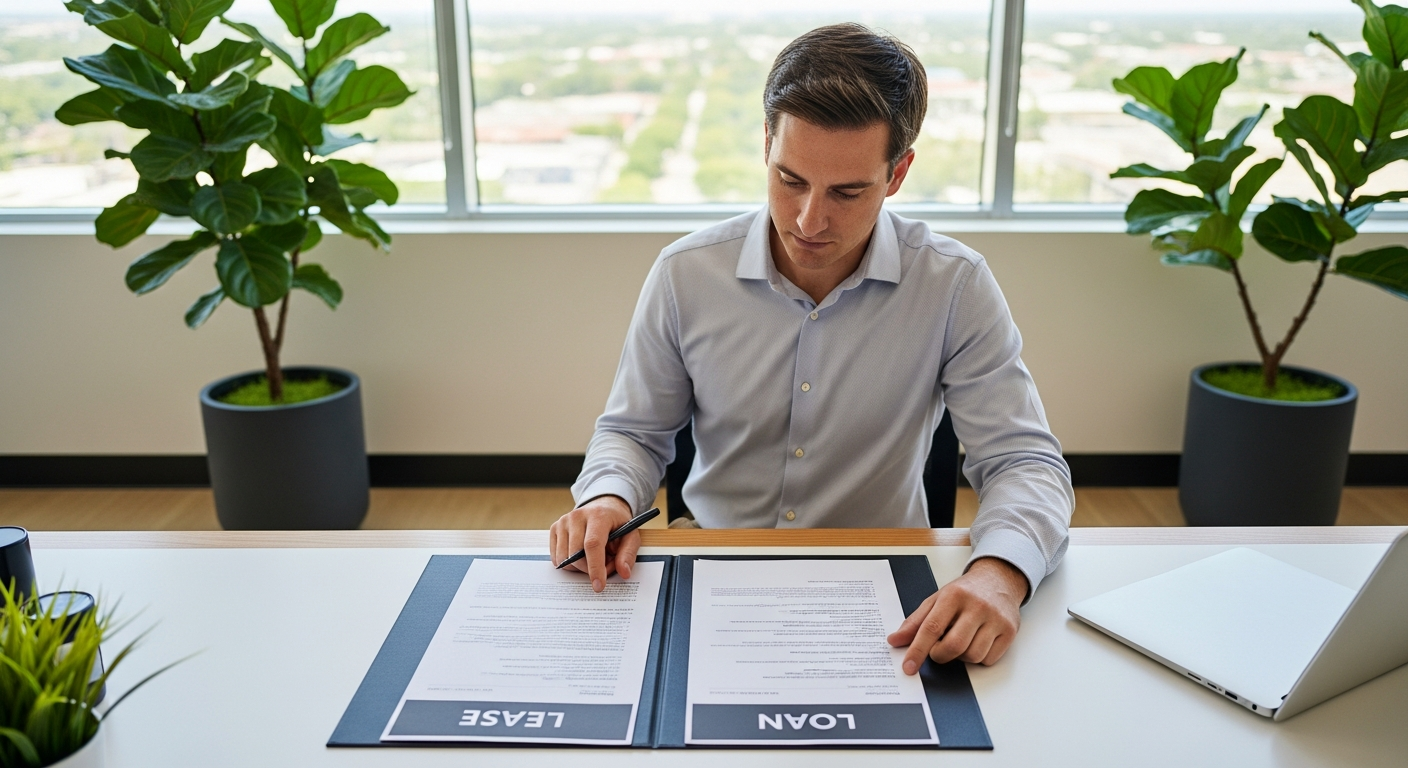
The Real Cost Comparison: Financing vs. Leasing
Monthly payments are just one part of the picture. To make an informed decision, you need to understand total cost of ownership over the equipment's useful life.
Example scenario: A landscaping company needs a $80,000 commercial mower.
Equipment financing (60-month term, 8% interest rate):
- Monthly payment: approximately $1,622
- Total paid over term: approximately $97,320
- You own the mower after 60 months
- Residual value of equipment (assuming 30% depreciation): approximately $56,000
- Net cost of ownership: approximately $41,320
Equipment operating lease (60-month term):
- Monthly payment: approximately $1,350 (based on leasing only the depreciated value)
- Total paid over term: approximately $81,000
- No ownership at end of term
- If you need the same type of equipment again, you start another lease
- Net cost over 10 years (two lease cycles): approximately $162,000
Over a long enough time horizon, financing and owning your equipment is almost always less expensive. Leasing saves money in the short term but costs more over the life of the asset when you factor in perpetual payments and no residual ownership.
When Equipment Financing Makes More Sense
Equipment financing is the stronger choice in the following situations:
- The equipment has a long useful life. Heavy machinery, industrial equipment, and commercial vehicles that last 10 to 20 years are strong candidates for financing. You benefit from ownership long after the loan is paid off.
- You want to build equity in the asset. Owned equipment can be sold, used as collateral for future loans, or transferred as part of a business sale. Leased equipment offers none of those options.
- You qualify for Section 179 deductions. Under Section 179 of the IRS tax code, businesses can deduct the full cost of qualifying equipment in the year it is placed in service. For 2026, the deduction limit is $1,220,000. This dramatically reduces the effective cost of financing. Visit Crestmont's Section 179 resource page to learn how this applies to your purchase.
- You have stable cash flow. If your business generates consistent revenue and can comfortably handle the monthly payment, ownership builds long-term value.
- You need specialized or customized equipment. Custom-built or modified equipment has limited resale value in a lease scenario. If you own it, you control its future entirely.
When Equipment Leasing Makes More Sense
Leasing offers genuine advantages in specific circumstances:
- Technology that becomes obsolete quickly. Computers, software-driven diagnostic tools, and medical imaging devices can be outdated within a few years. Leasing lets you hand back the old equipment and upgrade to the latest model when the term ends.
- Preserving working capital. If your business is in a growth phase and cash is needed elsewhere, a lower lease payment frees up capital for hiring, marketing, or inventory. You can explore working capital loans as a complement to your leasing strategy if cash flow demands both.
- Short-term or project-based equipment needs. Construction companies bidding on a specific contract may need a crane or excavator for one job. A short-term lease is more cost-effective than financing a piece of equipment you will only use once.
- Startups or businesses with limited credit history. Some leasing companies are more flexible on credit requirements because they retain ownership of the asset, reducing their risk.
- Off-balance-sheet financing needs. Businesses managing debt ratios or preparing for acquisition may benefit from keeping equipment off the balance sheet.
Industry-Specific Guidance
The right choice often depends on your industry. Here is how different sectors typically approach this decision:
- Construction and contracting: Heavy equipment like excavators, loaders, and cranes typically has long useful lives. Financing is common because ownership builds value over many years of use. According to Forbes, construction businesses that own their core equipment have stronger balance sheets and better borrowing power for future growth.
- Healthcare and medical practices: MRI machines, ultrasound units, and diagnostic equipment can be expensive and are subject to rapid technological advances. Leasing is widely used in this sector to stay current with medical technology without taking on large long-term debt.
- Restaurants and food service: Commercial kitchen equipment tends to have long useful lives. Financing is often preferred because restaurants customize their kitchens and need to control the equipment long term.
- Technology companies and professional services: Computers, servers, and telecommunications equipment depreciate quickly. Leasing is a natural fit for tech-forward businesses that need to stay ahead of hardware cycles.
- Transportation and logistics: Semi-trucks and commercial vehicles are high-value assets with strong resale markets. Financing is often more economical because the equipment holds value and generates revenue for years after the loan is paid off. As CNBC has noted, fleet ownership is a strategic advantage for transportation companies competing on cost.
How Crestmont Capital Can Help
Whether you decide to finance or lease, Crestmont Capital has solutions built for businesses across every industry. As one of the top-rated business lenders in the country, Crestmont works with established businesses and growth-stage companies alike to find the right fit for their equipment needs.
Through the small business financing hub, you can explore the full range of options available: from equipment loans to commercial leasing programs, all designed with competitive rates and fast approvals.
The Crestmont team understands that no two businesses are the same. A restaurant owner replacing a commercial oven has different priorities than a logistics company building out a fleet of semi-trucks. Every financing recommendation starts with understanding your business goals, cash flow, and growth timeline.
Real-World Scenarios
Scenario 1 - The established manufacturer: A metal fabrication company with 12 years in business needs to replace two CNC machines at a combined cost of $220,000. The machines have a 15-year useful life, and the business generates $4.2 million in annual revenue. Financing at 7.5% over 72 months results in a manageable monthly payment, the machines are eligible for a full Section 179 deduction this year, and the company owns valuable assets outright by year six. Financing is the clear winner.
Scenario 2 - The growing med spa: A medical spa needs two laser aesthetic devices at $90,000 each. The technology is expected to advance significantly within four years, and newer models will attract more clients. A 36-month operating lease keeps monthly costs lower, allows for an upgrade at the end of the term, and preserves cash for marketing and staff. Leasing makes more strategic sense here.
Scenario 3 - The startup food truck owner: A new food truck operator needs a customized truck build-out worth $75,000. The truck will be customized to their exact menu and workflow, making it hard to return at lease end. The owner plans to operate for at least seven years. Financing gives them full ownership of a unique, income-generating asset with a strong potential resale value if they later expand to a brick-and-mortar location.
Scenario 4 - The IT services company: An IT company needs 40 workstations and two servers totaling $120,000. Hardware cycles are 3-4 years. A 36-month lease lets them refresh all technology at the end of the term without dealing with disposal of outdated hardware. The lower monthly payments also free up capital for software subscriptions and talent acquisition.
Scenario 5 - The construction subcontractor: A plumbing subcontractor lands a two-year commercial contract that requires a specialized pipe threading machine. Rather than financing a $45,000 piece of equipment they may only use intensively for one project, they opt for a short-term 24-month lease. The monthly cost aligns with the project revenue, and they have no residual equipment to manage when the contract ends.
Scenario 6 - The regional trucking company: A logistics operator wants to add four refrigerated semi-trucks to its fleet. At $175,000 each, the total is $700,000. The trucks will be used daily for 8-10 years and generate consistent freight revenue. Bloomberg industry data shows owner-operators consistently outperform on total cost of ownership compared to lease-dependent fleets over a 10-year horizon. Financing gives this company the equity, flexibility, and long-term cost advantage it needs.
Tax Considerations You Cannot Afford to Ignore
Both financing and leasing offer real tax advantages, but they work differently.
With financing, you can take advantage of depreciation deductions spread over the equipment's useful life, or elect Section 179 expensing to deduct the entire purchase price in Year 1. Bonus depreciation provisions may also apply. For businesses with strong current-year income, front-loading the deduction can produce significant tax savings.
With leasing, the monthly lease payments are typically fully deductible as a business operating expense. You do not claim depreciation since you do not own the asset. The deductions are spread evenly over the lease term rather than concentrated in Year 1.
The right tax strategy depends on your business's income, tax bracket, and growth projections. Work with your CPA to model both scenarios before committing.
Frequently Asked Questions
Can I finance used equipment?
Yes. Many lenders offer financing for used equipment, though terms and rates may vary. Lenders generally require an appraisal or fair market value assessment for equipment over a certain age. Crestmont Capital offers used equipment financing across most equipment categories.
What credit score do I need to qualify for equipment financing?
Requirements vary by lender. Many equipment financing programs are accessible to businesses with credit scores in the 600-650 range, particularly because the equipment serves as collateral. Stronger credit profiles typically unlock better rates and longer terms.
Can I lease equipment if my business is relatively new?
Yes. Some leasing companies are more flexible with newer businesses than traditional lenders because they retain ownership of the equipment. Startups with less than two years in business may find leasing more accessible than financing.
What happens if I need to exit a lease early?
Early lease termination usually comes with penalties. The remaining payments may be due in full, or the leasing company may charge a set termination fee. Read your lease agreement carefully before signing to understand your exit options.
Is equipment financing the same as a business loan?
Equipment financing is a specific type of secured business loan where the equipment serves as collateral. It functions similarly to a term loan but is purpose-built for asset purchases. Traditional term loans, by contrast, can be used for any business purpose.
Can I negotiate equipment lease terms?
Yes. Monthly payments, lease duration, end-of-lease purchase options, and maintenance provisions are all potentially negotiable depending on the leasing company. Businesses with strong credit and high purchase volumes often have the most leverage.
Does financing equipment affect my ability to borrow for other needs?
Equipment loans do appear on your balance sheet and impact your debt-to-income ratios. However, because the equipment is a productive asset generating revenue, lenders often view this type of debt favorably compared to unsecured borrowing.
Next Steps: Getting the Right Financing for Your Equipment
The decision between equipment financing and leasing is not one-size-fits-all. It depends on how long you need the equipment, your cash flow situation, your tax strategy, and where your business is headed. The good news is you do not have to figure it out alone.
Crestmont Capital's team works with business owners every day to find the most cost-effective and strategically sound way to get the equipment they need. Whether you are financing a single machine or putting together a multi-unit fleet acquisition, the process starts with a simple conversation about your goals.
Take the first step today and apply for equipment financing or explore your leasing options at https://offers.crestmontcapital.com/apply-now.
Conclusion
Equipment financing for small business is one of the most powerful tools available for growth. Whether you choose to finance and own your equipment or lease it for maximum flexibility, the right decision depends on your specific business model, financial health, and long-term plans. Ownership builds equity and is almost always less expensive over the life of the asset. Leasing offers lower short-term payments and the ability to upgrade as technology changes. Both serve real business needs.
The key is to run the numbers, consult your tax advisor, and work with a lender who understands your industry. Crestmont Capital is here to help you make that call with confidence and get funded fast.
Disclaimer: The information provided in this article is for general educational purposes only and is not financial, legal, or tax advice. Funding terms, qualifications, and product availability may vary and are subject to change without notice. Crestmont Capital does not guarantee approval, rates, or specific outcomes. For personalized information about your business funding options, contact our team directly.








