
The embroidery industry sits at the intersection of craftsmanship and commerce, and the numbers behind it have rarely looked stronger. Whether you operate a single-head home studio or a multi-head commercial shop running around the clock, understanding the latest embroidery business statistics helps you price work with confidence, plan equipment investments, and spot demand shifts before competitors do.
This 2026 roundup gathers the most important market size figures, growth projections, revenue benchmarks, and trend data for the embroidery and apparel decoration industry in one place. Every section below is built to answer a practical question: how big is this market, how fast is it growing, who is buying, and what does that mean for your business this year.
In This Article
- Embroidery Industry Overview: Market Size and Growth
- Key Embroidery Business Statistics for 2026
- Embroidery Market Segments and Services
- Revenue and Profitability Benchmarks
- Employment and Business Demographics
- Growth Drivers and Trends Shaping 2026
- Embroidery vs. Other Decoration Methods
- What These Statistics Mean for Shop Owners
- How Crestmont Capital Helps Embroidery Businesses
- Real-World Scenarios
- Frequently Asked Questions
- How to Get Started
- The Bottom Line for 2026
Embroidery Industry Overview: Market Size and Growth
Embroidery is one of the oldest forms of textile decoration, but as a modern commercial industry it is anything but static. Market research firms that track the global embroidery market, which covers finished embroidered goods, custom apparel services, and decorative textiles, currently value it between $4.0 billion and $6.6 billion depending on how broadly the scope is defined.
Fortune Business Insights values the global embroidery market at $6.64 billion and projects it will reach $10.64 billion by 2032, a compound annual growth rate of 5.3 percent. SkyQuest Technology takes a slightly narrower view, valuing the market at $4.34 billion with a projection of $7.41 billion by 2033 at a CAGR of 6.9 percent. Cognitive Market Research is more aggressive, forecasting growth from $4.07 billion to $7.73 billion by 2033, which implies a CAGR of 9.6 percent.
Whichever estimate you prefer, the direction is consistent: steady, durable, single-digit to high-single-digit annual growth for at least the next seven years. Few mature manufacturing-adjacent industries can say that.
The equipment side of the industry tells the same story. The global embroidery machine market, covering computerized single-needle, multi-needle, and industrial multi-head hardware, is estimated at $5.8 billion to $6.1 billion today and is projected to reach $7.4 billion to $8.1 billion by 2032 to 2035, growing at roughly 3.25 to 4.7 percent per year. Machine sales are a leading indicator: shops buy equipment when order volume justifies it, so sustained machine market growth signals sustained demand for embroidered goods.
Key Stat: According to the U.S. Small Business Administration, more than 33 million small businesses operate in the United States, and the vast majority of embroidery shops fall into that category. Most are micro or small operations with two to ten employees, which makes access to flexible small business financing a defining factor in which shops can scale.
Embroidery also sits inside a much larger category. The global decorated apparel market, which includes embroidery, screen printing, direct-to-garment, and direct-to-film printing, is projected to reach $68.17 billion by 2030 at a CAGR of 13.0 percent. Embroidery is consistently the highest-value segment within that market because of its durability, perceived quality, and dominance in corporate and uniform wear.
Key Embroidery Business Statistics for 2026
Here are the headline numbers every embroidery business owner, investor, and industry watcher should know going into 2026. Each figure is drawn from current market research and industry surveys, and each one has practical implications for how you run or fund a shop this year.
- Global embroidery market size: $4.0 billion to $6.6 billion in current estimates, with the most widely cited figure at $6.64 billion.
- Projected global market by 2032 to 2035: $7.4 billion to $10.6 billion.
- Expected CAGR: 5.3 percent to 6.9 percent for the overall market, with high-growth segments tracking up to 9.6 percent.
- Embroidery machine market: $5.8 billion to $6.1 billion today, heading toward $7.4 billion to $8.1 billion within a decade.
- Decorated apparel market: projected to hit $68.17 billion globally by 2030 at 13.0 percent CAGR.
- U.S. commercial embroidery market: approximately $1 billion in annual revenue, inside a U.S. decorated apparel market exceeding $5 billion to $6 billion.
- U.S. business count: roughly 950 to 1,000 dedicated commercial embroidery shops, plus tens of thousands of additional businesses offering embroidery alongside screen printing, DTF, and promotional products.
- Typical shop size: two to ten employees covering machine operation, digitizing, and design work.
- Service diversification: more than 66 percent of decorated apparel businesses offer multiple services beyond embroidery.
- Regional production share: Asia-Pacific accounts for approximately 40 to 47 percent of global embroidery production, while North America leads in on-demand custom and boutique services.
By the Numbers
Embroidery Business Statistics: Key Figures for 2026
$6.64B
Current global embroidery market value, projected to reach $10.64B by 2032
5.3-6.9%
Expected annual growth rate for the global embroidery market through 2033
$1B
Approximate annual revenue of the U.S. commercial embroidery market
66%+
Share of decorated apparel businesses offering services beyond embroidery
Two things stand out in this data. First, the U.S. market is fragmented: there is no dominant national chain, and most revenue flows through thousands of small, independently owned shops. Second, the shops that grow fastest are the ones that diversify. A pure embroidery shop competes on a narrower field than a shop that also offers screen printing, patches, and promotional products.
Embroidery Market Segments and Services
Embroidery demand is not one market but several, and each segment buys differently, prices differently, and grows at a different rate. Understanding where your revenue comes from, and which segments are expanding, is the first step in turning industry statistics into business decisions.
Corporate Apparel and Uniforms
Corporate workwear is the backbone of commercial embroidery. Polo shirts, button-downs, jackets, scrubs, and hospitality uniforms all carry logos, and embroidery remains the default decoration method for professional wear because it survives repeated industrial laundering. This segment rewards consistency, fast turnaround, and the ability to handle repeat orders of mixed sizes, and it produces the steady B2B revenue that most mid-sized shops are built on.
Sports, Schools, and Team Wear
Team uniforms, spirit wear, and school apparel form the second major segment. Volume here is seasonal, with heavy ordering in late summer and early spring, and orders tend to be large but price-sensitive. Shops serving this segment typically run multi-head machines and compete on per-piece cost at quantities of 50 to 500 units.
Personalized Consumer Products
The fastest-growing segment is direct-to-consumer personalization: monogrammed gifts, wedding party apparel, baby items, pet accessories, and custom hats sold through Etsy, Shopify, and Amazon storefronts. Order sizes are small, often one to five pieces, but per-piece margins are the highest in the industry. This segment is the primary entry point for home-based embroidery businesses.
Patches and Specialty Work
Embroidered patches for motorcycle clubs, military units, first responders, and brands are a high-margin niche with loyal repeat buyers. Specialty work also includes 3D puff embroidery on caps, tackle twill for jerseys, and chenille for letterman jackets. These techniques command premium pricing because fewer shops can execute them well.
Fashion and Boutique Embroidery
High-end fashion houses and boutique brands use embroidery as a design feature rather than a logo application. This segment is smaller in volume but influential in driving technique trends, and it feeds demand for digitizing talent capable of complex, artistic stitch files.
Revenue and Profitability Benchmarks
How much does an embroidery business actually make? The answer depends almost entirely on scale, segment mix, and how the shop acquires customers. Current industry data breaks down roughly as follows.
- Home-based and solo operations running a single machine with one operator typically generate $20,000 to $50,000 per year. These businesses are often part-time or supplemental income ventures, and most sell through online marketplaces or local word of mouth.
- Small commercial shops with one to five employees and multiple machine heads commonly produce $150,000 to $500,000 in annual revenue. This is the range where a business transitions from a job into an asset, and where equipment financing decisions start to shape growth capacity.
- Mid-sized decorated apparel businesses span a wide band. Industry surveys of the decorated apparel sector show about 30 percent of businesses generate $1 million or less in annual sales, and 54 percent report sales under $3 million. Established mid-sized shops range from $250,000 to more than $3 million to $5 million per year.
Profitability in embroidery is driven by three variables: machine utilization, stitch-count pricing discipline, and labor efficiency. The standard pricing model charges per thousand stitches, with common rates between $1.00 and $3.00 per thousand stitches depending on design complexity, garment type, and order size. A well-run shop keeps machines running billable work 60 to 75 percent of available hours; shops below 40 percent utilization almost always struggle, regardless of how good their work is.
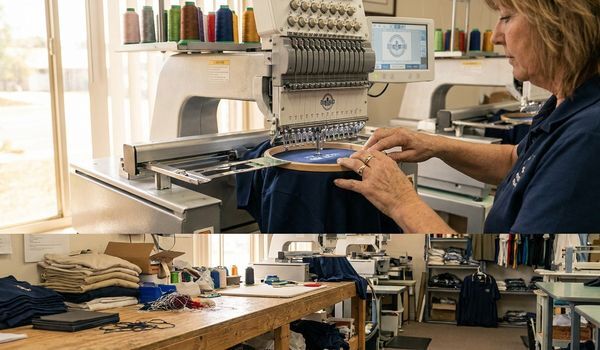
Material and consumable costs, including thread, stabilizer, needles, and blanks, typically run 15 to 25 percent of the job price. Labor is the largest controllable expense, which is why multi-head machines matter so much: a four-head machine produces four times the output of a single-head with roughly the same labor input. That math is the core reason equipment investment is the single most common growth move in this industry.
Ready to Scale Your Embroidery Shop?
From single-head startups to multi-head production floors, fast equipment financing helps you add capacity when demand is there. Apply in minutes, no obligation.
Apply Now →On the cost side, entry into the industry is relatively accessible. A quality single-needle machine package with digitizing software and starter supplies runs $8,000 to $15,000. A commercial multi-needle machine suitable for a growing shop costs $12,000 to $25,000, and a production-grade multi-head machine runs $40,000 to $60,000 or more. Most growing shops reach a point where the limiting factor is not demand but the capital to buy the next machine, which is exactly where equipment financing earns its place.
Employment and Business Demographics
The embroidery and custom sewing workforce is specialized and relatively small. Nationally, tailors, dressmakers, and custom sewers number roughly 15,000 workers earning a median annual wage of $36,000 to $40,000, according to federal labor data from the U.S. Bureau of Labor Statistics tracked through the U.S. Census Bureau business surveys. Textile and cut-and-sew production adds approximately 50,000 production workers across U.S. mill operations.
Within embroidery specifically, the staffing model is lean. A typical commercial shop employs two to ten people: machine operators, a digitizer who converts artwork into stitch files, and often an owner who handles sales and customer relationships. Digitizing skill is the scarcest resource in the industry, and shops with in-house digitizing capability turn orders faster and keep more margin than shops that outsource file preparation.
Business formation data from the Census Bureau shows continued strength in new business applications across retail and custom manufacturing categories, and embroidery benefits from one of the lowest barriers to entry of any production business. A home-based shop can launch for under $15,000, sell nationally through e-commerce from day one, and reach profitability on part-time hours. That accessibility is a double-edged sword: it keeps the industry growing, but it also means new competitors enter every market constantly.
Growth Drivers and Trends Shaping 2026
Several structural forces are pushing embroidery industry growth in 2026, and each one creates specific opportunities for shop owners who position early.
The Personalization Economy
Consumers increasingly expect products made for them, and corporate buyers increasingly expect branded everything. Personalization demand spans monogrammed gifts, custom team merch, limited-run brand drops, and on-demand company stores. According to Forbes reporting on e-commerce and small business trends, customized products consistently command premium pricing and stronger customer loyalty than commodity goods. Embroidery, with its high perceived value and durability, captures a disproportionate share of that demand.
Technology: Faster Machines, Smarter Software
Machine technology keeps compressing production time. Modern multi-needle machines switch thread colors automatically, run at 1,000 to 1,500 stitches per minute, and network directly to order management systems. AI-assisted digitizing software has cut file preparation time dramatically, lowering the skill barrier for producing complex designs. Each of these advances raises output per labor hour, which flows directly to shop profitability.
Corporate Branding and the Return of Uniform Programs
Post-pandemic workforce normalization has revived uniform and branded apparel programs across logistics, healthcare, hospitality, and field services. These are contract-style accounts with recurring quarterly orders, exactly the kind of predictable revenue that supports equipment financing and expansion decisions.
On-Demand E-Commerce Integration
Print-on-demand platforms have normalized the model of selling custom goods with no inventory. Embroidery shops that integrate with Shopify, Etsy, or corporate swag platforms can accept orders automatically and produce them in small batches profitably. This channel rewards shops with fast turnaround and consistent quality over shops with the lowest price.
Pro Tip: More than 66 percent of decorated apparel businesses now offer multiple services beyond embroidery, including screen printing, DTF transfers, and promotional products. Diversification is the single most reliable path past the $500,000 revenue ceiling that stalls most single-service shops.
Nearshoring and Supply Chain Shifts
While Asia-Pacific still holds 40 to 47 percent of global production share, North American shops are winning work that prioritizes speed, communication, and small-batch flexibility over unit cost. Reuters coverage of manufacturing trends has documented the broader nearshoring shift, and custom apparel decoration is one of the clearest beneficiaries because turnaround time matters more than price for most corporate and event orders.
Embroidery vs. Other Decoration Methods
Embroidery competes with screen printing, direct-to-garment printing, and direct-to-film transfers for the same decorated apparel dollars. Each method wins in different situations, and most successful shops eventually offer more than one.
| Factor | Embroidery | Screen Printing | DTG / DTF |
|---|---|---|---|
| Best for | Polos, caps, jackets, uniforms, premium items | T-shirts in volume, simple designs | Full-color art, photos, small runs |
| Durability | Highest, outlasts the garment | High with proper curing | Moderate, fades with washes |
| Perceived value | Premium, professional | Standard | Casual, creative |
| Small-order economics | Strong margins at 1-12 pieces | Poor below 24-48 pieces | Good at small runs |
| Entry equipment cost | $8,000-$25,000 to start | $5,000-$30,000+ | $10,000-$25,000 |
The strategic takeaway: embroidery owns the premium, professional, and corporate end of the market, where margins are healthiest and customers are stickiest. Shops that add screen printing or DTF do so to capture volume work and become a one-stop vendor, not because those methods replace embroidery.
What These Statistics Mean for Shop Owners
Data only matters if it changes decisions. Here is how the 2026 numbers translate into practical moves for embroidery business owners at each stage.
If you are starting out, the low entry cost and the personalization boom favor a focused launch: pick one segment, master it, and reinvest early profits into a second machine head before expanding services. The $20,000 to $50,000 revenue range is where most home-based shops plateau, and breaking past it almost always requires commercial-grade equipment.
If you run an established small shop, the utilization math matters most. Before adding capacity, push billable machine hours toward 60 percent of available time. Once you are there, a multi-head machine is the highest-ROI purchase in the industry because it multiplies output without multiplying labor. The revenue data is clear: shops crossing from $150,000 toward $500,000 do it with capacity, not just hustle.
If you are scaling toward seven figures, diversification and contract accounts are the levers. Corporate uniform programs, school contracts, and promotional product add-ons smooth out seasonality and raise customer lifetime value. At this stage, working capital becomes as important as equipment, because large B2B orders mean buying blanks and materials weeks before invoices get paid.
How Crestmont Capital Helps Embroidery Businesses
Growth in this industry is capital-driven: the shops that expand are the ones that can buy the next machine, stock blanks for a large contract, or add a digitizer before the orders arrive. Crestmont Capital works with embroidery and apparel decoration businesses at every stage, and the financing products map directly to the growth moves the statistics point to.
For equipment purchases, equipment financing lets you put a $25,000 multi-needle machine or a $50,000 multi-head production unit to work immediately while spreading the cost across the revenue it generates. If you are evaluating specific hardware, our guide to commercial embroidery machine financing walks through the numbers by machine class.
For the day-to-day realities of the business, including blank inventory purchases ahead of large corporate orders, seasonal team-wear rushes, and payroll during slow months, unsecured working capital loans and a business line of credit smooth out the cash flow gaps that every shop in the $150,000 to $500,000 range knows well.
If you are earlier in the journey and mapping out what funding your shop might need, start with our complete guide to embroidery business loans, which covers qualification, loan types, and how lenders evaluate apparel decoration businesses.
Fuel Your Next Growth Move
Join thousands of small businesses that trust the #1 rated business lender in the U.S. Fast decisions, flexible terms, real people.
Apply Now →Real-World Scenarios: How Shops Use Financing to Grow
Statistics describe the industry. These composite scenarios, drawn from the patterns lenders and industry surveys see repeatedly, show how individual shops turn those numbers into growth.
Scenario 1: The Home Studio Breaking the Plateau
A solo operator in Ohio runs a single-needle machine from a spare room, selling monogrammed gifts and local team orders through Etsy. Revenue has been stuck at $35,000 for two years because every large order means late nights and turned-down work. A $14,000 multi-needle machine, financed over 48 months at roughly $350 per month, lets her accept the 50-piece corporate orders she previously declined. Within a year, monthly revenue doubles and the machine payment is covered by a single mid-sized order each month.
Scenario 2: The Small Shop Landing a Uniform Contract
A three-person shop in Texas wins a recurring uniform contract with a regional restaurant group: 400 embroidered pieces per quarter. The catch is cash flow. Blanks, thread, and stabilizer for each quarterly run cost $9,000 upfront, and the restaurant pays net-45. A $25,000 working capital facility covers materials and payroll through the payment gap, turning a stressful contract into the shop's most profitable account.
Scenario 3: The Diversification Play
An established embroidery shop in Florida at $400,000 in annual revenue keeps losing bids because customers want one vendor for embroidery, screen printing, and promotional products. Remembering that two-thirds of decorated apparel businesses diversify, the owner finances a $45,000 DTF and screen printing setup. Eighteen months later, average order value is up 60 percent and revenue crosses $650,000, with existing embroidery customers driving most of the new service sales.
Scenario 4: The Multi-Head Capacity Jump
A school-focused shop in the Midwest turns away work every August because two single-head machines cannot keep pace with spirit wear season. A financed four-head machine at $52,000 quadruples output during the eight-week rush. The seasonal surge that used to cap annual revenue at $280,000 now pushes it past $420,000, and the machine runs contract work for local businesses the rest of the year.
Scenario 5: The Digitizing Upgrade
A shop owner in California outsources digitizing at $15 to $40 per design with 24-hour turnaround, which costs rush orders and eats margin on small jobs. Investing in professional digitizing software and training brings file preparation in-house. Rush fees become pure profit, turnaround drops to same-day, and the shop wins several corporate accounts that required four-hour file turnaround.
Scenario 6: The Second Location Decision
A profitable embroidery business in Georgia considers a second location near a logistics hub with several large uniform-wearing employers. Instead of draining operating cash, the owners finance build-out and equipment, keeping the original location's working capital intact. The second shop reaches breakeven in month nine, faster than the first location did, because the playbook and accounts were already proven.
Frequently Asked Questions
How big is the embroidery industry in 2026? +
The global embroidery market is valued between $4.0 billion and $6.6 billion in current estimates, with the most widely cited figure at $6.64 billion from Fortune Business Insights. The U.S. commercial embroidery segment generates approximately $1 billion annually, inside a broader U.S. decorated apparel market exceeding $5 billion to $6 billion.
How fast is the embroidery market growing? +
Current projections put the compound annual growth rate between 5.3 percent and 6.9 percent through 2032 to 2033, with some high-growth segments tracking up to 9.6 percent. The broader decorated apparel market is growing even faster at roughly 13 percent CAGR through 2030.
How many embroidery businesses are there in the United States? +
There are approximately 950 to 1,000 dedicated commercial embroidery service businesses in the U.S., plus tens of thousands of additional shops that offer embroidery alongside screen printing, DTF, and promotional products. Most are small businesses employing two to ten people.
How much revenue does the average embroidery business make? +
Revenue scales with size. Home-based single-machine operations typically generate $20,000 to $50,000 per year. Small commercial shops with multiple heads commonly produce $150,000 to $500,000. In the broader decorated apparel industry, about 30 percent of businesses generate $1 million or less, and 54 percent report sales under $3 million.
What is the typical profit margin for an embroidery business? +
Well-run embroidery shops commonly achieve gross margins of 50 to 70 percent on decorated goods, because thread and consumables run only 15 to 25 percent of job price. Net margins depend on machine utilization and labor efficiency. Shops keeping machines billable 60 to 75 percent of available hours are typically the most profitable.
How much does it cost to start an embroidery business? +
A home-based startup with a quality single-needle machine, digitizing software, and starter supplies runs $8,000 to $15,000. A commercial multi-needle machine for a growing shop costs $12,000 to $25,000, and production-grade multi-head machines run $40,000 to $60,000 or more. Equipment financing is the most common way shops fund these purchases.
What is the embroidery machine market worth? +
The global embroidery machine market is estimated at $5.8 billion to $6.1 billion currently and is projected to reach $7.4 billion to $8.1 billion by 2032 to 2035, growing at 3.25 to 4.7 percent annually. Steady machine sales signal steady end-market demand for embroidered products.
Who are the largest customers for embroidery services? +
Corporate buyers dominate commercial embroidery: uniforms, branded polos, jackets, and workwear. Schools and sports teams form the second major segment with seasonal volume. Consumer personalization through e-commerce is the fastest-growing customer segment, and patches, military, first responder, and club work form a high-margin niche.
Is the embroidery business profitable in 2026? +
Yes, for shops that manage utilization and pricing discipline. The industry growth rate of 5.3 to 6.9 percent, combined with premium per-piece margins and relatively low material costs, supports strong profitability. The most common failure mode is underutilized equipment, not weak demand.
What trends are driving embroidery industry growth? +
Four drivers stand out in 2026: the personalization economy and custom consumer goods, faster computerized machines and AI-assisted digitizing, the revival of corporate uniform and branding programs, and on-demand e-commerce integration that lets shops accept small-batch orders automatically.
How does embroidery compare to screen printing? +
Embroidery wins on durability, perceived value, and small-order economics, making it the default for polos, caps, jackets, and corporate wear. Screen printing wins on cost for large t-shirt runs with simple designs. Most successful decorated apparel businesses eventually offer both, since more than 66 percent of shops now diversify services.
What percentage of apparel decoration businesses offer embroidery? +
Embroidery is the highest-value segment of the decorated apparel market, and more than 66 percent of decorated apparel businesses offer multiple services, typically combining embroidery with screen printing, DTF transfers, or promotional products. Pure single-method shops are increasingly the minority.
How many employees does the average embroidery shop have? +
Most commercial embroidery shops are lean operations with two to ten employees, typically a mix of machine operators, a digitizer, and an owner handling sales. Nationally, the specialized workforce of tailors, dressmakers, and custom sewers numbers roughly 15,000, with a median annual wage of $36,000 to $40,000.
What is the outlook for the embroidery industry through 2030? +
The outlook is consistently positive across research firms: the global market is projected to reach $7.4 billion to $10.6 billion between 2032 and 2035, the decorated apparel market is tracking toward $68.17 billion by 2030, and North American shops are gaining nearshoring-driven demand for fast-turnaround custom work.
How can an embroidery business finance new equipment? +
Equipment financing lets a shop acquire a commercial machine with a small down payment and fixed monthly payments matched to the revenue the machine produces. Working capital loans and business lines of credit cover inventory and cash flow gaps. Lenders like Crestmont Capital specialize in exactly these purchases for apparel decoration businesses, with fast applications and decisions.
Put the 2026 Numbers to Work
The data says this industry is growing. Make sure your shop has the equipment and working capital to capture it. Apply in minutes.
Apply Now →How to Get Started
Complete our quick application at offers.crestmontcapital.com/apply-now. It takes just a few minutes.
A Crestmont Capital advisor will review your needs and match you with the right financing option for your shop.
Receive your funds and put them to work, often within days of approval.
The Bottom Line for 2026
The embroidery business statistics for 2026 describe an industry that is mature but far from stagnant: a global market worth up to $6.6 billion and growing at 5.3 to 6.9 percent annually, a U.S. commercial segment generating roughly $1 billion per year, and a decorated apparel category racing toward $68 billion by 2030. Demand is being pulled by personalization, corporate branding, and e-commerce, while technology keeps lowering the cost of production.
For shop owners, the message in the data is consistent. Capacity drives revenue, diversification drives resilience, and access to capital determines who can act on either one. Whether your next move is a first commercial machine, a multi-head upgrade, or a working capital cushion for contract accounts, Crestmont Capital can help you fund it. Apply today and put the growth of this industry to work for your business.
Disclaimer: The information provided in this article is for general educational purposes only and is not financial, legal, or tax advice. Funding terms, qualifications, and product availability may vary and are subject to change without notice. Crestmont Capital does not guarantee approval, rates, or specific outcomes. For personalized information about your business funding options, contact our team directly.

About the author and reviewer
Allan GarfinkleMBA (Finance), JD
Chief Revenue Officer, Crestmont Capital
Allan Garfinkle is the Chief Revenue Officer at Crestmont Capital, where he has spent more than a decade leading revenue strategy, business development, and operational growth. With 28 years of experience building and advising startups and small businesses, Allan has helped more than 10,000 business owners navigate financing decisions, growth opportunities, and changing economic conditions. He earned a Bachelor of Science in Economics and an MBA with a concentration in Finance from Northeastern University, as well as a Juris Doctor from New England Law, where his studies focused on contracts and business law. His writing draws on extensive practical experience in small-business lending, equipment financing, business credit, and commercial finance.