
The latest pallet supplier statistics confirm what warehouse managers already feel on the dock every morning: pallets are the quiet backbone of the American supply chain, and the industry that builds, sells, pools, and repairs them is in the middle of a steady, structurally supported growth cycle. Nearly every physical good sold in the United States spends time on a pallet at some point in its journey, which makes the pallet market a reliable proxy for manufacturing output, warehouse activity, and retail demand all at once. For any business that ships, stores, or receives freight, understanding the numbers behind this industry is genuinely useful intelligence.
This report gathers the most important pallet industry statistics for 2026 in one place, from market size and growth forecasts to material share, pricing trends, pooling and recycling data, and the competitive landscape among pallet suppliers. Every figure is drawn from published industry research, trade association data, and government sources, organized so business owners, warehouse operators, and procurement teams can actually use it to plan purchases, time orders, and negotiate from a position of knowledge.
In This Article
- The Pallet Supply Industry at a Glance
- U.S. and Global Pallet Market Size and Growth
- Pallet Statistics by Material Type
- Pallet Demand by End-Use Industry
- Pallet Pricing and Cost Trends in 2026
- Pallet Pooling, Recycling and the Circular Economy
- The Pallet Supplier Landscape
- Regional Breakdown of U.S. Pallet Supply
- What These Pallet Supplier Statistics Mean for Your Business
- Financing Pallet and Material Handling Purchases in 2026
- Real-World Scenarios: Putting Pallet Industry Data to Work
- Frequently Asked Questions
- Next Steps for Business Owners
The Pallet Supply Industry at a Glance
The pallet supply industry covers every business that manufactures new pallets, reconditions and resells used ones, operates rental and pooling networks, or brokers loads between buyers and sellers. It is a sprawling, mostly regional industry that sits underneath virtually every other sector of the physical economy, and its scale surprises most people the first time they see the numbers.
The headline figures for 2026:
- An estimated 1.9 billion to 2.2 billion pallets are in circulation across the United States at any given time, roughly six pallets for every person in the country.
- U.S. manufacturers produce approximately 400 million to 500 million new pallets per year, with hundreds of millions more repaired and returned to service by recyclers.
- The U.S. pallet market is valued between roughly $20 billion and $27 billion, depending on whether research firms count only new pallet sales or include pooling, repair, and management services.
- Wood remains the dominant material by a wide margin, accounting for an estimated 90% to 95% of all pallets in the U.S. market.
- Industry estimates consistently find that more than 80% of U.S. commerce moves on a pallet at some point, and some analyses put the share of consumer goods above 90%.
- The industry is highly fragmented, with roughly 2,500 to 3,500 pallet companies operating in the United States, most of them small regional operators.
Behind those topline numbers sits an industry being reshaped by three durable forces: the continued buildout of e-commerce fulfillment and warehouse capacity, a manufacturing reshoring trend that is raising domestic freight volumes, and a corporate sustainability push that is accelerating pallet pooling and recycling. Each of those forces shows up clearly in the statistics below.
U.S. and Global Pallet Market Size and Growth
Ask five research firms how big the pallet market is and you will get five different answers, mostly because each defines the category differently. Some count only new pallet sales. Others fold in recycled pallets, pooling revenue, and total pallet management programs. The useful takeaway is not any single number but the consistent band they all land in and the steady growth they all project.
Published estimates for the global pallet market in 2025 generally cluster between $65 billion and $82 billion, with wood pallets representing the large majority of that value. Forecasts for the early to mid-2030s range from roughly $100 billion to $125 billion, implying compound annual growth rates between about 4.5% and 5.6%. That is a notably steady growth profile for a mature industrial category, and it reflects the fact that pallet demand tracks the physical economy rather than any single trend.
In the United States, the pallet market is generally estimated at $20 billion to $27 billion annually when new sales, recycled pallet transactions, and pooling services are combined. New wooden pallet and container manufacturing alone runs into the billions of dollars each year, and U.S. government data on wood container and pallet manufacturing shipments can be tracked through the Census Bureau's Annual Survey of Manufactures, which tallies the sector under its own industry code. Broader manufacturing shipment trends, which correlate closely with pallet demand, are published monthly in the Census M3 survey of manufacturers' shipments, inventories, and orders.
Several structural drivers support that growth outlook through the rest of the decade:
- E-commerce fulfillment. U.S. e-commerce sales have grown to well over $1 trillion annually and now represent roughly 15% to 16% of total retail sales, and every one of those fulfillment networks runs on pallets. More fulfillment centers, more sortation hubs, and more regional delivery stations all translate directly into pallet demand.
- Warehouse construction. The U.S. has added hundreds of millions of square feet of warehouse and distribution space over the past five years. Every new distribution center needs a stocked float of pallets before the first inbound truck arrives.
- Manufacturing reshoring. Announced investments in domestic semiconductor plants, battery factories, food processing, and building materials production raise the volume of goods that enter the U.S. freight system at home rather than at a port, which increases domestic pallet turns.
- Food and beverage distribution. Grocery and food service distribution is the single largest consumer of pallets in the country and grows reliably with population and consumer spending.
Growing your shipping or warehouse operation in 2026?
Crestmont Capital finances forklifts, racking, and material handling equipment from $10,000 to $5 million, with approvals in as fast as 24 hours.
Get a Fast QuotePallet Statistics by Material Type
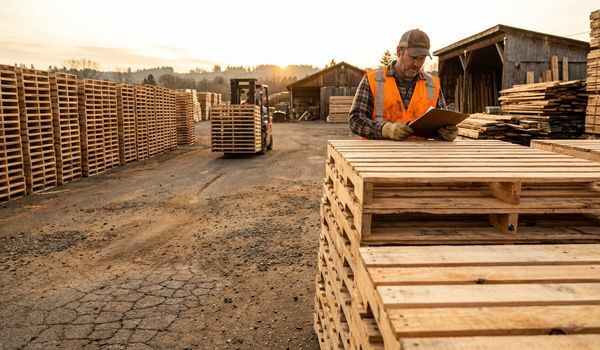
Wood's dominance of the pallet market is one of the most durable statistics in the entire supply chain industry. Despite decades of predictions that plastic or other materials would displace it, wood still accounts for an estimated 90% to 95% of the U.S. pallet market by unit volume. The reasons are practical: wood is strong, cheap, widely available, easy to repair, and carries natural surface friction that keeps cartons from sliding during transit.
The material breakdown for 2026 looks like this:
- Wood: roughly 90% to 95% of the market. Southern yellow pine and mixed hardwoods are the most common species. Pallets and containers consume an estimated 40% to 45% of all U.S. hardwood lumber production, which makes the pallet industry one of the largest single buyers of domestic hardwood.
- Plastic: roughly 4% to 6% of the market, growing faster than wood. Plastic pallets are common in pharmaceutical, food processing, and closed-loop automotive applications where hygiene, wash-down capability, and dimensional consistency matter. They typically cost $60 to $150 or more each, which limits them to high-turn, controlled-loop environments. Growth estimates for the plastic pallet segment run in the 6% to 8% annual range.
- Metal: under 1%, niche only. Aluminum and steel pallets serve specialty applications like aerospace, defense, and cleanrooms where fire resistance or extreme durability justifies a price that can exceed several hundred dollars per unit.
- Corrugated and presswood: small but growing niche. Lightweight paper-based and molded wood pallets appeal for one-way export shipments and air freight, where tare weight directly reduces freight cost.
Within the wood category, the 48-by-40-inch GMA pallet remains the overwhelming standard footprint in North America. Originally standardized by the Grocery Manufacturers Association, the 48x40 accounts for an estimated 30% to 35% of all pallets produced and an even higher share of the pooled and recycled fleet. Warehouse racking, trailer loading patterns, and automation systems across the country are engineered around that footprint, which is one reason it has resisted displacement for more than half a century.
Pallet construction splits into two main designs. Stringer pallets, built on parallel boards, dominate U.S. production because they are fast and cheap to build. Block pallets, built on solid blocks that allow true four-way forklift entry, hold a growing share because they perform far better in automated warehouses and heavy-duty pooling networks.
Pallet Demand by End-Use Industry
Pallet demand mirrors the structure of the physical economy. The industries that ship the most freight buy the most pallets, and their ordering patterns drive the seasonal rhythm of the entire pallet supply industry.
- Food and beverage: an estimated 30% to 40% of total pallet demand. Grocery distribution is the single largest end-use sector, and it consumes pallets in enormous volume through both white-wood purchases and the major rental pools. Food plants also drive demand for heat-treated and food-grade pallets.
- Retail and e-commerce: roughly 15% to 20%. Big-box retailers, club stores, and online fulfillment networks move goods almost exclusively on standardized pallets, and many now mandate specific pooled pallets for inbound shipments to their distribution centers.
- Manufacturing and industrial: roughly 15% to 20%. Chemicals, automotive parts, paper products, and building materials manufacturers are heavy pallet buyers, often requiring custom sizes and heavier-duty construction for dense loads.
- Pharmaceutical and healthcare: a smaller but fast-growing share. Drug makers and medical distributors favor plastic pallets and hygienic programs, and they represent one of the fastest-growing buyer segments.
- Agriculture and produce: highly seasonal. Harvest seasons create sharp regional demand spikes that pallet suppliers plan around months in advance.
Buying signal: When grocery, e-commerce, and manufacturing pallet orders all rise at the same time, pallet lead times stretch and recycled inventory tightens fast. Industry order data through 2025 showed exactly that pattern, with new pallet lead times in some regions running several weeks longer than their historical norm. Buyers who lock in supply agreements before peak season consistently pay less than buyers who shop spot.
Pallet Pricing and Cost Trends in 2026
Pallet pricing is one of the most transparent cost curves in the supply chain because it tracks a commodity input: lumber. When lumber prices spike, new wood pallet prices follow within weeks. When lumber normalizes, pallet prices drift back down, though rarely all the way, because labor, nails, fuel, and freight costs tend to ratchet upward over time.
Current 2026 price ranges by pallet type:
- New 48x40 wood pallets: roughly $15 to $27 each, depending on region, lumber species, grade, and order volume. Truckload-quantity buyers in softwood-rich regions pay the low end; small-quantity buyers in hardwood or high-cost regions pay the high end.
- Recycled and reconditioned pallets: roughly $5 to $12 each for standard grades. Grade A recycled pallets, which look and perform nearly new, command the top of that range and still cost 40% to 60% less than new.
- Plastic pallets: roughly $60 to $150 each for common nestable and rackable designs, with specialty hygienic and heavy-duty models running higher.
- Pooled rental pallets: a per-trip or per-day fee rather than a purchase price, typically structured so the renter pays only for actual use plus any lost or damaged units.
The past five years taught buyers a hard lesson about timing. During the 2021 lumber spike, new pallet prices in some regions briefly exceeded $70 per unit, and recycled pallets that normally sold for $6 or $7 were trading above $20. Prices have long since normalized, but the episode permanently changed buying behavior: far more shippers now hold supply agreements, maintain larger safety stocks of recycled pallets, or moved their inbound freight into rental pools to take pallet price volatility off their books entirely.
Pallet Pooling, Recycling and the Circular Economy
The pallet industry operates one of the oldest and most successful circular economy systems in American business, and the 2026 data shows it accelerating. Two parallel systems handle the end of a pallet's first trip: recycling, where used pallets are collected, repaired, and resold, and pooling, where a rental company owns the pallet fleet and cycles it continuously through the supply chain.
The recycling numbers are genuinely impressive:
- An estimated 95% of wood pallets in the United States are recovered at end of life rather than landfilled, making wood pallets one of the most-recycled products in the country, with a recovery rate that exceeds paper, aluminum cans, and corrugated boxes in most comparisons.
- Roughly 400 million or more used pallets flow through the repair-and-return system each year, with damaged units repaired by replacing deck boards and stringers, and unrepairable units ground into landscape mulch, animal bedding, or biomass fuel.
- Recycled pallets now represent an estimated 45% to 50% of all pallets in circulation, a share that has climbed steadily as buyers learned to trust reconditioned quality and as sustainability goals pushed procurement teams toward reused materials.
On the pooling side, the market is anchored by a small number of large operators. CHEP, owned by Brambles, is the largest pallet pooling company in the world, with Brambles reporting annual revenue in the $6 billion to $7 billion range and a pooled fleet numbering in the hundreds of millions of units globally. PECO Pallet is the second major U.S. wood pallet pooler, while iGPS operates the leading plastic pallet pool. Industry forecasts put pooling market growth at roughly 6% to 7% annually, faster than the pallet market overall, as more shippers trade ownership headaches for a per-trip service fee.
Pooling's growth is driven by two forces. First, the major retail chains increasingly mandate specific pooled pallets for inbound freight because consistent pallet quality keeps their automated distribution centers running without jams. Second, pooling converts a capital asset into an operating expense, which simplifies accounting and eliminates the reverse-logistics burden of collecting, sorting, and repairing a privately owned float.
Export shippers face one additional regulatory layer worth knowing. Under the international ISPM-15 standard, all solid wood packaging crossing most international borders must be heat-treated to a core temperature of 56 degrees Celsius for at least 30 minutes and stamped with the IPPC certification mark. Heat-treated pallets carry a modest price premium, and suppliers with certified heat-treatment capacity hold a meaningful competitive advantage in port-adjacent markets.
The Pallet Supplier Landscape
The pallet supplier landscape is a study in fragmentation at the bottom and consolidation at the top. The vast majority of the roughly 2,500 to 3,500 U.S. pallet companies are small, privately held regional operations serving customers within a few hundred miles of their plants, because pallets are bulky and expensive to ship relative to their value. A typical regional supplier runs a sawmill or assembly operation, a repair line for recovered pallets, and a small delivery fleet.
At the top of the market, consolidation has been the defining story of the past decade. National players like 48forty Solutions, Kamps Pallets, Millwood, and Pallet Logistics of America have grown through dozens of acquisitions of regional operators, building multi-state networks that can serve national accounts with consistent quality standards. Private equity capital has flowed into the sector precisely because the business model is simple, essential, and cash-generative. Meanwhile, CHEP and PECO dominate the rental pooling tier, and a growing tier of pallet brokers connects buyers and sellers without owning any plants at all.
For buyers, the practical implications of this structure matter more than the names:
- Local suppliers win on price and responsiveness for standard white-wood pallets, because freight economics keep the market regional.
- National suppliers win on consistency and scale for multi-location shippers who need one vendor, one quality spec, and consolidated invoicing.
- Recyclers win on total cost for any shipper whose loads can run on reconditioned pallets, which describes the majority of general freight.
- Poolers win on hassle for closed-loop distribution and retail-mandated shipping programs.
Pallet Supplier Industry
By the Numbers: 2026
$20-27B
Estimated U.S. pallet market size, 2025 to 2026
~2 Billion
Pallets in circulation across the U.S. supply chain
90-95%
Share of U.S. pallets still made from wood
~95%
Wood pallet recovery rate, among the highest of any product
400M+
New pallets produced in the U.S. each year
4.5-5.5%
Projected global market growth rate through the early 2030s
Regional Breakdown of U.S. Pallet Supply
Pallet markets are intensely regional because shipping a $12 recycled pallet 800 miles makes no economic sense. Supply, species mix, and pricing all vary by geography, and understanding the regional structure helps buyers source smarter.
- Southeast. The softwood belt spanning Georgia, Alabama, the Carolinas, and Tennessee is the largest new pallet production region in the country, built on abundant southern yellow pine and a dense manufacturing and logistics economy. New pallet prices here typically run at the national floor.
- Midwest. Indiana, Ohio, Illinois, and Michigan form the hardwood pallet heartland, serving the country's manufacturing core with heavy-duty hardwood pallets suited to dense industrial loads. The region also hosts some of the largest pallet recyclers in the country.
- Northeast. Dense consumption centers and limited timber supply make the Northeast a recycling-heavy market, where reconditioned pallets represent an above-average share of sales and prices run modestly above the national average.
- West. California's massive produce industry creates huge seasonal demand swings, while the Los Angeles and Long Beach port complex drives demand for export-compliant heat-treated pallets. Western prices tend to run at the national high end due to timber freight distances and labor costs.
- Texas and the South Central region. Cross-border trade with Mexico, booming warehouse construction in the Dallas and Houston corridors, and a fast-growing manufacturing base have made Texas one of the fastest-growing pallet markets in the country.
What These Pallet Supplier Statistics Mean for Your Business
Industry statistics only matter if they change decisions. Here is what the 2026 pallet data actually tells a business owner or operations manager:
First, pallets are a real line item worth managing. A mid-size distributor shipping 500 palletized orders a week spends six figures annually on pallets, and the difference between buying new, buying recycled, and pooling can swing that number by 40% or more. Businesses that treat pallets as an unmanaged commodity consistently overpay.
Second, the recycled market is the value play for most shippers. With roughly half the pallets in circulation now carrying a second or third life, reconditioned pallets have become a mainstream, quality-reliable option rather than a compromise. Unless your customer mandates new or pooled pallets, recycled Grade A pallets deliver the same freight performance at roughly half the cost.
Third, automation is quietly raising the quality bar. If your facility runs conveyorized sortation or automated storage, pallet quality stops being a purchasing detail and becomes an uptime issue. A single broken deck board can jam a conveyor line for an hour. Spec-grade new pallets or pooled pallets are the insurance policy.
Fourth, lumber cycles still matter. Pallet prices follow lumber with a short lag. Buyers who watch lumber markets and time bulk purchases or contract renewals to soft lumber pricing lock in measurably better pallet costs than buyers who simply reorder on autopilot.
Ready to put this data to work?
Whether you are buying forklifts, stocking a new warehouse, or expanding a pallet operation, Crestmont Capital funds it fast with flexible terms.
Apply in MinutesFinancing Pallet and Material Handling Purchases in 2026
Pallets themselves are rarely financed as standalone assets, but the operations around them absolutely are. New warehouse racking systems, forklifts and pallet jacks, automated palletizers, sawmill and nailing-line equipment for pallet manufacturers, and bulk inventory purchases ahead of seasonal peaks are all classic use cases for business financing. That is where Crestmont Capital, the top-rated business lender in the U.S., comes in.
Crestmont Capital's equipment financing programs fund forklifts, reach trucks, conveyor systems, stretch wrappers, and palletizing automation with approvals in as fast as 24 hours and terms structured around the equipment's working life. For pallet manufacturers and recyclers, that same financing covers nailing machines, dismantling lines, and sortation equipment, the exact machinery that turns recovered pallets into margin. Businesses running forklift fleets can also look at dedicated forklift financing and leasing options built for material handling operations.
For pallet buyers rather than pallet builders, unsecured working capital loans solve the timing problem that shows up in the pricing data above: lumber dips create buying windows that last weeks, not quarters, and having capital in place lets a distributor buy a quarter's worth of pallets when prices are soft instead of paying spot rates at the peak. Related reading on this blog includes our guide to pallet rack financing for warehouse buildouts, our breakdown of pallet manufacturing business loans for operators on the supply side, and our lumber yard statistics report for the upstream commodity picture that drives pallet pricing. For a broader view of funding options, the SBA's market research guide is a useful framework for sizing your own segment of this market before you borrow.
Financing angle: A forklift or automated palletizer that cuts double-handling typically pays for itself in one to two years through labor savings alone. Because the payback window is so short, material handling equipment is one of the easiest categories to justify on a cash-flow basis, and lenders treat it as strong collateral, which keeps rates competitive.
Real-World Scenarios: Putting Pallet Industry Data to Work
Scenario 1: A regional food distributor cuts pallet spend in half. A grocery distributor in the Midwest buying 200,000 new pallets a year at $19 each runs a $3.8 million pallet budget. After auditing its lanes, it moves 70% of volume to Grade A recycled pallets at $8 and keeps new pallets only for its export and retail-mandated accounts. Annual pallet spend drops by more than $1.5 million with zero operational change.
Scenario 2: An e-commerce 3PL specs up for automation. A fulfillment operator installing a new automated storage system discovers its mixed-quality recycled pallets jam the conveyor sensors. It shifts inbound requirements to spec-grade block pallets, negotiates a supply agreement with a national supplier, and finances the new racking and conveyor equipment through an equipment financing facility rather than draining cash.
Scenario 3: A pallet recycler funds a second repair line. A family-owned pallet recycler in the Southeast sees regional demand for reconditioned pallets climbing with the warehousing boom. It finances a used dismantling and repair line, doubles daily repair throughput from 4,000 to 8,000 pallets, and wins a contract with a national account that required guaranteed volume.
Scenario 4: A manufacturer solves an export problem. A building materials manufacturer landing its first overseas orders learns its standard pallets need ISPM-15 heat treatment. Rather than build a heat-treatment chamber, it contracts with a certified local supplier for heat-treated pallets at a $3 per-unit premium and keeps the export lane compliant from day one.
Scenario 5: A seasonal shipper buys ahead of the lumber cycle. An agricultural shipper that uses 80,000 pallets each harvest season watches lumber futures soften in the spring. Using a working capital facility, it buys its full seasonal float in May at $14 per pallet instead of paying $19 spot prices during the August rush, saving roughly $400,000 on a single buying decision.
Frequently Asked Questions
How big is the U.S. pallet market in 2026? +
Estimates for the U.S. pallet market range from roughly $20 billion to $27 billion annually, depending on whether the definition includes only new pallet sales or also counts recycled pallets, pooling, and repair services. Globally, the pallet market is valued between approximately $65 billion and $82 billion, with forecasts reaching $100 billion to $125 billion by the early to mid-2030s.
How many pallets are in circulation in the United States? +
Industry estimates put the U.S. pallet float between 1.9 billion and 2.2 billion units at any given time, roughly six pallets for every person in the country. U.S. manufacturers produce approximately 400 million to 500 million new pallets per year, while hundreds of millions more are repaired and returned to service by recyclers.
What percentage of pallets are made of wood? +
Wood accounts for an estimated 90% to 95% of all pallets in the U.S. market. Plastic holds roughly 4% to 6% and is growing faster than wood, while metal and corrugated paper designs serve small niche segments. Wood dominates because it is strong, inexpensive, widely available, and easy to repair.
What is the most common pallet size in the U.S.? +
The 48-by-40-inch pallet, standardized decades ago by the Grocery Manufacturers Association, is the dominant North American footprint. It accounts for an estimated 30% to 35% of all pallets produced and an even larger share of the pooled and recycled fleet, and most warehouse racking, trailers, and automation systems are engineered around it.
How much does a new wood pallet cost in 2026? +
New 48x40 wood pallets typically run $15 to $27 each depending on region, lumber species, grade, and order volume, with truckload buyers in softwood regions paying the least. Recycled Grade A pallets cost roughly $5 to $12 each, and plastic pallets range from about $60 to $150. Pallet prices track lumber markets with a short lag.
How much can a business save by buying recycled pallets? +
Most shippers save 40% to 60% per unit by switching from new to Grade A recycled pallets, with no meaningful performance difference for standard freight. Recycled pallets now represent an estimated 45% to 50% of all pallets in circulation, reflecting how mainstream the option has become for general shipping applications.
What is pallet pooling and how does it work? +
Pallet pooling is a rental model where a pooling company owns the pallet fleet and charges a per-trip or per-day fee. The shipper loads the pooled pallets, delivers them downstream, and the pooling company collects, inspects, repairs, and recirculates the empties. Pooling eliminates pallet ownership, guarantees consistent quality, and is increasingly mandated by major retail chains for inbound freight.
Who are the largest pallet suppliers in the U.S.? +
The industry splits into tiers. CHEP, owned by Brambles, is the largest pooling operator globally, with PECO Pallet the other major U.S. wood pallet pooler and iGPS leading plastic pooling. In manufacturing and recycling, national players like 48forty Solutions, Kamps Pallets, Millwood, and Pallet Logistics of America operate alongside roughly 2,500 to 3,500 mostly small, regional pallet companies.
How fast is the pallet industry growing? +
Published forecasts put global pallet market growth between roughly 4.5% and 5.6% per year through the early 2030s, with pallet pooling growing faster at around 6% to 7% annually. Growth is driven by e-commerce fulfillment expansion, warehouse construction, manufacturing reshoring, and steady food and beverage distribution demand.
What is ISPM-15 and when does it apply? +
ISPM-15 is the international phytosanitary standard requiring solid wood packaging, including pallets, to be heat-treated to a core temperature of 56 degrees Celsius for at least 30 minutes before crossing most international borders. Compliant pallets carry the IPPC stamp. It applies to export shipments, and certified heat-treated pallets carry a modest price premium.
Are plastic pallets replacing wood pallets? +
No. Plastic pallets are growing faster than wood, at roughly 6% to 8% annually, but they still represent only about 4% to 6% of the market. At $60 to $150 per unit, plastic makes economic sense mainly in closed-loop, high-turn environments like pharmaceutical distribution, food processing, and automotive parts shipping, where hygiene and dimensional consistency justify the cost.
How are pallets recycled? +
Pallet recyclers collect used pallets from warehouses, retailers, and manufacturers, sort them by size and condition, and repair damaged units by replacing broken deck boards and stringers. Repaired pallets are resold as reconditioned units, while unrepairable pallets are ground into landscape mulch, animal bedding, or biomass fuel. An estimated 95% of wood pallets avoid landfills entirely.
What share of U.S. lumber goes into pallets? +
Pallets and containers consume an estimated 40% to 45% of all U.S. hardwood lumber production, along with substantial softwood volumes, making the pallet industry one of the largest single buyers of domestic lumber. That purchasing scale is why pallet prices track lumber commodity markets so closely.
How do lumber prices affect pallet prices? +
Lumber is the dominant input cost in a wood pallet, so pallet prices follow lumber markets with a lag of only a few weeks. During the 2021 lumber spike, new pallet prices briefly exceeded $70 per unit in some regions. Buyers who watch lumber trends and time bulk purchases or contract renewals to soft lumber markets consistently secure better pallet pricing.
Can a business finance pallets and material handling equipment? +
Yes. Equipment financing covers forklifts, pallet jacks, racking, conveyor systems, palletizing automation, and pallet manufacturing machinery, often with approvals in as fast as 24 hours. Working capital loans cover bulk pallet purchases timed to favorable lumber markets. Financing preserves cash while letting the equipment or inventory pay for itself through operational savings.
Your supply chain runs on pallets. Your growth runs on capital.
Join thousands of U.S. businesses that fund equipment and inventory through Crestmont Capital. Fast approvals, flexible terms.
See Your OptionsNext Steps for Business Owners
Audit your current pallet spend. Pull your last 12 months of pallet invoices and calculate your true cost per shipped pallet, including repair, disposal, and any rental fees. You cannot benchmark against industry data until you know your own numbers.
Compare new, recycled, and pooled options per lane. Not every shipment needs the same pallet. Map which lanes allow reconditioned pallets, which require new or heat-treated units, and which major customers mandate pooled pallets, then price each segment separately.
Lock in supply before your peak season. Pallet lead times stretch when grocery, e-commerce, and manufacturing demand peaks simultaneously. A supply agreement negotiated ahead of your busy season protects both price and availability.
Line up financing before you need it. Whether the next move is a forklift fleet, a racking buildout, or a bulk pallet buy timed to the lumber market, pre-arranged capital turns a good buying window into actual savings instead of a missed opportunity.
The Bottom Line on Pallet Supplier Statistics in 2026
The pallet supplier statistics for 2026 describe an industry that is large, steady, and quietly essential: a $20 billion-plus U.S. market, roughly two billion pallets in circulation, wood still holding a 90%-plus share, and a recycling system that keeps 95% of wood pallets out of landfills. Growth in the 4.5% to 5.5% range is not flashy, but it is anchored to the most durable trends in the economy, from e-commerce fulfillment to manufacturing reshoring to the corporate circular economy push.
For business owners, the practical takeaways are simple. Pallets are a manageable cost line that rewards attention, recycled pallets are a proven 40% to 60% savings lever for most freight, automation is raising the quality bar for pallet specs, and lumber cycles create real buying windows for those with the capital to act. Use the data, plan the purchase, and line up funding before the pallet you need becomes the pallet you are waiting on.
Disclaimer: The information provided in this article is for general educational purposes only and is not financial, legal, or tax advice. Funding terms, qualifications, and product availability may vary and are subject to change without notice. Crestmont Capital does not guarantee approval, rates, or specific outcomes. For personalized information about your business funding options, contact our team directly.

About the author and reviewer
Allan GarfinkleMBA (Finance), JD
Chief Revenue Officer, Crestmont Capital
Allan Garfinkle is the Chief Revenue Officer at Crestmont Capital, where he has spent more than a decade leading revenue strategy, business development, and operational growth. With 28 years of experience building and advising startups and small businesses, Allan has helped more than 10,000 business owners navigate financing decisions, growth opportunities, and changing economic conditions. He earned a Bachelor of Science in Economics and an MBA with a concentration in Finance from Northeastern University, as well as a Juris Doctor from New England Law, where his studies focused on contracts and business law. His writing draws on extensive practical experience in small-business lending, equipment financing, business credit, and commercial finance.