
A delivery truck backs into a gate. A storm knocks down forty feet of chain-link along your yard. A break-in exposes a gap in your perimeter that your insurance carrier flags the very next week. Whatever the cause, a damaged commercial fence or compromised perimeter security system rarely waits for a convenient time in your budget cycle, and leaving the gap open even a few extra days can mean lost inventory, a liability claim, or a lapsed insurance requirement.
This guide covers what counts as a commercial fencing or perimeter security repair, why these costs tend to show up without warning, and how a business loan or line of credit can get the work done fast without forcing you to drain cash reserves or delay payroll. We will also walk through financing options, a step-by-step application process, real-world scenarios, and answers to the questions business owners ask most often when a fence or perimeter security issue lands on their desk.
In This Article
- What Counts as a Commercial Fencing or Perimeter Security Repair?
- Why These Repairs Hit Businesses Without Warning
- Key Benefits of Financing the Repair
- How Financing a Fence or Perimeter Repair Works
- Types of Financing to Cover the Cost
- Who This Financing Is Best For
- Comparing Your Funding Sources
- How Crestmont Capital Helps
- Step-by-Step Application Process
- Real-World Scenarios
- FAQ
- Next Steps
What Counts as a Commercial Fencing or Perimeter Security Repair?
Commercial fencing and perimeter security cover a wide range of physical barriers and access-control systems that protect a business property from unauthorized entry, theft, and liability exposure. When any part of that system fails or is damaged, the resulting repair or replacement is what we mean by a commercial fencing or perimeter security repair.
These repairs commonly include:
- Chain-link, welded wire, or ornamental steel fencing damaged by vehicles, storms, or vandalism
- Security fencing topped with barbed wire or anti-climb features around a yard, lot, or distribution center
- Automated or manual security gates, including motors, tracks, and access-control hardware
- Bollards, crash barriers, and vehicle gates protecting loading docks or storefronts
- Privacy or screening fencing required by local zoning or lease agreements
- Perimeter lighting and camera mounts that are physically attached to fence lines
In many cases, the fence itself is only part of the exposure. A gap in perimeter security can also mean a lapsed alarm zone, an exposed camera blind spot, or an access point that no longer locks correctly, all of which need to be addressed together rather than one piece at a time.
Why These Repairs Hit Businesses Without Warning
Most business owners do not budget a line item for fence repair the way they budget for rent or payroll. That is exactly what makes these costs so disruptive when they show up.
- Damage is rarely predictable. A storm, a vehicle collision, or an attempted break-in can take out a section of fencing in minutes, with no advance warning.
- Insurance carriers move fast on compliance. If a claims adjuster or underwriter flags a damaged perimeter as a policy condition, you may be given a short window to fix it or risk a coverage gap.
- One gap invites more damage. An open section of fence line is an open invitation for additional theft, dumping, or trespassing, which means delays tend to compound the total cost.
- Material and labor costs have climbed. Steel, chain-link, and skilled installation labor have all seen price increases in recent years, so a repair that once cost a few thousand dollars can now run significantly higher.
- Cash is usually tied up elsewhere. Payroll, inventory, and accounts payable rarely leave enough idle cash sitting around to absorb a five-figure perimeter repair without disrupting operations.
The result is the same timing mismatch that shows up with most emergency property repairs: the need is immediate, but the cash is not readily available. That is exactly the gap that short-term business financing is built to close.
Key Stat: Property crime cost U.S. businesses an estimated $16.6 billion in 2024, and inadequate perimeter security is one of the most commonly cited factors in insurance claims involving theft, vandalism, or unauthorized access at commercial sites.
Don't Let a Broken Fence Become a Liability
Get fast, flexible working capital to repair or replace your commercial fencing before it becomes a bigger problem. No obligation to apply.
Apply Now →Key Benefits of Financing the Repair
Rather than pulling from cash reserves or delaying the repair until the next budget cycle, financing a fencing or perimeter security repair offers several concrete advantages for a business owner.
- Speed. Alternative lenders can often approve and fund a loan or line of credit within one to three business days, far faster than waiting on a traditional bank or an insurance claim.
- Preserved liquidity. Financing keeps your operating cash available for payroll, inventory, and day-to-day expenses instead of tying it up in a single capital repair.
- Flexible repayment. Depending on the product, you can structure repayment as fixed monthly installments or a revolving line you draw against as costs come in.
- Reduced liability exposure. Closing a perimeter security gap quickly reduces the window in which your business is exposed to theft, trespassing, or an injury claim.
- Insurance compliance. Fast financing can help you meet a carrier-imposed repair deadline and avoid a policy lapse or non-renewal.
How Financing a Fence or Perimeter Repair Works
Financing a fencing or perimeter security repair follows much the same process as financing any other unplanned property expense. The goal is to get cash in hand quickly, size it accurately to the scope of work, and repay it on terms that fit your cash flow.
- Step 1: Get a contractor estimate. Have a fencing or security contractor assess the damage and provide a written estimate covering materials, labor, and any required permits.
- Step 2: Confirm any insurance or compliance deadlines. Check with your insurance broker and, if applicable, your landlord or local code enforcement, to identify any firm deadlines that should shape your financing timeline.
- Step 3: Choose a financing product that matches the scope. A single, known repair cost is often best matched to a working capital loan, while a phased project or an amount that could grow is often better suited to a business line of credit.
- Step 4: Submit basic financial documentation. Most alternative lenders ask for a few months of business bank statements and basic business information, which can typically be turned around in a day or two.
- Step 5: Receive funding and pay your contractor. Once approved, funds are usually deposited directly into your business bank account, giving you full control over paying the contractor, materials suppliers, or a security systems installer.
- Step 6: Repay on a schedule built around your cash flow. Repayment can be structured as fixed monthly payments, a revolving credit line, or a schedule tied to your business's typical revenue cycle.
Because speed is usually the deciding factor with a security-related repair, non-bank and alternative lenders that specialize in fast small business funding are typically a better fit than a traditional bank, which can take weeks to underwrite even a routine request.
By the Numbers
Commercial Property Security and Repair Costs
$16.6B
Estimated cost of property crime to U.S. businesses in 2024
1-3 Days
Typical funding speed for alternative business loans and lines of credit
33M+
Small businesses operating in the U.S., per the SBA
33%
Share of small businesses that saw a commercial insurance rate increase in 2025
Types of Financing to Cover the Cost
Not every financing product is built the same way, and the right one depends on how your repair costs are structured and how quickly the work needs to happen.
Working Capital Loans
A working capital loan delivers a lump sum upfront, repaid over a fixed term. This is often the cleanest fit when a contractor has provided a firm quote for the full repair and you know the total cost you need to cover.
Business Lines of Credit
A business line of credit lets you draw only what you need, when you need it, and pay interest only on the amount outstanding. This works well when a project is phased, such as repairing one damaged section now and reinforcing the rest of the perimeter over the following months.
Unsecured Working Capital Financing
For businesses that do not want to pledge collateral, unsecured working capital financing is available based primarily on business revenue and cash flow rather than hard assets, which is useful when time is the deciding factor.
Short-Term Business Loans
Short-term loans, typically repaid over a period of months rather than years, are well suited to a repair with a firm, near-term deadline, since the repayment window mirrors how quickly you expect to recover from the expense.
Whichever structure you choose, prioritize speed of funding and flexibility of use over chasing the absolute lowest rate. A perimeter security gap with an active liability exposure is rarely the moment to wait weeks on a traditional bank underwriting process. You can review the full range of financing products on our commercial financing hub.
Pro Tip: If your insurance carrier has flagged a damaged perimeter fence as a condition of renewing your policy, ask for the deadline in writing. A firm insurance deadline is often the single fastest way to justify prioritizing fast financing over a slower, lower-cost option.
Secure Your Property Without Draining Cash Reserves
Crestmont Capital helps business owners fund perimeter security repairs fast, so your property stays protected while you keep cash on hand for day-to-day operations.
See What You Qualify For →Who This Financing Is Best For
Perimeter fencing and security financing is relevant across a wide range of industries, but it tends to matter most for businesses that rely on a secured yard, lot, or facility perimeter as part of daily operations. Common candidates include:
- Distribution centers and warehouses with fenced yards for trailers and equipment
- Auto dealerships and repair shops with vehicle inventory stored outdoors
- Construction companies securing equipment and materials at job sites
- Manufacturers and industrial facilities with regulated or high-value storage areas
- Self-storage facilities and equipment rental yards
- Retail properties and shopping centers with parking lot or loading area fencing requirements
- Businesses that recently experienced a break-in, storm damage, or a vehicle collision with existing fencing
Financing also makes sense for businesses that are otherwise financially healthy and generating steady revenue, but simply do not carry a large enough cash reserve to absorb a five-figure perimeter repair without disrupting payroll, inventory purchasing, or other operating expenses.
Comparing Your Funding Sources
Business owners facing a fencing or perimeter security repair typically weigh a handful of funding sources. The table below compares the most common options on speed, cost structure, and best use case.
| Funding Source | Typical Speed | Cost Structure | Best For |
|---|---|---|---|
| Working Capital Loan | 1-3 business days | Fixed term, fixed payment | A single, known repair or replacement cost |
| Business Line of Credit | 1-3 business days | Interest only on funds drawn | Ongoing or phased fencing and security upgrades |
| Traditional Bank Loan | 2-8 weeks | Lower rate, strict underwriting | Non-urgent, well-planned capital projects |
| Insurance Claim Payout | Weeks to months | No direct financing cost, but slow | Covered losses with no urgent deadline |
| Owner Cash Reserves | Immediate | No interest, but depletes liquidity | Small repairs only, as a last resort |
For most businesses facing an active security gap or an insurance-driven deadline, a working capital loan or business line of credit strikes the best balance of speed and preserving liquidity for day-to-day operations.
How Crestmont Capital Helps
Crestmont Capital works with business owners who need funding fast and cannot afford to wait on a traditional bank's timeline. When a fence line goes down or a perimeter security gap opens up unexpectedly, our team can help you evaluate whether an unsecured working capital loan or a business line of credit is the better fit based on the scope and timeline of the repair.
Our underwriting process is built around real business performance rather than rigid, one-size-fits-all criteria, which means approvals and funding can often happen in a matter of days rather than weeks. You can review the full range of options on our small business financing hub to see which product lines up best with your situation.
If your business works with fencing contractors directly, or if you are weighing a broader property security upgrade, you may also find our guides on financing for fencing contractors and security system financing useful for comparing how lenders evaluate related property and security projects.
Step-by-Step: Applying for Fencing and Perimeter Security Repair Financing
Once you have decided that financing makes sense, the application process itself is usually straightforward if you work with a lender that specializes in fast small business funding rather than a traditional bank. Here is what to expect from start to finish.
Initial Inquiry and Pre-Qualification
Most alternative lenders begin with a short application covering basic business details such as time in business, monthly revenue, and the reason for funding. This step typically takes only a few minutes and does not require a hard credit pull, so you can explore options without affecting your credit profile.
Document Submission
Once pre-qualified, you will usually be asked for three to six months of business bank statements, a voided check, and basic identification documents. Having a contractor estimate ready alongside these documents can help the lender size the request accurately from the start.
Underwriting Review
Unlike a traditional bank, which weighs personal credit history heavily, many alternative lenders focus primarily on business cash flow and revenue consistency. This is particularly useful for a business that is otherwise healthy but happens to be dealing with an unplanned property repair.
Approval and Offer Review
If approved, you will receive an offer outlining the funding amount, repayment structure, term length, and total cost of capital. Compare this against your contractor's timeline so the repayment terms line up with when the work will actually be completed.
Funding and Disbursement
Once you accept an offer, funds are typically deposited directly into your business bank account, often within one to two business days. From there, you have full control over how the money is used, whether that means paying a contractor deposit, purchasing materials, or covering a security systems installer's invoice.
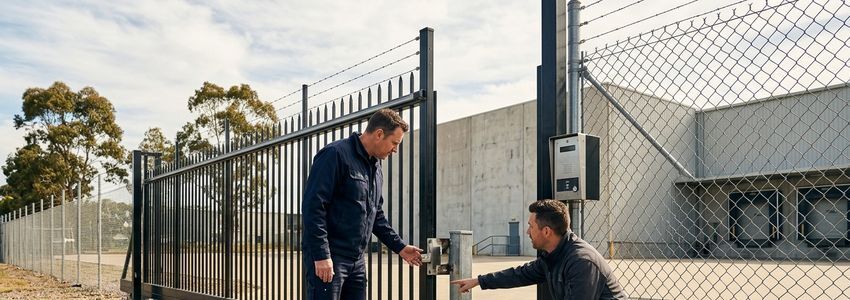
Reminder: A damaged perimeter fence is not just a cosmetic problem. It can void portions of your insurance coverage, create liability exposure, and give inspectors or auditors a reason to flag your facility during a compliance review.
Real-World Scenarios
Scenario 1: The Distribution Center
A regional distribution center had forty feet of perimeter chain-link fencing destroyed when a delivery trailer backed through it during a shift change. With trailers and inventory exposed overnight, the company used a working capital loan to fund an emergency repair completed within 48 hours, avoiding a gap in coverage and a potential theft loss.
Scenario 2: The Auto Dealership
A used car dealership's perimeter security gate motor failed after years of daily use, leaving the vehicle lot accessible overnight. The dealership opened a business line of credit to cover both the gate motor replacement and an upgraded access-control panel, drawing only what was needed for each phase of the project.
Scenario 3: The Construction Yard
A construction company's equipment yard fencing was damaged during a severe storm, and the company's insurance carrier flagged the exposed perimeter as a condition of continued coverage with a two-week repair deadline. A short-term business loan allowed the company to complete the repair well within the deadline and avoid a lapse in its policy.
Scenario 4: The Self-Storage Facility
A self-storage operator experienced a break-in that damaged both the perimeter fence and the automated entry gate. Rather than delay repairs while an insurance claim was processed, the operator used unsecured working capital financing to fund immediate repairs, then reimbursed the loan once the insurance payout arrived.
Get Your Perimeter Repaired Before It Costs You More
Talk to Crestmont Capital about fast, flexible funding for your commercial fencing or perimeter security repair today.
Apply Now →Frequently Asked Questions
What counts as a commercial fencing or perimeter security repair?
It includes repairing or replacing damaged chain-link, welded wire, or ornamental fencing, security gates and their motors, access-control hardware, bollards, crash barriers, and any related perimeter lighting or camera mounts attached to the fence line.
Why do fence and perimeter security repairs often need to happen quickly?
A damaged perimeter creates an active security gap that increases the risk of theft, vandalism, or an injury claim. Insurance carriers also frequently require repairs within a short window as a condition of continued coverage.
Can a business loan be used to pay for fencing or perimeter security repairs?
Yes. Many businesses use a working capital loan, business line of credit, or short-term loan to fund fencing and perimeter security repairs, especially when the work needs to happen quickly.
How fast can I get financing to cover a fencing repair?
Alternative and non-bank lenders can often approve and fund working capital loans or lines of credit within one to three business days, compared to several weeks for a traditional bank loan.
Is a business line of credit better than a lump-sum loan for these repairs?
It depends on the scope of the project. If the repair is a single, known cost, a working capital loan is often simpler. If the project is phased or the final cost is uncertain, a line of credit lets you draw only what you need.
Do I need collateral to finance a perimeter security repair?
Not necessarily. Unsecured working capital financing is available for many businesses based primarily on revenue and cash flow, without requiring specific collateral to be pledged.
What documents do lenders typically require for this type of financing?
Most lenders request recent business bank statements, basic financial information, and a contractor estimate if available. Alternative lenders generally require less extensive documentation than traditional banks.
Will my insurance company cover the cost of a perimeter fence repair?
It depends on your policy and the cause of damage. Even when a claim is covered, insurance payouts can take weeks or months to process, which is why many businesses use financing to complete the repair immediately and reimburse the loan once the claim settles.
What happens if I delay a perimeter security repair?
Delaying a repair can extend your exposure to theft, vandalism, and liability claims, and in some cases can put you at risk of a lapsed or non-renewed insurance policy if the carrier has flagged the issue.
How much does it typically cost to repair commercial fencing?
Costs vary widely based on materials, the length of fence line affected, and labor rates in your area. A contractor estimate is the best way to determine your specific repair cost before applying for financing.
Can financing cover both fence repair and security system upgrades together?
Yes. Many businesses use a single line of credit or loan to cover related work, such as repairing a damaged fence section while also upgrading gate access-control or camera coverage along the same perimeter.
What industries most commonly need this type of financing?
Distribution centers, warehouses, auto dealerships, construction companies, self-storage facilities, and manufacturers with fenced yards or lots are among the most common businesses to need fencing and perimeter security financing.
Does having a recent break-in or vandalism incident affect my ability to get financing?
No. A recent security incident does not disqualify a healthy business from financing. Many alternative lenders focus on your business's cash flow and revenue trends rather than the specific reason for the funding request.
Should I use cash reserves instead of financing to cover a fencing repair?
If your business has ample idle cash reserves, using them avoids financing costs. However, many businesses prefer to preserve liquidity for payroll and operations, and use financing instead to keep cash reserves intact.
How do I get started financing a commercial fencing or perimeter security repair?
Start by getting a written estimate from a fencing or security contractor, then compare business loan and line of credit options based on how quickly the repair needs to happen and any insurance or compliance deadlines.
Next Steps
Have a fencing or security contractor assess the damage and quote the full scope of work.
Confirm any timelines from your insurance carrier, landlord, or local code enforcement.
Decide between a lump-sum loan and a revolving line of credit based on the scope of your repair.
Submit your application, get an approval decision, and pay your contractor directly.
Conclusion
A damaged commercial fence or a gap in perimeter security is more than a maintenance annoyance. It is an active liability and insurance risk that tends to grow the longer it sits unresolved. Because these repairs typically arrive without warning and require fast action, many business owners turn to a working capital loan or business line of credit rather than disrupting payroll or operating funds. Whether you are dealing with storm damage, a vehicle collision, or a break-in, understanding your financing options ahead of time means you can respond to a commercial fence repair with confidence instead of scrambling for cash under a tight deadline.
Disclaimer: The information provided in this article is for general educational purposes only and is not financial, legal, or tax advice. Funding terms, qualifications, and product availability may vary and are subject to change without notice. Crestmont Capital does not guarantee approval, rates, or specific outcomes. For personalized information about your business funding options, contact our team directly.