
 (800) 949-0401
Commercial Door Installation Business Loans: The Complete Financing Guide for Commercial Door Contractors
Commercial door installation business loans give contractors the capital they need to take on bigger jobs, invest in specialized equipment, maintain healthy cash flow, and grow a profitable trade business in one of construction's most in-demand specialties. Whether you install automatic sliding doors at retail centers, fire-rated doors in hospitals, heavy steel doors at warehouses, or high-speed roll-up doors at distribution facilities, financing can be the difference between winning a contract and watching a competitor take it. This guide breaks down every funding option available to commercial door contractors today.
In This Article
- What Are Commercial Door Installation Business Loans?
- Types of Commercial Doors and Why They Require Specialized Financing
- What Commercial Door Contractors Need Financing For
- Best Loan Types for Commercial Door Contractors
- Financing at a Glance: Key Industry Stats
- How to Qualify for a Commercial Door Contractor Loan
- How Crestmont Capital Helps Commercial Door Contractors
- Tips for Getting the Best Financing Terms
- Next Steps
- FAQ
What Are Commercial Door Installation Business Loans?
Commercial door installation business loans are financing products specifically suited to contractors who install, repair, and maintain doors in commercial, industrial, and institutional settings. Unlike residential door work, commercial door contracting involves heavier materials, stricter code requirements, larger project budgets, and longer payment cycles. Financing bridges the gap between the money you spend upfront and the payments you receive weeks or months later.
These loans can fund everything from purchasing a new service van to buying a full inventory of hardware, hiring additional installers, covering payroll between commercial contracts, and even bonding and insurance requirements required to bid on government or large corporate projects.
The commercial door industry sits at the crossroads of construction, security, fire safety, and building automation. According to the U.S. Small Business Administration, specialty trade contractors represent one of the fastest-growing segments of the small business economy, and commercial door installation is one of those niches where a single well-funded contractor can command a very healthy market share.
Whether you operate as a standalone commercial door company or as a subcontractor on large construction projects, access to small business loans can accelerate your growth and protect your cash flow through slow seasons and contract delays alike.
Ready to Grow Your Commercial Door Business?
Get fast, flexible financing from the #1 business lender in the U.S. No obligation - apply in minutes.
Apply Now →Types of Commercial Doors and Why They Require Specialized Financing
Not all commercial doors are created equal. Each door type demands different tools, training, hardware stock, and project timelines. Understanding the scope of work in your niche helps lenders understand your business model, and it helps you determine exactly how much financing you need.
Automatic Sliding and Swing Doors
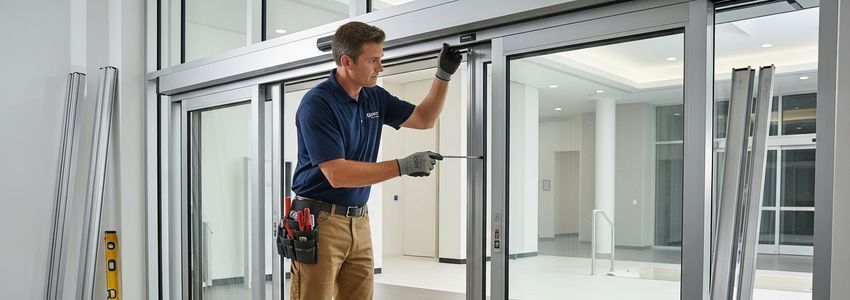
Automatic door systems are among the most technically complex installations in the commercial door world. They require sensor arrays, motorized operators, control boards, and precision alignment. Contractors need specialized diagnostic tools, factory training certifications, and a ready stock of proprietary parts. A single automated entrance installation at a grocery store or hospital can run from $8,000 to $25,000 or more. To stock parts and deploy certified crews, you need working capital on hand.
Fire-Rated Doors
Fire doors are installed in virtually every commercial building subject to life-safety codes. These assemblies, including the door, frame, hardware, and closer, must meet strict NFPA and IBC standards. Inspections, certifications, and code compliance documentation add overhead to every job. Fire door replacement and installation in hospitals, schools, and multi-family residential buildings is a significant revenue stream, but the liability and compliance burden requires proper bonding, insurance, and business infrastructure that all cost money.
Steel and Hollow Metal Doors
Heavy steel and hollow metal doors are the workhorse of commercial construction. They appear in office buildings, schools, government facilities, and industrial plants. Large commercial GC projects may require dozens to hundreds of units, meaning your upfront material cost can run six figures before you receive a single payment. Lines of credit are particularly valuable here, letting you draw funds as you purchase materials and repay as invoices come in.
Roll-Up and Overhead Doors
Commercial roll-up doors serve warehouses, loading docks, self-storage facilities, and manufacturing plants. Steel coiling doors and sectional overhead doors require hydraulic lift equipment, spring-tension expertise, and vehicles capable of transporting large door panels. The service and replacement market for roll-up doors is enormous, and contractors who can respond quickly to broken spring or motor failures build loyal commercial client rosters.
Aluminum Storefront Doors
Aluminum storefront and curtain-wall door systems are the entry points for retail, restaurant, and office buildings. They combine glass, aluminum framing, and hardware into aesthetically focused assemblies. Related work overlaps with glazing, which is why contractors in this niche also benefit from reviewing Glazing Contractor Business Loans resources.
High-Speed and Specialty Industrial Doors
High-speed fabric roll-up doors, cold-storage doors, blast-resistant doors, and clean-room doors serve specialized industrial and pharmaceutical clients. These are high-margin niches where a single installation can top $50,000 to $100,000. The equipment required for these installations and the extended sales cycles before payment create significant cash flow challenges that financing helps solve.
Industry Insight
The commercial door and hardware market in the U.S. generates an estimated $10+ billion in annual revenue across manufacturing, distribution, and installation. Specialty trade contractors in this space earn average gross margins of 25-40% on installed projects, making it one of the more profitable niches in commercial construction.
What Commercial Door Contractors Need Financing For
Before choosing a loan product, it helps to map your financing need to a specific category. Commercial door contractors typically need funding in these areas:
Specialized Tools and Installation Equipment
Commercial door installation requires tools you simply cannot borrow from a neighbor. Hydraulic door-frame spreaders, electric actuator test kits, automatic door operator programming tools, laser levels rated for heavy-frame work, and heavy-duty welding equipment for steel frames all represent significant upfront investments. A well-equipped installation crew can easily require $30,000 to $80,000 in tools before the first job is complete. Equipment financing allows you to spread that cost over the productive life of the tools.
Service Vehicles and Fleet
Commercial door contractors depend on capable work vehicles. A service van needs to carry heavy steel doors, aluminum panels, frames, actuators, and a full complement of hand and power tools. Many contractors run 1-ton cargo vans or medium-duty trucks with custom shelving and lift gates. A new commercial service van can cost $50,000 to $80,000 fully outfitted. Equipment financing lets you acquire the vehicle through the loan itself, with the vehicle serving as its own collateral.
Hardware and Door Inventory
Fast-response commercial clients, particularly property managers and facility operators, want same-day or next-day service. That requires keeping stock on hand. Door closers, panic hardware, hinges, automatic operators, replacement glass panels, and roll-up door components all sit on shelves waiting for the right job. A well-stocked contractor might carry $20,000 to $60,000 in parts inventory. Working capital loans and lines of credit keep that inventory funded without draining cash reserves.
Bonding and Insurance
Bid bonds, performance bonds, and payment bonds are required on virtually every public and many private commercial projects. Premium costs for a $500,000 performance bond can run several thousand dollars, and insurance premiums for commercial contractor coverage add up quickly. Many contractors use short-term working capital to cover these costs at contract award, then repay as project draws come in.
Payroll Between Contracts
Experienced commercial door installers are hard to find and harder to replace. Keeping skilled employees on payroll during slow seasons or between large contracts is a challenge every contractor faces. A business line of credit is ideal for this purpose - draw what you need, repay when a contract funds, and keep your best people employed year-round.
Marketing and Business Development
Growing beyond referrals requires a digital presence, trade association memberships, and sometimes a dedicated estimator or sales person. These investments can generate strong returns but require upfront capital. According to Forbes, small businesses that invest consistently in marketing grow 2-3x faster than those that rely solely on word of mouth.
Certifications and Training
Automatic door certifications from AAADM (American Association of Automatic Door Manufacturers), BHMA credentials, and factory authorizations from door system brands require time and money. Sending technicians to training programs can cost $2,000 to $5,000 per person, but those credentials unlock higher-margin work and preferred vendor status with national property management firms.
Best Loan Types for Commercial Door Contractors
The right loan type depends on what you're funding, how quickly you need capital, and your business's financial profile. Here's a breakdown of the most effective financing options for commercial door installation companies.
Equipment Financing
Equipment financing is purpose-built for acquiring physical assets - tools, vehicles, lifts, and machinery. The equipment itself serves as collateral, which means approval requirements are often more flexible than unsecured loans. Terms typically range from 24 to 72 months with fixed payments that match your budget. For commercial door contractors, this is usually the first financing product to explore when capital needs are tied to specific equipment purchases. Visit our equipment financing page to learn more about rates and terms.
Working Capital Loans
Working capital loans provide lump-sum funding that can be used for any business purpose - inventory, payroll, marketing, bonding costs, or operational overhead. They're particularly useful when you land a large contract and need to gear up fast. Repayment terms typically range from 6 to 24 months. Our short-term business loans are designed exactly for this purpose.
Business Lines of Credit
A revolving line of credit functions like a business credit card without the high interest rates. You're approved for a maximum credit limit, draw what you need when you need it, repay the drawn amount, and the credit becomes available again. Lines of credit are perfect for managing cash flow gaps between invoicing and payment, funding recurring inventory purchases, and handling payroll during contract gaps.
SBA Loans
The Small Business Administration guarantees loans through approved lenders, enabling smaller businesses to access larger loan amounts at competitive rates. SBA 7(a) loans can fund up to $5 million and are appropriate for commercial door contractors looking to purchase real property, acquire another business, or fund major long-term expansions. The tradeoff is a more rigorous application process and longer approval timelines. Many contractors use SBA loans for strategic growth while relying on alternative lenders for quick-turn working capital needs.
Invoice Financing and Factoring
If your commercial door business invoices general contractors or property managers on net-30 or net-60 terms, you can use those invoices as collateral for immediate cash. Invoice financing (a loan against unpaid invoices) and invoice factoring (selling invoices to a third-party at a discount) both accelerate your cash flow by turning receivables into working capital within 24-48 hours. This is a powerful tool for contractors whose clients are creditworthy but slow to pay.
Fast Business Loans
When a time-sensitive job comes in, a competitor submits a lower bid based on their cash advantage, or an urgent equipment breakdown requires immediate replacement, speed matters. Alternative lenders, including Crestmont Capital, can approve and fund fast business loans in as little as 24-48 hours, compared to weeks or months for bank approval processes.
Financing at a Glance: Key Industry Stats
Commercial Door Contractor Financing: By the Numbers
$10B+
U.S. commercial door market annual revenue
$50K-$100K
Typical startup tooling and vehicle cost per crew
30-60 days
Typical commercial invoice payment terms
24-48 hrs
Crestmont Capital funding speed after approval
6 months
Minimum time in business for most loan products
How to Qualify for a Commercial Door Contractor Loan
Lenders evaluate commercial door contractors using a combination of business and personal financial factors. Here's what most lenders look at and how to position your application for the best outcome.
Time in Business
Most lenders want to see at least 6 months of operating history to approve working capital loans or lines of credit. For larger SBA-backed loans, 2+ years of operating history is standard. Equipment financing can sometimes be approved for newer businesses because the equipment serves as collateral.
Annual Revenue
Lenders use your annual revenue as a guide to your repayment capacity. Most working capital lenders require a minimum of $100,000 to $150,000 in annual revenue. Larger loan amounts require proportionally higher revenue. According to U.S. Census Bureau data, specialty trade contractors generate median revenues well above these thresholds, which means most established commercial door businesses qualify for meaningful financing amounts.
Credit Score
Personal credit scores matter, particularly for newer businesses. A score of 600 or above opens up most alternative lending options. Scores of 680+ unlock better rates. That said, Crestmont Capital evaluates the overall health of your business, not just your credit score, making it possible to qualify even with less-than-perfect credit history if your revenue and cash flow are strong.
Commercial Accounts and Contracts
If you have existing commercial contracts or long-term service agreements with property management companies, GCs, or government agencies, those can significantly strengthen your loan application. They demonstrate stable, recurring revenue that de-risks the loan from the lender's perspective.
Business Bank Statements
Most alternative lenders require 3-6 months of business bank statements. These statements verify your revenue, show your average daily balance, and reveal cash flow patterns. Keeping a clean business bank account - one used exclusively for business income and expenses - makes this process faster and more favorable.
Pro Tip: Separate Your Business Finances
One of the simplest things you can do to improve your loan approval odds and get better rates is to maintain a dedicated business checking account used only for business transactions. Mixing personal and business finances is one of the most common reasons loan applications get delayed or declined. A clean, dedicated account tells lenders your business is organized and well-managed.
How Crestmont Capital Helps Commercial Door Contractors
Crestmont Capital is rated the #1 business lender in the United States, and we specialize in helping specialty trade contractors like commercial door installation companies access the capital they need - fast. Here's what sets us apart from banks and other lenders.
Speed That Matches Your Business
Commercial construction moves fast. When a property manager calls needing 20 doors installed before a tenant moves in, you don't have three weeks to wait for a bank loan. Crestmont Capital funds approved applicants in as little as 24-48 hours, giving you the ability to say yes to urgent, high-value contracts that your slower-funded competitors have to turn down.
No Collateral Required for Many Products
Many of our working capital and line of credit products are unsecured, meaning you don't have to pledge your home, vehicle, or equipment to access funding. This is a significant advantage for contractors who want to protect their personal assets while still accessing meaningful business credit.
Flexible Qualification Criteria
We evaluate your business holistically. If your revenue is strong and your cash flow is consistent, we can often approve funding even if your credit score isn't perfect or your business is relatively new. Our goal is to find a way to say yes, not to find reasons to say no.
Dedicated Funding Advisors
Every commercial door contractor who applies through Crestmont Capital is matched with a dedicated funding advisor who understands the specialty trades. They can help you identify the right loan product for your specific need, structure your application for the strongest possible approval, and walk you through repayment options that fit your cash flow cycle.
Full Suite of Financing Products
From equipment financing to working capital loans, lines of credit to short-term funding, Crestmont Capital offers the full range of products your commercial door business might need at different stages of growth. No need to shop multiple lenders - we can handle it all.
Ready to Grow Your Commercial Door Business?
Get fast, flexible financing from the #1 business lender in the U.S. No obligation - apply in minutes.
Apply Now →Tips for Getting the Best Financing Terms
Whether you're applying for your first business loan or looking to refinance existing debt, these strategies will help you secure better rates and higher approval amounts.
Know Your Numbers Before You Apply
Lenders are more confident when borrowers come prepared. Know your last 12 months of revenue, your average monthly cash inflow, your current outstanding debt obligations, and how much you need - and why. A contractor who says "I need $75,000 to purchase a new service vehicle and stock parts for three upcoming commercial contracts" is a much stronger applicant than one who says "I just need money."
Build Your Business Credit Proactively
Business credit scores (Dun and Bradstreet, Experian Business, Equifax Business) are separate from personal credit. Establish your business credit profile by opening vendor accounts, paying on time, and applying for a business credit card. Strong business credit makes future financing cheaper and easier to access.
Document Your Commercial Contracts
If you have signed contracts, letters of intent, or service agreements, include them with your loan application. Documented future revenue strengthens your repayment case significantly, especially for working capital loans tied to specific projects.
Consider Your Repayment Timing
Match your loan repayment structure to your revenue cycle. If you receive large lump payments at project completion, balloon payment structures or shorter-term loans may be appropriate. If you have steady monthly service contracts, traditional amortizing loans with fixed monthly payments work best. Talk to your Crestmont Capital funding advisor about structuring payments to match your cash flow.
Avoid Stacking Too Much Debt
Multiple simultaneous merchant cash advances or high-cost loans can trap contractors in a cycle of debt payments that consume more cash than the original loans generated in growth. Be strategic: use each financing product for a specific purpose, track your debt service coverage ratio, and pay off high-interest positions before stacking new debt.
Debt Service Coverage Ratio (DSCR)
Your DSCR is calculated by dividing your net operating income by your total annual debt payments. A DSCR of 1.25 or higher (meaning you earn $1.25 for every $1.00 of debt payments) is typically the minimum threshold for commercial loan approval. Calculate yours before applying to understand how much additional debt your business can support.
Next Steps
Identify Your Specific Funding Need
Is it a vehicle? Tooling? Inventory? Working capital between contracts? Knowing the purpose helps you choose the right loan product and borrow only what you need.
Gather Your Documents
Pull your last 3-6 months of business bank statements, your most recent tax return, and any signed contracts or service agreements. Having these ready speeds up the approval process significantly.
Apply with Crestmont Capital
Submit your application online in minutes at offers.crestmontcapital.com/apply-now. Our team reviews applications quickly and will contact you within one business day.
Review Your Offer
Your dedicated funding advisor will present financing options tailored to your business. Review the terms, ask questions, and choose the product that aligns with your cash flow and growth goals.
Get Funded and Execute
Once approved, funds arrive in your business bank account typically within 24-48 hours. Use the capital to purchase equipment, stock inventory, cover payroll, or take on that next large commercial contract with confidence.
Ready to Grow Your Commercial Door Business?
Get fast, flexible financing from the #1 business lender in the U.S. No obligation - apply in minutes.
Apply Now →Conclusion
Commercial door installation is a specialty trade with strong demand, healthy margins, and real barriers to entry that protect established contractors. But growth in this industry requires capital: for equipment, vehicles, inventory, bonding, and the working capital to bridge the gap between doing the work and getting paid. The right financing strategy lets you take on bigger contracts, hire better crews, and build the kind of scalable business that generates lasting value.
From equipment financing for your next service vehicle to lines of credit that keep payroll funded between jobs, Crestmont Capital has the products, speed, and expertise to support commercial door contractors at every stage of growth. Apply today and find out how much your business qualifies for - no obligation required.
Frequently Asked Questions
What are commercial door installation business loans?
Commercial door installation business loans are financing products designed to help contractors who install, repair, and maintain commercial doors fund their operations. They can cover equipment purchases, vehicles, inventory, payroll, bonding costs, and working capital gaps between contracts.
How much can a commercial door contractor borrow?
Loan amounts vary widely based on your revenue, credit profile, and business history. Many commercial door contractors qualify for $25,000 to $500,000 or more through working capital loans, equipment financing, and lines of credit combined.
What credit score do I need to qualify?
Most alternative lenders, including Crestmont Capital, look for personal credit scores of 600 or above. Higher scores unlock better rates. However, strong business revenue and cash flow can compensate for a lower credit score in many cases.
How fast can I get funded?
Crestmont Capital can approve and fund qualified applicants in as little as 24-48 hours. This is significantly faster than traditional banks, which can take weeks or months for commercial loan approvals.
Can I get a loan if my commercial door business is new?
Yes, but options are more limited for very new businesses. Most working capital lenders want at least 6 months in business. Equipment financing can sometimes be approved for newer businesses since the equipment serves as its own collateral.
What is equipment financing and how does it work for door contractors?
Equipment financing lets you acquire tools, vehicles, and machinery by using the equipment itself as collateral. You make fixed monthly payments over the loan term (typically 24-72 months) and own the equipment outright when the loan is paid off. It's ideal for service vehicles, hydraulic lifting equipment, and specialized installation tools.
What is a business line of credit?
A business line of credit is a revolving credit facility that lets you draw funds up to your approved limit, repay them, and draw again. It functions like a business credit card but typically with lower rates. It's ideal for managing cash flow gaps, funding recurring inventory, and covering payroll between large contracts.
Do I need collateral to get a business loan?
Not always. Many working capital loans and lines of credit from alternative lenders are unsecured, meaning no collateral is required. Equipment financing uses the equipment itself as collateral. SBA loans may require collateral for larger amounts.
Can I use a business loan to fund bonding and insurance costs?
Yes. Working capital loans and lines of credit can be used for any legitimate business expense, including surety bond premiums, general liability insurance, and contractor's professional liability coverage. These are common uses among contractors who need bonding to bid on public or large commercial projects.
How does invoice financing help commercial door contractors?
Invoice financing allows you to borrow against unpaid invoices from creditworthy commercial clients. Instead of waiting 30-60 days for payment, you receive up to 80-90% of the invoice value within 24-48 hours. This is particularly valuable for contractors with large receivables from general contractors or property managers who pay on extended terms.
What documents are needed to apply for a commercial door contractor loan?
Most lenders require 3-6 months of business bank statements, your most recent business tax return, a government-issued ID, and basic business information. Some lenders also request a voided business check, proof of insurance, and any signed contracts or purchase orders related to your funding need.
Are SBA loans a good option for commercial door contractors?
SBA loans offer competitive rates and long repayment terms, making them excellent for large capital investments like real estate or major equipment. However, the approval process is longer and more documentation-intensive. Most commercial door contractors use SBA loans for strategic expansion while relying on faster alternative lenders for day-to-day working capital needs.
How can financing help me take on larger commercial contracts?
Large commercial contracts often require significant upfront investment in materials, labor, and equipment before you receive any payment. Financing lets you meet those upfront costs confidently, bid on larger projects knowing you have the capital to execute, and scale your crew and equipment to handle higher-volume work.
What is the minimum annual revenue required to qualify?
Most alternative lenders require a minimum of $100,000 to $150,000 in annual gross revenue. Some products have lower minimums for smaller loan amounts. Higher revenue generally enables access to larger loan amounts and better terms.
Why choose Crestmont Capital over a bank for contractor financing?
Crestmont Capital offers faster approvals (24-48 hours vs. weeks), more flexible qualification criteria, no collateral required for many products, and dedicated funding advisors who understand the specialty trades. Banks often decline contractors with less-than-perfect credit or inconsistent revenue cycles; Crestmont looks at the full picture of your business health.
Disclaimer: The information provided in this article is for general educational purposes only and is not financial, legal, or tax advice. Funding terms, qualifications, and product availability may vary and are subject to change without notice. Crestmont Capital does not guarantee approval, rates, or specific outcomes. For personalized information about your business funding options, contact our team directly.








