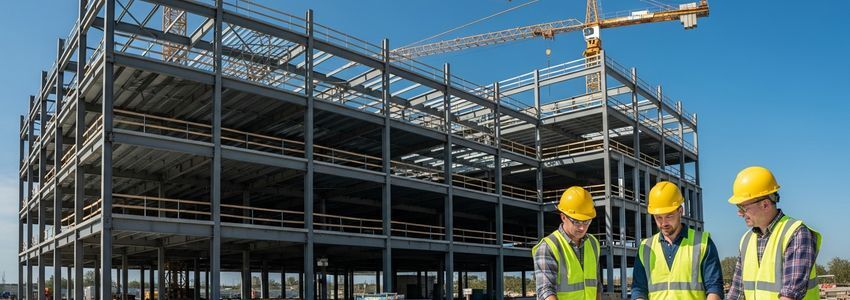
Embarking on a new construction project is a significant milestone, representing growth, opportunity, and a tangible vision for your business's future. However, turning architectural drawings into a physical structure requires substantial capital, which is where commercial construction loans become essential. This specialized form of financing is designed to cover the costs associated with building or renovating commercial properties from the ground up.
In This Article
- What Are Commercial Construction Loans?
- Types of Commercial Construction Loans
- Commercial Construction Loan Rates and Terms
- How Commercial Construction Loans Work
- Qualifying for a Commercial Construction Loan
- Documents Required for Commercial Construction Financing
- Commercial Construction Loan vs. SBA Loan
- How Crestmont Capital Helps
- Real-World Examples
- How to Get Started
- Frequently Asked Questions
- Conclusion
What Are Commercial Construction Loans?
Commercial construction loans are short-term financing instruments specifically designed to fund the costs of building or substantially renovating a commercial property. Unlike a standard commercial mortgage, which finances a completed building, a construction loan provides capital in stages to cover expenses as the project progresses. This type of loan is ideal for developers, business owners, and investors looking to build properties like office buildings, retail centers, industrial warehouses, apartment complexes, or mixed-use developments.
The core purpose of this financing is to bridge the gap between initial project costs and long-term, stable financing. Once construction is complete and the property receives a certificate of occupancy, the construction loan is typically paid off, often by refinancing into a traditional commercial mortgage. This structure protects the lender by ensuring funds are used as intended and the project is advancing according to plan.
These loans are considered higher risk for lenders than traditional mortgages because there is no existing, income-producing asset to serve as collateral at the outset. The collateral is the project itself, which is not yet complete. This higher risk profile influences the loan's structure, interest rates, and qualification requirements.
What Do Commercial Construction Loans Cover?
Comprehensive commercial construction financing is structured to cover a wide array of project-related expenses. These costs are generally categorized into two main groups: hard costs and soft costs.
- Land Acquisition: Funds to purchase the land where the project will be built. In some cases, if the borrower already owns the land, its equity can be used toward the down payment requirement.
- Hard Costs: These are the tangible costs directly related to the physical construction of the building. This includes materials (lumber, steel, concrete), labor (wages for construction workers), site improvements (grading, utilities, landscaping), and the general contractor's fee. It also covers major systems like HVAC, plumbing, and electrical.
- Soft Costs: These are indirect expenses that are necessary for the project but not part of the physical construction. Examples include architectural and engineering fees, permits and inspection fees, legal fees, appraisal fees, project management costs, and insurance during construction.
- Interest Reserve: Lenders often build an interest reserve into the loan amount. This account is used to make the interest-only payments on the loan during the construction phase, so the borrower doesn't have to cover these payments out-of-pocket while the property is not yet generating income.
- Contingency Reserve: A portion of the loan is set aside as a contingency fund, typically 5-10% of the total construction cost. This reserve covers unexpected overruns, delays, or changes, providing a crucial financial buffer to ensure the project stays on track.
It's important to note that while the loan covers project costs, it often runs parallel to other financing needs. For instance, contractors may need separate construction equipment financing to purchase the machinery required for the job, which is a distinct but related financial product.
Types of Commercial Construction Loans
The world of commercial construction financing is not one-size-fits-all. Different project scopes, timelines, and business goals require different funding structures. Understanding the primary types of loans available is the first step in identifying the right solution for your specific development.
1. Construction-Only Loan
This is a straightforward, short-term loan that covers only the construction phase of the project. It typically has a term of 12 to 24 months and features an interest-only payment structure. The funds are disbursed in draws as construction milestones are met. The major drawback is that once the building is complete, the borrower must secure separate, long-term financing (a "take-out loan") to pay off the construction loan. This means going through a second underwriting and closing process, which involves additional time, fees, and the risk that market conditions or the borrower's financial situation may have changed.
2. Construction-to-Permanent Loan (One-Time Close)
This is often the most popular and efficient option. A construction-to-permanent loan combines the construction loan and the permanent mortgage into a single transaction with one closing. During the construction phase (typically 12-24 months), the borrower makes interest-only payments on the funds that have been drawn. Once the project is complete, the loan automatically converts into a standard, fully amortizing commercial mortgage with a much longer term (e.g., 20-30 years). This single-close process saves on closing costs, simplifies paperwork, and locks in the long-term interest rate from the beginning, protecting against future rate hikes.
3. Mini-Perm Loan
A mini-perm loan acts as a bridge between the construction loan and a long-term permanent mortgage. It's a short-term loan, typically lasting 2 to 5 years, that pays off the initial construction loan once the project is complete. This option is useful when a property needs time to stabilize and establish a track record of rental income before it can qualify for the best permanent financing terms. It allows the developer to lease up the property and demonstrate its cash flow potential to future long-term lenders.
4. Acquisition and Development (A&D) Loan
This type of loan is used for larger-scale projects and covers more than just the vertical construction of a building. An A&D loan finances the purchase of a large tract of raw land (acquisition) and the costs of preparing it for construction (development). Development costs can include clearing the land, building roads, installing sewer and water lines, and other essential infrastructure. Once the land is developed, the developer may then seek a separate construction loan for the actual buildings.
5. Bridge Loan
While not exclusively a construction loan, a bridge loan can be used to finance a construction project under specific circumstances. It's a short-term loan used to "bridge" a gap in funding. For example, a developer might use a bridge loan to quickly acquire a property or start initial construction while arranging for more traditional, long-term commercial construction loans. They are typically faster to fund but come with higher interest rates and fees.
Key Insight: The choice between a construction-only and a construction-to-permanent loan is a critical decision. A one-time close saves on fees and locks in your long-term rate, but a two-time close might offer more flexibility if you anticipate market conditions improving by the time you need permanent financing.
Commercial Construction Loan Rates and Terms
Understanding the typical rates, terms, and fee structures is crucial for budgeting and evaluating the financial viability of your project. Commercial construction loan rates are influenced by several factors, including the prime rate, the lender's risk assessment, the borrower's creditworthiness, and the overall strength of the project. Because these loans are inherently risky, rates are generally higher than those for standard commercial mortgages.
Interest Rates
Interest rates on commercial construction loans are almost always variable, tied to a benchmark index like the Prime Rate or SOFR (Secured Overnight Financing Rate). The rate is expressed as "Index + Margin." For example, if the Prime Rate is 8.5% and the lender's margin is 1.5%, your interest rate would be 10.0%. The margin is determined by the lender's assessment of the project's risk.
- Variable Rate: During the construction phase, the rate will fluctuate as the benchmark index changes. This means your interest-only payments can increase or decrease over the life of the construction period.
- Interest-Only Payments: You are only required to pay interest on the amount of money that has been disbursed to date, not the total loan amount. This keeps payments lower during the non-income-generating construction phase.
As of late 2023 and early 2024, borrowers can expect rates to be significantly higher than in previous years due to federal monetary policy. According to a report by Forbes Advisor, commercial real estate loan rates have seen a substantial increase, a trend that directly impacts construction financing.
Loan Terms and Ratios
Lenders use specific metrics to determine the loan amount and manage their risk exposure. The two most important ratios are Loan-to-Cost (LTC) and Loan-to-Value (LTV).
- Loan-to-Cost (LTC): This ratio compares the loan amount to the total cost of the project (land + hard costs + soft costs). Lenders typically finance up to 75-80% LTC, meaning the borrower must contribute the remaining 20-25% as a cash down payment or land equity. A higher borrower contribution signals a stronger commitment and reduces the lender's risk.
- Loan-to-Value (LTV): This ratio compares the loan amount to the appraised value of the completed project (the "as-completed" value). Lenders also cap the LTV, often around 65-75%. The loan must satisfy both the LTC and LTV requirements, and the lender will approve the lower of the two amounts.
- Loan Term: The construction phase term is short, typically 12-24 months, with some extensions possible for complex projects. If it's a construction-to-permanent loan, the permanent phase can extend for 20-30 years.
Common Fees
Beyond the interest rate, be prepared for several fees associated with securing a commercial construction loan:
- Origination Fee: A fee for processing and underwriting the loan, usually 0.5% to 2.0% of the total loan amount.
- Appraisal and Inspection Fees: You will need a specialized appraisal to determine the "as-completed" value. You'll also pay for each inspection required before a draw is released.
- Title Insurance and Legal Fees: Standard costs to ensure the property title is clear and to cover the lender's legal review of documents.
- Guaranty Fees: If the loan is backed by an agency like the SBA, there will be an associated guaranty fee.
- Unused Funds Fee: Some lenders may charge a small fee on the undrawn portion of the loan commitment.
Get a Clear Picture of Your Project's Financing
Don't let complex rates and terms hold you back. Our experts can help you model the costs and find the best commercial construction loan for your needs.
Apply Now →How Commercial Construction Loans Work
The process for a commercial construction loan is fundamentally different from a standard mortgage due to its phased funding structure, known as the draw process. This ensures that the lender's capital is deployed responsibly and aligns with the project's actual progress, mitigating risk for all parties involved.
The entire lifecycle, from application to completion, follows a structured path:
- Application and Underwriting: The process begins with a detailed application. The lender performs rigorous due diligence, analyzing the borrower's financial health, the developer's experience, the contractor's reputation, and the economic viability of the project itself. This includes reviewing architectural plans, budgets, and market studies.
- Appraisal and Approval: A specialized appraisal is ordered to determine two key values: the "as-is" value of the land and the "as-completed" value of the finished project. Assuming the project meets the lender's criteria (LTC, LTV, etc.), the loan is approved and moves to closing.
- Closing and Initial Draw: At closing, the borrower signs the loan documents. The first draw is often made at this time to cover the land purchase (if applicable) and initial soft costs like permits and fees.
- The Draw Process: This is the core of the loan's administration. Instead of receiving a lump sum, the borrower requests funds in stages (draws) as construction progresses. A typical draw request involves the general contractor submitting a detailed request with invoices and lien waivers from subcontractors.
- Inspection and Funding: Before releasing funds for a draw, the lender sends an independent inspector to the site. The inspector verifies that the work claimed in the draw request has been completed to specification and is in line with the project budget. Once the inspection report is approved, the lender releases the funds to the borrower or directly to the contractor.
- Project Completion: This cycle of draw requests, inspections, and funding continues until the project is finished. The final draw is released after the building receives its Certificate of Occupancy (CO) from the local municipality, signifying it is complete and fit for use.
- Loan Conversion or Payoff: Upon completion, the loan enters its final stage. If it's a construction-to-permanent loan, it automatically converts to a long-term, amortizing mortgage. If it's a construction-only loan, the borrower must use a pre-arranged "take-out" loan to pay off the balance in full.
Quick Guide: The Commercial Construction Loan Draw Process
①
Work Completed
Contractor completes a phase (e.g., foundation) and submits a draw request.
②
Inspection
Lender's inspector visits the site to verify the completed work.
③
Approval
Inspector submits a positive report to the lender for approval.
④
Funds Disbursed
Lender releases the funds to pay for the completed work.
⑤
Repeat
The cycle repeats for each new phase of construction until completion.
Qualifying for a Commercial Construction Loan
Qualifying for a commercial construction loan is more rigorous than for a standard mortgage because the lender is financing a concept rather than a tangible, income-producing asset. Lenders scrutinize what is often called the "Five C's of Credit," with special emphasis on the borrower's experience and the project's details.
1. Character (Experience and Reputation)
This is arguably the most important factor. Lenders need to see that you have a "dream team" capable of executing the project successfully. This includes:
- Developer/Borrower Experience: Have you successfully completed similar projects in the past? A strong track record of finishing projects on time and on budget is critical. First-time developers will face much higher scrutiny.
- General Contractor's Qualifications: The lender will vet your general contractor, reviewing their portfolio, financial stability, licensing, and insurance. A reputable contractor with experience in your specific type of project is non-negotiable.
- Architect and Engineer: The credentials and experience of your design and engineering team also add credibility to the project.
Key Insight: For lenders, the borrower's and contractor's track record is paramount. A well-documented history of successful projects can often compensate for minor weaknesses in other areas of the application.
2. Capital (Down Payment / Equity)
Lenders require significant "skin in the game" from the borrower. As mentioned earlier, you'll typically need to contribute 20-25% of the total project cost in cash. If you already own the land, the equity in the land can often be counted toward this contribution. This capital injection demonstrates your commitment and provides a protective equity cushion for the lender.
3. Capacity (Ability to Repay)
The lender needs to be confident in your ability to handle the loan payments. They will analyze:
- Personal and Business Financials: Strong cash flow, low debt-to-income ratios, and healthy liquidity are essential.
- Projected Income: For investment properties, the lender will analyze your pro-forma, which projects the property's future income and expenses. They will calculate a projected Debt Service Coverage Ratio (DSCR) to ensure the completed property's net operating income can comfortably cover the future mortgage payments (typically requiring a DSCR of 1.25x or higher).
4. Collateral
The primary collateral for the loan is the project itself: the land and the improvements being constructed. The lender secures a first-position lien on the property. They may also require personal guarantees from the business owners, meaning your personal assets could be at risk if the loan defaults.
5. Conditions
The lender will assess the external market conditions and the project's specific details. This includes:
- Market Feasibility: Is there sufficient demand for the type of property you are building in that specific location? Lenders will review market analysis, vacancy rates, and comparable property values.
- Detailed Plans and Budget: A thorough, line-item budget and a complete set of architectural plans are required. Any vagueness or inconsistencies will be a major red flag.
Do You Have What It Takes to Qualify?
Our pre-qualification process is fast and simple. Find out where you stand and get expert guidance on strengthening your application.
See If You Qualify →
Documents Required for Commercial Construction Financing
Preparing a comprehensive and well-organized loan package is critical for a smooth and successful application process. Lenders require extensive documentation to perform their due diligence. While the exact list can vary by lender and project, you should be prepared to provide the following:
Project-Specific Documents
- Detailed Business Plan: An executive summary of the project, its purpose, market position, and financial projections.
- Construction Budget: A detailed, line-item budget covering all hard and soft costs. This should be prepared by an experienced contractor or cost estimator.
- Architectural and Engineering Plans: Complete, permit-ready blueprints, site plans, and specifications.
- General Contractor Agreement: A signed contract with your GC, outlining the scope of work, timeline, and payment schedule.
- Contractor Information: The GC's resume, portfolio of completed projects, financial statements, insurance certificates, and licenses.
- Appraisal Report: An "as-completed" appraisal from a lender-approved appraiser.
- Environmental Reports: A Phase I (and possibly Phase II) Environmental Site Assessment to ensure the land is free of contamination.
- Zoning and Permits: Documentation confirming the property is properly zoned for your intended use and that necessary permits have been or can be obtained.
- Land Purchase Agreement: If you are acquiring the land as part of the loan.
Borrower Financial Documents
- Personal Financial Statement: For all principals/guarantors with a 20% or greater ownership stake.
- Tax Returns: Typically 2-3 years of personal and business federal tax returns.
- Business Financial Statements: 2-3 years of balance sheets and profit & loss (P&L) statements for the borrowing entity.
- Business Bank Statements: Several months of recent statements to verify liquidity.
- Business Debt Schedule: A list of all current business debts and their terms.
- Entity Documents: Articles of incorporation, operating agreement, and proof of good standing for your business entity (LLC, S-Corp, etc.).
Gathering these documents in advance will demonstrate your preparedness and significantly expedite the underwriting process. For more information on financing for contractors, explore our guide on construction business loans.
Commercial Construction Loan vs. SBA Loan
When seeking construction business financing, many business owners consider Small Business Administration (SBA) loans. The most relevant SBA program for construction is the SBA 504 loan. While a conventional commercial construction loan is a direct agreement between you and a lender, an SBA 504 loan involves three parties: you (the borrower), a conventional lender (like a bank), and a Certified Development Company (CDC) that administers the SBA-guaranteed portion.
The key difference is that SBA 504 loans are specifically for owner-occupied properties, meaning your business must occupy at least 51% of the new building. They are not suitable for speculative or purely investment properties. The SBA 504 program offers long-term, fixed-rate financing for major fixed assets that promote business growth and job creation.
Here’s a comparison:
| Feature | Conventional Commercial Construction Loan | SBA 504 Loan for Construction |
|---|---|---|
| Primary Use | Any commercial property (owner-occupied, investment, speculative). | Owner-occupied properties only (business must occupy 51%+). |
| Down Payment | Typically 20-25% of total project cost. | As low as 10% of total project cost. |
| Interest Rate | Variable during construction; can be fixed or variable for permanent loan. | Blended rate. Bank portion is variable/fixed; SBA portion is fixed for the life of the loan. |
| Loan Structure | Single lender provides financing. Can be construction-only or construction-to-perm. | Bank provides 50%, CDC/SBA provides 40%, borrower provides 10%. |
| Term Length | Short-term (1-2 years) for construction; up to 25-30 years for permanent. | Long-term (20-25 years) fixed-rate financing for the SBA portion. |
| Approval Speed | Generally faster as it involves fewer parties. | Can be slower due to coordination between the bank, CDC, and SBA. |
For business owners planning to build a facility for their own operations, an SBA 504 loan is an incredibly attractive option due to the low down payment and long-term fixed rates. For developers building investment properties, a conventional commercial construction loan is the appropriate path.
How Crestmont Capital Helps
Navigating the complex landscape of commercial construction lenders can be daunting. Each lender has different risk appetites, underwriting criteria, and preferred project types. This is where Crestmont Capital provides immense value. We are a business lender and a financial partner for your business.
Our team specializes in connecting developers and business owners with the right financing solutions for their unique projects. We leverage our extensive network of banks, private lenders, and financial institutions to find the most competitive rates and favorable terms available.
The Crestmont Advantage:
- Expert Guidance: Our financing experts understand the nuances of commercial construction loans. We help you prepare a compelling loan package that highlights your project's strengths and mitigates perceived risks.
- Access to a Wide Lender Network: Instead of applying to banks one by one, you get access to our entire network with a single application. We know which lenders are actively funding projects like yours.
- Streamlined Process: We manage the communication and paperwork, saving you time and allowing you to focus on what you do best: planning and managing your construction project.
- Customized Solutions: We don't believe in one-size-fits-all. We take the time to understand your project goals and financial situation to structure the optimal commercial financing solution, whether it's a conventional loan, an SBA 504 loan, or a more creative financing structure.
Let Us Build Your Financing Package
Partner with Crestmont Capital to access a network of top commercial construction lenders and get the expert support you need to secure funding.
Start Your Application →Real-World Examples
To better illustrate how commercial construction loans work in practice, let's consider a few hypothetical scenarios.
Example 1: Building a New Medical Office
- The Project: A group of doctors wants to build a new 10,000-square-foot medical office for their growing practice. They already own the land, which is valued at $500,000.
- Total Project Cost: The total construction cost (hard and soft costs) is estimated at $3.5 million. The total project value is $4 million ($3.5M construction + $500K land).
- Financing Need: The doctors need a loan to cover the $3.5 million construction cost.
- The Solution: They apply for an SBA 504 loan because it will be an owner-occupied facility. The total project cost is $4 million. The SBA 504 structure requires a 10% down payment, or $400,000. Since their land equity is $500,000, this more than covers the down payment requirement. A bank provides a $2 million loan (50%), and a CDC provides a $1.6 million loan (40%), fully funding the construction.
Example 2: Developing a Retail Strip Center
- The Project: An experienced developer plans to build a small retail strip center on a parcel of land she is purchasing for $1 million.
- Total Project Cost: The land costs $1 million, and the construction costs are projected to be $4 million. The total project cost is $5 million. The "as-completed" appraisal values the finished center at $6.5 million.
- Financing Need: The developer needs financing for both the land and construction.
- The Solution: The developer seeks a conventional commercial construction loan. The lender's maximum Loan-to-Cost (LTC) is 80%. 80% of $5 million is $4 million. The lender's maximum Loan-to-Value (LTV) is 75%. 75% of the $6.5 million completed value is $4.875 million. The lender will approve the lower of the two, so the loan amount is capped at $4 million. The developer must contribute the remaining $1 million (20%) as a cash down payment.
How to Get Started
Securing a commercial construction loan is a detailed but manageable process. Following a structured approach will increase your chances of success. Here are the steps to begin your journey with Crestmont Capital.
Initial Consultation & Pre-Qualification
Start by completing our simple online application or calling our team. We'll have a brief discussion to understand your project scope, timeline, and financial standing to determine initial eligibility.
Document Gathering
We will provide you with a comprehensive checklist of all the necessary documents outlined in the "Documents Required" section above. Our team can assist you in organizing your package to present your project in the best possible light.
Lender Matching & Underwriting
Once your package is complete, we submit it to our network of carefully selected commercial construction lenders whose criteria match your project. We manage the communication and field questions from underwriters on your behalf.
Term Sheet and Closing
We'll help you review and compare the term sheets you receive. Once you select the best offer, we will work with you and the lender to navigate the final steps of appraisal, final approval, and closing the loan so you can break ground.
Frequently Asked Questions
What is the minimum credit score for a commercial construction loan?
Most lenders look for a personal credit score of 680 or higher from all guarantors. However, the strength of the project, your experience, and your liquidity are often more important than the score alone. Some lenders may consider scores in the mid-600s for an otherwise strong application.
How long does it take to get a commercial construction loan approved?
The timeline can vary significantly based on the project's complexity and the completeness of your application package. A well-prepared application can move through underwriting in 45-60 days, while more complex projects or incomplete packages can take 90 days or longer.
Can I act as my own general contractor?
This is generally discouraged by lenders unless you are a licensed, experienced general contractor with a long track record of successfully completing similar projects. Lenders prefer an independent, third-party contractor to ensure unbiased oversight and project management.
What happens if my project goes over budget?
This is what the contingency reserve is for. It's a portion of the loan (typically 5-10%) set aside for unexpected costs. If cost overruns exceed the contingency, you will likely be required to cover the difference with your own funds to keep the project moving forward.
Can I use a commercial construction loan to renovate an existing building?
Yes. Commercial construction loans are not just for ground-up construction. They can also be used for substantial renovations, expansions, or gut rehabs of existing commercial properties. The loan structure and draw process work similarly.
Is a personal guarantee always required?
For most small to medium-sized projects, yes. Lenders almost always require personal guarantees from all principals with a significant ownership stake (usually 20% or more). This ensures you are personally committed to the project's success. Non-recourse loans (without personal guarantees) are typically reserved for very large projects with highly experienced, well-capitalized developers.
What is an "interest reserve"?
An interest reserve is a portion of the loan proceeds set aside in a separate account to make the monthly interest-only payments during the construction period. This prevents the borrower from having to make payments out-of-pocket while the property is not generating any income.
What is a "take-out" loan?
A take-out loan is the permanent, long-term financing that "takes out" or pays off the short-term construction-only loan once the project is complete. If you get a construction-to-permanent loan, the take-out financing is already built-in.
Can I get a fixed interest rate on my construction loan?
The construction phase of the loan is almost always a variable rate tied to an index like the Prime Rate. However, with a construction-to-permanent loan, you can often lock in a fixed rate for the permanent mortgage portion of the loan at the time of the initial closing.
What's the difference between Loan-to-Cost (LTC) and Loan-to-Value (LTV)?
LTC compares the loan amount to the total project cost. LTV compares the loan amount to the appraised value of the completed project. Lenders use both metrics, and your loan amount will be limited by the lower of the two calculations. For example, a lender might approve up to 80% LTC or 75% LTV, whichever is less.
Are there commercial construction lenders for startups or first-time developers?
It is significantly more challenging for first-time developers to secure financing. Lenders heavily prioritize experience. A first-timer's best chance is to have a very strong financial position (high liquidity, large down payment), a highly experienced general contractor and project team, and a project in a strong market. Partnering with an experienced developer can also be a viable strategy.
What kind of insurance is required during construction?
You will typically need a builder's risk insurance policy, which covers property damage from events like fire, theft, and vandalism during construction. Additionally, your general contractor must carry general liability insurance and workers' compensation insurance. The lender will need to be listed as an additional insured on these policies.
Can I finance 100% of my construction project?
Generally, no. Lenders require the borrower to have significant equity in the project, typically 15-25% of the total cost. The only exception might be if you own the land free and clear and its value is high enough to meet the lender's equity requirement. Even then, most lenders want to see some cash contribution from the borrower.
What is a "soft cost"?
Soft costs are project expenses that are not direct construction costs. This includes things like architectural fees, engineering fees, appraisal costs, legal fees, permits, and the interest reserve. They typically make up 20-30% of a total project budget.
Do I need to have tenants pre-leased before getting a loan?
For investment properties like retail or office buildings, having some pre-leasing in place significantly strengthens your application. It demonstrates market demand and reduces the lender's risk. While not always a strict requirement, a higher pre-leasing percentage will lead to more favorable loan terms.
Conclusion
Commercial construction loans are the financial engine that powers new development and business expansion. While the process is more complex than securing a traditional mortgage, understanding the key components - from loan types and qualification criteria to the critical draw process - can demystify the experience. The construction industry remains a vital part of the economy, with the U.S. Census Bureau reporting billions in new private nonresidential construction spending each month.
Successfully financing your project hinges on meticulous planning, a strong project team, and a well-prepared financial package. Whether you are building an owner-occupied facility with an SBA 504 loan or developing an investment property with conventional financing, the right funding structure is paramount. Partnering with an experienced financing advisor like Crestmont Capital can streamline your search for the best commercial construction financing, connecting you with the right lenders and guiding you from groundbreaking to grand opening.
Disclaimer: The information provided in this article is for general educational purposes only and is not financial, legal, or tax advice. Funding terms, qualifications, and product availability may vary and are subject to change without notice. Crestmont Capital does not guarantee approval, rates, or specific outcomes. For personalized information about your business funding options, contact our team directly.