
 (800) 949-0401
Commercial Canning Equipment Financing: The Complete Guide for Business Owners
Commercial canning equipment financing gives food producers, co-packers, breweries, and specialty food brands a way to acquire fillers, seamers, retorts, and full canning lines without draining cash reserves. Whether you are scaling from a manual seamer to a semi-automatic line or investing in a fully automated system that can run thousands of cans per hour, the right financing structure lets you upgrade production capacity while preserving working capital for ingredients, labor, and growth.
This guide breaks down exactly how commercial canning equipment financing works, what it costs, which equipment types qualify, and how to choose the right funding structure for your food business. We will also cover real-world scenarios, a full FAQ, and the exact steps to apply.
Food and beverage manufacturing is one of the most capital-intensive small business categories in the country. Canning equipment in particular represents a major line item because it directly determines throughput, shelf life, and the retail channels a producer can realistically supply. A brand stuck on a manual seamer cannot chase a national grocery contract, no matter how strong the product itself is. Financing exists precisely to close that gap between where a business is today and where its next contract or growth opportunity requires it to be.
In This Article
What Is Commercial Canning Equipment Financing?
Commercial canning equipment financing is a business loan or lease structured specifically to help food and beverage producers purchase the machinery used to fill, seal, and package products in cans. This includes standalone fillers and seamers, integrated canning lines, retort sterilization systems, labelers, and depalletizers. Instead of paying the full purchase price upfront, a business spreads the cost over monthly payments tied to a fixed term, typically three to seven years depending on the equipment's useful life.
Because canning equipment is a tangible, income-producing asset, lenders can use the machinery itself as collateral. That makes canning equipment financing more accessible than unsecured working capital loans, even for growing food brands that do not have years of financial history or significant real estate to pledge.
Key Stat: The U.S. canned food market was valued at roughly $72.1 billion in 2025 and is projected to grow to $75.0 billion in 2026, according to industry market research, driven by consumer demand for shelf-stable, convenient products.
Key Benefits of Financing Your Canning Equipment
- Preserve working capital. Keep cash available for ingredients, packaging, labor, and marketing instead of tying it up in a single equipment purchase.
- Match payments to revenue. Fixed monthly payments make budgeting predictable, and many lenders offer seasonal or step-payment structures for producers with harvest-driven cycles.
- Access newer, faster technology. Financing makes it possible to acquire automated fillers and seamers that increase throughput without a large upfront capital outlay.
- Equipment secures the loan. Because the canning line itself serves as collateral, approval requirements are often less restrictive than for unsecured financing.
- Preserve other credit lines. Financing equipment separately from a working capital line or credit card keeps your other credit facilities available for day-to-day operations.
- Scale production without waiting. Fast approval and funding timelines mean you can respond to a new retail contract or seasonal demand spike without delay.
Ready to Upgrade Your Canning Line?
Get fast, flexible financing from the #1 business lender in the U.S. No obligation, apply in minutes.
Apply Now →How Commercial Canning Equipment Financing Works
The process is more straightforward than most first-time applicants expect. Because the transaction is secured by the equipment itself, lenders can move faster and require less documentation than a general-purpose business loan. Here is the typical path from application to a running canning line.
- Get a vendor quote. Identify the fillers, seamers, retort, or full line you want to purchase and obtain a formal quote from the equipment manufacturer or dealer.
- Submit a simple application. Most equipment financing applications require basic business information, the equipment quote, and recent bank statements. Many approvals for equipment under $150,000 require no full financial package.
- Receive underwriting decisions quickly. Because the equipment secures the transaction, decisions often come back within 24 to 48 hours for standard requests.
- Choose your structure. Decide between an equipment loan (you own the asset from day one, building equity) or an equipment lease (lower payments, with a purchase option at the end of the term).
- Funding goes to the vendor. Once approved, funds are sent directly to the equipment seller, and your new canning equipment is delivered and installed.
- Make fixed monthly payments. Terms typically run three to seven years, matched to the expected useful life of the machinery.
Throughout this process, the equipment vendor is often a helpful partner. Established canning equipment manufacturers and dealers work with financing companies regularly and can often recommend lenders who understand the specific machinery being purchased, which speeds up the underwriting conversation considerably. It also helps to have a clear picture of your expected production volume increase, since lenders like to see how the new equipment will translate into revenue capacity, not just replace an existing bottleneck.
Types of Canning Equipment You Can Finance
Lenders that specialize in food and beverage equipment will finance nearly every piece of hardware in a canning operation, including:
- Fillers — volumetric, gravity, or pressure fillers for liquids, sauces, and semi-solids
- Seamers — manual, semi-automatic, and fully automatic double-seaming machines
- Full canning lines — integrated systems combining filling, seaming, labeling, and case packing
- Retort and sterilization systems — pressure cookers and continuous retorts required for shelf-stable, low-acid canned foods
- Depalletizers and can conveyors — equipment that moves empty cans into the production line
- Labeling and coding equipment — pressure-sensitive labelers, date coders, and inkjet printers
- Case packers and palletizers — end-of-line equipment for packaging finished product for shipment
- CO2 purging and modified atmosphere systems — used to extend shelf life and preserve product quality
Both new and used equipment typically qualify, and financing can also cover installation, delivery, and setup costs bundled into a single monthly payment. This is particularly valuable for retort and sterilization systems, which often require electrical, plumbing, and venting modifications to a facility that can add tens of thousands of dollars to the total project cost if paid out of pocket.
Many producers also finance ancillary equipment alongside the core canning line, such as walk-in coolers for staging finished product, conveyor systems connecting multiple production stages, and quality control equipment like seam inspection tools and check-weighers. Bundling these items into a single financing agreement simplifies bookkeeping and often results in a lower blended rate than financing each piece separately.
By the Numbers
Commercial Canning Equipment Financing — Key Figures
$8K-$70K+
Typical range for entry-level to compact automated canning lines
$75B
Projected size of the U.S. canned food market in 2026
24-48 Hrs
Typical approval turnaround for standard equipment requests
3-7 Yrs
Common repayment terms matched to equipment useful life
Who This Financing Is Best For
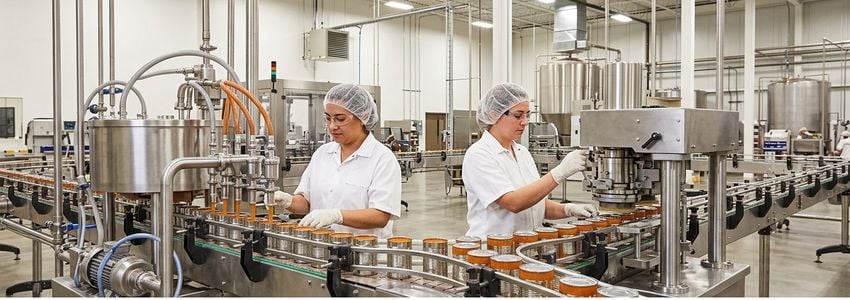
Commercial canning equipment financing works well for a wide range of food and beverage businesses, including:
- Craft beverage producers — breweries, hard seltzer makers, and beverage co-packers moving from kegging to canning or expanding can line capacity
- Specialty food brands — sauce, soup, and preserve makers scaling from farmers market volumes to retail distribution
- Co-packing and contract manufacturing operations — businesses that can products on behalf of other brands and need to expand throughput
- Agricultural producers — farms and cooperatives canning produce, meats, or dairy products for direct sale or wholesale
- Seafood and meat processors — operations that need retort and sterilization capability for shelf-stable protein products
- Growing food startups — businesses that have proven demand through a co-packer relationship and are ready to bring canning in-house
If your business has a signed purchase order, a new retail account, or growing demand you cannot currently meet with manual seaming, equipment financing is typically the fastest path to added capacity.
Lenders also look favorably on businesses that can demonstrate consistent sales history, even at a small scale, because it shows the new equipment is replacing a genuine bottleneck rather than speculative capacity. A farmers market vendor with two years of steady sales and a signed letter of intent from a regional grocer, for example, presents a much stronger application than a brand-new company with no sales history at all. If you fall into the newer business category, consider starting with a smaller, lower-cost piece of equipment and building a track record before financing a larger integrated line.
Financing Options Compared
| Option | Ownership | Best For | Typical Term |
|---|---|---|---|
| Equipment Loan | You own the equipment immediately | Businesses planning to use the line long-term | 3-7 years |
| Equipment Lease | Lender owns; option to buy at term end | Businesses wanting lower monthly payments or frequent upgrades | 2-5 years |
| SBA 504 Loan | You own the equipment | Larger, long-life fixed asset purchases with lower rates | 10-25 years |
| Working Capital Loan | N/A (unsecured, general use) | Supplementing equipment costs or covering install/setup | 6-24 months |
For most independent food producers, a direct equipment loan or lease is the fastest and simplest route. The SBA 504 loan program can be a strong option for larger, long-life equipment purchases when a business qualifies and can work with a Certified Development Company, but the application timeline is typically longer than a direct equipment financing product.
Some producers also consider a business line of credit to cover smaller equipment purchases or to bridge the gap between financing approval and vendor delivery. A revolving line does not typically offer the same fixed, predictable payment structure as a dedicated equipment loan, but it can be useful for producers who need flexibility to purchase smaller add-on components, such as labeling machines or conveyor sections, without initiating a new financing application each time.
Don't Let Outdated Equipment Cap Your Output
See your financing options for new or used canning equipment in minutes, with no obligation.
Get Started →How Crestmont Capital Helps Food Producers Finance Canning Equipment
Crestmont Capital works with food and beverage businesses across the country to structure financing for production equipment, including food equipment financing and general equipment financing for both new and used machinery. Our team understands that canning lines are capital-intensive purchases, and we structure terms around your production cycle rather than forcing a one-size-fits-all payment schedule.
For businesses that prefer to preserve ownership flexibility, we also offer equipment leasing options that keep monthly payments lower while still providing a path to ownership. If your business also needs working capital alongside equipment financing, for example to cover ingredient inventory as you ramp up production, our working capital loans can complement an equipment purchase.
Businesses evaluating a larger capital project, including a full canning line combined with facility upgrades, may also want to review our breakdown of food processing equipment financing and our guide to blast freezer financing, since many canning operations also require cold storage capacity to support shelf-stable and frozen product lines. We also offer SBA loan options for businesses that qualify and want longer terms on larger equipment investments.
Our team has worked with food producers at every stage, from a first-time canning line purchase to a multi-million dollar facility expansion, and we know the questions that matter most: how quickly can the equipment be installed and running, what happens if production volume changes, and how does the payment schedule align with cash flow through busy and slow seasons. We build financing structures around those realities rather than a generic template.
Real-World Scenarios
Scenario 1: The craft brewery scaling into cans. A regional brewery producing 4,000 barrels annually had been selling exclusively in kegs and bottles. After landing distribution in three new states, the brewery needed a mobile canning line capable of running 60 cans per minute. Equipment financing covered the $85,000 line with a five-year term, letting the brewery keep its cash reserves intact for the additional hop and grain inventory the new accounts required.
Scenario 2: The hot sauce brand outgrowing its co-packer. A hot sauce company that had been using a co-packer for two years secured a national retail placement requiring volumes the co-packer could no longer accommodate on short notice. Financing a semi-automatic filler and seamer for $42,000 allowed the brand to bring production in-house within six weeks, meeting the retailer's delivery deadline.
Scenario 3: The seafood processor adding shelf-stable products. A seafood processor that had only sold fresh and frozen product wanted to add a shelf-stable canned tuna line to reach new grocery channels. Financing covered a retort sterilization system and integrated canning line for approximately $210,000, structured over seven years to match the equipment's expected service life.
Scenario 4: The farm cooperative canning surplus produce. A vegetable farming cooperative wanted to reduce spoilage losses by canning surplus produce at peak harvest. A used canning line, financed for $28,000 over four years, let the cooperative convert unsold produce into a shelf-stable product line sold through farmers markets and a regional grocery chain.
Scenario 5: The specialty soup maker replacing aging equipment. A specialty soup producer running a 12-year-old seamer began experiencing seal failures that led to product recalls risk. Refinancing into a new automated seamer for $65,000 eliminated the seal defects and increased line speed by 40 percent, paying for itself within 18 months through reduced waste and higher throughput.
Scenario 6: The pet food company expanding into wet food cans. A dry pet food manufacturer wanted to launch a wet food product line to compete with larger national brands. Financing a dedicated $95,000 canning line for pet food, separate from its existing dry food packaging equipment, allowed the company to launch the new product category within four months without disrupting its core production schedule.
These scenarios share a common thread: in each case, the business had already validated demand for its product, whether through existing sales, a signed contract, or a clear expansion opportunity. Equipment financing worked because it matched capital investment to a specific, identifiable growth trigger rather than a speculative bet on future sales. This is the pattern lenders look for when evaluating a canning equipment application, and it is the pattern that tends to produce the strongest return on the investment.
Key Stat: According to industry analysis referenced by Forbes, automation is becoming increasingly accessible for small food manufacturers, enabling scalability without requiring the massive capital outlays that once limited upgrades to only the largest producers.
Frequently Asked Questions
Turn Growing Demand Into Production Capacity
Apply today and find out how quickly you can add or upgrade your canning line.
Apply Now →Next Steps
Identify the specific fillers, seamers, or line you need and obtain a formal price quote.
Have three to six months of recent business bank statements ready to speed up underwriting.
Apply online in minutes with no obligation to move forward.
Compare terms, choose your structure, and get your equipment ordered and installed.
Common Mistakes to Avoid When Financing Canning Equipment
Even well-run food businesses can stumble on a few predictable pitfalls when financing production equipment for the first time. Avoiding these mistakes can save both time and money over the life of the loan.
- Underestimating installation and facility costs. Retort systems, in particular, often require electrical or plumbing upgrades. Build these costs into your financing request rather than discovering them after the equipment arrives.
- Financing more capacity than current demand supports. A canning line sized for volumes you do not yet have creates payment pressure without matching revenue. Size your purchase to your near-term growth trajectory, with a plan to add capacity again later if needed.
- Overlooking maintenance and training costs. New equipment, especially automated lines, often requires operator training and a service contract. Factor these ongoing costs into your overall budget, not just the equipment price itself.
- Choosing the longest term without regard for equipment life. Stretching payments beyond the useful life of the equipment can leave you paying for a machine that is already worn out or obsolete.
- Skipping the vendor comparison step. Equipment pricing and lead times vary significantly between manufacturers. Get at least two or three quotes before finalizing your financing request.
Conclusion
Commercial canning equipment financing gives food and beverage producers a practical path to add capacity, meet new retail or distribution demand, and modernize aging production lines without depleting cash reserves. Whether you need a single semi-automatic seamer or a fully integrated canning and retort system, structuring the purchase as equipment financing keeps your working capital available for the ingredients, labor, and growth initiatives that keep your business moving forward. If you are ready to explore your options, Crestmont Capital can help you find a financing structure that fits your production goals and your budget.
Disclaimer: The information provided in this article is for general educational purposes only and is not financial, legal, or tax advice. Funding terms, qualifications, and product availability may vary and are subject to change without notice. Crestmont Capital does not guarantee approval, rates, or specific outcomes. For personalized information about your business funding options, contact our team directly.








