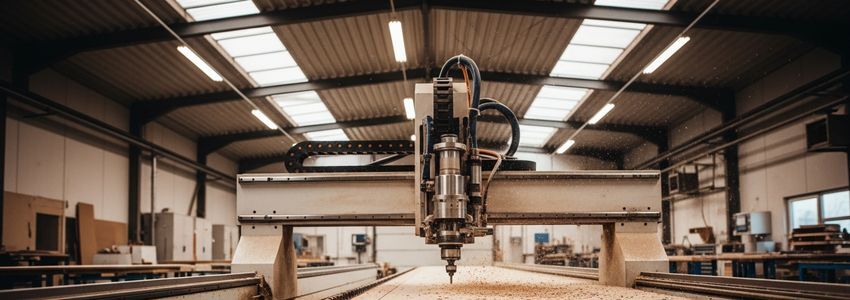
CNC (Computer Numerical Control) tables are among the most transformative pieces of equipment a manufacturing, fabrication, or woodworking business can acquire. These precision machines automate cutting, engraving, routing, and machining with accuracy that manual methods simply cannot match. But they come with a substantial price tag - ranging from $5,000 for entry-level routers to well over $500,000 for industrial plasma and laser cutting systems. CNC table financing and leasing give business owners a realistic path to acquiring this technology without depleting working capital or taking on unmanageable debt.
This guide covers everything you need to know about financing or leasing a CNC table - from how the process works and what lenders look for, to the types of machines covered and the best strategy for your situation.
In This Article
- What Is CNC Table Financing?
- Types of CNC Tables You Can Finance
- Financing vs. Leasing: Which Is Right for You?
- How CNC Table Financing Works
- Who Qualifies for CNC Equipment Financing?
- CNC Industry by the Numbers
- Benefits of Financing Your CNC Table
- How Crestmont Capital Helps
- Real-World Scenarios
- Financing Options Comparison
- How to Get Started
- Frequently Asked Questions
What Is CNC Table Financing?
CNC table financing is a type of equipment financing specifically designed to help businesses acquire CNC machines - including routers, plasma cutters, laser cutters, water jet cutters, and milling machines - through a structured loan or lease arrangement. Rather than paying the full purchase price upfront, the business makes manageable monthly payments over a set term, typically 24 to 84 months.
The CNC table itself typically serves as collateral for the loan. This means lenders have real security backing the deal, which generally results in more favorable rates compared to unsecured financing. Businesses from woodworking shops and metal fabricators to sign makers and aerospace component manufacturers use this financing strategy every day.
CNC table financing is part of the broader equipment financing category - one of the most popular and accessible forms of business funding in the U.S. According to the Equipment Leasing and Finance Association (ELFA), over 80% of U.S. businesses that use equipment rely on some form of equipment financing or leasing. This tool is not just for large manufacturers; small machine shops, custom fabricators, and startup production facilities use it routinely.
Key Point: CNC table financing lets you acquire equipment that generates revenue immediately - often allowing the machine to pay for itself through increased production output and new contract capacity.
Types of CNC Tables You Can Finance
Not all CNC tables are the same, and the financing terms can vary based on the machine type, cost, and expected useful life. Here are the most common types that businesses finance:
CNC Router Tables
Used primarily in woodworking, sign making, plastics, and composites. Prices typically range from $5,000 to $150,000. These are among the most commonly financed CNC machines for small-to-midsize shops. A professional cabinet maker or custom furniture shop may use a CNC router table to dramatically accelerate production while maintaining precise joinery.
CNC Plasma Cutting Tables
Used for cutting metal sheets with a plasma torch. Cost range: $10,000 to $300,000+. Metal fabricators, auto body shops, and HVAC contractors rely on these for fast, accurate cuts on steel, aluminum, and stainless steel. Financing plasma tables is common because the per-cut economics are so strong once volume picks up.
CNC Laser Cutting Tables
Used for ultra-precise cutting of metals, wood, acrylic, and composites. Prices range from $15,000 for entry CO2 systems to $1 million+ for industrial fiber laser systems. Laser tables are popular in electronics manufacturing, aerospace, and custom fabrication. Many lenders offer favorable terms on laser cutters because they hold value well and have strong demand in the secondary market.
CNC Water Jet Tables
Used to cut almost any material without heat distortion - including thick metals, stone, glass, and rubber. Cost range: $50,000 to $500,000+. Water jet tables are common in aerospace, architecture, and specialized manufacturing. Their high cost makes financing virtually essential for all but the largest operations.
CNC Milling Machines and Machining Centers
Used for precision metal parts production. Prices range from $20,000 for basic vertical mills to $500,000+ for multi-axis machining centers. Job shops, automotive part suppliers, and defense contractors use these regularly, and financing is essentially standard practice in the industry.
Ready to Finance Your CNC Equipment?
Get competitive rates and fast approvals from the #1 business lender in the U.S. Apply in minutes - no obligation.
Apply Now →Financing vs. Leasing: Which Is Right for You?
Before you apply, it is important to understand the key difference between financing and leasing a CNC table. Both spread the cost over time, but they have different implications for ownership, accounting, and end-of-term options.
| Factor | Equipment Financing (Loan) | Equipment Leasing |
|---|---|---|
| Ownership | You own the equipment outright after final payment | Lender retains ownership during lease term |
| Monthly Payment | Typically higher | Typically lower |
| Down Payment | May require 10-20% down | Often requires first/last payment only |
| End of Term | Equipment is yours | Buy out, renew, or return the equipment |
| Technology Obsolescence | You bear the risk of equipment aging | Easier to upgrade at end of lease |
| Balance Sheet | Asset and liability appear on balance sheet | Operating lease may keep off balance sheet |
| Best For | Businesses that want long-term ownership | Businesses that want flexibility and lower payments |
For most manufacturing businesses that plan to use a CNC table for 5 years or more, equipment financing often makes the most sense because total cost of ownership is lower and the asset builds equity. For businesses in fast-moving technology sectors, leasing provides the flexibility to upgrade without being stuck with outdated equipment.
How CNC Table Financing Works
The process of financing a CNC table is straightforward and moves much faster than traditional bank loans. Here is the typical workflow:
Quick Guide
How CNC Table Financing Works - At a Glance
Identify the CNC table you need and get a quote from the vendor.
Apply online with basic business info, time in business, and revenue figures.
Alternative lenders can approve within hours. Traditional banks may take 1-4 weeks.
The lender pays the vendor directly, and you begin making monthly payments.
Put your CNC table to work generating revenue while making predictable monthly payments.
Who Qualifies for CNC Equipment Financing?
Qualification criteria vary by lender and loan amount, but here are the general benchmarks most equipment lenders use:
- Time in business: Most lenders require at least 6 months to 2 years in operation. Startup businesses may qualify through startup-specific programs.
- Credit score: Personal credit scores of 600+ are often sufficient for equipment loans. Higher scores (680+) unlock better rates and terms.
- Annual revenue: Most alternative lenders require $100,000 or more in annual revenue.
- Industry: Manufacturing, fabrication, woodworking, metalworking, sign making, and aerospace are all strong industries for equipment lending.
- Loan amount: Loans under $150,000 often require minimal documentation. Larger loans will require financial statements and tax returns.
Good to Know: Bad credit does not automatically disqualify you for CNC table financing. Because the equipment serves as collateral, lenders may approve borrowers with credit scores as low as 550-580, particularly if revenue is strong and the business has been operating for several years.
CNC Industry by the Numbers
By the Numbers
CNC Equipment Financing - Key Statistics
$100B+
Global CNC machine market size (2024)
80%
of U.S. businesses use equipment financing or leasing
24-84
Typical loan term range in months
24hrs
Typical alternative lender approval time
Benefits of Financing Your CNC Table
There are compelling reasons why most businesses choose to finance rather than pay cash for CNC equipment - even when they have the cash available.
Preserve Working Capital
Spending $150,000 in cash on a CNC table leaves your business with reduced reserves for payroll, materials, marketing, and unexpected expenses. Financing spreads that cost over time while you continue to deploy your cash where it generates the highest return. A business with strong cash flow can often generate more value from $150,000 in working capital than the interest cost of a financing arrangement.
Immediate Revenue Generation
A CNC table that is being financed is still working and generating revenue from day one. Unlike a cash purchase that depletes your resources, financing lets the machine pay for itself through the production it enables. Many shops find that the additional capacity from a new CNC table pays for its monthly note within the first few months of operation.
Upgrade Flexibility
CNC technology continues to advance rapidly. Shorter lease terms give businesses the flexibility to upgrade to faster, more capable equipment at the end of the term rather than being locked into aging machinery for a decade. This is particularly valuable in laser cutting and multi-axis machining where the technology is evolving quickly.
Predictable Monthly Costs
Fixed monthly payments make budgeting straightforward. You know exactly what your equipment cost is each month, making cash flow planning much simpler than managing variable capital expenditures.
Build Business Credit
Making on-time payments on an equipment loan strengthens your business credit profile. A stronger credit profile makes future financing easier and less expensive - a compounding benefit that grows over time. This is especially important for newer businesses that are still establishing their financial history.
Important Note: Always consult your accountant or financial advisor regarding the specific accounting and tax treatment of your equipment financing or lease arrangement.
How Crestmont Capital Helps with CNC Table Financing
Crestmont Capital specializes in equipment financing for manufacturing and fabrication businesses across the United States. As the #1 business lender in the country, Crestmont has helped thousands of businesses acquire the equipment they need to grow - including CNC routers, plasma tables, laser cutters, and machining centers.
What sets Crestmont apart is a combination of speed, flexibility, and personalized service. Rather than forcing every business into a one-size-fits-all loan structure, Crestmont's advisors work to understand your specific situation - your revenue, cash flow, industry, and growth plans - and structure financing that genuinely works for your business.
Crestmont offers capital equipment financing for machines ranging from $5,000 entry-level CNC routers to multi-million dollar industrial laser and water jet systems. Whether you are a three-person custom shop or a 50-employee fabrication facility, the team at Crestmont has the programs and expertise to help you get funded.
Crestmont also works with businesses at every stage of credit development. Strong credit earns better rates. But if your credit history has some challenges, Crestmont has programs designed for those situations too. The team considers the full picture of your business - not just a three-digit score.
Additionally, if you are looking to complement your CNC table with broader financing - such as a business line of credit for materials and operational expenses - Crestmont offers that as well, allowing you to build a complete financing strategy for your growth.
Talk to a Crestmont Equipment Financing Specialist
Get a customized CNC financing quote within hours. No hard credit pull required to see your options.
Get Your Quote →Real-World Scenarios: CNC Table Financing in Practice
Understanding how CNC table financing works in the real world helps illustrate whether it is the right move for your business. Here are six scenarios that reflect common situations our clients face.
Scenario 1 - The Growing Woodworking Shop
A custom cabinet maker in Ohio had been hand-routing and using a basic table saw for years. Business was growing, but production was limited. A $35,000 CNC router financed over 48 months at a competitive rate resulted in monthly payments under $900. Within 90 days, the shop had landed two large commercial contracts it could not have handled before. The machine paid for itself in the first year.
Scenario 2 - The Metal Fabricator Upgrading to Plasma
A structural steel fabricator in Texas was using manual plasma torches for all cuts. A $120,000 CNC plasma cutting table financed over 60 months reduced material waste by 18% and cut job completion time in half. The monthly payment was offset within the first month by reduced labor and material costs alone.
Scenario 3 - The Sign Shop Adding Laser Capability
A sign company in Florida wanted to offer laser-cut acrylic and metal products to compete with larger regional players. A $28,000 fiber laser table financed over 36 months added an entirely new revenue stream. The shop now books laser work that generates more than triple the monthly financing cost.
Scenario 4 - The Startup Machine Shop
A machinist with 15 years of experience at a large manufacturer wanted to start his own job shop. With only one year in business and limited credit history, he used a startup equipment financing program to acquire a $65,000 vertical machining center. The specialized program took his industry experience and equipment value into account alongside his limited credit history.
Scenario 5 - The Aerospace Supplier Scaling Up
An aerospace component supplier in California received a contract requiring tolerances only achievable on a 5-axis machining center priced at $350,000. Equipment financing allowed them to take the contract without depleting reserves needed for materials and compliance costs. The contract revenue covered the monthly note within the first billing cycle.
Scenario 6 - The Custom Furniture Maker Leasing for Flexibility
A high-end furniture maker in New York preferred leasing over buying because CNC router technology was advancing rapidly. A 36-month lease on a $55,000 machine gave them state-of-the-art capability at a lower monthly cost, with the option to upgrade at lease end. When the lease expired, they moved to a newer machine with expanded capabilities at comparable payments.
Comparing CNC Table Financing Options
Not all CNC table financing comes from the same source, and the type of lender you choose will significantly impact your rate, terms, and approval speed.
| Lender Type | Typical Rate | Speed | Requirements | Best For |
|---|---|---|---|---|
| Traditional Bank | 6-10% APR | 2-6 weeks | Strong credit, 2+ years | Established businesses with excellent credit |
| SBA Loan | 7-12% APR | 4-12 weeks | Extensive documentation | Long-term, larger equipment purchases |
| Alternative Lender | 8-25% APR | 24-72 hours | 6+ months, $100K+ revenue | Fast approvals, growing businesses |
| Equipment Leasing Co. | Varies by structure | 1-5 business days | Moderate credit, proof of revenue | Businesses wanting upgrade flexibility |
| Vendor Financing | Promotional or standard | Same-day to 1 week | Varies by vendor | Buyers purchasing directly from manufacturer |
Compare Your CNC Financing Options Today
Crestmont Capital has programs for businesses at every stage - from startups to established manufacturers. Apply in minutes.
Apply Now →How to Get Started with CNC Table Financing
Contact your preferred CNC vendor and get a written quote for the machine you need.
Complete the quick application at offers.crestmontcapital.com/apply-now - takes just a few minutes.
A Crestmont Capital advisor will review your application and present your best financing options.
Conclusion
CNC table financing is one of the most strategically sound moves a manufacturing or fabrication business can make. Rather than holding capital hostage in a depreciating asset, you leverage financing to acquire productive capacity while keeping working capital flexible. The monthly payment model lets the machine prove its own value before you have spent the full purchase price.
Whether you need a $15,000 CNC router for a small woodworking shop or a $400,000 industrial laser cutting system for a high-volume fabrication facility, the fundamentals are the same. Crestmont Capital is ready to help you find the right structure with fast approvals, competitive rates, and programs designed for businesses at every stage. Apply today and get your CNC table working for your business.
Frequently Asked Questions
Disclaimer: The information provided in this article is for general educational purposes only and is not financial, legal, or tax advice. Funding terms, qualifications, and product availability may vary and are subject to change without notice. Crestmont Capital does not guarantee approval, rates, or specific outcomes. For personalized information about your business funding options, contact our team directly.