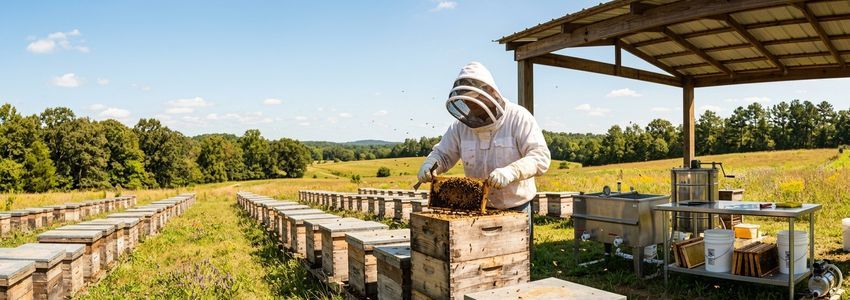
Running a profitable commercial apiary means more than tending hives. It means having the right extraction, processing, and storage equipment to turn a honey harvest into revenue before the window closes. Beekeeping equipment financing gives beekeepers and honey producers a way to acquire that equipment now and pay for it over time, instead of draining cash reserves right before the busiest season of the year.
In This Article
- What Is Beekeeping Equipment Financing?
- Key Benefits of Financing Your Apiary Equipment
- How Beekeeping Equipment Financing Works
- Types of Financing for Beekeeping and Honey Operations
- Who Qualifies for This Financing?
- Comparing Financing Options
- How Crestmont Capital Helps Beekeepers
- Real-World Scenarios
- Frequently Asked Questions
- Next Steps
- Conclusion
What Is Beekeeping Equipment Financing?
Beekeeping equipment financing is a category of small business funding designed to help commercial beekeepers, honey producers, and pollination service operators purchase the specialized equipment their operations depend on. Rather than a single loan product, it is an umbrella term covering equipment loans, equipment leases, working capital loans, and lines of credit, all applied to the unique needs of the apiary and honey production industry.
This type of financing applies to a wide range of commercial operators:
- Commercial Honey Producers: Operations that harvest, extract, and bottle honey for wholesale or retail sale.
- Migratory Pollination Services: Beekeepers who truck hives between almond orchards, fruit farms, and other crops for pollination contracts.
- Hobbyist-to-Commercial Transitions: Beekeepers scaling from a handful of backyard hives into a registered commercial apiary business.
- Value-Added Honey Product Makers: Businesses producing creamed honey, honey-infused products, mead, beeswax candles, or cosmetics.
- Queen and Nuc Breeders: Operations that raise and sell queen bees or nucleus colonies to other beekeepers.
If your business depends on hives, extraction equipment, or honey processing infrastructure, this type of financing is built for your specific capital needs, whether you are buying your first commercial extractor or outfitting an entire honey house.
Key Benefits of Financing Your Apiary Equipment
Paying cash for a full commercial extraction setup can tie up capital you need for hive maintenance, bee stock replacement, and seasonal labor. Financing spreads that cost out while letting you use the equipment right away. Here is where it makes the biggest difference.
Scale Extraction Capacity Before Harvest
A radial or tangential extractor with higher frame capacity can cut extraction time dramatically during peak harvest. Financing lets you upgrade before the nectar flow starts, rather than bottlenecking your entire operation with an undersized extractor.
Preserve Cash for Hive Health and Labor
Bee stock replacement, mite treatments, and seasonal labor are ongoing costs that do not pause for equipment purchases. Financing equipment separately keeps your working capital available for the day-to-day costs of keeping colonies healthy and productive.
Upgrade Processing and Bottling Infrastructure
Moving from bulk drum sales to retail-ready bottled honey requires uncapping machines, settling tanks, filtration systems, and bottling lines. Financing this infrastructure allows smaller operations to capture higher retail margins instead of selling at wholesale bulk prices.
Add Hive Boxes and Frames Ahead of Splits
- Langstroth or top-bar hive boxes for colony splits and expansion
- Frames, foundation, and queen excluders
- Protective suits, veils, and smokers for seasonal labor
- Bee trucks, forklifts, and pallet equipment for migratory operations
Expanding hive count ahead of a growth season requires upfront capital for boxes and frames well before that revenue materializes. Financing bridges that gap.
Manage Seasonal Cash Flow
Most honey revenue is concentrated in a few months each year, while equipment and hive costs are ongoing. A business line of credit can smooth out that seasonal imbalance, giving you access to capital between harvests without taking on a large lump-sum loan.
Ready to Expand Your Apiary Operation?
Get fast, flexible financing from the #1 business lender in the U.S. No obligation - apply in minutes.
Apply NowHow Beekeeping Equipment Financing Works
The process for financing apiary and honey production equipment follows a similar path to other small business equipment financing, with some added flexibility for the seasonal nature of the industry.
- Identify Your Equipment Need: Get a quote or invoice for the extractor, uncapping machine, bottling line, hive equipment, or vehicle you want to purchase.
- Submit a Simple Application: Provide basic information about your beekeeping business, including time in operation, annual revenue, and the amount you are seeking.
- Speak With a Financing Specialist: A specialist reviews your business and helps match you with the equipment loan, lease, or working capital product that fits your seasonal cash flow.
- Submit Supporting Documents: Most lenders request 3-6 months of business bank statements. Larger requests may require tax returns or a simple profit and loss summary.
- Get Approved and Funded: Once approved, you sign the agreement electronically and funds are released, often within a few business days, so equipment arrives before your season starts.
Quick Guide
How Beekeeping Equipment Financing Works - At a Glance
Submit basic details about your apiary business and the equipment you need to purchase.
A financing specialist reviews your revenue and matches you with equipment loan or lease terms.
Review your offer, e-sign, and receive funds, often within a few business days.
Put your new extractor, uncapping line, or bottling equipment to work ahead of harvest season.

Types of Financing for Beekeeping and Honey Operations
Different financial products suit different needs within a beekeeping operation. Understanding each option helps you match the right tool to the right expense.
Equipment Financing
Equipment financing is used to purchase honey extractors, uncapping machines, settling tanks, bottling equipment, and other apiary machinery. The equipment itself typically serves as collateral, which can make approval easier even for newer operations.
- Best for: Extractors, uncapping lines, bottling equipment, refrigeration units.
- Terms: Repayment terms typically span 2 to 7 years, often matched to the expected lifespan of the equipment.
Working Capital Loans
Working capital loans provide a lump sum for general operating needs, such as hive expansion, seasonal labor, or bee stock replacement ahead of a growth season.
- Best for: Hive boxes, frames, seasonal labor, and pre-harvest supply purchases.
- Terms: Typically 3 to 18 months.
Business Line of Credit
A revolving line of credit is well suited to the seasonal nature of honey production. Draw funds as needed between harvests and only pay interest on what you use.
- Best for: Bridging the gap between harvest seasons and managing unpredictable expenses.
- Terms: Revolving credit, access funds on demand.
SBA Loans
SBA loans are partially guaranteed by the U.S. Small Business Administration and can offer longer terms and lower rates for larger investments, such as building a dedicated honey processing facility.
- Best for: Honey house buildouts, major facility expansion, large equipment purchases.
- Terms: Long repayment terms with a slower approval process, often 30 to 90 days.
Operations that also run pollination contracts and move hives between farms may find useful parallels in our guide to agricultural equipment financing, which covers similar seasonal financing challenges for farm-adjacent businesses.
| Financing Type | Best Use Case | Funding Speed | Typical Term |
|---|---|---|---|
| Equipment Financing | Extractors, uncapping machines, bottling lines | 2-5 days | 2-7 years |
| Working Capital Loan | Pre-season hive expansion, seasonal labor | 1-2 days | 3-18 months |
| Business Line of Credit | Managing seasonal honey flow cash gaps | 1-3 days | Revolving |
| SBA Loan | Facility buildout, large-scale expansion | 30-90 days | 7-25 years |
Key Stat: According to the U.S. Census Bureau, honey production and related apiary products contribute hundreds of millions of dollars annually to U.S. agricultural output, with commercial beekeeping operations increasingly relying on mechanized extraction equipment to scale output.
Who Qualifies for This Financing?
Lenders evaluate several factors when reviewing an application for beekeeping equipment financing. While requirements vary by lender and product, most will assess the following.
Time in Business
Most lenders prefer at least 6 to 12 months of operating history, though newer apiaries transitioning from hobbyist to commercial status may still qualify for smaller equipment loans, especially with strong personal credit or documented pre-orders.
Annual Revenue
Honey sales, pollination contract income, and value-added product revenue all count toward the revenue picture lenders review. Consistent deposits, even if seasonal, demonstrate a viable business.
Credit Profile
A personal credit score of 600 or higher typically unlocks better rates, though some equipment financing products are available to business owners with lower scores, particularly when the equipment itself secures the loan.
Business Financials
Bank statements showing consistent seasonal deposits, along with any pollination contracts or wholesale purchase agreements, help strengthen an application, especially for larger funding requests.
Industry-Specific Factors
Lenders familiar with agricultural and apiary businesses understand seasonality is normal. Diversified revenue, such as combining honey sales with pollination contracts or queen breeding, is often viewed favorably.
Pro Tip: Before applying, gather your last 3-6 months of business bank statements and a rough count of your hive inventory. Lenders evaluating agricultural equipment financing want to see consistent honey sales revenue or pollination contract income, not just hive count.
How Crestmont Capital Helps Beekeepers
Crestmont Capital understands that beekeeping and honey production run on a different calendar than most small businesses. Equipment needs to be in place before the nectar flow, not after, and cash flow follows a distinctly seasonal rhythm from spring buildup through fall harvest.
Rather than the rigid requirements of a traditional bank, Crestmont Capital offers a streamlined path to capital through our commercial financing and equipment financing products, built around your business's actual cash flow rather than a rigid seasonal snapshot.
Here is what sets our approach apart:
- Speed: Our online application takes minutes, with approvals often issued within hours and funding in as little as a few business days, so your extractor or bottling line is ready before harvest.
- Flexibility: From equipment financing to working capital and lines of credit, we structure funding around your seasonal revenue pattern instead of a rigid monthly schedule.
- Realistic Underwriting: We look at your total business picture, including pollination contracts and seasonal sales, not just a single credit number.
- Dedicated Support: A financing specialist walks you through your options and stays available as your operation grows season over season.
Let Crestmont Capital Fund Your Next Season
From extractors to hive frames, get the working capital your honey business needs, deposited fast.
Get Started TodayReal-World Scenarios
Here is how beekeeping equipment financing plays out for different types of commercial apiary and honey operations.
Scenario 1: The Growing Honey Producer's Extractor Upgrade
The Business: "Golden Comb Apiaries," a 200-hive operation selling bottled honey at farmers markets and to local grocers.
The Challenge: Their manual 4-frame extractor takes days to process a harvest that keeps growing each year, delaying bottling and risking product quality.
The Solution: The owner secures $18,000 in equipment financing to purchase a motorized 20-frame radial extractor and an uncapping tank.
The Outcome: Extraction time drops from four days to less than one, allowing the operation to bottle and sell honey faster while it is freshest, and take on two new wholesale grocery accounts the following season.
Scenario 2: The Migratory Pollination Operation's Fleet Expansion
The Business: "Blue Ridge Pollination Services," a commercial beekeeping operation that trucks 800 hives to almond orchards each spring.
The Challenge: A new pollination contract requires moving 300 additional hives, but their current flatbed truck and forklift cannot handle the added volume.
The Solution: The business uses a $45,000 equipment loan to purchase a used flatbed truck and a hive-loading forklift attachment.
The Outcome: The operation fulfills the larger contract on schedule, adding a six-figure pollination revenue stream while keeping existing equipment dedicated to their established routes.
Scenario 3: The New Commercial Beekeeper's Honey House Buildout
The Business: "Prairie Gold Honey Co.," a beekeeper transitioning from 50 backyard hives to a licensed commercial operation.
The Challenge: State regulations require a dedicated honey processing room with commercial-grade flooring, ventilation, and food-safe extraction equipment before selling wholesale.
The Solution: The owner combines a $12,000 working capital loan for facility improvements with a smaller equipment loan for a commercial extractor and bottling setup.
The Outcome: The business becomes licensed for wholesale sales, securing its first grocery store placement within six months of completing the buildout.
Comparing Financing Options
Choosing the right financing product depends on what you are funding and how quickly you need results. Here is a deeper look at the key trade-offs.
Loan vs. Line of Credit
The core decision most beekeepers face is between a term loan and a line of credit.
- A term loan works best for a specific, known purchase, such as a new extractor or bottling line, where you know the exact cost upfront.
- A line of credit is better suited to managing the seasonal ebb and flow of honey production revenue, where expenses arise unpredictably between harvests.
Use a loan to buy equipment, and a line of credit to manage the calendar between harvests.
Speed vs. Cost
Faster funding often comes with a cost trade-off.
- Faster options like working capital loans can fund in a day or two, ideal for last-minute pre-harvest needs, but often carry higher costs than slower options.
- Slower options like SBA loans offer the best rates and longest terms but require weeks or months of processing time.
Weigh whether the opportunity, like catching harvest season on time, justifies the cost of faster capital.
Collateral Requirements
Consider whether you want the purchased equipment to secure the loan.
- Secured equipment loans use the extractor, truck, or bottling equipment itself as collateral, often resulting in easier approval and better terms.
- Unsecured products, like many working capital loans, do not require specific collateral but may come with higher rates or a personal guarantee requirement.
Don't Let Equipment Costs Slow Your Growth
Apply today and see what beekeeping equipment financing options you qualify for. No obligation.
Apply NowFrequently Asked Questions
What is beekeeping equipment financing?
Beekeeping equipment financing is a type of business funding used to purchase or lease equipment for commercial apiaries and honey production, including extractors, uncapping tools, hive components, and bottling machinery. It allows beekeepers to spread the cost of expensive equipment over time instead of paying the full amount upfront.
How much does commercial beekeeping equipment cost?
Costs vary widely by scale. A manual honey extractor can run $500 to $2,000, while a motorized radial extractor for a larger operation can cost $5,000 to $20,000 or more. Full processing lines with uncapping machines, settling tanks, and bottling equipment can exceed $50,000 for larger commercial apiaries.
What can I use beekeeping equipment financing for?
Funds can be used for honey extractors, uncapping machines, settling and filtering tanks, bottling and labeling equipment, hive boxes and frames, protective gear, bee trucks or trailers, refrigerated storage, and facility buildouts for honey processing rooms.
Do I need good credit to qualify?
Not necessarily. While a stronger personal credit score (typically 600 or higher) opens up better rates, many equipment financing products weigh business revenue and time in operation more heavily than credit alone. Newer apiaries with limited credit history may still qualify for smaller equipment loans.
How fast can I get funded for honey extraction equipment?
Equipment financing for beekeeping operations is often funded within 2 to 5 business days once documentation is submitted and approved. Working capital loans and lines of credit can sometimes fund even faster, within 24 to 48 hours.
Can a new or small-scale beekeeping business qualify?
Yes, though options may be more limited. Newer operations with less than a year in business can often qualify for smaller equipment loans, especially if the owner has strong personal credit or can show pre-orders, pollination contracts, or farmers market sales history.
Is equipment financing better than a business line of credit for beekeepers?
It depends on your need. Equipment financing is ideal for a specific, known purchase like an extractor, since the equipment itself often serves as collateral. A line of credit is better for managing the seasonal ebb and flow of honey harvest cash flow throughout the year.
What documents do I need to apply?
Most lenders require basic business information, 3-6 months of business bank statements, and details about the equipment you want to purchase, including a quote or invoice. Larger loans or SBA financing may require tax returns and financial statements.
Can I finance a honey processing facility buildout, not just equipment?
Yes. Many commercial financing products, including working capital loans and SBA loans, can be used for facility improvements such as building out a dedicated honey house, adding commercial refrigeration, or upgrading electrical systems to run larger extraction equipment.
How does seasonality affect beekeeping loan repayment?
Beekeeping and honey production are highly seasonal, with most revenue concentrated around harvest and pollination season. Many lenders offer flexible repayment structures, and some working capital products adjust based on incoming revenue, which can help smooth out off-season cash flow.
What is the difference between financing and leasing beekeeping equipment?
With financing, you take out a loan to purchase the equipment and own it outright once the loan is repaid. With leasing, you make payments to use the equipment for a set term, often with an option to purchase at the end. Financing typically makes sense if you plan to use the equipment for many seasons; leasing can help if technology changes quickly or you want lower upfront payments.
Can I use beekeeping equipment financing for a mobile pollination business?
Yes. Commercial pollination operations that move hives between farms often need financing for bee trucks, forklifts, hive-moving equipment, and specialized trailers, in addition to standard extraction and processing gear. These are typically financed the same way as stationary apiary equipment.
Will applying for financing affect my credit score?
Most online lenders, including Crestmont Capital, use a soft credit pull for the initial application, which does not affect your credit score. A hard credit pull typically only occurs once you move forward with a specific financing offer.
What if I only need to finance a single piece of equipment, like an extractor?
Smaller equipment loans for single purchases like an extractor or uncapping machine are common and often have a simpler application process than larger facility loans. Many lenders offer equipment financing starting at just a few thousand dollars.
How do I get started with beekeeping equipment financing?
Start by identifying the specific equipment you need and getting a quote from your supplier. Then complete a simple online application with your business details and revenue information. A financing specialist will review your options and help match you with the right loan or lease structure for your apiary.
Next Steps
Getting started with beekeeping equipment financing is straightforward. Follow these steps to move from application to funded equipment.
Get a Quote for Your Equipment
Reach out to your equipment supplier for a quote on the extractor, uncapping machine, or hive equipment you need.
Apply Online in Minutes
Complete our simple application with basic business details. It will not impact your credit score.
Review Your Offer With a Specialist
A dedicated financing specialist walks you through your approved options and helps you choose the right term.
Get Funded and Get to Work
Once approved, funds are released and your new equipment can be ordered and in place before your next season.
Conclusion
For commercial beekeepers and honey producers, beekeeping equipment financing provides a practical way to scale extraction capacity, upgrade processing infrastructure, and expand hive operations without draining the cash reserves needed to keep colonies healthy through the season. Whether you need a single extractor, a full honey house buildout, or a fleet upgrade for a migratory pollination business, the right financing structure lets you invest ahead of harvest instead of scrambling to catch up.
By matching the right financing product, whether an equipment loan, working capital loan, line of credit, or SBA loan, to your specific need, you can grow your apiary business on your own timeline. Take the next step today and see what financing options are available for your beekeeping operation.
Disclaimer: The information provided in this article is for general educational purposes only and is not financial, legal, or tax advice. Funding terms, qualifications, and product availability may vary and are subject to change without notice. Crestmont Capital does not guarantee approval, rates, or specific outcomes. For personalized information about your business funding options, contact our team directly.