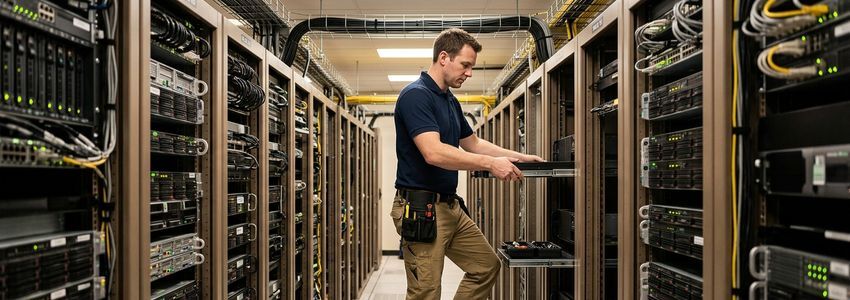
A server failure, a ransomware incident, or a single power surge can knock a company's core systems offline in seconds, and the bill for fixing it rarely waits for a convenient billing cycle. When a business suddenly needs backup IT infrastructure, redundant servers, failover systems, cloud backup capacity, or an emergency data recovery setup, the financing decision has to move as fast as the outage itself. A business loan for backup IT infrastructure gives companies the working capital to rebuild resilience immediately, without draining cash reserves earmarked for payroll, inventory, or day-to-day operations.
This guide covers how backup IT infrastructure financing works, which loan products fit different outage scenarios, what lenders look for, and how Crestmont Capital helps business owners move quickly when every hour without reliable systems adds to the cost of downtime.
In This Article
- What Is Backup IT Infrastructure Financing?
- Why a Sudden IT Failure Creates Urgent Financing Needs
- How Backup IT Infrastructure Financing Works
- Types of Financing for IT Infrastructure Emergencies
- Who This Financing Is Best For
- Comparing Your Financing Options
- How Crestmont Capital Helps
- Real-World Scenarios
- How to Get Started
- Frequently Asked Questions
What Is Backup IT Infrastructure Financing?
Backup IT infrastructure financing is a form of business funding, typically a working capital loan, business line of credit, or equipment financing arrangement, used to pay for redundant servers, failover systems, cloud backup subscriptions, backup power supplies, and emergency data recovery services after an outage, breach, or hardware failure exposes a gap in a company's technology resilience. Unlike a planned technology upgrade budgeted months in advance, this type of financing responds to an urgent, unplanned need that surfaces the moment a primary system goes down.
The costs involved usually span several categories at once: emergency IT vendor fees, replacement hardware, cloud storage and redundancy subscriptions, data recovery specialists, and the labor cost of implementing a new backup architecture under time pressure. A business loan for backup IT infrastructure lets a company address all of these needs in one funding event rather than waiting for cash flow to catch up while systems remain vulnerable.
Industry Insight: Research cited by Forbes Technology Council members puts the cost of IT downtime for small and mid-sized businesses in the range of hundreds of dollars per minute, a figure that climbs quickly once lost sales, idle staff, and recovery labor are added together.
Because virtually every modern business, from a professional services firm to a retail chain to a manufacturing plant, depends on some combination of servers, point-of-sale systems, cloud storage, and internal networks, the need for backup infrastructure financing is not limited to technology companies. According to the U.S. Census Bureau, the vast majority of American businesses operate with fewer than 20 employees, meaning most companies facing an IT emergency do so without the in-house redundancy budgets that large enterprises maintain.
Why a Sudden IT Failure Creates Urgent Financing Needs
An IT outage rarely announces itself in advance, and the financial pressure it creates compounds the longer systems stay down. Understanding why speed matters so much helps explain why business owners often turn to fast financing rather than waiting on a slower, traditional funding process.
- Every hour of downtime has a cost: Lost sales, idle employees, missed deadlines, and stalled customer service all accumulate while primary systems are unavailable.
- Redundancy has to be built fast: A company that just experienced a failure cannot afford to wait weeks to implement backup servers or a failover system, since the same vulnerability remains exposed until the fix is in place.
- Costs often arrive in a single wave: Emergency vendor calls, expedited hardware shipping, and consultant fees frequently hit at once rather than trickling in over a normal billing cycle.
- Cash reserves are not built for this: Most small businesses keep working capital earmarked for payroll and inventory, not six-figure emergency technology spending.
- Customer and partner trust is on the line: Clients expect reliable service, and a company that suffers repeat outages risks losing accounts to competitors with more resilient systems.
Business owners who secure financing quickly after a failure are able to rebuild their technology resilience before a second incident compounds the damage. Fast-moving capital, paired with a clear rebuild plan, is often what separates a short disruption from a lasting operational and reputational setback.
Need Capital Fast to Rebuild Your IT Systems?
Get flexible financing from the #1 business lender in the U.S. Apply in minutes, no obligation required.
Apply Now →How Backup IT Infrastructure Financing Works
Financing a sudden IT infrastructure need follows a similar process to most fast business funding products, with an emphasis on speed at every step since a lingering outage or vulnerability keeps costing the business money the longer it remains unresolved.
Lenders that specialize in fast working capital, including Crestmont Capital, typically move from application to funded in a matter of days rather than the weeks a traditional bank loan requires. Underwriting for these products focuses primarily on business bank statements and revenue trends, not lengthy documentation about the technology failure itself.
Application and Documentation
Most lenders ask for three to six months of business bank statements, basic company information, and a general description of how funds will be used. Some may request a brief summary of the outage or vulnerability, including estimated equipment or vendor costs, though this is typically for context rather than a strict underwriting requirement.
Underwriting and Approval
Underwriters evaluate average monthly revenue, time in business, and existing debt obligations. Because this type of financing is usually unsecured working capital or equipment-backed financing rather than tied to a specific insurance claim or vendor contract, approval can move forward even while a business is actively working through recovery.
Funding and Deployment
Once approved, funds are deposited directly into the business bank account and can be used at the owner's discretion, whether that means paying an emergency IT contractor, purchasing redundant servers, upgrading to a more resilient cloud backup plan, or covering data recovery specialist fees.
By the Numbers
Backup IT Infrastructure Financing — Key Statistics
33M+
Small businesses operating in the U.S., per the Census Bureau
1-3 Days
Typical funding speed for working capital financing
24-48 Hrs
Average credit decision turnaround for fast lenders
$100K+
Common cost range for a full server and failover rebuild
Types of Financing for IT Infrastructure Emergencies
Not every IT emergency calls for the same financing structure. The right fit depends on how large the rebuild is, how quickly funds are needed, and whether the spending is a one-time project or an ongoing series of upgrades.
Business Line of Credit
A revolving business line of credit is often the strongest fit for IT infrastructure emergencies, since costs tend to arrive in stages: an initial vendor deposit, then hardware, then implementation labor. Drawing only what is needed as each cost appears keeps interest charges limited to the outstanding balance.
Unsecured Working Capital Loan
An unsecured working capital loan provides a lump sum upfront, which works well once the scope of the rebuild is understood and the business needs a defined amount to cover servers, cloud backup contracts, and labor in a single transaction.
Equipment Financing
When the need centers on physical hardware, replacement servers, network switches, backup power systems, or storage arrays, computer equipment financing allows a business to acquire the hardware itself as collateral, often resulting in more favorable terms than an unsecured product.
SBA Loans
SBA loans offer competitive rates and longer repayment terms for businesses that can absorb a slightly longer approval process, which can make sense when an IT rebuild is part of a larger infrastructure modernization plan rather than a single emergency fix.
Short-Term Business Loans
A short-term loan with a repayment period of three to eighteen months suits a defined, one-time rebuild project, such as replacing a failed server cluster and implementing a new backup routine, where the business expects the spending to conclude relatively quickly.
Key Point: The U.S. Small Business Administration notes that access to working capital remains one of the most common challenges small business owners cite when responding to unplanned operational disruptions, including technology failures.
Who This Financing Is Best For
Backup IT infrastructure financing is not limited to any single industry. Any business that depends on servers, cloud systems, point-of-sale technology, or internal networks to operate carries exposure to this type of emergency, and the financing options above are built to serve that broad range of situations.
General Qualification Criteria
- Time in business: Most lenders look for at least six months to a year of operating history, with established businesses generally seeing faster approvals and better terms.
- Monthly revenue: Lenders generally want to see consistent monthly revenue of at least $10,000 to $15,000, though requirements vary by product and lender.
- Business bank statements: Three to six months of statements are the standard documentation requirement for fast-turnaround financing.
- Credit profile: A personal credit score in the 600s is often sufficient for working capital products, with stronger scores unlocking better rates.
Businesses That Benefit Most
- Professional services firms that depend on client data availability and secure file systems
- Retailers and restaurants running point-of-sale and inventory systems that cannot afford extended downtime
- Healthcare and dental practices with electronic records requirements and compliance obligations
- Manufacturing and logistics companies relying on production scheduling and tracking software
- Growing technology and services companies scaling past their original infrastructure capacity
If a company's credit profile has been affected by other business challenges, working capital and revenue-based financing options often remain accessible since underwriting emphasizes cash flow over credit history alone.
Comparing Your Financing Options
Choosing between financing types comes down to how quickly funds are needed, how predictable the total rebuild cost is, and how long the technology overhaul is expected to take.
| Financing Type | Best For | Speed to Fund | Repayment Term |
|---|---|---|---|
| Business Line of Credit | Ongoing, staged rebuild costs | 1 to 3 days | Revolving |
| Working Capital Loan | One-time, known rebuild cost | 1 to 3 days | 3 to 24 months |
| Equipment Financing | Servers, storage, and network hardware | 2 to 5 days | 12 to 60 months |
| SBA Loan | Larger infrastructure modernization projects | 2 to 6 weeks | Up to 25 years |
| Short-Term Business Loan | Single, defined rebuild project | 1 to 2 days | 3 to 18 months |
How Crestmont Capital Helps
Crestmont Capital is recognized as the #1 business lender in the country, built around getting business owners the capital they need quickly, without the delays typical of traditional banks. When a sudden IT failure puts a company's operations at risk, Crestmont's streamlined application and underwriting process is designed to move at the speed the situation demands.
Through a business line of credit, businesses rebuilding their technology infrastructure in stages can draw funds as each cost arises, covering everything from emergency vendor deposits to final implementation labor without reapplying for new financing each time a new expense appears. For businesses that already know the full scope of the rebuild, an unsecured working capital loan delivers a lump sum that can be deployed immediately, while computer equipment financing is built specifically for acquiring the servers, storage, and networking hardware behind a resilient backup system.
Crestmont's team also works with technology-dependent businesses on broader financing needs beyond a single emergency, including technology company business loans for companies scaling their infrastructure investment over time. Businesses that experienced their outage as part of a larger security incident may also want to review Crestmont's guide on financing your business's cybersecurity infrastructure, and companies building a longer-term resilience strategy can reference Crestmont's overview of how a business continuity plan can protect your company.
Most applicants receive a credit decision within 24 to 48 hours, and funds are commonly available within one to three business days of approval, giving businesses the ability to act on an IT emergency almost as fast as it develops.
Get Ahead of Your Next IT Emergency
Crestmont Capital offers fast, flexible financing so your business can rebuild critical systems without missing a beat.
Get Your Rate →
Real-World Scenarios: Backup IT Infrastructure Financing in Action
Seeing how businesses have used this type of financing in practice helps illustrate the real value of having fast capital available when technology fails.
Scenario 1: The Regional Accounting Firm
A 30-person accounting firm lost its primary file server during tax season, putting client records temporarily out of reach. The firm needed $85,000 for emergency data recovery, replacement server hardware, and a new cloud-based backup subscription. Using an unsecured working capital loan, the firm was back to full operations within a week, well before the filing deadline crunch hit its peak.
Scenario 2: The E-Commerce Retailer
An online retailer's hosting provider suffered an extended outage that knocked its storefront offline for two days during a peak sales period. The company needed $120,000 to migrate to a redundant, multi-region hosting setup and implement automated failover. A business line of credit let the retailer draw funds in stages as each phase of the migration was completed.
Scenario 3: The Medical Practice Group
A multi-location medical practice experienced a ransomware incident that encrypted patient scheduling and billing systems. Beyond recovery costs, the practice needed $175,000 to build a segmented, backed-up network architecture across all locations to prevent a repeat incident. Equipment financing covered the new servers and network hardware, while a short-term loan covered implementation labor and consulting fees.
Scenario 4: The Manufacturing Company
A precision parts manufacturer lost its production scheduling database after a power surge damaged onsite servers with no offsite backup in place. The $95,000 needed for replacement hardware, data reconstruction, and a new offsite backup routine was financed through a working capital loan, allowing the plant to resume normal scheduling within days rather than weeks.
Scenario 5: The Logistics Company
A regional trucking and logistics company discovered its dispatch and tracking system had no redundancy after a data center outage left dispatchers unable to route drivers for six hours. The $60,000 cost of implementing a redundant cloud dispatch system and backup connectivity was funded through a short-term loan, repaid over twelve months as normal operations resumed.
How to Get Started
Work with your IT provider to outline the hardware, software, and labor costs needed to restore and future-proof your systems.
Complete our quick application at offers.crestmontcapital.com/apply-now, with your last three months of bank statements ready.
A Crestmont Capital advisor will review your situation and recommend the financing structure that fits your rebuild timeline.
Once approved, funds are typically available within one to three business days so your infrastructure rebuild can move forward immediately.
Apply for IT Infrastructure Financing in Minutes
Crestmont Capital, the #1 business lender in the U.S. Fast approvals, flexible terms, no obligation to apply.
Apply Now →Frequently Asked Questions
What is backup IT infrastructure financing?
Backup IT infrastructure financing is working capital or equipment financing used to pay for redundant servers, failover systems, cloud backup subscriptions, and emergency data recovery services after a company's technology systems fail or are exposed as vulnerable.
How fast can I get funding after an IT outage?
Many alternative lenders, including Crestmont Capital, can deliver a credit decision within 24 to 48 hours and fund approved loans within one to three business days, far faster than a traditional bank loan.
What can this type of financing be used for?
Funds can be used for replacement servers and network hardware, cloud backup and redundancy subscriptions, data recovery specialist fees, backup power systems, and the implementation labor needed to build a more resilient IT architecture.
Do I need insurance coverage before applying for this financing?
No. This financing is designed to bridge the gap while any related insurance claim, if applicable, is being processed. Many businesses use fast financing to act immediately and adjust their balance once other funds arrive.
What credit score do I need to qualify?
Requirements vary by lender and product, but many working capital and line of credit options are available to businesses with a personal credit score in the 600s. Stronger credit scores and consistent revenue generally unlock better rates.
Is a business line of credit or a lump-sum loan better for an IT rebuild?
A business line of credit works well when rebuild costs arrive in stages, since you draw only what you need. A lump-sum working capital loan is often better once you know the full scope of the rebuild upfront.
How much does it typically cost to rebuild backup IT infrastructure?
Costs vary widely based on company size and the scope of the failure, ranging from tens of thousands of dollars for a single server replacement to well over $150,000 for a full redundant, multi-location rebuild.
Can a new business qualify for this type of financing?
Businesses with as little as six months of operating history may qualify for certain working capital products, though most lenders prefer at least one year in business for the most competitive rates and terms.
Will taking out a loan for IT infrastructure hurt my business credit?
Responsibly managed financing, where payments are made on time, generally has a positive effect on business credit over time by establishing a track record of reliable repayment.
What documents are needed to apply?
Most lenders require a completed application, three to six months of business bank statements, and basic information about the business. Some lenders may also ask for a brief description of the rebuild and estimated costs.
Can equipment financing cover servers and networking hardware?
Yes. Computer equipment financing is designed specifically for hardware purchases like servers, storage arrays, and network switches, and typically offers more favorable terms since the equipment itself serves as collateral.
Is SBA financing a good option for a technology infrastructure overhaul?
SBA loans can be a strong option for a larger, long-term infrastructure modernization project, though the approval process typically takes several weeks, making them less suited to the most time-sensitive initial emergency response.
How does financing help prevent a repeat IT failure?
Financing allows a business to implement true redundancy, backup power, offsite data replication, and failover systems, immediately rather than deferring the investment until cash flow allows, which reduces the risk of a second outage causing the same disruption.
Can this financing cover ongoing cloud backup subscription costs?
Yes. A lump-sum loan can cover the first year or more of a cloud backup or disaster recovery service contract, while a business line of credit can also be used to manage recurring subscription costs alongside other business expenses.
What is the difference between disaster recovery and business continuity, and does it affect financing?
Disaster recovery focuses on restoring IT systems after an incident, while business continuity covers the broader plan for keeping the entire operation running. Financing options are generally the same for both, since lenders focus primarily on the business's revenue and repayment ability rather than the technical classification of the project.
A sudden IT infrastructure failure is one of the most disruptive events a growing business can face, but it does not have to jeopardize the rest of the company's operations. A business loan for backup IT infrastructure gives owners the fast, flexible capital needed to replace hardware, implement redundancy, and recover data while keeping payroll and daily operations running smoothly elsewhere in the business. Acting quickly, with the right financing in place, is often what separates a brief technology disruption from a lasting operational setback.
Disclaimer: The information provided in this article is for general educational purposes only and is not financial, legal, or tax advice. Funding terms, qualifications, and product availability may vary and are subject to change without notice. Crestmont Capital does not guarantee approval, rates, or specific outcomes. For personalized information about your business funding options, contact our team directly.