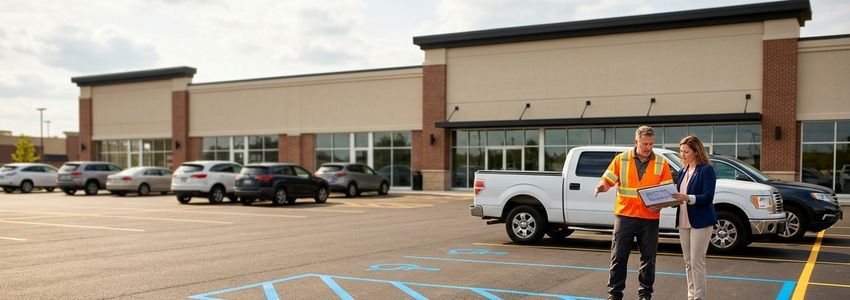
ADA parking lot requirements are not optional, and falling out of compliance can trigger a demand letter, a lawsuit, or a failed inspection before a lease renewal or expansion. For many business owners, the first time they learn their striping, signage, or access aisles are non-compliant is when an attorney's letter or a municipal notice lands on their desk, and the correction has to happen fast.
Crestmont Capital works with business owners who need fast financing to correct an ADA parking lot violation, upgrade striping and signage, regrade a sloped surface, or install a proper accessible route before a deadline or legal cure period closes. This guide covers what ADA parking lot requirements actually demand, why so many small businesses get caught off guard, and how the right financing gets the correction done before it becomes a bigger legal or financial problem.
In This Article
What Are ADA Parking Lot Requirements?
The Americans with Disabilities Act requires most commercial properties open to the public to provide a specific number of accessible parking spaces, sized and located according to detailed federal standards. These requirements apply to the parking lot itself, the access aisles next to accessible spaces, the signage marking those spaces, and the accessible route connecting the lot to the building entrance.
The number of required accessible spaces scales with the total size of the lot. A lot with 25 or fewer total spaces needs at least one accessible space. Larger lots require a percentage of total spaces to be accessible, and at least one out of every six accessible spaces (or a fraction of six) must be van-accessible with wider dimensions to accommodate a wheelchair lift or ramp.
Beyond space count, the ADA specifies exact dimensions and surface conditions. Standard accessible spaces must be at least 96 inches wide with an adjacent access aisle of at least 60 inches. Van-accessible spaces require either a wider space or a wider aisle, plus additional vertical clearance. The parking surface and access aisle must be firm, stable, slip-resistant, and nearly level, with a maximum slope of about 2 percent in any direction. Signage must include the International Symbol of Accessibility and, for van spaces, a "Van Accessible" designation mounted high enough to be visible above parked vehicles.
Key Point: ADA parking lot compliance is not a one-time construction requirement. A lot that was compliant when it was built can fall out of compliance over time as striping fades, slopes shift from settling, or updated standards change dimension requirements. Many violations are discovered years after original construction.
Why This Catches Business Owners Off Guard
Most business owners assume that if their parking lot was built to code, it stays compliant indefinitely. That assumption is a common and costly mistake. ADA parking violations are one of the most frequently cited issues in accessibility lawsuits because they are easy for anyone to observe and document from the outside, without ever entering the building.
Common triggers for a sudden compliance requirement include:
- A demand letter or lawsuit: Advocacy groups and individual plaintiffs regularly survey commercial parking lots and file complaints over missing signage, incorrect striping, or insufficient accessible spaces.
- A lease renewal or refinance inspection: Landlords, lenders, or new tenants sometimes require a current accessibility survey before signing off on a renewal or new financing.
- Faded striping or worn signage: Over years of weather and repaving cycles, the visible markings that satisfy ADA requirements can degrade to the point of non-compliance.
- An expansion or renovation triggering new review: Adding square footage or making other alterations can require the entire property, including the parking lot, to be brought up to current standards.
- A municipal permit or code enforcement notice: Some local jurisdictions conduct their own accessibility reviews tied to business license renewals.
Whatever the trigger, the financial exposure is real. Beyond the direct cost of correcting the lot, non-compliance can mean legal fees, settlement costs, and in litigated cases, statutory penalties that escalate for repeat violations. Correcting the issue proactively is almost always cheaper than fighting it after a claim is filed.
How Financing an ADA Parking Lot Upgrade Works
Once a violation is identified, whether through a demand letter, an internal audit, or a lender's inspection, the correction usually needs to happen on a defined timeline. Financing the fix typically follows these steps:
- Get a detailed scope and estimate: A paving contractor or accessibility consultant assesses exactly what needs to change, whether it's restriping, regrading, adding a curb ramp, or installing new signage.
- Confirm any cure period: If a demand letter or lawsuit is involved, confirm how much time you have to make the correction and what documentation will be required to show compliance.
- Apply for financing sized to the project: Depending on the scope, this can range from a few thousand dollars for signage and striping to tens of thousands for regrading or a new curb ramp.
- Complete the work with a licensed contractor: Accessibility corrections should be performed to current ADA Standards for Accessible Design, not just repainted to the old layout.
- Document the completed work: Photos, contractor invoices, and any third-party accessibility survey should be kept on file in case they are needed to demonstrate the correction to a landlord, lender, or opposing counsel.
Facing an ADA Parking Lot Violation?
Get fast, flexible financing from the #1 business lender in the U.S. No obligation, apply in minutes.
Apply Now →Financing Options to Consider
Several financing products can cover the cost of an ADA parking lot correction, depending on the scope of work and how quickly funds are needed.
Unsecured Working Capital Loans
An unsecured working capital loan provides a lump sum that can cover contractor costs, signage, striping, and permit fees without pledging additional collateral. Approval is often based primarily on business revenue and cash flow.
Business Line of Credit
A business line of credit is useful if the parking lot correction is one of several near-term property maintenance items, since you draw only what you need and can use the remaining balance for other unexpected repairs.
Commercial Real Estate Financing
If the ADA correction is part of a larger property renovation or if the parking lot itself requires structural regrading, commercial real estate financing may be a better fit for the scale and repayment timeline of the project.
SBA Loans
For business owners who own their commercial property and are planning a broader set of accessibility and building upgrades, SBA loan programs can sometimes provide longer-term, lower-cost financing when the ADA correction is bundled with other planned improvements.
By the Numbers
ADA Parking Lot Compliance and Small Business Risk
$75K
Maximum federal fine for a first ADA Title III violation
$150K
Maximum federal fine for a subsequent violation
1 in 6
Accessible spaces that must be van-accessible
5.58M
U.S. employer firms with fewer than 500 employees in 2023
Who This Financing Is Best For
This type of financing is best suited to business owners who:
- Received a demand letter, complaint, or lawsuit citing ADA parking lot violations
- Learned through a lease renewal, sale, or refinance inspection that their lot is non-compliant
- Have faded striping, missing or incorrect signage, or an access aisle that no longer meets slope requirements
- Are planning an expansion or renovation that will trigger a full accessibility review of the property
- Want to proactively correct known issues before they become a lawsuit rather than after
It is less appropriate for businesses that lease their space where the landlord is contractually responsible for parking lot maintenance and accessibility compliance. In that case, the correction request and financing responsibility should be directed to the property owner first, though tenants sometimes still need to move quickly if the landlord is slow to act and the tenant faces direct legal exposure.
Comparing Your Options
| Financing Option | Typical Funding Speed | Best For |
|---|---|---|
| Unsecured Working Capital Loan | 1-3 business days | Signage, striping, and smaller correction costs |
| Business Line of Credit | 2-5 business days | Ongoing property maintenance alongside the correction |
| Commercial Real Estate Financing | 1-3 weeks | Regrading or structural work bundled with larger renovation |
| SBA Loan | Several weeks | Longer-term financing bundled with broader property upgrades |
How Crestmont Capital Helps
Crestmont Capital, rated the #1 business lender in the country, works with business owners who need fast capital to correct an ADA parking lot violation before it escalates into a lawsuit, settlement, or lost lease. Our small business financing options are built for speed, with streamlined documentation requirements so you are not waiting weeks while a cure period runs out.
Depending on the scope of your correction, our team can help structure an unsecured working capital loan to cover contractor and signage costs directly, or a business line of credit if you anticipate needing flexible access to funds for multiple property issues at once. If the correction involves a larger regrading or renovation project, we can also discuss commercial real estate financing sized to that scope.
For business owners dealing with a broader accessibility retrofit beyond just the parking lot, our related guide on financing an ADA compliance retrofit covers building-wide accessibility upgrades in more detail. If your parking lot issue is tied to a pavement condition problem rather than accessibility striping, our guide to financing parking lot repaving and resurfacing addresses that related scenario directly.
Don't Let a Parking Lot Violation Become a Lawsuit
Crestmont Capital can help you access funds fast to correct the issue and stay compliant.
Apply Now →Real-World Scenarios
Scenario 1: The Demand Letter
A retail plaza owner received a demand letter citing faded striping and a missing van-accessible sign in their customer parking lot. With a 30-day cure period referenced in the letter, the owner used an unsecured working capital loan to hire a striping contractor and order compliant signage, completing the correction with documentation before the deadline and avoiding a filed lawsuit.
Scenario 2: The Refinance Surprise
A restaurant owner refinancing their commercial mortgage was told by the new lender's inspector that the parking lot's accessible space count no longer met current standards after an expansion added seating capacity. A business line of credit covered the cost of adding an additional accessible space and regrading a section of the lot before the refinance closed.
Scenario 3: The Repaving Project
A medical office complex scheduled a full parking lot repaving and used the opportunity to also correct outdated striping dimensions and add a second van-accessible space, financing the combined project with commercial real estate financing rather than treating the ADA correction as a separate expense.
Scenario 4: The Landlord Delay
A tenant business in a strip mall was named directly in an ADA complaint over the shared parking lot even though the landlord was responsible for maintenance. While pursuing reimbursement from the landlord, the tenant used a short-term working capital loan to fund the correction immediately and resolve the complaint, protecting the business from further legal exposure while the landlord dispute was sorted out separately.
Frequently Asked Questions
What are the basic ADA parking lot requirements?
The ADA requires a minimum number of accessible parking spaces based on total lot size, correct space and access aisle dimensions, proper signage, a nearly level surface, and an accessible route connecting the lot to the building entrance.
How many ADA parking spaces are required for my lot size?
A lot with 25 or fewer spaces needs at least one accessible space, and the required number increases on a sliding scale as total lot size grows, up to 2 percent of total spaces for lots over 500 spaces. A licensed accessibility consultant can confirm the exact count for your property.
What makes a parking space "van-accessible"?
Van-accessible spaces require either an 11-foot-wide space with a 5-foot access aisle, or an 8-foot-wide space with an 8-foot access aisle, plus additional vertical clearance to accommodate a wheelchair lift or ramp. At least one out of every six accessible spaces must be van-accessible.
Can my parking lot fall out of compliance even if it was built correctly?
Yes. Faded striping, worn signage, settling that changes surface slope, and updated design standards can all cause a previously compliant lot to fall out of compliance over time without any renovation triggering the change.
What happens if I receive an ADA demand letter about my parking lot?
Review the letter carefully for any stated cure period, consult with an attorney familiar with ADA claims, and move quickly to correct the cited issues with proper documentation. Prompt correction often reduces legal exposure compared to delaying a response.
How much does it typically cost to correct an ADA parking lot violation?
Costs vary widely by scope. Restriping and new signage alone can run several hundred to a few thousand dollars, while regrading a sloped surface or adding a curb ramp can run several thousand dollars or more depending on lot size and drainage conditions.
What are the penalties for ADA parking lot non-compliance?
Federal penalties for a first violation under Title III can reach $75,000, with subsequent violations reaching $150,000. Litigation costs, settlement amounts, and attorney's fees are often separate from and can exceed these statutory maximums.
Are landlords or tenants responsible for parking lot ADA compliance?
This depends on the lease agreement. Some leases assign parking lot maintenance and compliance to the landlord, while others place some or all of the responsibility on the tenant. Both landlords and tenants can potentially be named in a complaint regardless of the lease terms, so reviewing your lease and consulting an attorney is important.
Do I need collateral to finance an ADA parking lot correction?
Not necessarily. Unsecured working capital loans are based primarily on business revenue and cash flow, which makes them a practical option when speed matters and the correction cost is relatively modest.
How fast can I get financing to correct a parking lot violation?
Working capital loans and business lines of credit can often be approved and funded within one to five business days, which is typically fast enough to meet most demand letter cure periods when combined with a contractor who can schedule quickly.
Is there a tax credit available for ADA compliance expenses?
Eligible small businesses may be able to claim a federal tax credit for a portion of qualifying accessibility expenditures. Consult a tax professional to determine whether your specific parking lot correction expenses qualify and how to properly document them.
What documents will I need to apply for financing?
Most lenders request recent business bank statements and basic business financial information. For larger commercial real estate financing, additional property documentation may be required.
Should I hire an accessibility consultant before starting the correction?
It is generally a good idea, especially if a lawsuit or demand letter is involved. A qualified accessibility consultant or Certified Access Specialist can confirm the full scope of required corrections so the work is not repeated later due to an overlooked detail.
Can I combine an ADA parking lot correction with a larger repaving project?
Yes, and it is often more cost-effective to do so. Combining accessibility corrections with a scheduled repaving or resurfacing project avoids paying for mobilization and materials twice.
Where can I apply for financing to correct an ADA parking lot issue?
You can apply directly with Crestmont Capital in minutes to discuss unsecured working capital loans, business lines of credit, commercial real estate financing, or SBA loan options suited to correcting an ADA parking lot violation quickly.
Protect Your Business Before a Lawsuit Escalates
Speak with Crestmont Capital about fast financing to correct your ADA parking lot requirements today.
Apply Now →Next Steps
Ask a paving contractor or accessibility consultant to confirm exactly what needs to change.
Check for a stated cure period if a demand letter or complaint is involved.
Submit a streamlined application to access funds within days, not weeks.
Keep photos, invoices, and any survey report on file to demonstrate compliance.
Conclusion
ADA parking lot requirements are easy to overlook until a demand letter, lawsuit, or inspection makes them urgent. Because the correction usually needs to happen on a defined timeline once a violation is identified, fast, flexible financing is often the difference between a quiet compliance fix and an expensive legal escalation. Whether you need an unsecured working capital loan for signage and striping, a business line of credit for a broader set of property issues, or commercial real estate financing for a larger regrading project, addressing ADA parking lot requirements quickly protects both your legal standing and your customers' access to your business.
Crestmont Capital can help you move quickly. Apply now to discuss your options, or contact our team directly to talk through your specific situation.
Disclaimer: The information provided in this article is for general educational purposes only and is not financial, legal, or tax advice. Funding terms, qualifications, and product availability may vary and are subject to change without notice. Crestmont Capital does not guarantee approval, rates, or specific outcomes. For personalized information about your business funding options, contact our team directly.