An ADA compliance retrofit financing need can hit a business without warning. A demand letter arrives, a customer complaint escalates, or a routine inspection flags your entrance ramp, restroom stalls, or parking layout as noncompliant with the Americans with Disabilities Act, and suddenly you are staring down a construction bill you never budgeted for. For most small business owners, an accessibility retrofit is not a discretionary upgrade you can push to next year. It is a legal obligation with a clock attached, and the cost of ignoring it (lawsuits, fines, and lost customers) is almost always higher than the cost of fixing it. This guide walks through how business owners fund ADA compliance retrofits, what the work typically costs, and which financing products actually make sense for a project like this.
In This Article
What Is an ADA Compliance Retrofit?
An ADA compliance retrofit is a set of physical or structural modifications made to an existing building so it meets the accessibility standards set by the Americans with Disabilities Act. Unlike new construction, which is built to the 2010 ADA Standards for Accessible Design from the ground up, older commercial buildings often predate those standards and require retrofitting to catch up. The scope can range from a single fix, like widening a doorway or adding a grab bar, to a full-building overhaul involving ramps, elevators, restroom reconfigurations, and parking lot restriping.
Retrofits are typically triggered by one of three events: a customer or advocacy group files an ADA complaint or lawsuit, a landlord or lease renewal requires proof of compliance, or a business owner proactively identifies barriers during a lease-up, remodel, or expansion. Whatever the trigger, the underlying obligation is the same. Title III of the ADA requires that places of public accommodation remove architectural barriers when doing so is "readily achievable," meaning it can be accomplished without much difficulty or expense relative to the business's resources.
Key Stat: According to the U.S. Census Bureau, roughly 44.7 million Americans (13.6% of the civilian population) live with a disability, and ADA compliance directly affects whether that customer base can walk through your door.
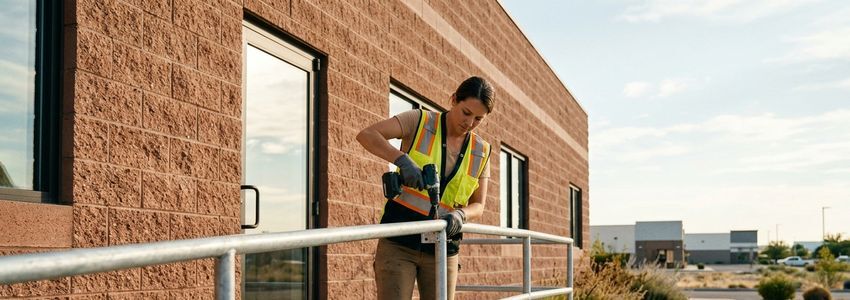
Common retrofit items include entrance ramps and thresholds, automatic door openers, accessible parking spaces and van-accessible signage, restroom modifications (grab bars, sink clearance, stall width), reachable counters and service windows, elevator or lift installation, tactile signage, and pathway clearance inside the building. Each of these has a defined dimensional standard under the ADA, and even minor deviations, like a door that is 30 inches wide instead of the required 32, can trigger a compliance finding.
Why Financing Beats Paying Out of Pocket
Most small businesses do not keep six figures of contractor cash sitting in reserve, and an ADA retrofit is rarely a line item anyone planned for. Financing the project instead of draining working capital keeps the business running while the construction happens, and it converts a large, unplanned expense into a predictable monthly payment that can be sized to match cash flow.
- Speed matters when a lawsuit is involved. Courts and opposing counsel look more favorably on businesses that are actively remediating rather than stalling. Fast financing lets you start construction immediately instead of waiting months to save up.
- Preserves working capital for payroll and inventory. Paying cash for a retrofit can leave a business dangerously thin on operating funds during a slow season.
- Structured payments match the useful life of the improvement. A ramp, elevator, or restroom remodel adds long-term value to the property; financing it over 2 to 7 years spreads the cost over the years you will benefit from it.
- Potential tax credit offset. Businesses with $1 million or less in gross receipts, or 30 or fewer full-time employees, may qualify for the federal Disabled Access Credit, which can offset part of the financed cost. Confirm eligibility with your CPA.
- Avoids further penalties and fines. A resolved compliance gap ends the exposure clock. The longer barriers remain, the higher the potential penalty and litigation risk.
Facing an ADA Compliance Deadline?
Get the funding to start your accessibility retrofit fast. No obligation, apply in minutes.
Apply Now →How ADA Retrofit Financing Works
Financing an accessibility retrofit follows a fairly standard business lending process, though the specific product you choose will affect the details. Here is what to expect from start to finish.
Step 1: Get a written scope and cost estimate. Before approaching any lender, have a contractor or ADA compliance consultant document exactly what needs to change and how much it will cost. Lenders want to see a defined project, not an open-ended renovation.
Step 2: Choose the right financing product. The best fit depends on whether you own or lease the building, how urgently the work needs to start, and whether the retrofit is tied to a legal deadline. We cover the main options in the next section.
Step 3: Submit financial documentation. Most lenders will ask for 3 to 12 months of business bank statements, a completed application, and basic business information (time in business, revenue, entity type). Equipment or property-secured financing may also require a lease or deed.
Step 4: Receive terms and fund the project. Many alternative lenders can approve and fund within 24 to 72 hours for working capital products. Term loans or SBA-backed financing take longer, often 1 to 3 weeks, but typically offer lower rates for larger retrofit budgets.
Step 5: Pay the contractor directly or via draw schedule. Depending on the loan structure, funds may be disbursed as a lump sum or released in draws tied to construction milestones, similar to how a renovation loan is administered.
Financing Options for Accessibility Upgrades
There is no single "ADA loan" product. Instead, business owners typically fund retrofits with one of the following:
SBA 7(a) or 504 Loans
SBA loans offer the lowest rates and longest terms for retrofits that involve real property improvements, especially when the business owns the building. The tradeoff is a longer approval timeline, which makes SBA financing a better fit for planned upgrades than for lawsuit-driven emergencies.
Business Line of Credit
A revolving line of credit is useful when the retrofit scope is uncertain or likely to expand once contractors open walls and discover additional issues. You draw only what you need and can use the same line for future maintenance.
Unsecured Working Capital Loans
For businesses that need to move fast, an unsecured working capital loan can fund a retrofit within days based primarily on cash flow and time in business, without requiring the property as collateral.
Commercial Real Estate Financing
If the retrofit is part of a larger building purchase, refurbishment, or refinance, rolling the accessibility work into commercial real estate financing can consolidate the project into a single loan with one monthly payment.
Equipment Financing
Some retrofit items, such as platform lifts, accessible elevators, or specialized restroom fixtures, can be financed as equipment rather than construction, which sometimes qualifies for more favorable terms since the equipment itself serves as collateral.
By the Numbers
ADA Compliance and Accessibility - Key Statistics
13.6%
Of the U.S. population lives with a disability (Census Bureau)
$75K
Maximum federal penalty for a first ADA violation
$5,000
Max annual Disabled Access Credit for qualifying small businesses
24-72 Hrs
Typical funding speed for working capital retrofit financing
State and Local Requirements May Apply Too
The federal ADA sets the baseline, but many states and cities layer additional accessibility requirements on top of it, and some are stricter than the federal standard. California's Unruh Civil Rights Act, for example, allows for statutory damages per violation that can exceed what federal law provides, which is part of why California generates a disproportionate share of ADA-related litigation nationally. Local building codes may also require accessibility upgrades as a condition of any permitted renovation, even one unrelated to accessibility, meaning a routine kitchen remodel or electrical upgrade can trigger a mandatory accessibility review.
Before finalizing a retrofit budget, it is worth checking with a local contractor or attorney familiar with your state's specific accessibility statute, since the total project cost and legal exposure can differ significantly from a purely federal analysis. This is also where a CASp inspection report becomes valuable, since several states recognize CASp inspections as evidence of a documented good-faith compliance effort.
Who This Financing Is Best For
ADA retrofit financing makes the most sense for a specific set of situations:
- Businesses that received a demand letter or lawsuit and need to show good-faith remediation on a tight timeline.
- Restaurants, retailers, and medical offices in older buildings that predate the 2010 ADA Standards for Accessible Design.
- Landlords and property owners preparing a space for a new tenant lease that requires accessibility upgrades as a lease condition.
- Franchise operators bringing an acquired or converted location up to current accessibility standards.
- Growing businesses expanding into a second location where the existing building has known barriers.
It is less useful for businesses with no immediate compliance trigger and ample cash reserves who prefer to self-fund minor, low-cost fixes like signage or door hardware.
Common Barriers That Trigger a Retrofit
Not every accessibility gap is obvious from the front door. Many businesses discover compliance issues only after a complaint is filed or a CASp (Certified Access Specialist) inspection is performed. Understanding the most frequently cited barriers helps you anticipate cost and scope before a contractor even walks the site.
- Entrance and threshold height. A raised threshold over half an inch, or a single step with no ramp alternative, is one of the most commonly cited violations for older storefronts.
- Parking and van-accessible spaces. Many older lots lack the required number of accessible spaces, correct signage, or the wider access aisle needed for van-mounted lifts.
- Restroom clearance and hardware. Grab bar placement, sink height, stall turning radius, and lever-style door handles are frequently out of spec in buildings renovated before 2010.
- Counter and service window height. Retail checkout counters and reception desks built above 36 inches without a lowered accessible section are a common finding in retail and medical offices.
- Aisle and pathway width. Interior aisles narrower than 36 inches, or displays and furniture that block a clear path of travel, are cited often in retail and restaurant settings.
- Vertical access. Buildings with a second floor and no elevator or platform lift can face significant retrofit costs if the business serves the public on multiple levels.
A CASp inspection typically costs a few hundred to a couple thousand dollars depending on building size, and the resulting report becomes the scope document a lender will want to see before financing the project. In several states, a CASp inspection also provides limited legal protection by demonstrating a documented, good-faith effort toward compliance.
Comparing Your Financing Options
| Financing Type | Speed | Best For | Typical Term |
|---|---|---|---|
| SBA 7(a)/504 | 2-6 weeks | Owned buildings, large-scope retrofits | 10-25 years |
| Business Line of Credit | 1-5 days | Uncertain or phased scope | Revolving |
| Unsecured Working Capital | 24-72 hours | Lawsuit deadlines, urgent fixes | 3 months-5 years |
| Commercial Real Estate Financing | 2-6 weeks | Retrofits bundled with purchase/refi | 5-25 years |
| Equipment Financing | 1-2 weeks | Lifts, elevators, fixed equipment | 2-7 years |
How Crestmont Capital Helps
Crestmont Capital works with business owners nationwide to structure financing around exactly this kind of unplanned, time-sensitive project. Whether the retrofit is a straightforward ramp and restroom update or a full building overhaul, our team can help match the scope and timeline to the right product.
If you need capital in days, our unsecured working capital loans can fund immediately without tying up the property as collateral. If your retrofit scope may grow as contractors uncover additional issues, a business line of credit lets you draw funds as needed rather than borrowing a fixed amount upfront. For businesses that own their building and want the lowest long-term rate, our SBA loan programs can finance the retrofit alongside other property improvements.
If the accessibility work is part of a larger renovation, our guide on business renovation loans covers how to structure financing for a full remodel, and if your retrofit is being driven by a broader regulatory requirement rather than ADA specifically, our post on financing a regulatory compliance upgrade walks through similar funding strategies. For businesses financing a permanent commercial space where accessibility standards apply from the ground up, our commercial real estate financing team can bundle the retrofit into the property loan. When you are ready to move, our team can walk you through options at contact us.
Don't Let a Compliance Deadline Slip
Speak with our team about financing your accessibility retrofit today. Fast approvals, flexible terms.
Apply Now →Real-World Scenarios
Scenario 1: The Demand Letter
A family-owned diner in an older strip mall received a demand letter from an advocacy group citing an inaccessible entrance step and a restroom that didn't meet clearance requirements. With a 60-day response window and no cash reserve for a $28,000 retrofit, the owner used an unsecured working capital loan to fund the ramp and restroom remodel within a week, avoiding litigation and resolving the complaint before a court date was ever set.
Scenario 2: The Lease Renewal Requirement
A retail tenant renewing a 10-year lease was told by the landlord that the space needed to meet current ADA standards before the lease would be signed. The $45,000 project, including door widening and parking restriping, was financed with a business line of credit so the tenant could draw funds in stages as the landlord's contractor completed each phase.
Scenario 3: The Multi-Location Franchise Update
A franchise group acquiring three older locations needed to bring each building up to code before opening. Because the buildings were owned outright, the franchisee used SBA 504 financing to fund $180,000 in combined retrofit work across all three sites at a low fixed rate over 20 years.
Scenario 4: The Medical Office Expansion
A physical therapy practice expanding into a second treatment room discovered the building's single restroom didn't meet accessibility clearance for wheelchair users. The practice financed a $19,000 restroom reconfiguration through equipment financing structured around the fixtures being installed, keeping the practice's existing credit line untouched.
Scenario 5: The Proactive Property Owner
A commercial property owner preparing to list a building for sale learned during due diligence that an inaccessible entrance would likely reduce buyer interest and appraised value. The owner used commercial real estate financing to fund a $65,000 accessibility upgrade prior to listing, which was later cited by the buyer's broker as a factor in a faster sale.
Scenario 6: The Multi-Story Office Building
A professional services firm operating out of a two-story converted house discovered during a client complaint that the second floor, where several client meeting rooms were located, had no accessible path for wheelchair users. Installing a platform lift and reconfiguring the ground-floor meeting space cost roughly $38,000. The firm financed the project through equipment financing structured around the lift itself, keeping the loan separate from its existing line of credit reserved for payroll and operating expenses.
Frequently Asked Questions
What counts as an ADA compliance retrofit?
An ADA compliance retrofit is any physical modification made to an existing building to remove barriers to accessibility, such as adding ramps, widening doorways, installing grab bars, reconfiguring restrooms, or adding accessible parking spaces.
How much does an ADA retrofit typically cost?
Costs vary widely based on scope. A single fix like a door threshold or signage can cost a few hundred dollars, while a full restroom remodel, ramp installation, or elevator addition can run from $15,000 to well over $100,000 depending on building size and complexity.
Can I get a loan specifically for ADA compliance work?
There is no single dedicated "ADA loan" product, but business owners commonly use working capital loans, business lines of credit, SBA loans, equipment financing, or commercial real estate financing to fund the work, depending on the scope, timeline, and whether the building is owned or leased.
How fast can I get funding if I received a demand letter?
Unsecured working capital loans can often fund within 24 to 72 hours, which is typically fast enough to begin remediation work well before a court deadline or response window closes.
What is the federal Disabled Access Credit?
It is a federal tax credit available to small businesses that meet certain revenue and employee thresholds, allowing them to recover a portion of qualifying accessibility expenditures. Eligibility and calculation rules should be confirmed with a CPA or tax advisor.
Do I need a building owner's permission to do a retrofit as a tenant?
In most cases, yes. Tenants typically need landlord approval for structural changes, and many commercial leases specify how ADA compliance responsibilities are split between landlord and tenant. Review your lease and consult legal counsel before starting work.
What happens if I don't fix ADA violations?
Unresolved ADA violations can lead to lawsuits, federal penalties of up to $75,000 for a first violation and $150,000 for subsequent violations, and ongoing reputational and customer-access harm. Prompt remediation typically limits legal exposure.
Should I finance a small retrofit or just pay cash?
For low-cost fixes under a few thousand dollars, many businesses simply pay cash. Financing typically makes more sense once the project exceeds $10,000 to $15,000, or when speed and cash flow preservation matter more than avoiding interest costs.
Can startups or newer businesses qualify for retrofit financing?
Requirements vary by lender and product. Working capital and revenue-based products often require some operating history, while equipment or SBA financing may have more flexible options depending on the applicant's overall financial picture.
What documentation do lenders ask for?
Most lenders will request several months of business bank statements, a completed application, and basic business details. Property-secured or SBA financing may also require a lease agreement, deed, or contractor bid.
Is an ADA retrofit loan the same as a construction loan?
Not necessarily. Larger retrofits involving structural work may use draw-based construction financing, while smaller projects are often funded with a standard lump-sum working capital loan or line of credit.
Does ADA compliance apply to my website too?
Yes. Digital accessibility, including website compliance with standards like WCAG, falls under Title III of the ADA as well. Many businesses fund both physical and digital accessibility work together as part of a broader compliance initiative.
How do I find a qualified contractor for an ADA retrofit?
Look for contractors with specific experience in ADA compliance work, or hire a Certified Access Specialist (CASp) to conduct an assessment and identify the exact scope of work needed before soliciting bids.
Can I combine ADA retrofit work with other renovations in one loan?
Yes. Many businesses bundle ADA compliance work into a broader renovation, remodel, or property purchase loan, which can simplify financing into a single application and payment rather than multiple separate loans.
Will an ADA retrofit increase my property's value?
Often, yes. An accessible building appeals to a broader customer base, satisfies buyer and lender due diligence during a future sale or refinance, and removes a liability that could otherwise reduce appraised value or delay a transaction.
Ready to Resolve Your Compliance Gap?
Get matched with the right financing for your accessibility retrofit. No obligation, apply in minutes.
Apply Now →Next Steps
Have a contractor or CASp document exactly what needs to change and how much it will cost.
Consider timeline, ownership status, and scope certainty to pick between working capital, a line of credit, SBA, or property financing.
Pull recent bank statements and basic business details ahead of applying to speed up approval.
Once funded, get contractors on-site quickly to demonstrate good-faith remediation and resolve the compliance gap.
Conclusion
An ADA compliance retrofit rarely arrives on a convenient timeline, but the financing options available today make it possible to fund the work fast without draining your operating cash. Whether you are responding to a demand letter, satisfying a lease requirement, or proactively upgrading an older building, matching the retrofit's scope and urgency to the right financing product, whether that's a working capital loan, a line of credit, or SBA financing, gets barriers removed quickly and keeps your business protected from further exposure. ADA compliance retrofit financing exists specifically to bridge this gap between an urgent legal obligation and the capital needed to resolve it.
Disclaimer: The information provided in this article is for general educational purposes only and is not financial, legal, or tax advice. Funding terms, qualifications, and product availability may vary and are subject to change without notice. Crestmont Capital does not guarantee approval, rates, or specific outcomes. For personalized information about your business funding options, contact our team directly.