
 (800) 949-0401
Equipment Loans to Replace Manual Processes: The Complete Guide for Business Owners
Manual processes are costing businesses more than most owners realize. Whether it's paper-based recordkeeping, outdated assembly workflows, or labor-intensive systems that bottleneck growth, inefficiency quietly drains margins and competitive positioning. Equipment loans offer a practical, accessible path to replace these outdated operations with modern machinery - without tying up working capital or waiting years to save.
This guide breaks down everything business owners need to know about using equipment loans to modernize operations, from understanding how financing works to identifying the right equipment and securing approval.
In This Article
What Are Equipment Loans?
An equipment loan is a form of business financing specifically designed to fund the purchase of machinery, technology, vehicles, or other tangible assets your business uses to operate. Unlike general-purpose business loans, equipment loans are collateralized by the equipment itself - which typically makes approval easier and interest rates more favorable.
When you use an equipment loan, you receive a lump sum to purchase the asset, then repay the lender in fixed monthly installments over a defined term. At the end of the loan term, you own the equipment outright. This ownership model is distinct from equipment leasing, where you return or renegotiate at the end of the term.
Equipment loans are available through banks, credit unions, and alternative lenders like Crestmont Capital. Approval timelines vary, but alternative lenders often fund in days rather than weeks - a key advantage when your operations can't afford delays.
Industry Insight: According to the Equipment Leasing and Finance Association (ELFA), over 80% of U.S. businesses finance at least some portion of their equipment rather than paying cash outright - making equipment financing one of the most widely used business funding tools available.
Why Replacing Manual Processes Matters
Manual operations carry hidden costs that erode profitability over time. Labor costs are the most obvious - but there's also the cost of human error, limited throughput, slower turnaround times, and the inability to scale without proportionally increasing headcount. In competitive markets, businesses clinging to manual processes risk falling behind rivals who have already invested in automation and modern equipment.
Consider a manufacturing company still relying on manual assembly where a comparable automated line could triple output with the same floor space. Or a logistics company still manually sorting and scanning packages where a conveyor system with automated scanning could process thousands more units per shift. In each case, the manual process isn't just inefficient - it's a structural ceiling on what the business can achieve.
The good news is that equipment loans make modernization accessible at virtually any scale. You don't need to wait until you've accumulated capital; you finance the equipment now and let the resulting productivity gains fund repayment.
By the Numbers
Equipment Modernization - Key Statistics
80%+
U.S. businesses finance equipment rather than paying cash
$1T+
Annual equipment financing volume in the U.S. economy
2-5 Days
Typical funding timeline with alternative lenders
100%
Equipment cost can often be financed - no large down payment required
How Equipment Loans Work
The equipment loan process is straightforward once you understand the key steps. Here is a breakdown of how most equipment financing transactions proceed from application to funding:
Determine what equipment you need to replace manual processes and get a quote from a supplier or vendor.
Submit a short application with basic business information, revenue details, and equipment specs. Many lenders can pre-approve within hours.
Review your loan offer, including loan amount, interest rate, monthly payment, and term length. Negotiate if needed.
Once you sign the agreement, the lender pays the vendor directly or sends funds to your account. Equipment is delivered and you begin operations.
Loan terms typically range from 12 to 84 months depending on the equipment's useful life, loan amount, and lender policy. Interest rates vary based on creditworthiness, business revenue, and time in business. Equipment that retains value longer (such as CNC machines or heavy manufacturing equipment) may qualify for longer terms and better rates, since the collateral holds value over time.
Ready to Replace Manual Processes?
Get fast equipment financing from the #1 business lender in the U.S. Apply in minutes, get funded in days.
Apply Now ->Types of Equipment You Can Finance to Replace Manual Processes
Equipment loans can fund virtually any business asset that replaces manual labor or outdated systems. Below are the most common categories businesses finance when transitioning away from manual operations:
Manufacturing and Production Equipment
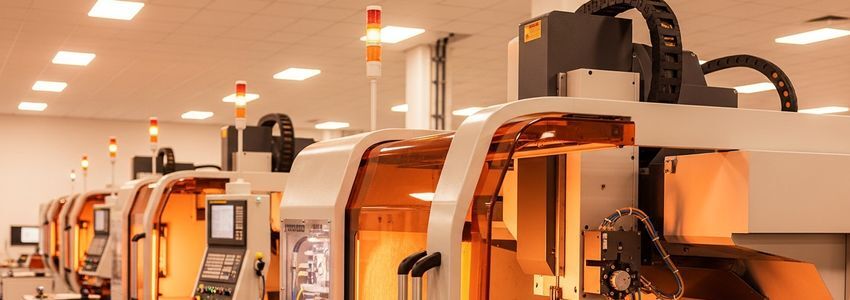
CNC machines, automated presses, robotic welders, conveyor systems, and packaging lines all replace manual fabrication and assembly. Manufacturing equipment financing is one of the most common use cases for equipment loans, often generating immediate ROI through higher throughput and fewer errors.
Point-of-Sale and Retail Technology
Automated checkout systems, self-service kiosks, and inventory management platforms replace manual transactions and paper-based tracking. These upgrades reduce labor costs, minimize human error, and improve customer experience.
Agricultural Machinery
Tractors, harvesters, automated irrigation systems, and GPS-guided equipment replace manual field operations. Farm equipment financing allows agricultural businesses to scale without proportionally expanding their workforce.
Healthcare and Diagnostic Equipment
Automated diagnostic machines, digital imaging systems, and electronic health record infrastructure replace manual data entry and paper-based processes in medical practices.
Warehouse and Logistics Equipment
Forklifts, automated sorting systems, conveyor lines, and warehouse management technology replace manual picking, sorting, and tracking. These investments dramatically reduce labor hours per shipment while improving accuracy.
Construction and Heavy Equipment
Modern construction equipment financing enables contractors to replace labor-intensive manual excavation, compacting, and grading with efficient machinery - reducing project timelines and improving safety.
Office Technology and Software Systems
Enterprise software platforms, automated billing systems, digital workflow tools, and cloud infrastructure replace manual administrative processes, paperwork, and spreadsheet-driven operations.
Key Benefits of Equipment Financing for Process Modernization
Using an equipment loan to fund your modernization initiative delivers several strategic advantages over paying cash or doing nothing:
Preserve Cash Flow
Instead of draining your operating cash reserves on a large equipment purchase, financing spreads the cost over time. Your cash stays available for payroll, inventory, marketing, and other operational needs.
Immediate Productivity Gains
You get the equipment now and start benefiting immediately - before you've finished paying for it. In many cases, the productivity improvement generates enough additional revenue to offset the monthly payment within months.
Fixed, Predictable Payments
Most equipment loans carry fixed interest rates and fixed monthly payments, making it easy to budget. Unlike variable-rate credit lines, your equipment loan cost is the same every month for the life of the term.
Ownership and Asset Building
When you finance rather than lease, you own the equipment at the end of the term. This builds your balance sheet, gives you equity in the asset, and provides flexibility to sell, upgrade, or keep using the equipment long after the loan is paid off.
Access to Better Equipment
Financing removes the ceiling on what you can afford. Instead of buying second-hand or entry-level equipment because of budget constraints, you can finance the high-performance equipment that will actually drive meaningful change in your operations.
Competitive Advantage
Businesses that modernize outcompete those that don't. Faster production, lower error rates, reduced labor costs, and better customer experiences are all natural outcomes of replacing manual processes - and they compound over time into lasting market advantages.
Key Stat: The SBA reports that small businesses consistently cite access to capital as their top barrier to growth. Equipment financing removes that barrier specifically for asset-based modernization projects - making it one of the most targeted growth tools available. (SBA.gov)
Who Qualifies for Equipment Loans?
Equipment loans are accessible to a broad range of businesses. Unlike some financing products that require perfect credit or years of history, equipment loans often have more flexible approval criteria because the equipment itself serves as collateral. Here are the general qualification benchmarks most lenders use:
| Qualification Factor | Typical Requirement | Notes |
|---|---|---|
| Time in Business | 1+ years | Startups may qualify with strong personal credit or large down payment |
| Annual Revenue | $100,000+ | Higher revenue improves terms and loan amounts |
| Credit Score | 580+ (personal or business) | Stronger scores yield better interest rates |
| Equipment Type | Business-use tangible assets | New and used equipment typically both eligible |
| Down Payment | 0-20% | Many lenders offer 100% financing with no down payment required |
Even businesses with imperfect credit often qualify for equipment financing because the collateral structure reduces lender risk. If your business has consistent revenue and a clear need for the equipment, your chances of approval are generally strong.
How Crestmont Capital Helps
Crestmont Capital specializes in equipment financing and small business loans for companies across every industry. When you're ready to replace manual processes with modern equipment, Crestmont makes the financing side simple:
- Fast approvals: Get a decision in as little as 24 hours - not weeks.
- Flexible amounts: Finance equipment from $10,000 to over $5 million.
- All industries welcome: Manufacturing, healthcare, agriculture, construction, logistics, retail, and more.
- New and used equipment: Finance brand-new machinery or quality used assets.
- Competitive rates: Access financing from Crestmont's broad network of lenders to get the best available terms.
Crestmont's advisors work with you to understand your equipment needs and match you to the right financing structure - whether that's a traditional equipment loan, an equipment lease, or a combination that optimizes your cash flow and balance sheet.
Modernize Your Operations Today
Talk to a Crestmont financing specialist about replacing your manual processes with equipment that pays for itself.
Get Financing Now ->Real-World Scenarios: Businesses Replacing Manual Processes with Equipment Loans
Scenario 1: A Regional Bakery Automates Production
A bakery owner was producing 200 loaves per shift manually, limited by hand-kneading and manual portioning. Using a $125,000 equipment loan to purchase a commercial dough sheeter, depositor, and proofing system, they increased output to 800 loaves per shift. Monthly loan payments of $2,400 were more than covered by the incremental revenue from nearly tripling production volume.
Scenario 2: A Construction Company Replaces Manual Grading
A mid-sized contractor was spending $30,000 per month in labor costs for manual grading and earthwork on residential developments. A $380,000 equipment loan funded two GPS-guided motor graders. The new equipment completed the same work with two operators instead of twelve, reducing monthly labor costs by $22,000 - far exceeding the monthly loan payment of $7,200.
Scenario 3: A Distribution Center Upgrades Its Pick-and-Pack Operation
A regional 3PL fulfillment center was manually picking and packing orders, processing 1,200 orders per day with a team of 25 pickers. A $600,000 equipment loan funded a semi-automated conveyor and barcode scan-and-sort system. Daily capacity jumped to 3,500 orders with a team of 12, cutting labor costs by 52% while increasing throughput nearly threefold. According to Forbes, automation in fulfillment centers has become a critical competitive differentiator.
Scenario 4: A Healthcare Clinic Digitizes Records and Diagnostics
A private medical practice was still managing paper patient records and outsourcing diagnostic imaging. A $95,000 equipment loan funded an electronic health records system and in-house diagnostic imaging equipment. Administrative time dropped by 60% and the clinic recaptured $8,000 per month in imaging revenue that had been going to an outside provider.
Scenario 5: A Landscape Company Scales with Equipment
A commercial landscaping firm was bidding $2.5 million annually in contracts but losing bids to competitors with faster equipment. An equipment loan funded three zero-turn mowers, a stand-on skid steer, and a trailer package at $210,000 total. Job completion times dropped 35%, allowing the team to take on 30% more contracts without adding headcount.
Scenario 6: A Restaurant Chain Automates Dishwashing
A high-volume restaurant replaced a manual three-sink dishwashing operation with a conveyor dishwashing system financed at $45,000. Labor hours for the dishwashing station dropped from 20 hours per day to 4, freeing the two freed-up team members for front-of-house support and reducing nightly labor costs substantially.
From Reuters: Small and mid-sized businesses that invest in automation and equipment modernization consistently report higher revenue growth rates and improved employee retention - as workers shift from repetitive manual tasks to more skilled, higher-value roles. (Reuters)
How to Get Started
List the manual processes causing the most bottlenecks and research the equipment that would replace them. Get vendor quotes so you know your target financing amount.
Complete our quick application at offers.crestmontcapital.com/apply-now - takes just a few minutes and requires only basic business information.
A Crestmont Capital advisor will review your equipment needs and match you with the right financing option and loan structure.
Receive your funds - often within days - and order your equipment. Start replacing manual processes and capturing productivity gains immediately.
Conclusion
Equipment loans are one of the most strategic tools available to business owners who want to grow but are held back by inefficient manual processes. By financing the equipment you need - rather than waiting years to save the capital - you accelerate your competitive position and start generating returns from day one.
Whether you run a manufacturing plant, a healthcare clinic, an agricultural operation, or a logistics company, the opportunity to modernize is real and accessible right now. Crestmont Capital's equipment financing programs are designed to make this transition fast, affordable, and straightforward.
Ready to stop letting manual processes limit your potential? Apply now and take the first step toward a more productive, profitable operation.
Frequently Asked Questions
Stop Letting Manual Processes Hold You Back
Crestmont Capital offers fast, flexible equipment financing for businesses ready to modernize. Apply today and get funded in days.
Apply Now ->Disclaimer: The information provided in this article is for general educational purposes only and is not financial, legal, or tax advice. Funding terms, qualifications, and product availability may vary and are subject to change without notice. Crestmont Capital does not guarantee approval, rates, or specific outcomes. For personalized information about your business funding options, contact our team directly.








