Trade show booth fabrication equipment financing gives exhibit builders, display manufacturers, and custom fabrication shops a way to buy or upgrade CNC routers, laser cutters, large-format printers, and finishing equipment without draining cash reserves. For companies building custom exhibits, signage, and displays for trade shows, the right machinery is the difference between winning a six-figure build contract and turning it down because the shop cannot handle the specs.
This guide breaks down how trade show booth fabrication equipment financing works, which machines qualify, how much you can expect to pay, and how to structure a deal that keeps your exhibit shop competitive without overextending your working capital.
In This Article
What Is Trade Show Booth Fabrication Equipment Financing?
Trade show booth fabrication equipment financing is a type of commercial equipment loan or lease specifically structured for the machinery exhibit builders, display manufacturers, and fabrication shops use to produce custom trade show booths, retail displays, and branded environments. Instead of paying cash upfront for a CNC router, laser cutter, or large-format printer, the lender advances funds (or purchases the equipment and leases it to you) and you repay over a fixed term.
The exhibit and display industry depends on precision fabrication equipment to deliver the custom cabinetry, dimensional signage, backlit graphics, and modular structures clients expect. The global exhibition market was valued at roughly $46.3 billion in 2025, and the U.S. business-to-business exhibition industry alone accounts for more than $16 billion in direct annual spending, according to industry research cited by exhibition market analysts. That volume of activity means a steady stream of booth builds, refreshes, and rebuilds that keep fabrication shops busy year-round, provided the shop has the equipment to say yes to the work.
Because this equipment is specialized and often expensive, most shop owners do not pay cash. Financing spreads the cost over the useful life of the machine, preserves cash for payroll and materials, and in many cases lets the business start generating revenue from the new equipment before the first payment is due.
Key Benefits of Financing Exhibit Fabrication Equipment
- Preserve working capital. A $40,000 CNC router does not have to come out of your operating account. Financing keeps cash available for payroll, materials, and the next job's deposit.
- Match payments to revenue. Fabrication shops often see seasonal spikes around major trade show calendars (January, spring, and fall convention seasons). Financing can be structured so payment timing aligns with cash flow.
- Take on bigger contracts. A shop limited to flat-panel cutting cannot bid on jobs requiring dimensional lettering, curved laminate forms, or large-format backlit graphics. New equipment expands what you can quote.
- Potential tax advantages. Many equipment purchases qualify for accelerated depreciation treatment under current tax rules; a tax professional can confirm specifics for your business.
- Stay current on technology. CNC and laser technology moves quickly. Financing (particularly leasing) makes it easier to upgrade every few years instead of being stuck with aging machines.
- Fast access to capital. Equipment-secured financing often approves faster than unsecured loans because the machine itself serves as collateral, reducing lender risk.
Key Stat: According to industry research, roughly 81% of trade show attendees hold purchasing authority at their companies, which is why exhibitors keep investing in custom booth builds even as other marketing budgets tighten. That steady exhibitor demand is what keeps fabrication shops busy and makes equipment upgrades pay for themselves quickly.
Ready to Equip Your Fabrication Shop?
Get fast, flexible financing from the #1 business lender in the U.S. No obligation, apply in minutes.
Apply Now →How Trade Show Booth Fabrication Equipment Financing Works
The mechanics of equipment financing are more straightforward than many fabrication shop owners expect. Here is the process from application to delivery.
Quick Guide
How Equipment Financing Works, At a Glance
Pick your CNC router, laser cutter, printer, or finishing equipment and get a vendor quote.
Submit a simple application with basic business and revenue information. Most applications take minutes.
Because the equipment secures the loan, approvals can come back in as little as 24 to 48 hours.
Funds go directly to the vendor (or reimburse you), and your new machine ships to the shop.
Terms typically run 24 to 72 months depending on equipment type and useful life.
Most equipment loans require a down payment of 0% to 20%, depending on your credit profile, time in business, and the type of equipment. Established fabrication shops with strong revenue history often qualify for little to no money down, while newer shops may need to put down 10% to 25%. Loan terms generally run from two to seven years, with longer terms available for heavier capital equipment like industrial CNC routers and large-format flatbed printers that have a longer useful life.
Equipment You Can Finance
Exhibit fabrication shops rely on a wide range of specialized machinery, and most of it qualifies for equipment financing because it holds resale value and has a defined useful life. Common equipment categories include:
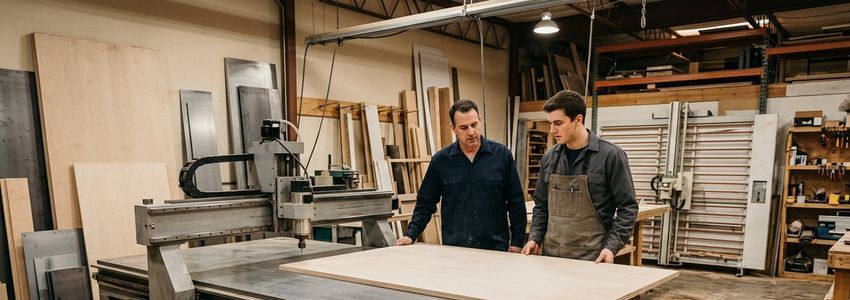
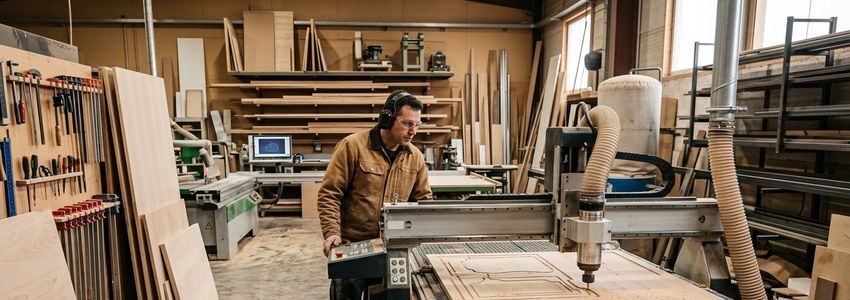
- CNC routers for cutting and carving dimensional signage, cabinetry, and structural panels. Industrial models with automatic tool changers run anywhere from $15,000 to well over $100,000.
- Laser cutters (CO2 and fiber) for precision cutting and engraving of acrylic, wood, foam board, and thin metals used in signage and display elements. Mid-range shop units typically run $10,000 to $25,000, with heavy-duty industrial systems reaching $50,000 to $100,000 or more.
- Large-format and flatbed UV printers for printing graphics directly onto rigid substrates, fabric, and backlit panels.
- Vacuum forming and thermoforming equipment for creating curved, molded display components and dimensional letters.
- Panel saws and edgebanders for precise sheet-good cutting and finished edge work on custom cabinetry and counters.
- Lamination equipment for mounting printed graphics to substrates with a professional, bubble-free finish.
- Paint booths and finishing equipment for achieving the smooth, branded finishes clients expect on custom exhibit structures.
- Upholstery and sewing equipment for fabric-based pop-up displays, tension fabric structures, and soft-sided exhibit walls.
- Crating, packaging, and shipping equipment including custom road cases and crate-building tools, critical for shops that ship booths to venues nationwide.
- Forklifts and material handling equipment for moving large panels and finished booth components through the shop.
Because this equipment spans such a wide price range (a single laser cutter upgrade might run $20,000 while a full shop buildout with CNC routing, printing, and finishing equipment can easily exceed $250,000), financing structures are typically tailored equipment-by-equipment or bundled into a single larger facility to outfit an entire production line at once.
Who This Financing Is Best For
Trade show booth fabrication equipment financing makes the most sense for a specific set of businesses in the exhibit and display industry:
- Custom exhibit houses that design and build trade show booths for corporate clients and need to expand capacity or bid on larger builds.
- Sign and display manufacturers adding CNC or large-format printing capability to move from subcontracting fabrication work to producing it in-house.
- Trade show display rental companies that need to refresh inventory with modular, reusable structures built on newer equipment.
- Retail display and store fixture fabricators whose equipment needs overlap heavily with exhibit builders (CNC routing, laminate work, finishing).
- Growing fabrication shops that have outgrown a single general-purpose CNC machine and need dedicated equipment for specific production stages.
- Shops bidding on larger contracts where the client's spec sheet requires capabilities (five-axis CNC, large-bed flatbed printing) the shop does not currently have.
If your shop is turning down work because of equipment limitations, or routinely outsourcing cutting, printing, or finishing to a competitor, that is usually the clearest signal that financing new equipment will pay for itself through retained margin on jobs you can now complete in-house.
Comparing Your Financing Options
Fabrication shop owners generally have four main paths to fund new equipment. Each has tradeoffs worth understanding before you commit.
| Option | Typical Term | Down Payment | Best For |
|---|---|---|---|
| Equipment Loan | 24 to 72 months | 0% to 20% | Shops that want to own the equipment outright and build equity |
| Equipment Lease | 24 to 60 months | Often $0 | Shops that want to upgrade technology every few years |
| Business Line of Credit | Revolving | N/A | Smaller equipment purchases, materials, and tooling flexibility |
| SBA Loan (7a or 504) | Up to 10 to 25 years | 10% to 20% | Large equipment buildouts or combined equipment plus facility projects |
An equipment loan builds equity in the machine and typically offers the lowest total cost over time if you plan to keep the equipment for its full useful life. A lease can make sense if your shop depends on staying current with the newest CNC or printing technology, since leasing makes it easier to trade up at the end of the term. The U.S. Small Business Administration notes that its 7(a) and 504 programs are commonly used for exactly this kind of fixed-asset purchase, though SBA approval timelines typically run longer than a direct equipment loan.
Pro Tip: If you are financing multiple pieces of equipment for a shop buildout, ask your lender about a single master financing agreement rather than separate loans for each machine. This simplifies your monthly payments and often improves pricing versus financing each piece one at a time.
How Crestmont Capital Helps Exhibit Fabrication Businesses
Crestmont Capital works with fabrication shop owners to structure fabrication equipment financing and CNC machine financing around the realities of the exhibit and display business, including seasonal trade show calendars and large one-off contracts that require fast equipment turnaround. Whether you need a single laser cutter or a full shop buildout spanning CNC routing, printing, and finishing equipment, Crestmont's equipment financing programs are built to move quickly.
For shops that also need working capital flexibility alongside equipment purchases (to cover materials, freight, and labor on a large booth build while financing the machinery separately), Crestmont also offers a business line of credit that can be used alongside equipment financing. If your shop is expanding into related production work, the museum exhibit fabrication equipment financing guide and vinyl sign making equipment financing guide cover adjacent equipment needs that often overlap with trade show booth production.
Expand Your Fabrication Capacity
Finance the CNC routers, laser cutters, and printers your exhibit shop needs to win bigger contracts.
Apply Now →Real-World Scenarios
Scenario 1: The Growing Exhibit House
A 15-person custom exhibit house in the Midwest had been subcontracting all CNC routing to a local sign shop, losing roughly 20% margin on every job that required dimensional cutting. After financing a mid-range CNC router with automatic tool changer for approximately $45,000, the shop brought fabrication in-house, cut turnaround time on client proofs by half, and recovered the equipment cost within 14 months through retained margin alone.
Scenario 2: The Sign Shop Expanding Into Trade Show Displays
A regional sign manufacturer wanted to break into trade show booth fabrication but lacked a large-format flatbed printer capable of printing directly to rigid substrates. Financing a flatbed UV printer let the shop quote its first 20x20 island booth contract, a job worth more than $80,000, that it could not have bid on previously.
Scenario 3: The Shop Replacing Aging Equipment
An established fabrication shop running a 12-year-old CNC router faced increasing downtime and repair costs. Rather than continue patching an aging machine, the owner financed a replacement with a 5-year term, keeping monthly payments close to what the shop had been spending on repairs and service calls, while eliminating unplanned downtime during peak trade show season.
Scenario 4: The Full Shop Buildout
A startup exhibit fabrication company needed to outfit an entire shop from scratch: a CNC router, laser cutter, panel saw, and laminator, totaling roughly $180,000 in equipment. A single structured equipment financing package with staggered delivery dates let the company phase in equipment as contracts came online, rather than raising all the capital before landing its first client.
Scenario 5: The Seasonal Capacity Crunch
A display rental company saw demand spike every January and September around major convention seasons. Financing a second laser cutter let the shop run two production lines in parallel during peak months, taking on rush orders it previously had to decline, while spreading the equipment cost evenly across the full year.
Frequently Asked Questions
Don't Turn Down Another Job
Finance the fabrication equipment your exhibit shop needs to bid on bigger, more profitable contracts.
Apply Now →Next Steps
List the jobs you have turned down or subcontracted, and the equipment that would let you keep that work in-house.
Reach out to equipment vendors for a formal quote on the CNC router, laser cutter, or printer you need.
Submit your application with Crestmont Capital and get a decision quickly, often within 24 to 48 hours.
Once funded, your equipment ships, and you can start quoting jobs you previously could not take on.
Conclusion
Trade show booth fabrication equipment financing lets exhibit builders, sign manufacturers, and display shops add the CNC routing, laser cutting, printing, and finishing capacity that wins bigger contracts, without tying up the cash needed to run day-to-day operations. With the exhibition industry continuing to grow and exhibitors maintaining strong budgets for custom booth builds, shops that can quote the full scope of a job, cutting, printing, and finishing included, are positioned to capture more of that spend. Whether you need a single laser cutter upgrade or a full shop buildout, structured equipment financing makes it possible to say yes to the next contract instead of turning it away.
Disclaimer: The information provided in this article is for general educational purposes only and is not financial, legal, or tax advice. Funding terms, qualifications, and product availability may vary and are subject to change without notice. Crestmont Capital does not guarantee approval, rates, or specific outcomes. For personalized information about your business funding options, contact our team directly.