Museum exhibit fabrication equipment financing gives exhibit shops, scenic studios, and display builders a way to acquire CNC routers, laser cutters, vacuum formers, and finishing equipment without draining working capital. For fabrication business owners who build museum displays, interactive exhibits, and gallery installations, the right financing structure can be the difference between turning down a project and scaling into larger, more profitable contracts.
This guide breaks down exactly how museum exhibit fabrication equipment financing works, what equipment qualifies, how much you can expect to finance, and how to choose between a loan, a lease, or an SBA-backed option. Whether you run a two-person prop shop or a full-scale exhibit fabrication company with a dozen employees, the information below will help you make a confident funding decision.
In This Article
What Is Museum Exhibit Fabrication Equipment Financing?
Museum exhibit fabrication equipment financing is a category of business equipment financing built specifically for shops that design, build, and install museum exhibits, gallery displays, interpretive panels, dioramas, and interactive installations. Instead of paying cash for expensive fabrication machinery, a fabrication shop borrows or leases the funds needed to acquire it, then repays the lender over a set term while the equipment is already generating revenue on active projects.
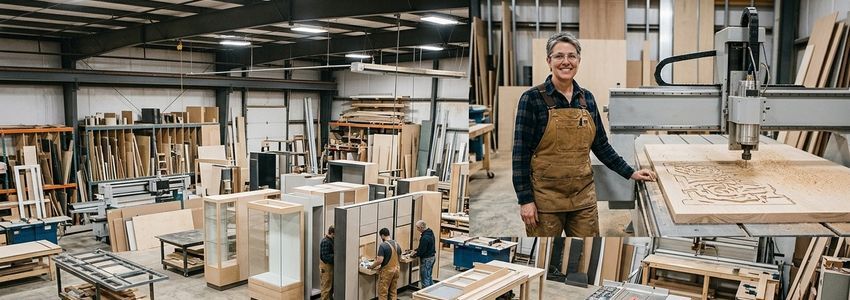
This type of financing typically covers the machinery, tools, and shop infrastructure exhibit fabricators rely on every day: CNC routers for cutting custom panels and armatures, laser cutters and engravers for signage and acrylic components, vacuum formers for shaping plastic and fiberglass elements, 3D printers for prototyping props and models, dust collection and finishing systems, and even specialized casting and mold-making equipment used for sculptural exhibit pieces.
Because the equipment itself typically secures the financing, lenders can often approve exhibit fabrication businesses with less documentation and faster turnaround than an unsecured loan would require. That structure makes equipment financing one of the most accessible funding tools available to small and mid-size fabrication shops, including newer businesses that may not yet have years of financial history.
Key Benefits of Financing Your Fabrication Equipment
Exhibit fabrication is an equipment-intensive business. A single CNC router or fiber laser can cost tens of thousands of dollars, and most shops need several major machines working together to deliver a finished exhibit on schedule. Financing lets owners get that equipment into production immediately instead of waiting months or years to save up the cash.
- Preserve working capital. Keep cash available for payroll, materials, and project deposits instead of tying it up in a single equipment purchase.
- Match payments to project revenue. Monthly payments can be structured around the cash flow of ongoing exhibit contracts rather than a single lump-sum outlay.
- Take on larger contracts. New capacity from an additional CNC router, laser cutter, or finishing line lets a shop bid on museum and institutional contracts it previously had to pass on.
- Access to newer, more capable machinery. Financing makes it realistic to upgrade to faster, more precise equipment that improves both turnaround time and finish quality.
- Potential tax advantages. Many equipment financing structures allow a business to expense a significant portion of the equipment cost in the year it is placed into service, though owners should always confirm specifics with their own accountant.
- Predictable budgeting. Fixed monthly payments make it easier to forecast overhead against upcoming exhibit fabrication contracts.
Ready to Equip Your Fabrication Shop?
Get fast, flexible equipment financing from the #1 business lender in the U.S. No obligation, apply in minutes.
Apply Now →How Museum Exhibit Fabrication Equipment Financing Works
The process is more straightforward than most fabrication business owners expect. Here is the typical path from application to equipment on the shop floor:
- Identify the equipment. Get a quote from your equipment vendor, or have a target price range ready if you are financing multiple pieces of machinery at once.
- Submit an application. Most lenders ask for basic business information, time in business, and recent bank statements. Many exhibit fabrication shops qualify with a simple application-only process for smaller equipment amounts.
- Underwriting review. The lender evaluates the business's revenue, credit profile, and the resale value of the specific equipment being financed.
- Approval and terms. You receive approved terms covering the financed amount, monthly payment, term length, and any down payment requirement.
- Funding and delivery. Once terms are signed, funds are released to the vendor (or reimbursed to you), and the equipment is delivered and installed in your shop.
- Repayment. You make fixed monthly payments over the agreed term while the equipment is already being used on active exhibit fabrication contracts.
Approval timelines vary by lender and loan size, but many equipment financing applications for amounts under $250,000 can be approved within one to three business days when documentation is complete, a pace Forbes Advisor's equipment financing guide notes is common across online and alternative lenders.
Types of Equipment You Can Finance
Exhibit fabrication shops run a wide mix of machinery, and most equipment financing programs are flexible enough to cover several categories in a single application. Common equipment types financed by museum exhibit fabrication businesses include:
- CNC routers and CNC mills for cutting wood, plastic, foam, and composite panels
- Laser cutters and laser engravers for acrylic graphics, signage, and fine detail work
- 3D printers for prototyping props, scale models, and custom exhibit components
- Vacuum forming machines for shaping plastic and fiberglass display elements
- Table saws, panel saws, and edge banders for casework and cabinetry construction
- Spray booths, finishing equipment, and dust collection systems
- Welding equipment for metal armatures and structural exhibit frameworks
- Lighting and AV integration equipment used in interactive and immersive exhibits
- Delivery vehicles and lift equipment used for installation at museum and gallery sites
Key Stat: The U.S. Census Bureau's Arts, Entertainment, and Recreation economic census data tracks a sector approaching two million businesses nationwide, a market that depends on a steady pipeline of exhibit fabrication, renovation, and touring display work.
By the Numbers
Museum Exhibit Fabrication Equipment Financing - Key Figures
35K+
Active museums in the U.S. needing exhibit work
$5K-$500K
Typical equipment financing amount range
3-10 Yrs
Common repayment terms, matched to equipment life
24-72 Hrs
Possible approval time for smaller equipment amounts
Who This Financing Is Best For
Museum exhibit fabrication equipment financing tends to fit a specific set of business situations particularly well. It is most useful for:
- Established exhibit fabrication shops adding a second CNC router, laser cutter, or finishing line to keep up with growing project volume.
- Scenic and prop studios expanding from theatrical or trade show work into museum and institutional exhibit contracts, which often require more precise, higher-capacity equipment.
- Museum in-house fabrication departments that need to replace aging machinery without a large capital outlay from an annual operating budget.
- New exhibit fabrication businesses that have secured their first major museum or gallery contract but do not yet have the full equipment lineup required to deliver it.
- Growing shops that want to bid on larger RFPs from museums, science centers, and visitor centers but are currently equipment-constrained.
If your business is capital-constrained but has a clear, immediate use for the equipment, financing is generally a stronger fit than waiting to self-fund a purchase, particularly when a specific contract or deadline is on the line.
Equipment Loan vs. Equipment Lease vs. SBA Loan
There is no single "best" option for every exhibit fabrication business. The right choice depends on whether you want to own the equipment outright, how quickly technology in your shop tends to change, and how much documentation you are prepared to provide.
| Feature | Equipment Loan | Equipment Lease | SBA 7(a)/504 Loan |
|---|---|---|---|
| Ownership | You own the equipment once paid off | Option to return, renew, or buy out | You own the equipment once paid off |
| Down payment | Often 0-20% | Often minimal or none | Typically 10-20% |
| Approval speed | Fast, often 1-3 business days | Fast, often 1-3 business days | Slower, often 30-90 days |
| Best for | Equipment you plan to use long-term | Fast-evolving tech you may want to upgrade | Large purchases with time to spare |
| Credit flexibility | Moderate, asset-backed underwriting helps | Often the most flexible for newer businesses | Strictest credit and documentation requirements |
Pro Tip: If a museum contract has a hard installation deadline, an equipment loan or lease is usually the more realistic path. SBA loans offer strong rates but the 30-90 day underwriting timeline rarely lines up with an active project schedule.
How Crestmont Capital Helps Exhibit Fabrication Businesses
Crestmont Capital works with fabrication shops, scenic studios, and exhibit builders across the country to structure fabrication equipment financing around the realities of project-based work. Rather than a one-size-fits-all application, Crestmont looks at the equipment itself, the contract driving the purchase, and the shop's overall cash flow to structure a payment plan that fits.
For shops that need working capital alongside new machinery, such as covering materials and labor while a large museum contract is underway, Crestmont also offers unsecured working capital loans that can run alongside an equipment financing plan. Businesses that prefer a government-backed structure for a larger equipment package can also explore SBA loan options through Crestmont's lending network.
Crestmont has also financed equipment for adjacent fabrication niches that share many of the same machinery needs as museum exhibit builders, including shops covered in Crestmont's guides to CNC router financing and escape room prop fabrication equipment financing, two fabrication segments that overlap heavily with museum and exhibit work in both equipment and skill set.
For shops that want the flexibility to add equipment over time rather than financing a single large purchase up front, Crestmont's equipment leasing programs allow incremental additions to a shop's machinery lineup as new contracts come in, without renegotiating a new loan each time.
Building Your Next Museum Exhibit?
Get the fabrication equipment you need funded quickly, with flexible terms built around your project timeline.
Apply Now →Real-World Scenarios
Scenario 1: The growing exhibit shop. A 12-person fabrication studio wins a contract to build a traveling science exhibit for a regional museum network. The existing CNC router is booked solid with ongoing work, so the shop finances a second router to run both projects in parallel and hit the installation deadline without turning away other clients.
Scenario 2: The new business with its first big contract. A two-person prop and scenic studio lands its first museum contract, a natural history diorama requiring vacuum-formed rockwork and custom armatures. The shop does not yet own a vacuum former, so it finances the machine against the signed contract, delivering the exhibit on time and building a track record for future museum work.
Scenario 3: The in-house museum fabrication department. A mid-size museum's internal exhibits team is running a 15-year-old laser cutter that increasingly needs repairs. Rather than pulling from the museum's annual operating budget, the department finances a new laser cutter with predictable monthly payments that fit inside the existing exhibits line item.
Scenario 4: The trade show fabricator expanding into museums. A fabrication company that has built its business on trade show booths wants to move into higher-margin museum and gallery work, which requires finer finishing equipment and more precise CNC tooling. Financing a new finishing line and upgraded router lets the shop bid competitively on its first institutional RFP.
Scenario 5: The seasonal surge. An exhibit fabrication shop wins three simultaneous museum contracts ahead of a busy fall exhibit season. Rather than delaying any of the three projects, the shop finances a package of equipment, including a second CNC router and an additional finishing station, to run all three builds at once.
Frequently Asked Questions
Next Steps
Get a quote from your equipment vendor, or estimate a target range if financing multiple machines.
Most applications require a few months of business bank statements to verify cash flow.
Apply online in minutes with basic business details and your equipment quote.
Once approved, funds are released to your vendor and your equipment ships to your shop.
Take On Your Next Museum Contract with Confidence
Crestmont Capital helps exhibit fabrication shops finance the equipment behind every successful installation. Apply in minutes.
Apply Now →Conclusion
Museum exhibit fabrication equipment financing gives exhibit shops, scenic studios, and in-house museum fabrication departments a realistic path to the CNC routers, laser cutters, vacuum formers, and finishing equipment that modern exhibit work demands. Rather than turning down a contract because the shop lacks the right machinery, financing lets fabrication businesses say yes to bigger, more complex projects and build long-term relationships with museums and institutions that need reliable exhibit partners.
Whether you choose an equipment loan, an equipment lease, or an SBA-backed option, the right financing structure should match your shop's cash flow and the timeline of the contract driving the purchase. If you are ready to explore museum exhibit fabrication equipment financing for your shop, Crestmont Capital can help you find the structure that fits.
Disclaimer: The information provided in this article is for general educational purposes only and is not financial, legal, or tax advice. Funding terms, qualifications, and product availability may vary and are subject to change without notice. Crestmont Capital does not guarantee approval, rates, or specific outcomes. For personalized information about your business funding options, contact our team directly.