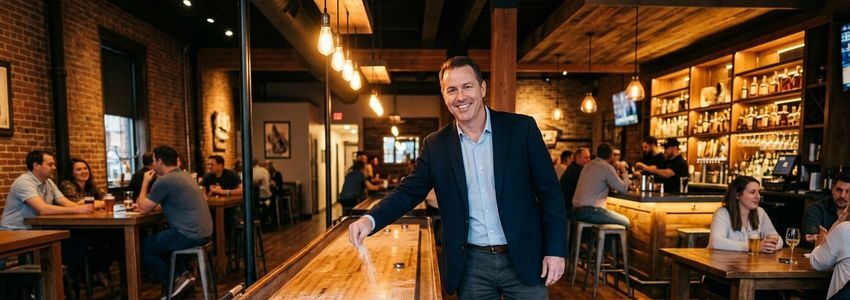
Shuffleboard table financing gives bar owners, restaurant operators, and entertainment venue managers a way to add a high-margin attraction without draining cash reserves on a single purchase. A quality commercial shuffleboard table can cost anywhere from $3,000 for an entry-level unit to well over $15,000 for a championship-grade table built from solid hardwood, and most independent operators simply do not have that kind of capital sitting idle. Financing turns a large upfront expense into a predictable monthly payment while the table itself starts generating revenue from the very first week it is installed.
Shuffleboard has quietly become one of the fastest-growing attractions in the bar and nightlife industry. It appeals to a broad range of customers, requires no special athletic ability, and naturally extends how long guests stay in a venue, which drives additional food and beverage sales. For an operator weighing whether to add one table or build out an entire shuffleboard lounge, understanding the financing landscape is the first step toward making a confident decision.
In This Article
What Is Shuffleboard Table Financing?
Shuffleboard table financing is a form of equipment financing that allows a business owner to purchase a commercial-grade shuffleboard table and pay for it over time instead of in one lump sum. Like other types of equipment financing, the table itself typically serves as collateral for the loan, which makes approval easier than it would be for an unsecured loan of the same size.
A commercial shuffleboard table is a precision piece of equipment. The playing surface, usually built from solid maple, must be perfectly level and finished to allow a weighted puck to glide smoothly from one end to the other. Tables range from 9 feet for tight spaces to 22 feet for tournament-style play, and the price climbs quickly with length, wood quality, and scoring electronics. Financing spreads that cost across 12 to 60 months, depending on the lender and the loan structure, so the table pays for itself through increased drink and food sales long before the final payment is due.
Business owners can also use the term "shuffleboard table financing" to describe equipment leasing, where the lender retains ownership of the table during the lease term and the operator makes fixed payments for the use of the equipment. Both structures accomplish the same core goal: get the table on the floor now, and pay for it out of the revenue it generates.
Key Stat: According to Forbes Advisor's 2025 small business lending research, nearly 29% of business owners who took out a business loan used the funds specifically for equipment purchases, making equipment financing one of the single most common reasons small businesses borrow.
Key Benefits of Financing a Shuffleboard Table
Paying cash for a shuffleboard table is not wrong, but it ties up working capital that could otherwise cover payroll, inventory, or marketing. Financing keeps that capital free while still getting the table installed on your timeline.
- Preserve cash flow. A single monthly payment is far easier to absorb than a $6,000 to $15,000 upfront hit to your operating account.
- Start generating revenue immediately. The table begins attracting customers and extending visit times from day one, often covering its own payment well before the loan matures.
- Predictable budgeting. Fixed monthly payments make it simple to forecast costs and plan staffing or marketing around the new attraction.
- Potential tax advantages. Many equipment financing structures allow the table to be treated as a business asset, and your accountant can advise on depreciation schedules that fit your situation.
- Build business credit. On-time payments on an equipment loan help build a stronger credit profile for future financing needs, whether that's a second table, a sound system upgrade, or a full venue expansion.
- Flexible terms for different credit profiles. Equipment-backed financing is often available to newer businesses or owners with less-than-perfect credit because the table itself secures the loan.
Ready to Add a Shuffleboard Table to Your Venue?
Get fast, flexible financing from the #1 business lender in the U.S. No obligation, apply in minutes.
Apply Now →How Shuffleboard Table Financing Works
The process of financing a shuffleboard table is similar to financing any other piece of commercial equipment. Lenders look at a handful of core factors: time in business, monthly revenue, personal and business credit, and the cost of the equipment itself.
- Choose your table and get a quote. Decide on length, wood species, and scoring system, then get a written quote from a shuffleboard manufacturer or dealer.
- Submit a financing application. Most equipment lenders ask for basic business information, recent bank statements, and the equipment quote. Approval decisions for smaller equipment amounts can often happen within 24 to 48 hours.
- Review your terms. Compare the monthly payment, total cost of financing, term length, and whether there is a buyout option at the end of a lease.
- Get funded and take delivery. Once approved, funds are typically sent directly to the equipment vendor or to your business account so you can pay for the table and arrange delivery and installation.
- Make monthly payments. You pay a fixed amount each month, and once the loan or lease term ends, the table is fully yours (if structured as a loan) or you may have a buyout option (if structured as a lease).
Types of Shuffleboard Tables and Financing Options
Not every shuffleboard table serves the same purpose, and the financing option that makes sense depends heavily on which type of table you are adding to your venue.
Table Length and Style
- 9 to 12-foot tables work well for smaller bars, breweries, or restaurants with limited floor space and a casual, walk-up play style.
- 14 to 16-foot tables are the most common choice for dedicated bar and entertainment venues, offering a true competitive feel without requiring a massive footprint.
- 18 to 22-foot championship tables are built for venues running leagues or tournaments and competing directly with other shuffleboard-focused concepts.
Financing Structures
- Equipment loans. You own the table from day one, and the loan is paid off over a fixed term, typically 12 to 60 months.
- Equipment leases. The lender owns the table during the lease term; this often comes with lower monthly payments and may include a $1 buyout or fair-market-value buyout at the end.
- Business lines of credit. A revolving line of credit can be drawn against to purchase a table and then used again later for other equipment or operating needs.
- SBA-backed loans. For larger purchases, such as financing multiple tables for a dedicated shuffleboard venue, an SBA 7(a) loan can offer longer repayment terms and competitive rates for qualifying businesses.
By the Numbers
Shuffleboard Table Financing - Key Statistics
29%
Of small business loans are used for equipment purchases (Forbes Advisor, 2025)
$39B
Estimated annual revenue of the U.S. bar and nightclub industry in 2025
28K+
Active drinking-places establishments nationwide (Census.gov NAICS 722410)
24-48 Hrs
Typical approval turnaround for smaller equipment financing requests
Who Shuffleboard Table Financing Is Best For
Shuffleboard table financing is a strong fit for several types of operators, each with slightly different motivations for adding the attraction.
- Bar and tavern owners looking to differentiate from nearby competitors and give customers a reason to stay longer and order another round.
- Brewery and taproom operators who want to create a more social, lingering experience that pairs naturally with flight tastings and group visits.
- Restaurant owners with bar space seeking to activate underused square footage during slower weekday hours.
- Entertainment venue and family entertainment center operators adding shuffleboard as one attraction among several, such as darts, billiards, or arcade games.
- Entrepreneurs opening a dedicated shuffleboard lounge or league-based concept who need to finance multiple tables at once rather than a single unit.
Pro Tip: Venues that pair a shuffleboard table with a modest bar menu upcharge, such as a reserved-table minimum spend, often recover the cost of financing faster because the table drives both longer dwell time and higher average ticket size per visit.
Financing vs. Leasing vs. Buying Outright
Every operator eventually asks the same question: should I finance, lease, or just pay cash? The right answer depends on your current cash position, how long you plan to keep the table, and how quickly you want to own it outright.
| Feature | Equipment Loan | Equipment Lease | Cash Purchase |
|---|---|---|---|
| Upfront Cost | Low to none | Low to none | Full purchase price |
| Ownership | Immediate | At end of term (if buyout chosen) | Immediate |
| Impact on Cash Flow | Minimal | Minimal | Significant |
| Approval Speed | 24-48 hours typical | 24-48 hours typical | Immediate (if funds available) |
| Best For | Owners who want to own the asset quickly | Owners who prioritize lowest monthly payment | Owners with ample reserve capital |
How Crestmont Capital Helps
Crestmont Capital works with bar, restaurant, and entertainment venue owners across the country to structure equipment financing that fits their cash flow and growth plans. Instead of a one-size-fits-all loan product, we look at your business specifically and help you decide whether an equipment financing plan, an equipment lease, or a business line of credit makes the most sense for your shuffleboard table purchase.
If you already have a track record in the bar or entertainment space, read how other sports bar owners have used financing to grow their venues, or see how a similar entertainment attraction was financed in our guide to darts bar equipment financing. Many of the same lending principles apply directly to shuffleboard tables.
Our commercial financing programs are built for speed. Most applicants receive a decision within one business day, and funding can often be completed within a week, so your table does not sit in a warehouse any longer than it has to.
Turn Floor Space Into Recurring Revenue
See how much you qualify for with no impact to your credit. Fast approvals, flexible terms.
Get Started →
Real-World Scenarios
Scenario 1: The Neighborhood Sports Bar
A sports bar owner in a mid-sized college town wanted to differentiate from three other bars within walking distance. She financed a 14-foot shuffleboard table using a 36-month equipment loan with a low monthly payment. Within four months, Thursday and Sunday night traffic increased noticeably as regulars started bringing friends specifically to play, and the added drink sales covered the monthly payment with room to spare.
Scenario 2: The Craft Brewery Taproom
A craft brewery owner added a 12-foot shuffleboard table to the taproom to extend average visit time beyond the typical flight-and-leave pattern. Financing the table through an equipment lease kept monthly costs low while the brewery focused its cash reserves on a new fermentation tank. The taproom now runs a casual Tuesday night shuffleboard league that reliably fills tables on an otherwise slow night.
Scenario 3: The Entertainment Venue Expansion
An entertainment venue that already offered darts and billiards wanted to add two shuffleboard tables to round out its game offerings. The owner used an SBA-backed loan structured through a Crestmont Capital application to finance both tables along with scoring electronics, spreading the cost over 60 months and keeping the payment manageable alongside existing equipment loans.
Scenario 4: The New Shuffleboard-Focused Concept
A first-time operator wanted to open a dedicated shuffleboard lounge with six championship-length tables. Because the business had no operating history, a traditional bank loan was not an option. Equipment financing, secured by the tables themselves, allowed the business to open with all six tables installed rather than waiting years to add them one at a time out of cash flow.
Frequently Asked Questions
Your Shuffleboard Table Could Be Installed Within Days
Apply now and find out what financing terms you qualify for, with no obligation.
Apply Now →Next Steps
Contact a shuffleboard table vendor and get a written quote for the table, length, and finish you want.
Submit your application with recent bank statements and the equipment quote.
Compare monthly payment, term length, and any buyout options before signing.
Once funded, coordinate delivery and installation, and start promoting the new attraction to customers.
Conclusion
Shuffleboard table financing makes it possible for bar, restaurant, and entertainment venue owners to add a proven, revenue-generating attraction without disrupting cash flow. Whether you choose an equipment loan, an equipment lease, or an SBA-backed option for a multi-table build-out, financing lets the table start paying for itself from the moment it hits the floor. With approval timelines often measured in days rather than weeks, there is little reason to delay giving your customers a new reason to stay a little longer and order another round.
Disclaimer: The information provided in this article is for general educational purposes only and is not financial, legal, or tax advice. Funding terms, qualifications, and product availability may vary and are subject to change without notice. Crestmont Capital does not guarantee approval, rates, or specific outcomes. For personalized information about your business funding options, contact our team directly.