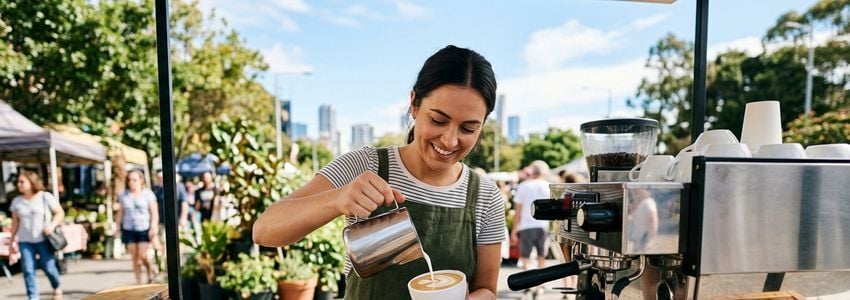
Mobile coffee cart financing gives aspiring and existing coffee cart entrepreneurs a way to fund the espresso machine, cart build-out, refrigeration, POS system, and permits needed to launch or grow a mobile coffee business without draining personal savings. Coffee carts have become one of the most accessible entry points into the specialty coffee industry, requiring far less upfront capital than a full coffee shop while still tapping into a market where nearly half of American adults drink specialty coffee daily. The challenge is that even a lean coffee cart setup can run anywhere from a few thousand dollars to well over $40,000 once you factor in a quality commercial espresso machine, grinder, cart or trailer build-out, and permitting costs.
For most first-time and growing coffee cart owners, that gap between available cash and total startup cost is exactly what financing is designed to close. This guide walks through how mobile coffee cart financing works, the types of funding available, what a typical package covers, and how to decide whether equipment financing, an SBA microloan, or a working capital loan is the right fit for your coffee cart business.
Demand for the category keeps climbing too. Forbes has tracked the long-running rise of specialty coffee consumption in the United States, a trend that recent industry data shows has only accelerated, with specialty coffee now outpacing traditional coffee among younger consumers. That gives mobile, low-overhead formats like coffee carts a large and growing customer base to serve.
In This Article
- What Is Mobile Coffee Cart Financing?
- Key Benefits of Financing Your Coffee Cart
- How Coffee Cart Financing Works
- Types of Financing Available
- What a Financing Package Can Cover
- Who Coffee Cart Financing Is Best For
- Comparing Your Funding Options
- How Crestmont Capital Helps
- Real-World Scenarios
- FAQ
- Next Steps
What Is Mobile Coffee Cart Financing?
Mobile coffee cart financing refers to any funding product used specifically to purchase, lease, build out, or upgrade the equipment and infrastructure that makes a mobile coffee business run. That typically includes a commercial espresso machine, a burr grinder, a refrigerated cart or trailer unit, a water and wastewater system, a point-of-sale terminal, and the permits and signage required to operate legally in your city or county. According to Forbes, small coffee operators are finding real profit opportunities in 2025 by staying nimble on format and equipment rather than committing to expensive fixed real estate.
Unlike a traditional bank loan that evaluates your business as a whole, equipment-based coffee cart financing is often secured by the equipment itself. That structure tends to make approval faster and more accessible for newer businesses, since the lender has collateral value in the cart and machinery rather than relying solely on years of tax returns or a long credit history.
Key Benefits of Financing Your Coffee Cart
- Lower upfront cash requirement: Spread a $10,000 to $40,000 equipment and build-out cost across manageable monthly payments instead of paying it all at once.
- Preserve working capital: Keep cash on hand for inventory, marketing, permits, and the slow early months before revenue stabilizes.
- Access to commercial-grade equipment: Finance a higher-quality espresso machine and grinder that can handle peak-hour volume, rather than settling for underpowered home equipment.
- Faster launch timeline: Equipment financing decisions can move in days rather than the weeks a traditional bank loan often takes.
- Credit-building opportunity: On-time payments on a business financing account help establish a credit profile that makes future funding, like an expansion into a second cart or a brick-and-mortar location, easier to secure.
Ready to Launch Your Coffee Cart?
Get fast, flexible financing from the #1 business lender in the U.S. No obligation, apply in minutes.
Apply Now →How Coffee Cart Financing Works
The mechanics of coffee cart financing are straightforward once you understand the basic sequence. Most business owners move through the same four steps regardless of which financing product they ultimately choose.
- Determine your total project cost. Add up the cart or trailer build-out, espresso machine and grinder, refrigeration, water systems, signage, permits, and a cushion for opening inventory.
- Choose a financing structure. Decide whether you need equipment financing tied to specific hardware, a working capital loan for broader startup costs, or a line of credit for ongoing flexibility.
- Submit an application. Most lenders ask for basic business information, a few months of bank statements, and, for newer businesses, a simple breakdown of the equipment being purchased.
- Receive funding and equip your cart. Once approved, funds are typically disbursed directly for equipment purchase or as a lump sum you use to pay vendors, allowing you to move quickly from application to opening day.
Types of Financing Available for Coffee Cart Businesses
Not every coffee cart owner needs the same type of funding. The right choice depends on whether you are launching a brand-new cart, replacing aging equipment, or expanding into a second location.
Equipment Financing
Equipment financing is the most direct fit for a coffee cart business because the espresso machine, grinder, and cart hardware serve as collateral. This often makes it easier to qualify for than an unsecured loan, and terms are structured around the useful life of the equipment, typically two to five years.
SBA Microloans
The SBA microloan program offers loans up to $50,000, with the average microloan around $13,000, specifically to help small businesses start up and expand. For a lean coffee cart launch, a microloan can cover equipment, inventory, and working capital in a single package, administered through nonprofit community lending intermediaries rather than a traditional bank.
Business Line of Credit
A business line of credit gives an already-operating coffee cart owner flexible, revolving access to capital for restocking inventory, covering a slow season, or handling an unexpected repair without applying for a new loan every time.
Unsecured Working Capital Loans
For coffee cart owners who need cash for costs beyond hard equipment, like permits, initial inventory, or marketing, an unsecured working capital loan provides funding without requiring the equipment itself as collateral.
Key Stat: The average SBA microloan is approximately $13,000, with a program maximum of $50,000, according to the U.S. Small Business Administration, making it one of the most accessible funding paths for a lean coffee cart launch.
What a Coffee Cart Financing Package Can Cover
A well-structured financing package can cover far more than just the espresso machine. Understanding the full scope helps you request the right amount the first time instead of coming back for a second round of funding mid-buildout.
By The Numbers
Mobile Coffee Cart Financing, Key Figures
$5K to $49K
Typical total startup cost range for a mobile coffee cart
$50K
Maximum SBA microloan amount available to small businesses
47%
Of American adults drank specialty coffee in the past day, per NCA data
2 to 5 Yrs
Typical equipment financing term length
A comprehensive coffee cart financing package typically covers the following categories:
- Commercial espresso machine and burr grinder
- Cart or trailer purchase and custom build-out, including plumbing and a sink system
- Refrigeration and cold storage for milk, syrups, and perishables
- Point-of-sale hardware and payment processing setup
- Generator or power hookup equipment for off-grid locations
- Health permits, business licenses, and vendor approval fees
- Initial inventory of beans, cups, lids, and packaging
- Branding, signage, and cart wrap design
Who Coffee Cart Financing Is Best For
Coffee cart financing tends to make the most sense for a specific set of business owners rather than every type of entrepreneur. Consider whether one of the following situations describes your business.
- First-time coffee entrepreneurs who want to test a concept and build a customer base before committing to the overhead of a full coffee shop lease.
- Existing baristas or coffee shop employees transitioning into ownership with strong operational knowledge but limited personal capital.
- Event and catering operators adding a mobile coffee service line to an existing food or event business.
- Coffee shop owners looking to add a second, mobile revenue stream without opening a second brick-and-mortar location.
- Farmers market and pop-up vendors upgrading from a basic setup to commercial-grade equipment as demand grows.
Comparing Your Funding Options
Choosing between equipment financing, an SBA microloan, and a line of credit comes down to how quickly you need funds, how much collateral you can offer, and whether your costs are one-time or ongoing.
| Financing Type | Best For | Typical Speed | Collateral |
|---|---|---|---|
| Equipment Financing | Espresso machine, grinder, cart hardware | Days | The equipment itself |
| SBA Microloan | Full startup package under $50,000 | Weeks | Varies by intermediary lender |
| Business Line of Credit | Ongoing inventory and repairs | Days | Typically unsecured |
| Working Capital Loan | Permits, inventory, marketing | Days | Unsecured |
How Crestmont Capital Helps Coffee Cart Entrepreneurs
Crestmont Capital works with mobile coffee cart owners at every stage, from a first-time cart launch to adding a second unit for a growing brand. Our equipment financing programs are built to fund the espresso machine, grinder, and cart build-out directly, so you are not tying up personal savings in hardware that starts generating revenue from day one.
If your coffee cart concept also involves a companion food truck or catering unit, our dedicated food truck financing programs can be paired alongside your coffee equipment funding. For coffee cart owners specifically focused on the machine itself, our coffee machine financing option is tailored to commercial espresso and brewing equipment.
Once your cart is up and running, a business line of credit gives you flexible access to funds for restocking, seasonal inventory swings, or an unexpected repair, without having to reapply for a new loan each time. We work with business owners across a wide range of credit profiles and time-in-business histories, and our team can walk you through which structure fits your specific launch or expansion plan.
If you are weighing a mobile cart against a larger mobile food operation, our guide on food truck financing breaks down how a similar financing structure applies to a bigger vehicle-based build-out. Coffee shop owners considering a permanent second location alongside a mobile cart may also find our coffee shop equipment financing guide useful for comparing the two paths.
Turn Your Coffee Cart Concept Into Reality
Equipment financing built around your espresso machine, cart build-out, and launch costs. No obligation to apply.
Apply Now →Real-World Scenarios
The First-Time Cart Owner
A barista with five years of coffee shop experience wants to launch her own cart at a downtown farmers market. She has $6,000 in savings but needs closer to $18,000 for a quality espresso machine, grinder, custom cart build, and permits. Equipment financing covers the gap, letting her keep her savings as a cash reserve for the first slow months.
The Catering Company Adding Coffee Service
An event catering business wants to add mobile espresso service as an upsell for weddings and corporate events. Rather than pulling from operating cash, the owner uses equipment financing to add a dedicated coffee cart and machine, generating a new revenue line without disrupting the core catering business.
The Coffee Shop Owner Expanding Mobile
An established coffee shop owner wants to test a second neighborhood before signing a new lease. Financing a mobile cart lets her validate demand at farmers markets and office parks first, using the data to decide whether a permanent second location makes sense.
The Cart Owner Replacing Aging Equipment
After three years of daily use, an existing coffee cart owner's espresso machine is breaking down during peak hours, costing him sales. Equipment financing lets him upgrade to a higher-capacity commercial machine without a large one-time cash outlay, paid down through the additional revenue the upgraded equipment generates.
The Pop-Up Vendor Going Commercial
A vendor who started with a basic home espresso setup at local pop-ups has outgrown the equipment and needs commercial-grade gear to meet health code requirements for a permanent vendor permit. An SBA microloan covers both the equipment upgrade and the permitting costs in a single package.
Pro Tip: Request financing for your full launch budget, including permits and opening inventory, rather than just the espresso machine. Coming back for a second round of funding mid-buildout often costs more time than requesting the right amount upfront.
Frequently Asked Questions
What is mobile coffee cart financing?
Mobile coffee cart financing is funding used specifically to purchase or lease the equipment and infrastructure needed to launch or grow a mobile coffee business, including the espresso machine, grinder, cart or trailer build-out, refrigeration, and permits.
How much does it cost to start a coffee cart business?
Total startup costs typically range from around $5,000 for a very basic setup to $49,000 or more for a fully custom cart with a premium commercial espresso machine, depending on equipment quality, cart build-out, and local permitting fees.
Can I get financing for a used coffee cart or espresso machine?
Yes. Many equipment financing programs cover both new and used commercial espresso machines, grinders, and cart hardware, which can significantly lower your total startup cost compared to buying everything new.
What credit score do I need to qualify for coffee cart financing?
Requirements vary by lender and product, but because equipment financing is often secured by the hardware itself, approval standards tend to be more flexible than a traditional unsecured bank loan. Lenders typically look at overall financial health rather than credit score alone.
How long does it take to get approved for coffee cart equipment financing?
Equipment financing decisions can often be made within a few business days once you submit basic business information and equipment details, which is significantly faster than the multi-week timeline of many traditional bank loans.
Is an SBA microloan a good option for a coffee cart business?
An SBA microloan, which offers up to $50,000 with an average loan size around $13,000, can be a strong fit for a lean coffee cart launch since it can cover equipment, inventory, and working capital in a single package.
Can I finance a coffee cart with no money down?
Some equipment financing programs offer low or no down payment structures depending on your qualifications and the equipment being financed. Terms vary, so it is worth discussing your specific situation with a financing specialist.
What's the difference between equipment financing and a business line of credit for a coffee cart?
Equipment financing is tied to a specific purchase, like your espresso machine or cart, and is repaid over a fixed term. A business line of credit is revolving and unsecured, better suited for ongoing costs like inventory or unexpected repairs after your cart is already operating.
Do I need a business plan to get coffee cart financing?
A formal business plan is not always required for equipment financing, especially for smaller amounts, but having a clear breakdown of your equipment needs and expected costs will speed up the application process considerably.
Can a brand-new coffee cart business get funding without prior revenue?
Yes, this is one of the main advantages of equipment-based financing. Because the equipment itself provides collateral value, brand-new businesses without an operating history can often still qualify, unlike many traditional revenue-based bank loans.
What can coffee cart financing be used for besides the cart itself?
Beyond the cart and espresso machine, financing can typically cover refrigeration, POS hardware, generators or power hookups, health permits and licensing fees, opening inventory, and branding or signage.
How much can I borrow to start or expand a coffee cart business?
Loan amounts vary widely based on the lender and product, from SBA microloans capped at $50,000 to larger equipment financing packages that scale with the total cost of your buildout, sometimes exceeding $50,000 for premium equipment or multiple cart units.
What are typical repayment terms for coffee cart equipment financing?
Equipment financing terms commonly run between two and five years, roughly matching the useful life of an espresso machine and cart hardware, which keeps monthly payments manageable relative to the revenue the equipment generates.
Should I lease or finance my espresso machine and cart equipment?
Financing builds equity in equipment you keep at the end of the term, which usually makes sense for core assets like your espresso machine and cart that you plan to use for years. Leasing can make sense for technology like POS systems that you may want to upgrade more frequently.
How do I apply for coffee cart financing with Crestmont Capital?
You can start the application process online in minutes through Crestmont Capital's application form. Our team will walk you through equipment financing, SBA microloan options, and working capital solutions to find the right structure for your coffee cart launch or expansion.
Your Coffee Cart Deserves the Right Equipment
Get financing built around your espresso machine, cart build-out, and launch budget in one simple application.
Apply Now →Next Steps
Include the espresso machine, cart build-out, permits, and opening inventory, not just the equipment.
Equipment financing, an SBA microloan, or a working capital loan each serve a different purpose.
Submit basic business details and equipment information to get started.
Once funded, work with your equipment vendors to get your cart on the street.
Conclusion
Mobile coffee cart financing exists to solve one specific problem: the gap between the cash you have on hand and the total cost of launching or upgrading a commercial-grade coffee cart. Whether you need $8,000 for a compact setup or closer to $40,000 for a fully custom cart with a premium espresso machine, structured financing lets you get equipped without draining personal savings or delaying your launch. With the specialty coffee category continuing to grow, especially among younger consumers, a well-equipped mobile cart is one of the lowest-overhead ways to build a coffee business from the ground up. If you are ready to explore your options, Crestmont Capital's team can help you find the right financing structure for your coffee cart, whether you are just starting out or expanding an already-successful cart into a second unit.
Disclaimer: The information provided in this article is for general educational purposes only and is not financial, legal, or tax advice. Funding terms, qualifications, and product availability may vary and are subject to change without notice. Crestmont Capital does not guarantee approval, rates, or specific outcomes. For personalized information about your business funding options, contact our team directly.