Knuckleboom truck financing gives logging, forestry, and heavy-haul business owners a way to acquire self-loading trucks without draining cash reserves on a single capital purchase. A new knuckleboom loader truck can run anywhere from $150,000 to well over $400,000 depending on the chassis, boom reach, and grapple configuration, which puts outright cash purchases out of reach for most small and mid-size operators. The good news is that lenders who understand heavy equipment, including specialty self-loading trucks, can structure financing that matches the seasonal cash flow patterns common in logging, land clearing, and construction supply hauling.
This guide walks through exactly how knuckleboom truck financing works, what lenders look for, the different loader configurations available, and how to decide between financing, leasing, and an SBA-backed loan. Whether you are adding your first self-loader or expanding a fleet of log trucks, the goal is the same: get the right equipment working for you without creating a cash flow problem that outlasts the truck itself.
In This Article
What Is a Knuckleboom Loader Truck?
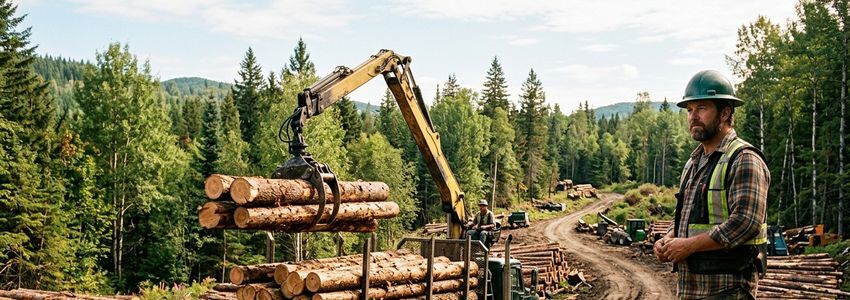
A knuckleboom loader truck is a commercial truck fitted with a hydraulic, articulated crane arm mounted behind the cab or at the rear of the chassis. Unlike a straight-boom crane, a knuckleboom boom folds at multiple joints, similar to a human arm bending at the elbow and wrist, which lets the operator reach into tight spaces, lift from awkward angles, and fold the entire assembly down flat for highway travel. Most units are paired with a grapple attachment for handling logs, scrap, pipe, or building materials, though some are configured with forks or slings for palletized freight.
In the forestry and logging sector, these trucks are often called self-loaders because the operator can load and unload logs without a separate loader machine or a second crew member. That single capability is the reason knuckleboom trucks have become standard equipment for small logging outfits, land clearing contractors, and companies that haul pipe, scrap metal, or construction materials to remote or congested job sites.
The cab-mounted hydraulic system that powers the crane is typically run off the truck's own engine through a power take-off unit, which means no separate generator or auxiliary power source is needed. Most units can rotate a full 360 degrees around the mounting point, giving the operator the ability to load from either side of the truck or directly behind it without repositioning the vehicle. This matters on narrow logging roads and congested job sites where maneuvering room is limited.
Key Benefits of Knuckleboom Truck Financing
- Preserve working capital: spread a six-figure purchase into predictable monthly payments instead of a single cash outlay.
- Match payments to seasonal revenue: logging and land clearing often have slow winter or wet-season stretches, and financing can be structured with seasonal or step payments.
- Add capacity without new labor costs: a self-loader often replaces the need for a dedicated loader operator or a second machine on site.
- Keep older equipment in reserve: financing a new or newer truck lets you keep an aging unit as a backup instead of retiring it outright.
- Potential tax advantages: equipment financing structures can allow a business to deduct depreciation and interest, though you should confirm specifics with your accountant.
- Faster approval than conventional bank loans: because the truck itself serves as collateral, equipment lenders can often move faster than a traditional commercial bank.
Ready to Add a Self-Loader to Your Fleet?
Crestmont Capital structures knuckleboom and log truck financing around your hauling season. Apply in minutes, no obligation.
Apply Now →How Knuckleboom Truck Financing Works
Knuckleboom truck financing follows the same general structure as other heavy equipment loans, with a few details specific to specialty crane-equipped trucks. Here is what the process typically looks like from application to delivery.
Quick Guide
How Knuckleboom Truck Financing Works: At a Glance
Pick a new or used knuckleboom truck from a dealer or private seller, including chassis, boom reach, and grapple specs.
Provide basic business information, time in business, and recent bank statements. Most lenders do not require a full tax-return package for equipment under $250,000.
The lender evaluates the equipment's value, your business cash flow, and credit history to set rate, term, and down payment.
Sign the equipment finance agreement, provide proof of insurance naming the lender as loss payee, and confirm delivery details.
The lender pays the dealer or seller directly, and the truck is delivered or picked up. Many approvals fund within 2-5 business days.
Down payments on knuckleboom truck financing typically range from 0% to 20%, depending on whether the truck is new or used, the strength of the business's financials, and the lender's risk appetite. Terms commonly run 36 to 72 months, with longer terms available for newer, higher-value trucks. Rates depend heavily on credit profile, time in business, and whether the truck is new or used, since used specialty equipment carries more valuation uncertainty for the lender.
Key Stat: The global knuckleboom loader market was valued at approximately $2.8 billion in 2024 and is projected to reach $4.6 billion by 2034, with the forestry segment alone accounting for roughly 45% of global demand, according to industry market research.
Types of Knuckleboom Loader Trucks
Not every knuckleboom truck is built the same way, and choosing the right configuration affects both the financing conversation and the long-term value of the equipment. Here are the most common configurations business owners finance.
- Log truck self-loaders: a knuckleboom crane mounted behind the cab of a tri-axle or tandem-axle truck, built specifically for loading and hauling logs or pulpwood, typically paired with a heel or grapple attachment.
- Flatbed-mounted knucklebooms: mounted on a standard flatbed chassis for hauling pipe, lumber, steel, or construction materials, common in utility and pipeline work.
- Roll-off and container-handling knucklebooms: configured with a shorter boom and higher lift capacity for loading debris boxes, scrap containers, or demolition material.
- Trailer-mounted and stationary knucklebooms: used in millyards, scrap yards, and recycling centers where the crane stays fixed in one location rather than traveling on a truck chassis.
- Articulated forestry loaders: track or wheeled machines, not truck-mounted, used for sorting and processing in the millyard, sometimes financed alongside a self-loader truck as part of a complete yard setup.
Boom reach, lift capacity at full extension, and grapple size are the three specs that matter most to lenders evaluating collateral value, since they directly affect resale value and how specialized the equipment is. A general-purpose flatbed knuckleboom usually retains value better than a highly specialized forestry configuration simply because it has a broader resale market.
Horsepower and hydraulic flow rate also factor into the financing conversation, particularly for larger forestry units that need to cycle quickly during high-volume harvesting days. A truck with a higher-output hydraulic pump can load and stack material faster, which translates into more billable hours per day on time-sensitive contracts. Lenders familiar with the forestry and construction equipment space understand these performance differences and factor them into how they value the collateral over the life of the loan.
Financing Available for New and Used Knuckleboom Trucks
From log truck self-loaders to flatbed-mounted cranes, get a quote in minutes with no impact to your credit score.
Get Your Rate →
Who This Financing Is Best For
Knuckleboom truck financing works best for businesses that need the equipment generating revenue immediately and cannot justify tying up six figures in cash. This typically includes:
- Independent logging contractors and small timber harvesting crews adding or replacing a self-loader
- Land clearing and site development companies that need to move logs, brush, and debris without hiring a separate loader crew
- Utility and pipeline contractors who haul pipe, poles, and materials to job sites with limited access
- Scrap metal and recycling yard operators handling material transfer between trucks and processing areas
- Construction material haulers delivering lumber, steel, or precast concrete that benefit from self-unloading capability
- Growing businesses that have outgrown renting or subcontracting loader work and want to bring that capability in-house
Lenders generally look for at least one to two years in business, though startups and newer operators can sometimes qualify with a larger down payment, a co-signer, or strong personal credit. Established businesses with 2+ years of consistent revenue typically see the most competitive rates and the lowest down payment requirements.
Financing vs. Leasing vs. SBA Loans
Business owners evaluating a knuckleboom truck purchase usually compare three paths: a direct equipment finance loan, an equipment lease, and an SBA-backed loan. Each has tradeoffs worth understanding before you sign anything.
| Option | Ownership | Typical Term | Best For |
|---|---|---|---|
| Equipment Financing | You own the truck once paid off | 36-72 months | Businesses planning to keep the truck long-term |
| Equipment Leasing | Lender owns it; option to buy at term end | 24-60 months | Businesses that want lower payments or plan to upgrade often |
| SBA 504 / 7(a) Loan | You own the truck once paid off | Up to 10 years for equipment | Established businesses wanting the lowest rates and longest terms |
Direct equipment financing is usually the fastest path to funding, often closing in days rather than weeks, and is the most common choice for operators who need the truck working on a job site quickly. Leasing can make sense if your business cycles equipment every few years or wants to minimize the monthly payment. SBA loans, backed through the U.S. Small Business Administration, typically offer the lowest rates and longest terms but come with more paperwork and a longer approval timeline, making them better suited to businesses that are not in a rush and have strong financials.
How Crestmont Capital Helps
Crestmont Capital works with logging, forestry, construction, and hauling businesses across the country to structure financing for self-loader trucks and other specialty crane equipment. As part of our broader crane financing and heavy truck financing programs, we evaluate both new and used knuckleboom trucks, including private-party and dealer purchases.
We also finance used equipment for businesses that want to buy a well-maintained truck off a dealer's lot rather than ordering new, and our construction equipment financing programs cover related machinery if you are building out a full yard or job-site fleet alongside the truck. If you already operate a grapple truck or are financing your first wood chipper or stump grinder for a tree service operation, our equipment financing programs are built to handle multiple pieces of equipment under one relationship rather than forcing a new application for every purchase.
Our underwriting team understands that logging and forestry revenue can be seasonal, and we work to structure payment schedules that reflect your actual cash flow rather than a rigid one-size-fits-all monthly payment. For businesses already running a fleet, we have also financed related equipment covered in our grapple truck financing guide and our logging equipment financing guide, both worth reviewing if you are planning a larger equipment purchase this year.
Key Stat: According to U.S. Census Bureau data, there were more than 8,100 logging firms operating in the United States as of 2022, the vast majority of them small businesses competing for the same limited pool of skilled equipment operators.
Real-World Scenarios
Scenario 1: The Independent Logger Replacing an Aging Self-Loader
A two-truck logging operation in the Pacific Northwest had been running a 12-year-old self-loader that was spending more time in the shop than in the woods. The owner financed a newer used flatbed knuckleboom with a 10% down payment and a 60-month term, keeping the old truck as a backup unit for high-volume weeks. The new truck's lower breakdown rate alone paid for a meaningful chunk of the monthly payment in reduced downtime, and the operation avoided losing an entire harvesting week to an unplanned repair for the first time in three seasons.
Scenario 2: A Land Clearing Contractor Adding Self-Loading Capability
A land clearing company had been subcontracting a loader operator every time they needed to move cleared timber off-site, adding both cost and scheduling delay. Financing a new log truck self-loader let them bring that function in-house, eliminating the subcontractor cost entirely within the first six months and giving them control over their own job-site schedule. The owner also found that having loading capability on standby let the crew take on smaller, last-minute clearing jobs that would previously have been turned down due to subcontractor availability.
Scenario 3: A Pipeline Contractor Expanding Material Handling
A utility contractor hauling pipe to remote right-of-way sites needed a way to unload material without waiting on a separate crane crew. They financed a flatbed-mounted knuckleboom truck with a 36-month term, matched to the length of a major pipeline contract, which let the equipment pay for itself directly out of that project's revenue. Once the original contract wrapped, the truck remained a core asset for future right-of-way and utility work rather than a piece of rented equipment that had to be returned.
Scenario 4: A Scrap Yard Operator Upgrading from Rental
A growing scrap metal yard had been renting a knuckleboom-equipped truck for material transfer between the scale and the processing area, paying a steady weekly rental fee. Once volume justified it, the owner financed a used unit with no money down, converting that rental expense into equity in an owned asset within the same monthly budget. Within a year, the yard added a second shift of material handling without needing to renegotiate a rental agreement or compete with other customers for equipment availability.
Stop Renting. Start Owning.
See what a knuckleboom truck payment looks like for your business. Fast, no-obligation quotes from Crestmont Capital.
Apply Now →By the Numbers
Knuckleboom Truck Financing: Key Statistics
$4.6B
Projected global knuckleboom loader market size by 2034
45%
Share of global demand from the forestry segment alone
8,100+
Logging firms operating in the U.S. (Census Bureau)
$45B
Total SBA 7(a)/504 loan capital delivered in FY2025
Frequently Asked Questions
Next Steps
Get a quote from a dealer or seller for the specific knuckleboom configuration you need.
Submit a quick application with Crestmont Capital, no obligation and no hard credit pull to see initial terms.
Compare rate, term, and down payment against your cash flow and hauling schedule.
Once funded, your truck is delivered and ready to start hauling and loading on your next job.
Get Your Knuckleboom Truck Working Sooner
Fast approvals, flexible terms, and a lender that understands logging and forestry cash flow. Apply today.
Apply Now →Conclusion
Knuckleboom truck financing gives logging, forestry, land clearing, and material hauling businesses a practical path to adding self-loading capability without tying up the cash a growing business needs for payroll, fuel, and day-to-day operations. Whether you are replacing an aging self-loader, adding a second truck to handle more volume, or bringing loading capability in-house for the first time, structured financing lets the equipment start paying for itself from day one instead of sitting on a balance sheet as a cash drain.
The right financing partner understands that logging and hauling revenue does not arrive in even monthly installments, and will work to structure a payment schedule that fits your actual business rather than forcing a generic template. If you are ready to move forward on a knuckleboom loader truck, getting pre-qualified first gives you real numbers to negotiate with when you sit down with a dealer or seller.
Equipment of this kind represents a significant investment, but it is also one of the more financeable categories available to small and mid-size businesses precisely because the truck itself secures the loan. That combination of real collateral value and genuine productivity gains is what makes knuckleboom truck financing a practical, low-friction way to grow a logging, forestry, or hauling operation without overextending your balance sheet.
Disclaimer: The information provided in this article is for general educational purposes only and is not financial, legal, or tax advice. Funding terms, qualifications, and product availability may vary and are subject to change without notice. Crestmont Capital does not guarantee approval, rates, or specific outcomes. For personalized information about your business funding options, contact our team directly.