Inflatable water park financing is the fastest-growing niche in outdoor recreation lending, and for good reason. Commercial inflatable water parks let entrepreneurs launch a seasonal attraction business without the multi-million-dollar price tag of a permanent concrete water park, but the equipment itself, the anchoring systems, the blowers, the safety gear, and the site preparation still represent a serious capital investment. Whether you are opening your first floating aqua park on a lake or expanding an existing operation with new slides and obstacle modules, understanding how inflatable water park financing works can be the difference between a smooth launch season and a cash-strapped scramble.
This guide walks through everything a business owner needs to know about financing an inflatable water park: what it covers, how the process works, what lenders look for, and how to choose the right funding structure for a business that, by nature, only generates revenue a few months a year.
In This Article
What Is Inflatable Water Park Financing?
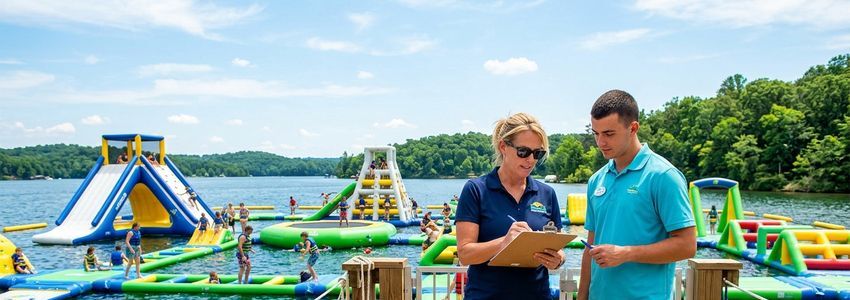
Inflatable water park financing refers to the funding solutions business owners use to purchase, install, and operate commercial-grade floating water park equipment. This includes modular inflatable slides, climbing towers, trampolines, obstacle courses, anchoring systems, high-capacity blowers, dock and staging platforms, safety equipment, and the vehicles or trailers often needed to transport and deploy units at lakes, ponds, quarries, or coastal locations.
Unlike a traditional business loan used for general working capital, inflatable water park financing is typically structured around the specific equipment being purchased. Lenders view the inflatable units and support equipment as collateral, which often makes approval more accessible than an unsecured loan, even for newer operators. The financing can also extend beyond the inflatables themselves to cover site prep, permitting costs, insurance premiums for the first season, staffing during buildout, and marketing to drive opening-day traffic.
Because inflatable water parks are inherently seasonal businesses in most parts of the country, financing terms are frequently structured with this in mind. That might mean smaller payments during the off-season months and larger payments during the peak summer season, a structure sometimes called seasonal or step payment financing.
It is also worth understanding that inflatable water parks fall into a distinct category from permanent, concrete water parks in the eyes of most lenders. A traditional water park with poured concrete slides, filtration systems, and permanent buildings requires construction financing that can run into the tens of millions of dollars and take years to permit and build. An inflatable water park, by contrast, is a modular, movable asset. That distinction matters because it means financing timelines are measured in weeks rather than years, and the equipment retains resale value that a lender can use to reduce risk on the loan. Many operators are drawn to the inflatable model precisely because it offers a lower barrier to entry into the recreation and attractions industry than a permanent facility would.
Key Stat: The U.S. outdoor recreation economy generated over $1.2 trillion in economic output in 2023, according to the U.S. Bureau of Economic Analysis, with water-based recreation among the fastest-growing segments as consumers prioritize experiential spending over goods.
Key Benefits of Financing Your Inflatable Water Park
Financing an inflatable water park instead of paying cash upfront offers several advantages for business owners who want to launch or expand without draining their entire capital reserve.
- Preserve working capital. Keep cash on hand for staffing, insurance, marketing, and unexpected repairs during your first season instead of tying it all up in equipment.
- Match payments to revenue. Seasonal payment structures align with your actual cash flow, so you are not making full loan payments during the winter months when the park is closed.
- Access newer, safer equipment. Financing makes it possible to buy commercial-grade units with updated safety certifications rather than settling for older, higher-liability equipment because it is all you can afford in cash.
- Build business credit. Making consistent payments on an equipment loan or lease helps establish a credit history that can support future expansion financing.
- Faster time to launch. Approved financing can get equipment ordered and delivered in weeks rather than months of saving, which matters when you are racing to open before peak season.
- Tax advantages may apply. Depending on how the equipment is financed, businesses may be able to deduct certain equipment costs. Consult a tax professional for guidance specific to your situation.
How Inflatable Water Park Financing Works
The process of financing an inflatable water park follows a fairly predictable path, though the exact steps can vary by lender and financing type.
- Step 1: Get a firm equipment quote. Work with your inflatable manufacturer or dealer to finalize which units, anchoring systems, blowers, and accessories you need, along with a total price.
- Step 2: Choose a financing structure. Decide between an equipment loan, an equipment lease, a working capital loan, or a line of credit, depending on whether you want to own the equipment outright or prefer lower upfront costs.
- Step 3: Submit an application. Most lenders require basic business information, time in business, revenue documentation (if you are an existing business), and details about the equipment being financed.
- Step 4: Underwriting and approval. The lender reviews your application, checks credit, and may evaluate the resale value of the equipment as collateral. Many equipment financing applications are decided within 24 to 72 hours.
- Step 5: Funding and equipment purchase. Once approved, funds are typically sent directly to the equipment vendor, or in some cases disbursed to you to complete the purchase.
- Step 6: Installation and launch. With equipment secured, you move into site prep, anchoring, safety inspection, staff training, and opening day.
Ready to Launch Your Inflatable Water Park?
Get fast, flexible financing from the #1 business lender in the U.S. No obligation, apply in minutes.
Apply Now →Types of Financing Available for Inflatable Water Parks
Not every inflatable water park operator needs the same financing structure. Here is a breakdown of the most common options.
Equipment Financing. A loan specifically for purchasing the inflatable units, blowers, and anchoring hardware. You own the equipment once the loan is paid off, and the equipment itself typically serves as collateral, which can make qualifying easier than an unsecured loan.
Equipment Leasing. Rather than purchasing outright, leasing allows you to use the equipment for a set term with lower monthly payments. This can be appealing for a first-year operator who wants to test the market before committing to full ownership, with the option to purchase, renew, or upgrade at the end of the term.
Working Capital Loans. These cover the operational side of the business, staffing, insurance, permits, marketing, and the day-to-day costs of running a seasonal attraction, separate from the equipment itself.
Business Lines of Credit. A revolving credit line gives you flexible access to funds for repairs, unexpected replacement inflatables, or bridging cash flow gaps between seasons without reapplying for a new loan every time.
SBA Loans. For established operators with strong financials, SBA-backed loans can offer competitive rates and longer terms, though the application process is typically longer and more document-intensive than direct equipment financing.
Quick Guide
How Inflatable Water Park Financing Works, At a Glance
Finalize your inflatable units, blowers, and anchoring package with a vendor.
Equipment loan, lease, working capital, or line of credit.
Many approvals happen within 24 to 72 hours.
Funds are disbursed, equipment is installed, and you open for business.
What Equipment and Costs Are Involved
Inflatable water park financing typically covers a range of equipment and setup costs. Understanding the full scope helps you request the right amount of funding from the start rather than coming up short mid-project.
- Modular inflatable units: slides, climbing walls, trampolines, monkey bars, balance beams, and obstacle course sections, which are typically sold as interchangeable modules that can be reconfigured season to season.
- Anchoring and mooring systems: anchors, buoys, tethers, and mooring lines that keep the park securely in place against wind and water movement.
- Blower systems: high-output electric or gas-powered blowers that keep inflatables rigid throughout operating hours, often requiring backup units in case of failure.
- Safety and rescue equipment: life jackets, rescue boards, safety ropes, first-aid stations, and signage required for insurance and local regulatory compliance.
- Docking and staging platforms: floating docks or platforms used for guest entry, exit, and lifeguard positioning.
- Transport and storage: trailers, storage containers, or covered structures for off-season storage and transport between locations if the business operates at multiple sites.
- Insurance and permitting: liability insurance premiums and local or state permitting fees, which can be substantial for water-based attractions.
Depending on the size of the operation, total startup costs for a commercial inflatable water park can range from under $50,000 for a small single-unit setup to several hundred thousand dollars for a multi-acre park with dozens of modules and full staffing infrastructure.
Location also plays a significant role in total project cost. A lakefront lease or land access agreement may carry its own upfront fees, while a site on owned property avoids that cost but may require additional permitting for commercial water-based activity. Operators should also budget for lifeguard staffing and certification, which is typically a non-negotiable requirement from both insurers and local health or parks departments. Many first-time operators underestimate staffing costs relative to equipment costs, so it is worth building a full first-season operating budget before finalizing how much to finance and in what structure.
Seasonality also affects how much financing makes sense in year one versus later expansion. A conservative approach for a brand-new operator is to finance a smaller initial equipment package, prove out demand for a full season, and then use a second round of financing, often on stronger terms given an established revenue history, to add modules or a second location the following year.
Pro Tip: Ask your equipment financing lender whether soft costs like installation labor, first-season insurance, and permitting fees can be rolled into the same loan as the inflatable equipment. Bundling these costs into one financing package can simplify cash flow planning significantly.
Who Inflatable Water Park Financing Is Best For
This type of financing tends to be the strongest fit for a specific set of business owners and operators.
- New entrepreneurs launching a first location on a lake, reservoir, or coastal property who need to preserve cash for the unpredictable costs of a first season.
- Existing campground, marina, or resort operators looking to add an inflatable water park as a new revenue stream and guest amenity without a large capital outlay.
- Party and event rental companies expanding into larger-scale aquatic attractions for festivals, corporate events, and private bookings.
- Multi-location operators who need to finance additional inflatable units to expand into a second or third body of water within the same region.
- Seasonal business owners who need payment structures that reflect the reality of a business that earns most of its revenue in a four to six month window.
Comparing Your Funding Options
Choosing the right financing path depends on your credit profile, how long you have been in business, and whether you want to own or lease the equipment. Here is how the main options compare.
| Financing Type | Best For | Ownership | Typical Speed |
|---|---|---|---|
| Equipment Financing | Buying inflatables outright | You own the equipment | 24 to 72 hours |
| Equipment Leasing | Lower upfront cost, testing the market | Lender retains title during term | 24 to 72 hours |
| Working Capital Loan | Staffing, insurance, marketing | N/A | 1 to 3 business days |
| Business Line of Credit | Flexible, recurring needs | N/A | Same week |
| SBA Loan | Established businesses, lower rates | You own the equipment | Several weeks |
How Crestmont Capital Helps
Crestmont Capital works with recreation and attraction business owners across the country to structure financing around the realities of a seasonal business. Rather than forcing a one-size-fits-all loan product, our team looks at your specific equipment needs, your operating season, and your growth plans.
Through our equipment financing programs, business owners can secure funding for inflatable units, blowers, anchoring systems, and support equipment, with approval decisions often available within a day or two. For operators who want lower monthly payments or prefer to test a new attraction before fully committing, our equipment leasing options provide flexibility without the full upfront commitment of ownership.
If your credit history is less than perfect, our bad credit equipment financing programs are built specifically for business owners who have been turned away by traditional banks but still have a viable business plan. And for the operational side of the business, from staffing and insurance to marketing your grand opening, our working capital loans can supplement your equipment financing so you launch fully funded.
Operators considering additional recreational attractions may also find useful comparisons in our guide to trampoline park business loans, which covers similar seasonal-attraction financing considerations, or our breakdown of bounce house rental business financing for operators running mobile or multi-attraction event businesses alongside a fixed water park location.
Get Your Water Park Season Funded
Crestmont Capital has helped thousands of business owners secure fast, flexible funding. See what you qualify for today.
Apply Now →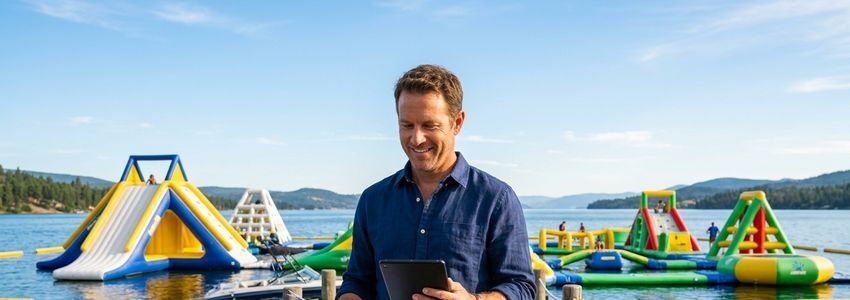
Real-World Scenarios
Scenario 1: The Lakefront Startup. A first-time entrepreneur wants to open a 20-module inflatable water park on a private lake near a growing suburb. With no prior business credit, he uses equipment financing collateralized by the inflatables themselves to secure funding, launching within eight weeks of signing his lease agreement with the lake's property owner.
Scenario 2: The Campground Expansion. An established campground with strong seasonal revenue wants to add an inflatable water park as a guest amenity to compete with newer resorts in the area. The owner uses a working capital loan alongside equipment leasing to add the attraction without disrupting cash reserves needed for existing campground operations.
Scenario 3: The Multi-Location Operator. A business that already operates one successful inflatable water park wants to expand to a second lake 90 minutes away. Using a business line of credit for flexibility, the owner finances a second full set of modules while retaining the option to move equipment between locations depending on demand.
Scenario 4: The Marina Add-On. A marina owner sees inflatable water parks as a way to increase weekday guest traffic. Rather than a large loan, the owner starts small with a compact equipment lease for a handful of modules, testing demand before committing to a larger buildout the following season.
Scenario 5: The Storm Replacement. An operator whose inflatables were damaged in an off-season storm needs fast replacement equipment before opening weekend. A rapid equipment financing approval allows new units to be ordered and installed within two weeks, preventing a costly delayed opening.
Scenario 6: The Event-Based Operator. A party and event rental company that already owns bounce houses and party equipment wants to add a large-scale inflatable water obstacle course for weekend festival bookings and corporate outings. Rather than a large standalone water park, the owner uses equipment financing to add a single premium unit that can travel to multiple event sites, generating incremental revenue from an existing client base without the overhead of a fixed location.
Key Stat: According to the Bureau of Economic Analysis, outdoor recreation value added to U.S. GDP grew faster than the overall economy in recent years, underscoring sustained consumer demand for experience-based attractions like inflatable water parks.
Frequently Asked Questions
Don't Let Funding Delay Your Opening Day
See how quickly Crestmont Capital can get your inflatable water park financed and ready for the season.
Apply Now →Next Steps
Get a written quote from your inflatable manufacturer or dealer covering all units, blowers, and anchoring hardware.
Consider whether ownership, leasing, or a combination with working capital fits your launch plan best.
Submit your application with your equipment quote and basic business details.
Coordinate equipment delivery, installation, permitting, and staff training around your target opening date.
Conclusion
Inflatable water park financing gives business owners a practical path to launching or expanding a seasonal attraction business without exhausting their cash reserves on equipment alone. From equipment loans and leasing to working capital and flexible lines of credit, the right financing structure can align your payments with your actual operating season while getting the safest, newest equipment into the water in time for opening day. Whether you are a first-time entrepreneur or an established operator adding a second location, understanding your financing options is the first step toward a profitable, well-funded season.
The recreation and attractions industry continues to reward operators who move quickly and confidently on new opportunities, and having the right financing partner in place can be the difference between watching a prime lake location go to a competitor and opening your own gates first. Taking the time now to line up equipment financing, working capital, or a flexible credit line means you can focus your energy on marketing, staffing, and guest experience once the season arrives, rather than scrambling for last-minute funding under pressure.
Disclaimer: The information provided in this article is for general educational purposes only and is not financial, legal, or tax advice. Funding terms, qualifications, and product availability may vary and are subject to change without notice. Crestmont Capital does not guarantee approval, rates, or specific outcomes. For personalized information about your business funding options, contact our team directly.