
 (800) 949-0401
How to Get Approved for a Business Loan Fast: The Complete 2026 Guide
Getting approved for a business loan quickly is one of the most pressing concerns for small business owners who need capital now, not weeks from now. Whether you are facing an unexpected expense, chasing a growth opportunity, or bridging a cash flow gap, the speed of your loan approval can make a real difference to your bottom line.
The good news: in 2026, faster approval options exist than ever before. Online lenders, streamlined SBA programs, and alternative financing products have transformed what is possible. But speed alone is not enough. You also need to position your application correctly so that lenders say yes the first time.
This guide walks you through every step of the process, from checking your credit and gathering documents to choosing the right lender and loan type. Follow these strategies and you can dramatically shorten your path from application to funding.
If you are ready to start now, apply for a business loan with Crestmont Capital and get a decision in as little as 24 hours.
- What Lenders Look for When Approving Business Loans
- How to Check and Improve Your Credit Before Applying
- Gather Your Documents Before You Apply
- Choose the Right Type of Business Loan
- How to Find the Fastest Business Loan Options
- Tips to Get Approved Faster
- Common Reasons Business Loans Get Denied
- Best Business Loan Options for Fast Approval in 2026
- How Crestmont Capital Can Help
- Next Steps
- Frequently Asked Questions
What Lenders Look for When Approving Business Loans
Before diving into tactics, it helps to understand what lenders are actually evaluating when they review your application. Most lenders assess several core factors commonly referred to as the Five Cs of Credit:
- Character: Your credit history, both personal and business, tells lenders how reliably you have repaid debt in the past.
- Capacity: Can your business generate enough income to service the new debt? Lenders look at your revenue, cash flow, and existing obligations.
- Capital: How much of your own money is invested in the business? Borrowers who have skin in the game are seen as lower risk.
- Collateral: Do you have assets that can back the loan if you default? This is especially important for secured products.
- Conditions: What is the purpose of the loan, and how does the current economic environment affect repayment likelihood?
Each lender weights these factors differently. Online lenders may focus more heavily on recent revenue and cash flow trends, while traditional banks tend to scrutinize credit scores and collateral more carefully. According to the U.S. Small Business Administration (SBA), small businesses that prepare thorough financial documentation and maintain strong credit are significantly more likely to receive loan approval.
For a deeper dive on exactly what lenders evaluate, see our guide on business loan requirements and what lenders look for.
Ready to Get Funded Fast?
Crestmont Capital specializes in fast, flexible business financing. Apply today and get a decision in as little as 24 hours.
Apply NowHow to Check and Improve Your Credit Before Applying
Your credit score is one of the most visible signals lenders use to evaluate your trustworthiness as a borrower. Both your personal and business credit scores can affect your approval odds and the rate you receive.
Personal Credit Score
Most lenders pull your personal credit score, particularly for small businesses where the owner's financial behavior mirrors the company's risk profile. A score of 680 or above is generally considered good. Scores above 720 open the door to better rates and longer terms.
To improve your personal credit before applying:
- Pay down revolving credit card balances to below 30% utilization
- Dispute any errors on your credit report through Experian, Equifax, or TransUnion
- Avoid opening new personal credit accounts in the 90 days before your loan application
- Make sure all bills are paid on time, including utilities and subscriptions
Business Credit Score
Your business credit profile, tracked by agencies like Dun and Bradstreet, Experian Business, and Equifax Business, reflects how your company handles its own financial obligations. Lenders value a clean business credit history with no derogatory marks.
To build or strengthen your business credit:
- Open a dedicated business bank account and keep it active
- Establish trade lines with suppliers who report to credit bureaus
- Pay all business invoices and credit accounts on time, or early
- Register your business with Dun and Bradstreet to obtain a DUNS number
According to Forbes Advisor, businesses that proactively manage both personal and business credit are far more likely to secure favorable loan terms quickly. Even small improvements in your score, just 20 to 30 points, can shift you from a decline to an approval.
Gather Your Documents Before You Apply
One of the biggest causes of delays in business loan approvals is incomplete documentation. Lenders cannot process your application without the required paperwork, and back-and-forth requests add days or even weeks to the timeline.
Having your documents ready before you hit "submit" is one of the simplest and most effective ways to get approved faster. Here is what most lenders require:
- Business bank statements: Typically the last 3 to 6 months, showing consistent deposits and cash flow
- Business and personal tax returns: Usually the last 2 years
- Profit and loss statement: Current year, preferably prepared by an accountant
- Balance sheet: Shows your assets, liabilities, and equity
- Business license and formation documents: Articles of incorporation, LLC operating agreement, or similar
- Government-issued ID: For all principal owners
- Voided business check: For ACH payment setup
- Accounts receivable and payable reports: If applicable
For a step-by-step walkthrough of the full application process, visit our guide on how to apply for a business loan.
Choose the Right Type of Business Loan
Not every loan product is designed for speed. Choosing the right type of loan based on your needs, timeline, and qualifications will dramatically affect how quickly you can get funded.
Business Loan Types: Speed vs. Requirements
- Merchant Cash Advance
- Short-Term Online Loan
- Revenue-Based Financing
- Working Capital Loans
- Business Line of Credit
- Equipment Financing
- Term Loans (Bank)
- Invoice Financing
- USDA Business Loans
- SBA 7(a) Loans
- SBA 504 Loans
- Commercial Real Estate
Here is a closer look at the fastest options and when to use each:
Working Capital Loans
Designed to fund everyday operational needs, unsecured working capital loans are among the most flexible and fast-approved products available. They do not require collateral and can be funded in 1 to 3 business days. They are ideal for payroll, inventory, or short-term operational needs.
Business Line of Credit
A business line of credit gives you access to a revolving pool of funds you can draw from as needed. Once approved, you can access cash nearly instantly. Online lenders often approve credit lines in 24 to 48 hours, making them a top choice for businesses that need ongoing flexibility.
SBA Loans
While SBA loans are not the fastest, they offer the most favorable terms, including lower rates and longer repayment periods. If your timeline allows 4 to 8 weeks, an SBA loan may be the best long-term choice. The SBA Express loan program does offer faster decisions, typically within 36 hours, for loans up to $500,000.
Equipment Financing
If you need to purchase specific equipment, equipment financing can be fast because the equipment itself serves as collateral. Many lenders can approve equipment loans within 24 to 72 hours, especially for standard commercial equipment.
How to Find the Fastest Business Loan Options
Knowing which lender types offer the fastest approvals helps you target the right institutions. Here is how lender categories typically compare:
Online and Alternative Lenders
Online lenders use automated underwriting models that can analyze your application in minutes rather than days. They rely heavily on recent bank statements, revenue, and sometimes social proof. For business owners with solid revenue but imperfect credit, online lenders are often the fastest path to approval. Many fund within 24 to 48 hours of approval.
Community Banks and Credit Unions
Community-based institutions often have more flexible underwriting than large national banks. They may take 1 to 2 weeks for approval but can offer better rates than many online lenders. Relationships matter here; if you already bank with a community lender, that history can accelerate your review.
SBA Preferred Lenders
SBA Preferred Lender Program (PLP) participants can approve SBA loans in-house without going back to the SBA for final authorization, which speeds up the process significantly. If you are pursuing an SBA loan, look specifically for PLP-approved lenders.
According to CNBC's small business coverage, the average small business loan from an online lender funds in under three days, compared to several weeks for traditional bank products.
Explore Your Financing Options
Not sure which loan is right for your business? Our team at Crestmont Capital will help you find the fastest and most affordable path to funding.
Apply NowTips to Get Approved Faster
Beyond choosing the right lender and loan type, there are specific actions you can take to speed up your own approval process. Many of these involve preparation that you can complete before you ever submit an application.
1. Apply to Multiple Lenders Strategically
Submitting applications to several lenders simultaneously can accelerate your timeline. However, be mindful that multiple hard credit inquiries within a short period can affect your score. Focus on lenders whose profiles match your qualifications. For business loans, multiple inquiries within a 14 to 45-day window are often treated as a single inquiry for scoring purposes.
2. Know Your Numbers
Lenders expect you to understand your own financial performance. Know your monthly and annual revenue, gross profit margin, current monthly expenses, and existing debt obligations before you apply. Being able to clearly articulate your financial position during underwriting signals competence and builds trust.
3. Maintain a Healthy Business Bank Balance
Lenders review your bank statements closely for average daily balances, consistency of deposits, and overdraft history. If your account shows frequent low balances or NSF fees, lenders may see that as a red flag. Aim to maintain a minimum average balance equal to at least one monthly payment of the loan you are requesting.
4. Have a Clear Purpose for the Funds
Lenders want to know exactly how you plan to use the money. A clear, specific use case, such as "purchase of two pieces of manufacturing equipment" or "fund payroll during seasonal slowdown," signals planning and financial discipline. Vague purposes like "general business needs" raise concerns.
5. Work with an Experienced Lender Who Specializes in Your Industry
Some lenders specialize in specific industries and understand the cash flow patterns, seasonality, and risks of those businesses. Working with a lender familiar with your sector means fewer questions and faster approvals.
Common Reasons Business Loans Get Denied
Understanding why loans are denied is just as important as knowing how to get approved. If your application has any of these red flags, address them before applying:
Low Credit Score
A personal credit score below 600 will disqualify you from most traditional bank and SBA products. Even for online lenders with looser requirements, a low score will result in higher rates and lower approval amounts. Spend 3 to 6 months improving your credit before applying if your score is below 600.
Insufficient Revenue
Lenders need confidence that you can repay the loan. If your monthly revenue does not comfortably cover the proposed payment plus your existing obligations, expect a denial or a reduced offer. Generally, a Debt Service Coverage Ratio (DSCR) below 1.0 is a hard stop for most lenders.
Too Little Time in Business
Most traditional lenders require at least 2 years in business. Startups and newer companies face a steeper climb. If you are under 2 years old, focus on alternative products designed for newer businesses.
Outstanding Tax Liens or Judgments
Unresolved IRS liens, court judgments, or business bankruptcies in the last 3 to 7 years are often automatic disqualifiers. These need to be resolved or disclosed before applying.
Excessive Existing Debt
If you already carry significant business debt relative to your revenue, lenders may see a new loan as too risky. Reducing outstanding balances before applying can improve both your debt-to-income ratio and your approval odds.
Incomplete or Inaccurate Application
Missing documents, inconsistencies between your application and bank statements, or errors in your financial reporting can cause delays or denials. Double-check every figure before submitting.
Best Business Loan Options for Fast Approval in 2026
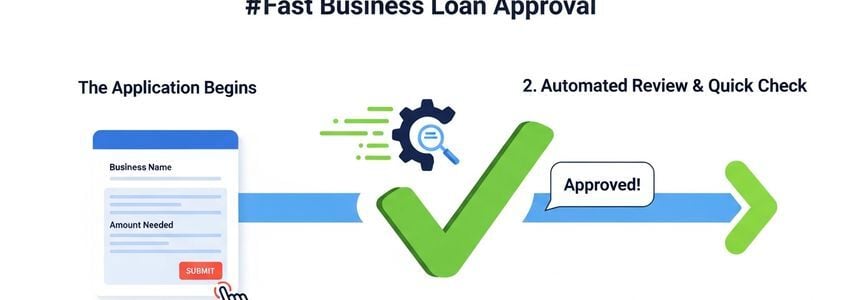
The following loan types offer the strongest combination of speed, accessibility, and flexibility for small business owners in 2026:
Short-Term Business Loans
These are lump-sum loans repaid over 3 to 18 months. Online lenders can fund in 24 to 72 hours. They are ideal for urgent needs but carry higher rates than traditional term loans. Use them when speed is more important than cost.
Business Lines of Credit
Revolving credit lines give you on-demand access to funds up to a set limit. Once approved, you can draw and repay repeatedly without reapplying. This makes them one of the most flexible and responsive tools in your financing toolkit.
Merchant Cash Advances (MCAs)
MCAs provide a lump sum in exchange for a percentage of your future credit card or debit card sales. Approval is often based primarily on sales volume rather than credit score. While funding can happen in under 24 hours, MCAs come with high factor rates and should be used carefully.
Invoice Financing
If your business has outstanding invoices, you can use them as collateral to access up to 80 to 90% of their face value immediately. This is ideal for B2B businesses with slow-paying clients who need cash now rather than waiting 30 to 90 days for payment.
Equipment Financing
When you need to purchase or lease equipment, equipment financing is one of the fastest secured options available. The equipment itself secures the loan, which reduces lender risk and speeds up approval. Explore your options through Crestmont Capital's small business financing solutions.
How Crestmont Capital Can Help
At Crestmont Capital, we are rated the number one business lender in the country, and we have helped thousands of small business owners access the capital they need, fast. Our streamlined application process is designed to eliminate friction and deliver decisions quickly.
Here is what sets Crestmont Capital apart:
- Fast decisions: Most applications receive a decision within 24 hours
- Flexible products: We offer working capital loans, lines of credit, SBA loans, equipment financing, and more
- Dedicated advisors: Our team works with you to find the right solution, not just the fastest one
- Transparent terms: No hidden fees, no surprises
- Bad credit options: We work with a wide range of credit profiles
Whether you need a small working capital injection or a large-scale equipment purchase financed, Crestmont Capital has the products and the expertise to get you there fast.
Get Your Business Loan Today
Apply in minutes, get a decision in 24 hours, and access funding as fast as the same business day. Crestmont Capital is ready to help.
Apply NowNext Steps to Get Your Business Loan Approved Fast
Now that you understand the full picture, here is your action plan for moving forward:
- Step 1: Check your credit. Pull both your personal credit report and your business credit profile. Identify any issues and address them before applying. Even small improvements can move you from denied to approved.
- Step 2: Organize your documents. Gather your last 3 to 6 months of bank statements, tax returns, P&L statement, and business formation documents. Having everything ready eliminates delays.
- Step 3: Define your loan purpose. Know exactly how much you need and what you will use it for. A clear, specific purpose increases approval odds and shows lenders you have a plan.
- Step 4: Choose the right loan type. Match your needs to the product. If you need cash in 24 hours, look at working capital or short-term online loans. If you can wait a few weeks for better terms, explore SBA or traditional bank products.
- Step 5: Apply with the right lender. Submit your application to a lender who specializes in your industry and credit profile. Crestmont Capital is an excellent starting point for fast, flexible business financing.
- Step 6: Respond quickly to underwriting requests. Once submitted, respond to any lender requests for additional documentation within hours, not days. Delays on your end extend the timeline.
- Step 7: Review your offer carefully. When you receive an approval, take the time to review all terms including total cost of capital, repayment schedule, and any prepayment penalties before signing.








