Harvest season does not wait for anyone. When your grapes hit peak ripeness, you have a narrow window to get them off the vine and into the crush pad, and the machine that makes it possible is one of the most expensive pieces of equipment a vineyard will ever buy. A new self-propelled grape harvester can run well into six figures, which is exactly why grape harvester financing has become the standard way vineyards, wineries, and custom harvesting operations put this machine to work without draining their cash reserves.
This guide walks through everything you need to know about financing a grape harvester: what it is, how it works, what the machines cost, how loans compare to leases, who qualifies, and how to get funded fast enough to make this year's harvest. Whether you are buying your first tow-behind unit or upgrading a fleet of self-propelled harvesters, you will leave with a clear picture of your options.
In This Article
- What Is Grape Harvester Financing?
- Key Benefits of Financing a Grape Harvester
- How Grape Harvester Financing Works
- Types of Grape Harvesters You Can Finance
- How Much Does a Grape Harvester Cost?
- Loans vs Leasing: Which Is Better?
- Who Qualifies for Grape Harvester Financing?
- How to Apply
- How Crestmont Capital Helps
- Real-World Scenarios
- FAQ
- How to Get Started
What Is Grape Harvester Financing?
Grape harvester financing is a form of equipment financing built around one specific machine: the mechanical harvester that shakes, beats, or cuts wine grapes and juice grapes off the vine. Instead of paying the full purchase price upfront, a lender or financing company provides the capital to buy the machine, and you repay that amount in fixed monthly installments over a set term, usually three to seven years. The harvester itself serves as collateral, which keeps approval requirements far more accessible than an unsecured loan of the same size.
Because the equipment secures the deal, lenders focus on the machine's value, your vineyard's revenue, and your time in business rather than demanding perfect credit or years of financial statements. That structure makes grape harvester financing one of the fastest ways to acquire a machine that can cost as much as a house. It is used by family vineyards buying their first tow-behind unit, large estate wineries upgrading to the latest self-propelled models, and custom harvesting contractors who run several machines across multiple clients each season.
Financing is available for every configuration on the market, including self-propelled harvesters, tow-behind and tractor-mounted units, and both new and used machines. Most lenders will also roll related costs into the same agreement, such as delivery, setup, and even a first service package, so the entire acquisition is covered under one predictable payment.
Key Benefits of Financing a Grape Harvester
Paying cash for a harvester is technically possible, but very few vineyard operations choose to do it. Financing wins out for practical, bottom-line reasons:
- Preserve working capital. A six-figure cash purchase can empty the reserves you need for labor, chemicals, barrels, and bottling. Financing keeps that cash available for the costs that keep the vineyard running.
- Match payments to revenue. A harvester earns its keep during a few intense weeks each year. Fixed monthly payments let the machine pay for itself out of the harvests it delivers, season after season.
- Lock in predictable costs. Custom harvesting rates and short-notice rental fees climb every year. Owning a financed machine converts a volatile per-ton expense into a fixed line item you can budget around.
- Harvest on your schedule. Owning the machine means picking at optimal ripeness instead of waiting in a contractor's queue while sugar levels spike or rain moves in.
- Build equity in a real asset. With a loan, every payment moves you closer to owning a machine with meaningful resale value. Well-maintained harvesters hold their worth for years.
- Fast approvals. Equipment financing decisions often come back within 24 to 48 hours, so a machine that becomes available in July can be in your rows before the fruit is ready.
For most operations, the question is not whether to own a harvester but how to structure the acquisition so the machine strengthens cash flow instead of straining it.
Ready to Finance Your Grape Harvester?
Get fast, flexible equipment financing from the #1 business lender in the U.S. Apply in minutes, with no obligation.
Apply Now →How Grape Harvester Financing Works
The mechanics of an equipment financing deal are straightforward. Here is the typical sequence from application to harvest:
Step 1: Find the machine. You identify the harvester you want, whether that is a new unit from a dealer like New Holland, Pellenc, or Oxbo, or a used machine from a dealer, auction, or private seller. You get a purchase price or a formal quote.
Step 2: Apply with a lender. You submit a short application with basic business details, the equipment information, and the purchase amount. For most deals under $500,000, a full financial document package is not required at the outset.
Step 3: Get approved. The lender evaluates the machine's value, your time in business, revenue, and credit profile. Approvals commonly arrive within one to two business days.
Step 4: Review and sign. You receive terms spelling out the amount financed, monthly payment, term length, and any down payment. Once you sign, the lender pays the dealer or seller directly.
Step 5: Take delivery and start paying. The harvester is delivered to your operation, and your fixed monthly payments begin on the agreed schedule. With a loan, you own the machine free and clear at the end of the term. With a lease, you choose whether to buy it out, return it, or upgrade.
The entire cycle, from application to funded deal, can close in under a week when the paperwork is clean. That speed matters when a well-priced used machine hits the market and three other vineyards are looking at it too.
Types of Grape Harvesters You Can Finance
Mechanical grape harvesters come in several configurations, and lenders finance all of them. Understanding the categories helps you match the machine to your acreage, terrain, and budget.
Self-Propelled Grape Harvesters
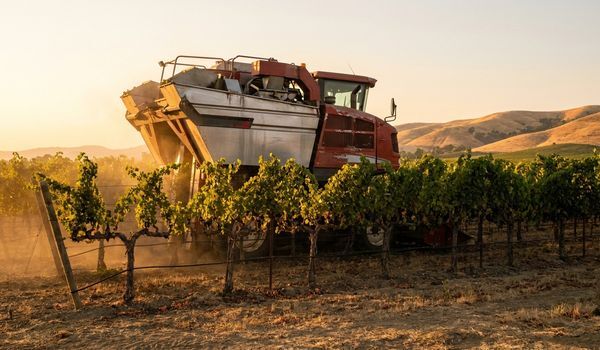
Self-propelled units are the flagship machines of large vineyards and custom harvesting operations. Models like the New Holland Braud series and the Oxbo 6030 straddle the vine row on their own chassis, with onboard engines, fruit conveyance, and cleaning systems. A single self-propelled machine can cover one and a half to two acres per hour and pick well over 100 tons in a day, work that would take a hand crew of dozens. These are the most expensive option, but they deliver the lowest per-ton harvesting cost at scale.
Tow-Behind and Tractor-Mounted Harvesters
Tow-behind harvesters pull behind a standard vineyard tractor and use the tractor's power take-off to run the picking mechanism. They cost significantly less than self-propelled machines and make sense for vineyards in the 20 to 150 acre range, operations with tighter row spacing, or owners who already own a suitable tractor. Pellenc and several specialty manufacturers build well-regarded tow-behind units, and the used market for these machines is active.
New vs Used Machines
New harvesters carry full warranties, the latest cleaning and sorting technology, and zero hours on the picking head. Used machines, often coming off lease returns or estate upgrades, can cut the acquisition cost by 40 to 60 percent while still delivering years of reliable service. Lenders finance both, and used equipment financing is one of the most common structures for a vineyard's first machine. If you are weighing broader equipment needs beyond the harvester, our guide to vineyard equipment financing for tractors, sprayers, and harvesters covers the full fleet picture.
The same logic applies across crop-specific machines. Vineyards that also farm tree fruit or nuts often pair their harvester with other financed equipment, and the structure of a grape harvester deal looks much like the combine harvester financing arrangements used in grain operations: the machine secures the loan, and seasonal revenue drives the repayment plan.
How Much Does a Grape Harvester Cost?
Grape harvester pricing spans a wide range depending on configuration, capacity, age, and condition. Here is what the market looks like today:
- New self-propelled harvesters: typically $350,000 to $500,000 or more, depending on options like onboard sorting tables, destemmers, and yield-mapping systems.
- New tow-behind harvesters: generally $150,000 to $250,000, plus the cost of a tractor if you do not already own one with adequate horsepower.
- Used self-propelled machines: commonly $120,000 to $300,000 depending on hours, model year, and maintenance history.
- Used tow-behind units: often $50,000 to $120,000, making them the entry point for many first-time buyers.
Beyond the sticker price, budget for delivery, which can run several thousand dollars for a cross-country haul, plus any setup, calibration, and operator training. Most lenders let you bundle these soft costs into the financed amount.
Key Stat: A modern self-propelled grape harvester can pick 150 tons or more of fruit per day, replacing a hand crew of 30 to 40 workers during the tightest window of the season. At typical custom harvesting rates of $325 to $450 per acre, owning the machine pays for itself quickly on larger acreage.
Those numbers explain why mechanical harvesting now handles the large majority of wine grape acreage in major producing regions. According to data tracked through the U.S. Census Bureau's Economic Census, agriculture and food production remain among the most capital-intensive sectors of the American economy, and equipment is consistently the largest single investment category for vineyard operators.
By the Numbers
Grape Harvester Financing - Key Statistics
$350K+
Typical starting price for a new self-propelled grape harvester
150+
Tons of fruit one modern harvester can pick in a single day
78%
Share of U.S. businesses that use financing to acquire equipment
24-48h
Typical approval window for equipment financing decisions
Grape Harvester Loans vs Leasing: Which Is Better?
The two dominant structures for financing a grape harvester are equipment loans and equipment leases. Both put the machine in your vineyard, but they differ on ownership, payment size, and end-of-term options.
With an equipment loan, you own the harvester from day one. The lender holds a lien until the final payment, then releases it. Loans usually require a down payment of 10 to 20 percent and carry slightly higher monthly payments than a lease, but you build equity with every installment and can sell or trade the machine later.
With an equipment lease, the financing company owns the machine and you pay for its use. Monthly payments run lower, down payments are often minimal, and at the end of the term you can buy the harvester at a preset residual, return it, or roll into a newer model. Leases suit operations that upgrade frequently or want the lowest possible payment.
| Feature | Equipment Loan | Equipment Lease |
|---|---|---|
| Ownership | You own it from day one | Lessor owns it; buyout option at term end |
| Down payment | Typically 10-20% | Often $0 to one month's payment |
| Monthly payment | Higher | Lower |
| Best for | Long-term ownership, 7+ years of use | Frequent upgrades, lowest cash outlay |
| End of term | Lien released, machine is yours free and clear | Buy out, return, or upgrade |
Pro Tip: If you plan to run the machine for seven years or more, a loan usually delivers the lowest total cost of ownership. If you expect to upgrade every three to five seasons as picking technology improves, a lease keeps payments down and your fleet current.
As Forbes Advisor's guide to equipment financing notes, the right structure depends on how long you intend to keep the asset and how you want the cost to flow through your books. Either way, the harvester itself anchors the deal, which is what keeps rates and terms favorable compared with unsecured borrowing.
Who Qualifies for Grape Harvester Financing?
Qualification standards for equipment financing are more flexible than most vineyard owners expect. Because the harvester secures the deal, lenders can work with a wider range of credit profiles and business histories than a bank offering an unsecured loan.
Most lenders look at four core factors:
- Time in business. Two or more years of operating history opens the most options, but younger vineyards and even first-generation operations can qualify with strong revenue or a larger down payment.
- Revenue and cash flow. Lenders want to see that your operation generates enough income to cover the payment. Vineyard financials, custom crushing contracts, and grape purchase agreements all help tell that story.
- Credit profile. Scores in the mid-600s and up typically qualify for standard programs. Lower scores can still get approved with additional collateral, a co-signer, or more money down.
- The machine itself. Newer equipment from recognized manufacturers holds value better and is easier to finance. Older used machines may carry shorter terms or slightly higher rates to reflect resale risk.
Established operations with clean credit can often finance 100 percent of the purchase price. Newer or credit-challenged buyers should expect to put 10 to 30 percent down. Either way, the approval process moves fast compared with traditional bank lending, and government-backed programs such as those listed on the SBA's loan programs page can supplement equipment financing for broader vineyard investments like land improvements or winery construction.
Fast Fact: Many equipment financing approvals come back within 24 to 48 hours, while a traditional agricultural bank loan can take three to six weeks. When a well-priced used harvester hits the market in June, speed wins the machine.
How to Apply for Grape Harvester Financing
The application process is built for speed. Most lenders ask for the same core items, and you can usually pull everything together in an afternoon:
1. Basic business information. Legal business name, entity type, tax ID, years in operation, and ownership structure.
2. Equipment details. The year, make, model, serial number if available, hours on the machine, and the agreed purchase price. A dealer invoice or formal quote works best.
3. Recent bank statements. Typically three to six months of business bank statements showing revenue and cash flow patterns.
4. Financials for larger deals. For amounts above $500,000, expect requests for two years of tax returns, a current profit and loss statement, and a balance sheet.
Once submitted, underwriting usually returns a decision within one to two business days. Approved deals move to documentation, where you review and sign the agreement electronically. The lender then pays the seller directly, and the machine is released for delivery. From first application to funded deal, clean files routinely close in three to five business days.
How Crestmont Capital Helps Vineyard Owners
Crestmont Capital has spent years financing the equipment that keeps American agriculture running, from harvesters and tractors to processing lines and cold storage. As the #1 rated business lender in the country, we structure equipment financing around the realities of seasonal revenue, not a generic corporate template.
Vineyard and winery clients choose Crestmont for a few consistent reasons:
- Speed. Approvals in as little as 24 hours and funding in days, so you never miss a machine or a harvest window.
- Flexible structures. Loans, leases, and seasonal payment schedules that align with when your operation actually generates revenue.
- New and used machines. We finance dealer-new equipment, auction purchases, and private-party used machines alike.
- Full-fleet coverage. Beyond harvesters, our agricultural equipment financing and farm equipment financing programs cover tractors, sprayers, irrigation systems, bins, and processing equipment, so one relationship funds the entire operation.
A dedicated funding specialist handles your file from application through funding, which means you talk to someone who understands what a Braud 9090X is and why picking at 26 Brix cannot wait for a committee meeting.
Harvest Waits for No One
Talk to a Crestmont Capital funding specialist today and get your harvester financed before the fruit is ready.
Get Funded Fast →Real-World Scenarios: Grape Harvester Financing in Action
Every vineyard's situation is different, but these scenarios show how financing structures play out in practice.
Scenario 1: The First-Generation Vineyard Buying Its First Machine
A 40-acre vineyard in Paso Robles had always hired a custom harvesting crew at $400 per acre. As custom rates climbed and scheduling got tighter, the owners decided to buy a used tow-behind harvester for $85,000. With two years of operating history and decent credit, they financed 90 percent of the price over five years. Their monthly payment lands well below what two seasons of custom harvesting would have cost, and they now pick each block at exactly the ripeness they want instead of waiting for a contractor's window.
Scenario 2: The Estate Winery Upgrading to Self-Propelled
A 300-acre estate operation in Napa Valley ran an aging tow-behind unit that broke down twice during the previous crush. They chose a new self-propelled harvester at $425,000 with an onboard sorting system. A six-year equipment loan with 15 percent down kept payments predictable, and the machine's speed cut their harvest window from three weeks to nine days, reducing exposure to late-season rain and letting their best blocks come off at optimal maturity.
Scenario 3: The Custom Harvesting Contractor Expanding Capacity
A custom harvesting contractor in Washington's Columbia Valley already owned two self-propelled machines and had more client demand than capacity heading into harvest. They leased a third machine to keep payments low and preserve the option to upgrade as technology improves. The lease payment runs below one week's worth of harvesting revenue, and the added capacity let them sign four new vineyard clients for the season.
Scenario 4: The Credit-Challenged Buyer Getting a Second Chance
A family vineyard in the Finger Lakes region went through a rough stretch after two frost-damaged vintages left their credit score bruised. A bank declined their equipment loan application. Through an equipment financing program that weighted the machine's value and the vineyard's current contracts more heavily than past credit events, they financed a used self-propelled harvester with 25 percent down. Three clean years of payments later, their credit profile has largely recovered, and the machine has become the backbone of their operation.
Frequently Asked Questions
What is grape harvester financing? +
Grape harvester financing is an equipment loan or lease used to purchase a mechanical grape harvester without paying the full price upfront. The machine itself serves as collateral, you make fixed monthly payments over a set term, and with a loan you own the harvester outright once the final payment is made.
How much does a new grape harvester cost? +
A new self-propelled grape harvester typically costs between $350,000 and $500,000 or more depending on options. New tow-behind units generally run $150,000 to $250,000. Used machines of both types can be found from roughly $50,000 to $300,000 depending on age, hours, and condition.
Can I finance a used grape harvester? +
Yes. Used grape harvesters are financed every day, whether purchased from a dealer, at auction, or from a private seller. Lenders review the machine's age, hours, and condition to set terms, and well-maintained used machines often qualify for structures very similar to new equipment.
What credit score do I need to finance a grape harvester? +
Scores in the mid-600s and above typically qualify for standard equipment financing programs. Lower scores can still be approved because the machine secures the deal, though you may need a larger down payment, additional collateral, or a co-signer to offset the added risk.
Is it better to lease or buy a grape harvester? +
It depends on how long you plan to keep the machine. Loans suit owners who will run the harvester for seven years or more and want to build equity. Leases offer lower payments and easy upgrades every few seasons, which suits operations that always want current picking technology.
How long are typical grape harvester financing terms? +
Most grape harvester financing terms run from three to seven years. New machines often qualify for the longest terms, while older used machines may be limited to three to five years to keep the repayment window aligned with the equipment's remaining useful life.
What interest rates should I expect on grape harvester financing? +
Rates vary with your credit profile, time in business, down payment, and the machine's age, but equipment financing rates are generally competitive because the harvester secures the loan. Strong borrowers see the lowest rates, while newer businesses and challenged credit pay a premium.
Can a brand-new vineyard qualify for equipment financing? +
Yes, though options narrow for operations with little history. Newer vineyards typically qualify by showing strong early revenue, signed grape purchase contracts, a meaningful down payment of 20 to 30 percent, or the personal credit strength of the owners.
How fast can I get funded for a grape harvester? +
Equipment financing is one of the fastest funding products available. Approvals commonly arrive within 24 to 48 hours, and clean deals frequently fund within three to five business days from application, fast enough to capture a machine before another buyer does.
Do I need a down payment to finance a grape harvester? +
Established operations with strong credit can often finance 100 percent of the purchase price. Most buyers put 10 to 20 percent down, and newer businesses or lower credit profiles should expect 20 to 30 percent. A larger down payment usually improves your rate and terms.
Can I finance multiple machines at once? +
Yes. Fleet financing is common for custom harvesting contractors and large estates adding several machines in a season. Lenders can package multiple harvesters into a single agreement or a master lease line, simplifying payments and speeding up approvals on later additions.
What documents do I need to apply? +
For most deals you need basic business information, the equipment details and price, and three to six months of business bank statements. Deals above roughly $500,000 usually also require two years of tax returns, a profit and loss statement, and a balance sheet.
Can delivery and setup costs be included in the financing? +
In most cases, yes. Lenders routinely roll soft costs such as freight, setup, calibration, and initial operator training into the financed amount, so the entire acquisition is covered under one payment rather than paid out of pocket at delivery.
What happens at the end of a grape harvester lease? +
At the end of a lease you typically have three options: buy the machine at the preset residual value, return it and walk away, or roll into a new lease on a newer model. Many leases include a fixed purchase option set at the start, so there are no surprises.
Why finance instead of paying cash for a grape harvester? +
Paying cash ties up capital your vineyard needs for labor, chemicals, and operating costs, while financing preserves liquidity and lets the machine pay for itself out of the harvests it delivers. Fixed payments also convert a volatile expense into a predictable, budgetable line item.
Get Your Harvester Before Harvest
Join the thousands of business owners who trust Crestmont Capital for fast, flexible equipment financing.
Apply Now →How to Get Started
Complete our quick application at offers.crestmontcapital.com/apply-now - it takes just a few minutes.
A Crestmont Capital advisor will review your vineyard's needs and match you with the right financing structure for your harvester.
Receive your funding and put your machine to work, often within days of approval.
Conclusion: Put Your Harvest on a Stronger Financial Footing
A mechanical grape harvester is one of the highest-impact investments a vineyard can make, and one of the largest. Grape harvester financing turns that six-figure hurdle into a manageable monthly payment, preserving the cash your operation needs while the machine pays for itself season after season. Whether you choose a loan for long-term ownership or a lease for flexibility, the right structure lets you harvest on your schedule, at the ripeness you choose, without waiting on anyone else's calendar.
The vineyards that thrive are the ones that treat equipment decisions as strategic moves, not emergencies. If you are ready to put a harvester to work in your rows, Crestmont Capital's funding specialists are ready to build the financing around your operation. Apply today and be ready well before the fruit says go.
Disclaimer: The information provided in this article is for general educational purposes only and is not financial, legal, or tax advice. Funding terms, qualifications, and product availability may vary and are subject to change without notice. Crestmont Capital does not guarantee approval, rates, or specific outcomes. For personalized information about your business funding options, contact our team directly.

Allan Garfinkle
Allan Garfinkle is the Chief Revenue Officer at Crestmont Capital, where he has spent more than a decade leading revenue strategy, business development, and operational growth. With 28 years of experience building and advising startups and small businesses, Allan has helped more than 10,000 business owners navigate financing decisions, growth opportunities, and changing economic conditions. He earned a Bachelor of Science in Economics and an MBA with a concentration in Finance from Northeastern University, as well as a Juris Doctor from New England Law, where his studies focused on contracts and business law. His writing draws on extensive practical experience in small-business lending, equipment financing, business credit, and commercial finance.