
The forklift dealer industry sits at the center of American material handling. Every pallet moved in a warehouse, every load lifted on a construction site, and every container worked at a port depends on equipment that dealers sell, lease, rent, and service. For business owners evaluating equipment purchases, and for dealers planning inventory and growth, the numbers behind this industry matter. This report compiles the most important forklift dealer statistics for 2026, covering market size, unit sales, dealer economics, safety data, and the technology trends reshaping how forklifts are bought, sold, and financed.
Whether you operate a dealership, run a warehouse, or simply want to understand where the material handling market is heading, these forklift dealer statistics provide a data-driven foundation for smarter decisions in 2026 and beyond.
In This Article
- What Is the Forklift Dealer Industry?
- Forklift Dealer Market Size and Growth Statistics
- Key Statistics by Equipment Segment
- Forklift Sales and Pricing Statistics
- Forklift Dealer Business Model and Revenue Statistics
- Forklift Safety Statistics
- Technology and Industry Trends for 2026
- What These Statistics Mean for Business Owners
- How Crestmont Capital Helps Forklift Dealers and Buyers
- Real-World Scenarios
- Frequently Asked Questions
- How to Get Started
What Is the Forklift Dealer Industry?
The forklift dealer industry encompasses the businesses that distribute, sell, lease, rent, and service forklifts and related material handling equipment. Dealers act as the critical link between manufacturers such as Toyota, Crown, Hyster-Yale, KION, Jungheinrich, and Mitsubishi Logisnext, and the end users that operate warehouses, distribution centers, manufacturing plants, lumber yards, and construction sites.
A typical forklift dealership generates revenue from several streams: new equipment sales, used equipment sales, short-term and long-term rentals, parts, service and maintenance contracts, and operator training. This diversified model makes the dealer network unusually resilient. When new equipment demand softens, parts and service revenue tends to hold steady because the installed base of forklifts still needs maintenance.
In the North American market, most dealers operate as authorized representatives of one or more manufacturers, often with exclusive territories. The industry includes large multi-branch dealer groups with dozens of locations, regional dealers with two to ten branches, and independent used-equipment specialists. According to the U.S. Census Bureau's wholesale trade data, the broader machinery, equipment, and supplies merchant wholesaler sector, which includes forklift dealers, encompasses tens of thousands of establishments and employs hundreds of thousands of workers nationwide.
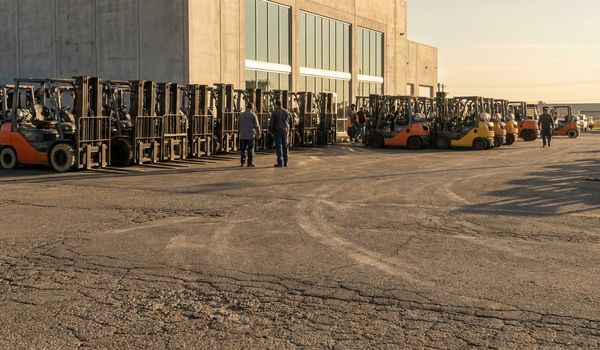
Forklifts themselves are classified by the Industrial Truck Association into seven classes, from electric rider trucks (Class I) through rough terrain forklifts (Class VII). Dealers typically carry several classes, with product mix shifting based on local industry demand. A dealer near a port will stock container handlers and high-capacity pneumatic tire trucks, while a dealer serving e-commerce fulfillment will focus on electric reach trucks and order pickers.
Forklift Dealer Market Size and Growth Statistics
The forklift industry is one of the largest equipment sectors in the world. Industry estimates place the global forklift market in the range of $60 billion to $85 billion in the mid-2020s, with analysts projecting the market to surpass $100 billion by the early 2030s as warehouse automation and e-commerce fulfillment continue to expand. North America accounts for roughly a quarter of global demand, putting the regional market in the neighborhood of $10 billion to $13 billion annually.
Unit volumes tell the same growth story. World Industrial Truck Statistics, the industry's global order tracking program, has reported worldwide forklift orders of roughly two million units per year in recent reporting periods. North American factory sales have consistently exceeded a quarter million units annually, making the United States one of the two largest national forklift markets in the world alongside China.
Key Stat: Global forklift orders have held near two million units per year, and North American factories ship more than 250,000 forklifts annually. Every one of those units passes through a dealer channel that also services the millions of forklifts already in the field.
Growth projections for the forklift market through 2030 generally fall in the mid-single digits on a compound annual basis, with electric and automated equipment growing considerably faster than the overall market. Several structural forces support this outlook:
- E-commerce fulfillment: Online retail continues to drive warehouse construction and equipment demand. Each new fulfillment center requires dozens to hundreds of forklifts and order pickers.
- Reshoring and manufacturing investment: Federal incentives and supply chain reconfiguration have spurred factory construction, and every new plant needs material handling equipment.
- Labor scarcity: Persistent warehouse labor shortages push operators toward higher-productivity equipment and semi-automated solutions.
- Fleet replacement cycles: The average forklift remains in service for 10 to 12 years, creating a large, predictable replacement market independent of new construction.
For dealers, the installed base is as important as new unit sales. With millions of forklifts operating in the United States, the aftermarket for parts, service, and refurbishment provides recurring revenue that smooths the cyclicality of new equipment demand. Dealers with strong service departments historically weather downturns far better than pure sales operations.
Key Statistics by Equipment Segment
Forklift demand splits across equipment classes, and the mix has shifted decisively toward electric power. Understanding segment-level statistics helps both dealers planning inventory and buyers choosing the right machine.
Electric Rider Trucks (Class I)
Class I electric counterbalance forklifts represent one of the largest and fastest-growing segments. Electrics now account for roughly two-thirds of new forklifts sold in North America, a share that has climbed steadily as battery technology improves and indoor air quality rules tighten. A typical new electric counterbalance forklift sells in the range of $20,000 to $45,000 depending on capacity and battery configuration.
Electric Narrow Aisle Trucks (Class II)
Reach trucks and order pickers serve high-density warehouse storage. E-commerce fulfillment has made Class II one of the strongest growth segments, as distribution centers pack more racking into every square foot. Narrow aisle equipment typically commands $30,000 to $50,000 per unit, with automated and wire-guided models at the premium end.
Electric Hand Trucks (Class III)
Walkie pallet jacks and stackers are the highest-volume, lowest-price segment, with units commonly selling from $3,000 to $12,000. Class III equipment moves in enormous quantities because nearly every warehouse, grocery store, and delivery operation uses pallet jacks. Lithium-ion conversions have revitalized this segment, cutting charging time and eliminating battery maintenance.
Internal Combustion Trucks (Classes IV and V)
IC cushion and pneumatic tire forklifts remain essential for outdoor work, lumber yards, building materials, and heavy manufacturing. New IC trucks generally range from $25,000 to $50,000, with high-capacity models above 15,000 pounds reaching $100,000 or more. While electrics gain share, IC trucks still dominate applications where duty cycles are long, surfaces are rough, or refueling speed matters.
Rough Terrain and Specialty Equipment (Class VII)
Rough terrain forklifts, telehandlers, and container handlers serve construction, agriculture, and port operations. These are lower-volume, higher-price machines, often $60,000 to $150,000 and up. Dealers in construction-heavy regions lean heavily on this class.
Forklift Sales and Pricing Statistics
Pricing data helps buyers budget accurately and helps dealers position their inventories. The table below summarizes typical 2026 price ranges by equipment type, based on current dealer market conditions.
| Equipment Type | Typical New Price Range | Typical Used Price Range |
|---|---|---|
| Electric pallet jack (Class III) | $3,000 to $12,000 | $1,500 to $6,000 |
| Electric counterbalance (Class I) | $20,000 to $45,000 | $8,000 to $25,000 |
| Narrow aisle reach truck (Class II) | $30,000 to $50,000 | $12,000 to $30,000 |
| IC pneumatic forklift (Class V) | $25,000 to $50,000 | $10,000 to $30,000 |
| High-capacity forklift (15,000+ lbs) | $60,000 to $150,000+ | $30,000 to $90,000 |
| Telehandler / rough terrain | $60,000 to $150,000+ | $35,000 to $100,000 |
Several pricing dynamics stand out in 2026. First, the used equipment market remains tight. Strong demand for late-model, low-hour used forklifts has kept resale values elevated, which benefits dealers selling trade-ins and buyers who eventually sell their equipment. Second, battery technology now represents a significant share of an electric forklift's price, and the choice between lead-acid and lithium-ion can swing a purchase by $5,000 to $15,000 per unit. Third, extended lead times on certain new models, a lingering effect of supply chain disruption earlier in the decade, have made well-maintained used equipment and dealer rental fleets more attractive.
Financing remains the dominant acquisition method. Industry surveys consistently show that a large majority of businesses acquire forklifts through financing or leasing rather than cash purchases, which is why dealer-arranged financing programs and independent equipment lenders play such a large role in the market.
Need Equipment Financing for Your Fleet?
Crestmont Capital finances new and used forklifts with fast approvals and flexible terms. No obligation, apply in minutes.
Apply Now →Forklift Dealer Business Model and Revenue Statistics
Forklift dealerships are diversified businesses, and their revenue mix explains why the dealer model has endured even as manufacturers experiment with direct sales. While every dealership differs, industry benchmarks generally describe a revenue mix along these lines:
- New equipment sales: typically 40 to 50 percent of total revenue, but often the lowest-margin stream
- Used equipment sales: roughly 15 to 20 percent, with stronger margins on reconditioned trade-ins
- Rental fleet: approximately 10 to 15 percent, one of the fastest-growing streams as customers shift from ownership to access
- Parts and service: roughly 20 to 30 percent, the highest-margin and most stable revenue in the business
The parts and service stream deserves special attention. A single forklift in regular use generates ongoing maintenance revenue for a decade or more. Dealers measure technician productivity, service contract penetration, and parts fill rates as carefully as unit sales. Many dealerships report that aftermarket operations contribute a disproportionate share of gross profit relative to their revenue share, which is why dealer groups continue to invest heavily in service infrastructure and technician recruitment.
Dealer consolidation is another defining statistic of the current era. Large dealer groups have been acquiring regional dealerships steadily, building multi-state footprints that can support national accounts. Toyota Material Handling, the world's largest forklift manufacturer by revenue, anchors a dealer network with hundreds of locations across North America, while Crown, Hyster-Yale, and Mitsubishi Logisnext maintain similarly extensive networks. At the same time, independent used-equipment dealers and rental specialists continue to thrive by serving price-sensitive buyers and niche applications.
On the demand side, the Small Business Administration's market research guidance underscores how equipment-intensive small businesses, from distributors to manufacturers, depend on access to material handling equipment. With more than 33 million small businesses operating in the United States, the addressable customer base for forklift dealers extends far beyond large warehouses.
By the Numbers
Forklift Dealer Industry - Key Statistics for 2026
$60B+
Estimated global forklift market size, projected to top $100B by the early 2030s
~2 Million
New forklifts ordered worldwide each year in recent industry tracking
250K+
Forklift units sold annually in North America, one of the world's largest markets
~66%
Share of new North American forklift sales that are electric-powered
10-12 Yrs
Average useful life of a forklift, driving a massive replacement market
20-30%
Typical share of dealer revenue from high-margin parts and service
Forklift Safety Statistics
Safety statistics are among the most consequential numbers in this industry, and every dealer and operator should know them. The Occupational Safety and Health Administration has long estimated that forklifts are involved in roughly 85 fatalities and about 34,900 serious injuries in the United States each year, with tens of thousands of additional less-serious incidents. Forklift overturns remain the leading cause of fatal forklift accidents, accounting for roughly a quarter of all forklift-related deaths.
Key Stat: OSHA estimates that approximately 70 percent of forklift accidents could be prevented with better training and safety policies. That single statistic explains why dealers increasingly bundle operator training with every equipment sale.
Several safety statistics shape dealer operations and equipment design:
- Training works: OSHA has estimated that better training could prevent the large majority of forklift accidents, which is why operator certification programs are now standard offerings at most dealerships.
- Pedestrian incidents: A substantial share of forklift injuries involve pedestrians struck by trucks, driving demand for proximity sensors, blue spotlights, and camera systems that dealers now sell as add-ons.
- Aging equipment risk: Older forklifts with worn brakes, chains, and masts are overrepresented in incident reports, one reason fleet modernization has both a productivity and a safety case.
- Telematics adoption: Fleet management systems that track impacts, speed, and operator behavior are now offered by most major dealers and are cited in industry case studies as reducing incident rates meaningfully within the first year of deployment.
For buyers, the safety data has a financial dimension. A single serious forklift accident can generate costs in the hundreds of thousands of dollars once medical claims, OSHA penalties, litigation, and downtime are tallied. Dealers that position modern safety-equipped equipment as risk reduction, not just capital expense, are winning more fleet replacement business.
Technology and Industry Trends for 2026
The forklift dealer industry in 2026 is being reshaped by four major technology and market trends. Each one shows up clearly in the statistics.
1. Electrification and Lithium-Ion Adoption
Electric forklifts have moved from niche to mainstream. With electrics now representing roughly two-thirds of new North American unit sales, the debate has shifted to battery chemistry. Lithium-ion batteries, which offer opportunity charging, zero maintenance, and longer cycle life than lead-acid, are the fastest-growing power option in the industry. Industry observers note that lithium-ion's share of new electric forklift sales has climbed from a small fraction a decade ago to a substantial and rapidly growing portion today. Dealers report that total cost of ownership calculations increasingly favor lithium-ion for multi-shift operations, even at a higher upfront price.
2. Automation and Semi-Autonomous Equipment
Automated guided vehicles and autonomous forklifts are growing at double-digit annual rates, albeit from a small base. Labor scarcity is the primary driver: with warehouses struggling to fill operator positions, automated pallet movers and robotic reach trucks handle repetitive horizontal transport while human operators focus on complex tasks. Dealers are building automation divisions, and manufacturer partnerships between traditional forklift brands and robotics companies have become common. Analysts covering the sector, including those whose work appears on business news outlets such as CNBC's business coverage, consistently identify warehouse automation as a defining investment theme of the decade.
3. Telematics and Data-Driven Fleet Management
Connected forklifts now transmit utilization, impact, battery health, and maintenance data to dealer and customer dashboards. Fleet telematics have shifted dealer service from reactive repair to predictive maintenance, improving uptime and deepening dealer-customer relationships. For multi-site customers, telematics data increasingly drives right-sizing decisions, revealing underused trucks that can be redeployed or returned from rental.
4. Shift Toward Rental, Leasing, and Flexible Access
Perhaps the most significant business-model trend is the shift from ownership to access. Dealer rental fleets have grown steadily as customers seek flexibility amid economic uncertainty. Short-term rental, long-term leasing, and full-maintenance programs let businesses convert capital expenses into operating expenses. Industry surveys suggest rental and leasing together now account for a meaningfully larger share of dealer revenue than a decade ago, and dealers continue to expand rental fleets in response.
Pro Tip: Businesses evaluating new equipment should ask dealers for telematics data from comparable fleets. Real utilization numbers often reveal that a right-sized, well-maintained used fleet outperforms an oversized new one on cost per pallet moved.
What These Statistics Mean for Business Owners
Statistics only matter if they change decisions. For business owners who buy and operate forklifts, the 2026 data points to several practical conclusions.
First, the replacement cycle is your negotiating leverage. With millions of aging forklifts in the field and dealers competing for replacement business, buyers have room to negotiate on price, service packages, and trade-in values, particularly at quarter-end and year-end when dealers push to hit unit targets.
Second, total cost of ownership beats purchase price. A $25,000 forklift with a cheap battery and no service plan can cost more over five years than a $35,000 unit with lithium-ion power and full maintenance. Fuel, batteries, maintenance, and downtime routinely exceed the purchase price over a machine's working life. Run the full numbers before choosing.
Third, financing structure affects real cost. Because the large majority of forklift acquisitions involve financing or leasing, the terms matter as much as the sticker price. Interest rate, term length, residual assumptions, and maintenance bundling all change the true monthly cost of a truck. Businesses should compare financing offers with the same rigor they apply to equipment quotes.
Fourth, safety investment pays for itself. With a single serious accident capable of producing six-figure costs, spending on training, telematics, and modern safety-equipped equipment is one of the highest-return decisions a fleet operator can make. Insurance premiums, OSHA exposure, and workers' compensation claims all move in the right direction when incident rates fall.
How Crestmont Capital Helps Forklift Dealers and Buyers
Whether you operate a forklift dealership or run a business that depends on material handling equipment, access to the right financing determines how fast you can act on the opportunities these statistics reveal. Crestmont Capital, rated the #1 business lender in the United States, provides tailored funding across the equipment lifecycle.
For equipment buyers, our forklift financing and leasing programs cover new and used trucks from any dealer, with terms structured around your cash flow. Businesses that want to preserve capital often choose equipment leasing, which can bundle maintenance and provide upgrade paths as technology evolves. For broader fleet needs, our equipment financing options span every forklift class, from walkie pallet jacks to high-capacity container handlers.
For forklift dealers, we provide working capital and floor-plan-style financing solutions that keep showrooms stocked and rental fleets growing. We understand dealer economics: the seasonality of equipment sales, the cash demands of a rental fleet, and the value of a strong service department. Our team structures funding that matches how dealerships actually operate.
We have also published in-depth resources for this industry. Our complete guide to forklift financing walks through loan structures, qualification requirements, and application strategy, while our article on leasing forklifts for warehouses and distribution centers covers the leasing decision in detail for high-throughput operations.
Ready to Put These Statistics to Work?
Get fast, flexible financing from the #1 business lender in the U.S. Approvals in hours, funding in days.
Apply Now →Real-World Scenarios
Numbers come alive in context. These scenarios illustrate how the 2026 forklift dealer statistics play out for real businesses.
Scenario 1: The E-Commerce Fulfillment Operator Expanding Capacity
A regional e-commerce fulfillment company wins a major new client and needs to outfit a 150,000-square-foot warehouse within 90 days. The equipment list includes 12 reach trucks, 8 electric counterbalance forklifts, and 20 electric pallet jacks, a package approaching $700,000. Rather than draining cash reserves, the company finances the fleet through an equipment financing arrangement with fixed monthly payments aligned to the new contract's revenue. The lithium-ion battery option adds upfront cost but eliminates battery rooms and watering labor, improving the five-year total cost of ownership. The deal reflects two statistics directly: the dominance of electric equipment in new sales and the central role of financing in fleet acquisition.
Scenario 2: The Independent Forklift Dealer Growing a Rental Fleet
A two-branch forklift dealership sees customers increasingly asking for rentals instead of purchases, mirroring the industry-wide shift toward flexible access. The owner wants to add 25 late-model used forklifts to the rental fleet, a roughly $400,000 investment that will generate recurring monthly revenue. Working capital financing lets the dealer buy the units at auction prices without touching operating cash. Within 18 months, rental revenue covers the financing payments and contributes a new high-margin income stream, illustrating why rental has become one of the fastest-growing dealer revenue categories.
Scenario 3: The Building Materials Yard Replacing an Aging IC Fleet
A building materials distributor operates 14 aging internal combustion forklifts, several past 12,000 operating hours. Maintenance costs are climbing, downtime is hurting deliveries, and two units fail a safety inspection. The owner replaces the fleet in phases over two years, trading in the old trucks while used values remain strong. Financing each phase keeps payments predictable, and telematics on the new units cut fuel waste and identify harsh operating before it becomes damage. The scenario reflects the replacement-market statistics: a 10 to 12 year average equipment life and elevated used equipment values.
Scenario 4: The Manufacturer Upgrading for Safety Compliance
A food manufacturer reviews its incident history and finds three recordable forklift accidents in two years, including one pedestrian near-miss that could have been catastrophic. With OSHA estimating that roughly 70 percent of forklift accidents are preventable, the company invests in operator training, pedestrian detection systems, and two new forklifts with factory-integrated safety features. The package is financed together, spreading the cost while insurance premiums and incident rates decline. The following year, the company records zero recordable incidents.
Frequently Asked Questions
How large is the forklift dealer industry in 2026? +
Industry estimates place the global forklift market in the $60 billion to $85 billion range, with North America representing roughly $10 billion to $13 billion of that total. The dealer channel supports not only new unit sales of more than 250,000 forklifts annually in North America but also the parts, service, and rental needs of millions of forklifts already in operation.
How many forklifts are sold each year? +
Worldwide forklift orders have run at roughly two million units per year in recent industry tracking by World Industrial Truck Statistics. North American factory sales consistently exceed a quarter million units annually, making the region one of the two largest forklift markets in the world.
What is the average price of a new forklift? +
Prices vary widely by class. Electric pallet jacks start around $3,000 to $12,000, standard electric counterbalance forklifts typically run $20,000 to $45,000, internal combustion trucks generally cost $25,000 to $50,000, and high-capacity or rough terrain machines can exceed $100,000. Battery choice can swing an electric forklift's price by $5,000 to $15,000.
Who are the largest forklift manufacturers? +
Toyota Material Handling has been the world's largest forklift manufacturer by revenue for more than two decades. Other major global players include KION Group, Jungheinrich, Crown Equipment, Hyster-Yale Materials Handling, and Mitsubishi Logisnext. Each operates through authorized dealer networks across North America.
What share of new forklifts are electric? +
Electric-powered forklifts now account for roughly two-thirds of new units sold in North America, a share that has climbed steadily as battery technology improves and indoor air quality expectations tighten. Within the electric segment, lithium-ion batteries are the fastest-growing power option.
How do forklift dealers make money? +
Dealers earn revenue across five streams: new equipment sales, used equipment sales, rentals, parts, and service. While new equipment is often the largest revenue line, parts and service typically deliver the highest margins and the most stable income, which is why aftermarket operations are central to dealer profitability.
How long does a forklift last? +
The average forklift remains in service for 10 to 12 years, or roughly 10,000 to 15,000 operating hours. Electric forklifts often outlast internal combustion models because they have fewer moving parts. This long service life creates a large, predictable replacement market for dealers.
What are the most important forklift safety statistics? +
OSHA estimates forklifts are involved in about 85 fatalities and roughly 34,900 serious injuries annually in the United States. Overturns are the leading cause of fatal incidents, and OSHA estimates that approximately 70 percent of forklift accidents could be prevented with better training and safety policies.
Is it better to buy, lease, or rent a forklift? +
It depends on utilization and cash flow. Buying suits high-hour, long-term applications. Leasing preserves capital and can bundle maintenance with upgrade paths. Renting provides maximum flexibility for seasonal or uncertain demand. Industry data shows a clear shift toward leasing and rental, and most businesses finance acquisitions rather than paying cash.
How is technology changing forklift dealerships? +
Four technologies are reshaping dealers: lithium-ion power, automation and semi-autonomous trucks, telematics-based fleet management, and digital sales channels. Telematics in particular has shifted dealer service from reactive repair to predictive maintenance, improving uptime and strengthening long-term customer relationships.
What credit score do I need to finance a forklift? +
Requirements vary by lender, but many equipment financing programs work with a wide range of credit profiles. Established businesses with solid revenue often qualify for competitive rates, while newer businesses may need stronger cash flow documentation or a larger down payment. Because the equipment itself serves as collateral, forklift financing is generally more accessible than unsecured borrowing.
Can I finance a used forklift? +
Yes. Used forklift financing is widely available, and strong resale values make lenders comfortable with late-model used equipment. Terms depend on the machine's age, hours, and condition. Financing used equipment is a common strategy for businesses building fleets cost-effectively.
How fast can forklift financing be approved? +
Specialized equipment lenders frequently issue decisions within 24 to 48 hours and fund within days. Speed matters in this market because well-priced used equipment and dealer promotions move quickly. Having financial statements, bank records, and equipment quotes ready accelerates the process.
What is the outlook for forklift dealers through 2030? +
Analysts generally project mid-single-digit annual growth for the forklift market through 2030, with electric, automated, and connected equipment growing considerably faster. E-commerce expansion, manufacturing investment, labor scarcity, and the replacement cycle all support continued dealer growth, particularly for dealers strong in service and rental.
How do I apply for forklift financing with Crestmont Capital? +
Start with the online application at offers.crestmontcapital.com/apply-now, which takes only a few minutes. A financing specialist will review your business, discuss the equipment you need, and structure terms around your cash flow. Approvals often arrive within hours, and funding can follow within days.
Grow Your Fleet or Your Dealership
Join thousands of businesses that trust Crestmont Capital for equipment financing. Fast approvals, flexible terms, real people.
Apply Now →How to Get Started
Complete our quick application at offers.crestmontcapital.com/apply-now. It takes just a few minutes.
A Crestmont Capital advisor will review your needs and match you with the right financing option for your equipment or dealership.
Receive your funds and put them to work, often within days of approval.
Conclusion
The forklift dealer statistics for 2026 describe an industry that is large, growing, and modernizing quickly. A global market measured in the tens of billions of dollars, annual worldwide orders near two million units, and North American sales above a quarter million trucks all confirm the sector's scale. Beneath the headline numbers, the shift toward electric and lithium-ion power, the rise of automation and telematics, and the growing preference for rental and leasing are changing what dealers sell and how they earn.
For business owners, the practical lessons are clear: negotiate from the strength of the replacement cycle, evaluate total cost of ownership rather than sticker price, structure financing as carefully as equipment selection, and treat safety investment as a financial decision. For dealers, the winners of the next five years will pair strong parts and service operations with growing rental fleets and genuine technology capability.
Whatever side of the transaction you are on, these forklift dealer statistics point to the same conclusion: the businesses that act on the data, and secure the right financing to move quickly, will be the ones that grow. Crestmont Capital is ready to help you do exactly that.
Disclaimer: The information provided in this article is for general educational purposes only and is not financial, legal, or tax advice. Funding terms, qualifications, and product availability may vary and are subject to change without notice. Crestmont Capital does not guarantee approval, rates, or specific outcomes. For personalized information about your business funding options, contact our team directly.

About the author and reviewer
Allan GarfinkleMBA (Finance), JD
Chief Revenue Officer, Crestmont Capital
Allan Garfinkle is the Chief Revenue Officer at Crestmont Capital, where he has spent more than a decade leading revenue strategy, business development, and operational growth. With 28 years of experience building and advising startups and small businesses, Allan has helped more than 10,000 business owners navigate financing decisions, growth opportunities, and changing economic conditions. He earned a Bachelor of Science in Economics and an MBA with a concentration in Finance from Northeastern University, as well as a Juris Doctor from New England Law, where his studies focused on contracts and business law. His writing draws on extensive practical experience in small-business lending, equipment financing, business credit, and commercial finance.