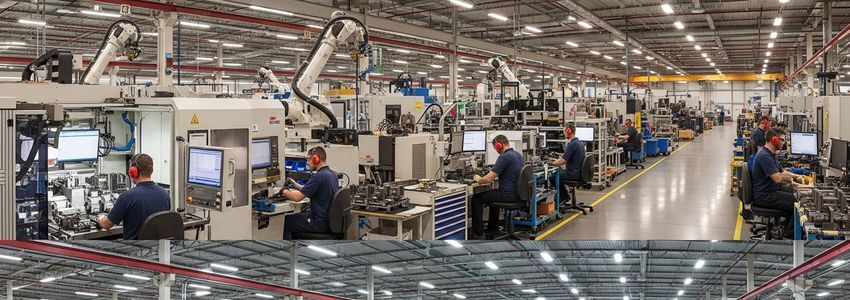
In the fast-paced world of modern manufacturing, efficiency, and capacity are not just goals; they are requirements for survival and growth. Upgrading your production line with the latest technology is essential to stay competitive, but the high upfront cost of machinery can be a significant barrier. This is where equipment financing for manufacturers provides a strategic solution, enabling businesses to acquire critical assets without depleting precious working capital. This comprehensive guide will explore how you can leverage equipment financing to scale your operations, boost productivity, and secure your position in the market.
In This Article
- What Is Equipment Financing for Manufacturers?
- Key Benefits of Equipment Financing for Production Upgrades
- Types of Manufacturing Equipment You Can Finance
- How Equipment Financing Works Step by Step
- Manufacturing Industry by the Numbers
- Who Qualifies for Manufacturing Equipment Financing?
- How Crestmont Capital Helps Manufacturers
- Equipment Financing vs. Other Funding Options
- Real-World Scenarios: Equipment Financing in Action
- How to Get Started
- Frequently Asked Questions
- Conclusion
What Is Equipment Financing for Manufacturers?
Equipment financing for manufacturers is a specialized type of business funding designed specifically for the acquisition of machinery and other physical assets. Instead of paying the full price for a piece of equipment upfront, a manufacturer can secure a loan or lease from a financial institution. The funding is used to purchase the equipment, and the manufacturer repays the lender over a set period with regular, predictable payments.
A key feature of this financing structure is that the equipment itself typically serves as the collateral for the loan. This is a significant advantage, as it means you may not need to pledge other business assets, like real estate or accounts receivable, to secure the funding. If the business were to default on the loan, the lender would repossess the financed equipment to recover its losses.
This financial tool is not just for buying brand-new machinery. It can be used for a wide range of needs, including:
- Purchasing new or used equipment
- Upgrading existing machinery to newer, more efficient models
- Financing "soft costs" associated with the acquisition, such as delivery, installation, and training
- Refinancing existing equipment loans to secure better terms or free up cash flow
Ultimately, manufacturing equipment financing acts as a bridge, allowing you to access the tools you need to grow today while spreading the cost over the productive life of the asset.
Key Benefits of Equipment Financing for Production Upgrades
Choosing to finance your equipment purchase rather than paying with cash offers a host of strategic advantages that can have a profound impact on your company's financial health and competitive positioning.
1. Preservation of Working Capital
This is arguably the most significant benefit. Heavy machinery is expensive, and paying for it with cash can drain your liquidity. This leaves your business vulnerable to unexpected expenses or unable to seize other opportunities. Financing allows you to keep your cash reserves intact for day-to-day operations, payroll, inventory, and strategic investments.
Key Insight: According to the U.S. Small Business Administration (SBA), insufficient cash flow is a leading cause of business failure. Equipment financing directly addresses this challenge by converting a large capital expenditure into a manageable operating expense.
2. Predictable Budgeting and Fixed Payments
Equipment loans and leases come with a fixed repayment schedule. You will have a consistent monthly payment over a predetermined term, which makes financial planning and budgeting much simpler. This predictability eliminates the uncertainty of fluctuating costs and helps you manage your cash flow with greater accuracy.
3. Potential Tax Advantages
Equipment financing can offer substantial tax benefits. Under Section 179 of the IRS tax code, businesses may be able to deduct the full purchase price of qualifying equipment in the year it is placed into service. This can significantly lower your taxable income. Additionally, the interest paid on an equipment loan is typically tax-deductible. For leases, the entire lease payment may be deductible as an operating expense. It is essential to consult with a tax advisor to understand the specific benefits for your business.
4. Gaining a Competitive Edge
Access to the latest technology allows you to produce higher-quality goods more efficiently and at a lower cost per unit. This could mean faster turnaround times, the ability to take on more complex jobs, or reduced material waste. By financing state-of-the-art equipment, you can outpace competitors who may be working with older, less efficient machinery.
5. 100% Financing Options
Many equipment financing programs cover the total cost of the asset, including soft costs like taxes, shipping, and installation. This means you can potentially acquire and implement new machinery with little to no money down, further protecting your cash reserves.
6. Building Business Credit
Successfully managing and repaying an equipment loan demonstrates financial responsibility and helps build a strong credit history for your business. A positive credit profile will make it easier and more affordable to secure other types of small business financing in the future.
Ready to Upgrade Your Production Line?
Don't let capital constraints hold your manufacturing business back. Get fast, flexible equipment financing from the #1 business lender in the U.S. No obligation - apply in minutes.
Apply Now →Key Stat: According to the Equipment Leasing and Finance Association (ELFA), over 80% of U.S. businesses use some form of equipment financing - making it the go-to capital strategy for manufacturers who want to grow without depleting cash reserves.
Types of Manufacturing Equipment You Can Finance
The scope of equipment that can be financed is incredibly broad, covering virtually every aspect of the modern manufacturing process. If a piece of equipment is essential to your operations and has a demonstrable useful life, it can likely be financed. Here are some of the most common categories of manufacturing equipment that businesses finance:
Production and Fabrication Machinery
- CNC Machines: Computer Numerical Control mills, lathes, routers, and plasma cutters.
- 3D Printers / Additive Manufacturing: Industrial-grade printers for prototyping and production.
- Metalworking Equipment: Press brakes, shears, laser cutters, waterjet cutters, and welding equipment.
- Plastic and Injection Molding Machines: Extruders, blow molding machines, and thermoforming equipment.
- Woodworking Machinery: Saws, sanders, planers, and CNC routers for wood.
Assembly and Automation
- Robotic Arms and Automation Systems: For welding, painting, assembly, and pick-and-place tasks.
- Conveyor Systems: Belt, roller, and overhead conveyors for moving materials and products.
- Automated Guided Vehicles (AGVs): For material transport within a facility.
Packaging and Processing
- Food Processing Equipment: Mixers, ovens, slicers, and grinders.
- Packaging and Bottling Lines: Fillers, cappers, labelers, and wrapping machines.
- Sorting and Inspection Systems: Vision systems and quality control sensors.
Material Handling and Logistics
- Forklifts, Lifts, and Cranes: For moving heavy materials and finished goods.
- Warehouse Racking and Storage Systems: Essential for organizing inventory.
- Loading Dock Equipment: Dock levelers, vehicle restraints, and seals.
Ancillary and Support Equipment
- Air Compressors and Generators: Powering tools and machinery.
- Computer Hardware and Software: Including CAD/CAM software and enterprise resource planning (ERP) systems.
- Lab and Testing Equipment: For quality assurance and research and development.
This is not an exhaustive list. The flexibility of equipment financing means that as manufacturing technology evolves, so do the financing opportunities available to acquire it.

How Equipment Financing Works Step by Step
Securing equipment financing, especially through a specialized lender like Crestmont Capital, is a streamlined and straightforward process designed to get you the machinery you need as quickly as possible. While specifics can vary, the typical journey follows these four key steps.
Step 1: Application and Consultation
The process begins when you submit an application. Modern lenders often provide a simple, one-page online application that can be completed in minutes. You will provide basic information about your business, such as its legal name, years in operation, and annual revenue, as well as details about the equipment you wish to purchase, including its cost and the vendor.
After submission, a financing specialist will likely contact you to discuss your needs in more detail. This consultation helps them understand your specific goals, cash flow situation, and the role the new equipment will play in your operations, allowing them to tailor the best financing solution for you.
Step 2: Documentation and Underwriting
Once the initial application is reviewed, the lender will request necessary documentation. For financing requests under a certain threshold (often around $250,000), the application itself may be sufficient. For larger amounts, you may be asked to provide:
- Recent business bank statements (typically 3-6 months)
- A formal quote or invoice for the equipment from the seller
- Business financial statements (profit and loss, balance sheet)
- Business and personal tax returns
The lender's underwriting team then reviews this information to assess the financial health of your business and the overall risk of the loan. They analyze factors like credit history, cash flow, and time in business to make an approval decision and determine the specific rates and terms they can offer.
Step 3: Approval and Agreement
This stage is often much faster with specialized lenders than with traditional banks. You can receive an approval in as little as a few hours. Once approved, you will be presented with a financing agreement that outlines all the terms and conditions, including:
- The total amount financed
- The interest rate
- The length of the term (e.g., 60 months)
- The fixed monthly payment amount
- Any fees or down payment requirements
It is crucial to review this document carefully. Once you are satisfied with the terms, you sign the agreement and return it to the lender.
Step 4: Funding and Equipment Acquisition
After the signed agreement is received, the process moves to the final funding stage. The lender will coordinate directly with the equipment vendor you have chosen. They will pay the vendor the full invoice amount for the machinery. Once the vendor confirms receipt of payment, they will release the equipment for shipment and delivery to your facility. Your repayment schedule begins according to the terms of your agreement, typically after you have received the equipment.
Manufacturing Industry by the Numbers
By the Numbers
U.S. Manufacturing - Key Statistics for Business Owners
$6.9T
U.S. manufacturing shipments value (U.S. Census Bureau)
12.7M
U.S. manufacturing jobs supporting communities nationwide
78%
of small manufacturers plan equipment investments to boost productivity
2-7 Days
Typical funding timeline with equipment financing (vs. weeks for traditional loans)
Who Qualifies for Manufacturing Equipment Financing?
Lenders evaluate several key factors to determine a business's eligibility for equipment financing. While requirements vary between institutions, they generally focus on a holistic view of your business's stability and ability to repay the loan. Here are the primary criteria underwriters consider:
1. Credit Score
Both your personal and business credit scores are important. A strong credit history demonstrates a track record of responsible debt management. While a high score (700+) will open the door to the best rates and terms, many lenders, especially those specializing in equipment financing, can work with business owners with scores in the 600s. They understand that a credit score is just one piece of the puzzle.
2. Time in Business
Lenders prefer to work with established businesses. The standard requirement is often a minimum of two years in operation. A longer history provides more data on your company's performance and stability. However, some lenders have programs specifically for startups or businesses with at least six months to one year of operating history, though the terms may be more stringent.
3. Annual Revenue
Your business's revenue is a direct indicator of its ability to generate the cash flow needed to make monthly loan payments. Lenders will look at your bank statements and financial reports to verify consistent revenue. While there isn't a universal minimum, a higher and more stable revenue stream increases your chances of approval for larger financing amounts.
4. Industry and Equipment Type
The lender will also consider the specifics of your industry and the equipment you are financing. Manufacturing is generally seen as a stable, asset-heavy industry, which is favorable for lenders. They will also assess the resale value and useful life of the equipment. Machinery that retains its value well may be easier to finance, as it represents lower risk for the lender.
5. Existing Debt
Underwriters will look at your current debt-to-income ratio to ensure your business can comfortably handle an additional monthly payment. If your business is already heavily leveraged, it may be more difficult to secure new financing, though options like refinancing could still be on the table.
Don't Self-Disqualify: Even if you think you might not meet one of these criteria perfectly, it's still worth applying. Lenders like Crestmont Capital can often find flexible solutions by weighing the strengths of your application, such as strong revenue, against a lower credit score or shorter time in business.
Pro Tip: Many manufacturers qualify for higher loan amounts than they expect. Crestmont Capital approves financing based on equipment value and business revenue - not just credit score. Even businesses with credit challenges may qualify through our specialized programs.
How Crestmont Capital Helps Manufacturers
Navigating the world of business financing can be complex, but partnering with a specialist can make all the difference. Crestmont Capital is not a traditional bank; we are a dedicated financial partner that understands the unique challenges and opportunities within the manufacturing sector. Here’s how we provide superior value to our manufacturing clients:
Speed and Efficiency
We know that in manufacturing, timing is everything. A delayed equipment purchase can mean a lost contract or a production bottleneck. Our application process is designed for speed. You can apply online in minutes, receive a credit decision in hours, and secure funding in as little as 24 hours. This allows you to act decisively and get your new equipment on the factory floor without delay.
Flexible and Tailored Solutions
One size does not fit all in manufacturing. We work closely with you to understand your business cycle, cash flow, and long-term goals. We then structure a financing plan that fits your needs, whether it’s an equipment loan, a capital lease, or a more flexible equipment leasing option like a Fair Market Value (FMV) lease. We can also create custom payment schedules, such as seasonal or deferred payments, to align with your revenue streams.
High Approval Rates
Unlike traditional banks that often have rigid, conservative lending criteria, we take a more comprehensive view of your business. We look beyond just the credit score to consider factors like your revenue, industry experience, and the value of the equipment itself. This approach allows us to approve a wider range of businesses, including those that may have been turned down elsewhere.
Expertise in Manufacturing
Our financing specialists have deep experience working with manufacturers. We understand the value and function of a CNC mill, a robotic welder, or a packaging line. This industry-specific knowledge enables us to underwrite deals more effectively and provide relevant, insightful advice to help you make the best financial decisions for your company’s growth.
Partner with a Manufacturing Financing Expert
Experience the Crestmont Capital difference. Our team specializes in equipment financing for manufacturers - same-day decisions available.
Get Your Free Quote →Equipment Financing vs. Other Funding Options
When you need to acquire new machinery, equipment financing is not your only choice. Understanding how it compares to other common funding methods can help you determine the best strategy for your specific situation.
| Feature | Equipment Financing / Lease | Cash Purchase | Traditional Bank Loan | SBA Loan |
|---|---|---|---|---|
| Upfront Cost | Low to none. Often 100% financing is available. | Very high. Requires 100% of the equipment cost upfront. | Moderate. Typically requires a 10-20% down payment. | Moderate. Often requires a 10-20% down payment. |
| Impact on Cash Flow | Minimal. Preserves working capital for operations. | Severe. Depletes a large amount of cash reserves. | Significant. The down payment reduces available cash. | Significant due to the down payment requirement. |
| Approval Speed | Very Fast. Often within 24-48 hours. | N/A. No approval needed. | Slow. Can take several weeks to months. | Very Slow. The process can take 30-90 days or more. |
| Collateral | The equipment itself serves as collateral. | N/A. | May require additional collateral, like real estate or a blanket lien on all business assets. | Often requires significant additional collateral and personal guarantees. |
| Documentation | Streamlined. Often a simple application is sufficient. | Simple transaction. | Extensive. Requires detailed business plans, financials, and projections. | Very extensive paperwork and documentation are required. |
| Best For | Quickly acquiring assets while preserving cash and for businesses of all credit profiles. | Highly cash-rich companies that do not need liquidity for other purposes. | Highly qualified businesses with strong credit and a long-standing bank relationship that do not need the equipment immediately. | Businesses seeking very low rates and long terms that can navigate a complex application process, such as those looking for SBA loans. |
Did You Know? Equipment financing payments are often structured to align with your production cycles, meaning your financing can be designed so that payment peaks occur when your business revenue is at its highest - reducing financial stress throughout the year.
Real-World Scenarios: Equipment Financing in Action
To better illustrate the practical application of equipment financing, let's explore a few hypothetical but realistic scenarios that manufacturers face.
Scenario 1: The Metal Fabrication Shop
The Challenge: "Precision Metal Works," a successful fabrication shop, receives a large, long-term contract from an aerospace company. To meet the contract's strict specifications and production volume, they need a new 5-axis CNC machining center, which costs $350,000.
The Problem: While profitable, paying $350,000 in cash would wipe out their operating reserves, leaving them exposed and unable to hire the additional staff needed for the contract.
The Solution: Precision Metal Works partners with Crestmont Capital for equipment financing. They are approved for 100% financing over a 7-year term. The monthly payment is predictable and easily covered by the revenue from the new contract. They acquire the machine, fulfill the contract, and significantly increase their shop's capabilities and revenue without touching their cash savings.
Scenario 2: The Food and Beverage Producer
The Challenge: "Fresh Harvest Foods" is a growing company that produces organic snacks. A major grocery chain wants to carry their products nationwide, but this requires a massive increase in production and new, certified packaging equipment to meet food safety standards. The total cost of the new packaging line is $180,000.
The Problem: The company is only three years old and has been reinvesting most of its profits into growth, so it lacks a long financial history and deep cash reserves. A traditional bank loan is not an option.
The Solution: They apply for equipment financing. The lender looks at their strong recent revenue growth and the signed purchase order from the grocery chain. They are approved for a 5-year equipment loan that includes the cost of installation and training. Fresh Harvest Foods gets the equipment on their floor in under a week, scales production, and successfully launches its products in the national market.
Scenario 3: The Custom Cabinet Maker
The Challenge: "Artisan Cabinets," a high-end custom woodworking business, is struggling to keep up with demand due to an outdated and inefficient edgebander. A new, automated model would triple their output for this part of the process, but it costs $75,000.
The Problem: The owner has a fair credit score but is worried about taking on a long-term loan for a piece of technology that might be surpassed in a few years.
The Solution: The owner opts for a Fair Market Value (FMV) equipment lease. This provides a lower monthly payment than a traditional loan. At the end of the 3-year lease term, they have the flexibility to either purchase the machine for its fair market value, return it and upgrade to the newest model, or renew the lease. This solution allows them to get the efficiency boost they need now while keeping their technology options open for the future.
How to Get Started
Taking the next step toward upgrading your production capacity is simple. If you're ready to explore how equipment financing can benefit your manufacturing business, here is a clear path forward:
- Identify Your Need: Determine the specific equipment you need to purchase. Get a formal quote or invoice from one or more vendors. This will establish the target financing amount.
- Gather Basic Information: Prepare some key details about your business, such as your legal business name, address, tax ID number, and recent revenue figures. For most applications, this is all you will need to start.
- Complete a Quick Application: The most efficient way to begin is by filling out a simple online application. This takes only a few minutes and provides the lender with the initial information needed to assess your request.
- Speak with a Specialist: A dedicated financing expert will review your application and contact you to discuss your options. This is your opportunity to ask questions and ensure the proposed financing structure aligns with your business goals.
Your Manufacturing Growth Starts Here
Our secure online application takes less than 5 minutes. Find out how Crestmont Capital can fuel your manufacturing success with equipment financing tailored to your needs.
Start Your Application →Frequently Asked Questions
What is the main difference between an equipment loan and an equipment lease?
The primary difference is ownership. With an equipment loan, you borrow money to purchase the asset and you own it from the start. With an equipment lease, you pay to use the equipment for a set period. At the end of the lease term, you may have the option to purchase it, return it, or renew the lease. Loans build equity, while leases often have lower monthly payments and can be treated as an operating expense.
Can I finance used manufacturing equipment?
Yes, many lenders, including Crestmont Capital, offer financing for both new and used manufacturing equipment. Financing used equipment can be a cost-effective way to upgrade your capabilities. Lenders will assess the age, condition, and expected useful life of the used machinery when determining financing terms.
What are typical interest rates for manufacturing equipment financing?
Interest rates vary widely based on several factors, including your business's credit score, time in business, financial health, the type and cost of the equipment, and the loan term. Rates can range from the single digits for highly qualified applicants to higher rates for businesses with more risk factors. The best way to know your specific rate is to apply and receive a personalized quote.
How long are the repayment terms for equipment loans?
Repayment terms typically align with the expected useful life of the equipment being financed. For manufacturing machinery, terms commonly range from two to seven years, though some programs may offer terms up to ten years for very expensive, long-lasting assets.
What is the Section 179 tax deduction and how does it apply?
Section 179 of the IRS tax code allows businesses to deduct the full purchase price of qualifying new or used equipment in the year it is put into service, rather than depreciating it over several years. This can provide a significant tax saving. Most types of manufacturing equipment qualify. Always consult with a tax professional to understand how this applies to your specific financial situation.
Is a down payment required for equipment financing?
It depends on the lender and your business's qualifications. Some financing programs offer 100% financing, meaning no down payment is required. Others may ask for a down payment of 10-20%, especially for newer businesses or those with less-than-perfect credit. Some lenders may only require the first and last month's payment upfront.
How quickly can I get approved and receive funding?
One of the major advantages of working with a specialized lender like Crestmont Capital is speed. The application process can often be completed online in minutes. Approvals can be granted in as little as a few hours, with funding available within 24 to 48 hours after all documentation is complete. This is significantly faster than traditional bank loans.
Will a personal guarantee be required?
For most small and medium-sized manufacturing businesses, a personal guarantee is a standard requirement for equipment financing. This means the business owner personally assumes responsibility for repaying the debt if the business defaults. It provides an extra layer of security for the lender.
Can I finance soft costs like installation, training, and shipping?
Yes, many equipment financing agreements can be structured to include soft costs. This allows you to bundle the total cost of acquiring and implementing the new equipment-including delivery, installation, and initial training-into a single, manageable monthly payment.
What happens if the equipment becomes obsolete before the loan is paid off?
This is a key consideration, especially for technology-heavy equipment. With an equipment loan, you are obligated to complete the payments even if the technology becomes outdated. An equipment lease, particularly a Fair Market Value (FMV) lease, can offer more flexibility, allowing you to upgrade to newer technology at the end of the term without being tied to an obsolete asset.
Can a new manufacturing business get equipment financing?
While more challenging, it is possible for startups to secure equipment financing. Lenders will place a heavier emphasis on the owner's personal credit score, a detailed business plan, and industry experience. Some lenders have specific programs designed for new businesses, though terms may be stricter.
What is the minimum credit score needed for equipment financing?
There is no universal minimum credit score, as each lender has its own criteria. Generally, a personal credit score of 620 or higher is a good starting point for many financing programs. Lenders like Crestmont Capital can often work with a wider range of credit profiles by looking at the overall health of the business, including revenue and time in business.
Does the equipment itself serve as collateral?
Yes, in most equipment financing agreements, the equipment being financed serves as its own collateral. This is a significant benefit because it means you typically do not have to pledge other business or personal assets, such as real estate or inventory, to secure the loan.
Can I pay off my equipment loan early?
This depends on the terms of your specific loan agreement. Some loans allow for early prepayment without any penalties, while others may include a prepayment penalty or require all interest to be paid regardless of when the principal is paid off. It's crucial to clarify this with your lender before signing the agreement.
What documents do I need to apply for manufacturing equipment financing?
For smaller financing amounts (e.g., under $250,000), a simple one-page application may be all that's required. For larger requests, you will likely need to provide additional documentation, which can include a few months of business bank statements, a quote or invoice for the equipment, and basic information about your business.
Conclusion
In a sector driven by innovation and efficiency, standing still is not an option. Upgrading your production capacity is a critical investment in your company's future. Equipment financing for manufacturers is a powerful and flexible financial tool that empowers you to make these essential investments without compromising your financial stability. By preserving cash flow, offering predictable payments, and providing significant tax advantages, it removes the financial barriers to growth.
Whether you need to add a single machine or overhaul an entire production line, a strategic financing partner can provide the capital and expertise to help you achieve your goals. By leveraging the right funding, you can enhance productivity, improve quality, and secure a lasting competitive advantage in the ever-evolving manufacturing landscape.
Disclaimer: The information provided in this article is for general educational purposes only and is not financial, legal, or tax advice. Funding terms, qualifications, and product availability may vary and are subject to change without notice. Crestmont Capital does not guarantee approval, rates, or specific outcomes. For personalized information about your business funding options, contact our team directly.