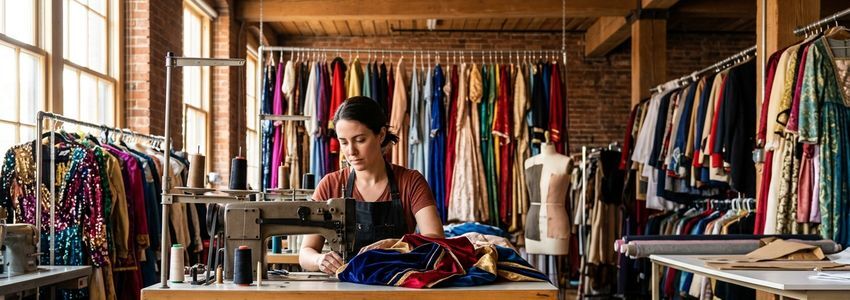
Costume shop equipment financing gives theatrical costume houses, costume manufacturers, and costume rental businesses a fast, structured way to fund industrial sewing machines, fabric cutting tables, dye vats, serger banks, and fabrication tools without draining working capital. For a growing costume shop, the right equipment is the difference between turning down a 200-piece theatrical production order and delivering it on time with room to spare.
This guide walks through exactly how costume shop equipment financing works, what qualifies, how much it costs, and how costume business owners across the country are using it to scale production capacity without waiting years to save cash for new machinery.
In This Article
What Is Costume Shop Equipment Financing?
Costume shop equipment financing is a type of commercial equipment loan designed specifically to fund the machinery, tools, and production equipment that costume shops, costume manufacturers, theatrical costume houses, and costume rental operations need to run and grow their business. Instead of paying full price upfront for an industrial sewing machine, a commercial embroidery system, or a fabric cutting table, a business owner spreads the cost over fixed monthly payments while putting the equipment to work from day one.
The lender uses the equipment itself as collateral in most cases, which typically makes approval faster and less dependent on real estate or other hard assets a costume shop owner might not have. This structure is common across small manufacturing and fabrication businesses, and costume shops fall squarely into that category because so much of their output depends on specialized production machinery rather than retail inventory alone.
Whether the shop produces costumes for regional theater companies, builds custom mascot and character costumes, manufactures licensed costume lines for retail, or runs a costume rental operation that also repairs and alters its own inventory, the financing mechanics are largely the same: a lender evaluates the business, the equipment, and the repayment plan, then funds the purchase so the shop can put new capacity to work immediately.
Key Benefits of Financing Your Costume Shop Equipment
Costume production is seasonal and project-driven. A shop might need triple its normal sewing capacity for six weeks during a theater season opener, then settle back to a steady baseline. Financing lets a shop scale equipment to match that demand curve without committing six figures of cash reserves to machines that sit idle in the off-season.
- Preserve working capital. Keep cash on hand for payroll, fabric and notions inventory, rent, and marketing instead of tying it up in a single large equipment purchase.
- Match payments to revenue. Fixed monthly payments are easier to budget around than a single large cash outlay, especially for a business with seasonal production cycles tied to theater schedules, conventions, or holiday costume demand.
- Access newer, more efficient machines. Modern industrial sergers, computerized embroidery machines, and automated cutting systems can dramatically cut production time per costume, which matters when a deadline is fixed by an opening night that will not move.
- Build business credit. On-time payments on an equipment loan can help a costume shop establish a stronger credit profile for future financing needs.
- Potential tax treatment advantages. Equipment financing structures can offer favorable treatment depending on how the loan or lease is structured; a tax professional can advise on specifics for your situation.
- Fast approval relative to traditional bank loans. Equipment-backed financing typically moves faster than conventional term loans because the equipment itself secures much of the risk.
For a costume shop competing for commissions against larger costume houses, having the production capacity to say yes to a big order, rather than turning it away because the current machines are maxed out, can be the single biggest driver of revenue growth in a given year.
How Costume Shop Equipment Financing Works
The process is more straightforward than many costume shop owners expect, especially compared to a traditional bank loan application. Here is the typical path from application to a fully equipped production floor.
Quick Guide
How Costume Shop Equipment Financing Works — At a Glance
Pick the machine (industrial sewing machine, cutting table, embroidery system) and get a vendor quote or invoice.
Most applications require basic business details, time in business, and recent bank statements — far less paperwork than a traditional bank loan.
Equipment-backed financing decisions often come back within one to two business days.
The lender pays the vendor directly, and the equipment ships or is installed, often within days of approval.
Once funded, the shop begins making fixed monthly payments over a term typically ranging from 24 to 72 months, depending on the equipment type and total loan amount. Terms are generally structured so the equipment itself is still useful and valuable throughout the full repayment period.
Key Stat: According to the U.S. Census Bureau's Annual Business Survey, small manufacturing and specialty production businesses with fewer than 20 employees represent the overwhelming majority of U.S. manufacturing establishments, underscoring how common equipment-dependent small shops like costume houses are across the country.
Types of Costume Shop Equipment You Can Finance
Costume shop equipment financing is not limited to a single machine type. Lenders that work with fabrication and manufacturing businesses typically finance a wide range of production equipment, including:
- Industrial sewing machines — single-needle, double-needle, and heavy-duty walking foot machines for structured costume pieces, armor, and outerwear.
- Sergers and overlock machines — for finishing seams quickly on high-volume production runs.
- Computerized embroidery machines — for logos, crests, and detailed decorative work on licensed or branded costume lines.
- Fabric cutting tables and automated cutters — including CNC fabric cutting systems for pattern consistency on bulk orders.
- Dye vats and fabric dyeing equipment — for shops that custom-dye fabric to match specific production color palettes.
- Steamers, pressing equipment, and finishing stations — essential for delivering stage-ready, wrinkle-free costumes.
- Pattern-making and draping tables — for custom fitting and original costume design work.
- Mold-making and fabrication tools — for shops producing armor pieces, masks, headwear, and sculpted costume elements.
- 3D printers and vacuum forming equipment — increasingly used for costume armor, props, and character pieces.
- Storage, racking, and inventory systems — for costume rental operations managing large wardrobes across multiple productions.
New and used equipment can typically both be financed, which matters for costume shops that often buy specialized or vintage machines (like a well-maintained used industrial serger) rather than only new equipment from a manufacturer catalog.
Many costume shops also find that a single financing arrangement can bundle several pieces of equipment into one application and one monthly payment, rather than juggling separate invoices and repayment schedules for each machine. This is particularly useful when a shop is building out an entire new production line at once, such as outfitting a new workroom with cutting tables, sewing stations, and a finishing area in a single buildout. Bundling equipment this way also simplifies bookkeeping, since depreciation schedules and loan tracking stay consolidated under one financing agreement instead of several.
What Determines the Cost of Costume Shop Equipment Financing
Several factors influence the rate and terms a costume shop will see on an equipment financing application. Understanding these in advance helps a business owner negotiate confidently and avoid surprises.
- Equipment type and resale value. Machines with strong resale markets, like well-known industrial sewing machine brands, often qualify for more favorable terms than highly specialized or custom-built fabrication tools with a thinner resale market.
- Time in business. Shops with several years of operating history and consistent revenue typically unlock better rates than brand-new businesses.
- Credit profile. Both business and, in some cases, personal credit history factor into the rate offered, though equipment financing tends to be more forgiving than a traditional bank loan.
- Loan term length. Shorter terms usually carry lower total interest cost but higher monthly payments; longer terms spread the cost out but increase total interest paid over the life of the loan.
- New vs. used equipment. New equipment often qualifies for slightly better terms than used equipment, since it typically carries a full manufacturer warranty and a longer expected useful life.
- Revenue consistency. Shops that can show steady monthly revenue, even if seasonal, tend to see smoother approvals than shops with highly erratic cash flow.
A costume shop owner evaluating multiple financing offers should compare not just the headline rate, but the total cost of financing over the full term, any origination fees, and whether the structure is a true loan (building equity in the equipment) or a lease (which may or may not include a purchase option at the end of the term).
Who Costume Shop Equipment Financing Is Best For
This type of financing fits a specific set of costume and theatrical production businesses particularly well:
- Established costume shops expanding capacity — a shop with steady contracts from regional theaters, opera companies, or dance companies that needs to add a second or third production line.
- Costume manufacturers scaling for licensed or wholesale lines — businesses moving from one-off custom work into repeatable production runs for retail or licensing partners.
- Costume rental businesses modernizing equipment — rental operations that also alter, clean, and repair their inventory in-house and need updated pressing, steaming, or sewing equipment.
- Theatrical fabrication shops — businesses that build costumes alongside props and set pieces and need fabrication tools like mold-making and vacuum forming equipment.
- Seasonal production houses — shops that see demand spikes around theater seasons, Halloween, conventions, or holiday productions and need to ramp capacity quickly.
It is a weaker fit for a brand-new hobbyist operation with no revenue history or for a business looking to finance consumable supplies like fabric and notions rather than durable equipment, since those are better suited to a working capital line or inventory financing instead.
Equipment Financing vs. Leasing vs. Cash vs. SBA Loans
Costume shop owners have several ways to acquire production equipment, and each comes with tradeoffs worth understanding before committing.
| Option | Speed | Best For | Key Tradeoff |
|---|---|---|---|
| Equipment Financing | Fast (1-3 days) | Shops that want to own the equipment outright | Fixed monthly payment obligation |
| Equipment Leasing | Fast (1-3 days) | Shops that want lower payments or plan to upgrade often | May not build equity in the equipment |
| Paying Cash | Immediate (if funds available) | Shops with significant cash reserves and no urgent need for liquidity | Ties up capital that could fund payroll, inventory, or marketing |
| SBA Loan | Slow (weeks to months) | Larger capital needs bundled with other business expenses | Extensive documentation and longer approval timelines |
For most costume shops that need a specific machine funded quickly to meet a production deadline, equipment financing or leasing tends to outperform an SBA loan on speed, and outperforms a cash purchase on cash flow flexibility. SBA loans remain a strong option when a shop needs a larger amount of capital for a combination of needs, such as a new leased space plus equipment plus working capital, bundled into a single loan.
Ready to Equip Your Costume Shop?
Get fast, flexible financing from the #1 business lender in the U.S. No obligation — apply in minutes.
Apply Now →How Crestmont Capital Helps Costume Shops Get Equipped
Crestmont Capital, rated the #1 business lender in the country, works with costume shops, theatrical fabrication businesses, and costume rental operations to fund the exact machinery their production floor needs. Rather than a one-size-fits-all loan product, Crestmont structures financing around the realities of a seasonal, project-based business.
Through equipment financing, costume shops can fund new or used sewing machines, cutting systems, and fabrication tools with payments structured to match the shop's cash flow. For shops that prefer lower upfront commitment or plan to upgrade machinery every few years as technology improves, equipment leasing is available as an alternative structure.
Shops that need broader working capital alongside equipment, whether to cover payroll during a slow season or stock up on fabric and notions ahead of a big production, can also explore Crestmont's unsecured working capital loans or a business line of credit to keep operations flexible between financing needs. For costume manufacturers considering a larger, blended financing package that covers equipment plus other expansion costs, Crestmont's SBA loan programs are worth evaluating as well.
Crestmont has also helped other theatrical and fabrication-focused businesses scale their equipment, as covered in Crestmont's guide on theatrical set building equipment financing and its companion piece on escape room prop fabrication equipment financing, both of which cover similar fabrication-heavy financing scenarios relevant to costume shops that also build props or set pieces.
Real-World Scenarios
Scenario 1: Regional Theater Costume House. A costume shop that has supplied three regional theaters for a decade lands a contract to costume an entire touring production, tripling its normal order volume. The shop finances two additional industrial sewing machines and a computerized embroidery system to hit the production deadline, then keeps the added capacity for future seasons.
Scenario 2: Licensed Costume Manufacturer. A small costume manufacturer that has sold custom pieces online for years signs a licensing deal to produce a themed costume line for national retail distribution. The shop needs automated cutting equipment to hit the volume and consistency requirements of a retail buyer, and finances a CNC fabric cutting system rather than depleting the cash reserve it needs for the first production run.
Scenario 3: Costume Rental Business Modernizing. A costume rental company with a 4,000-piece wardrobe has relied on decades-old pressing equipment that frequently breaks down during peak rental season. The company finances new commercial steamers and pressing stations so garments return to rental-ready condition faster between bookings.
Scenario 4: Theatrical Fabrication Studio. A fabrication studio that builds both costumes and stage props for a touring production company needs a vacuum forming machine and mold-making tools to produce lightweight armor pieces at scale. Financing the equipment lets the studio take on a larger multi-show contract it would otherwise have had to decline.
Scenario 5: New Costume Shop Owner Buying a Used Machine Fleet. An experienced costumer who previously worked for a larger costume house strikes out independently, financing a set of used but well-maintained industrial sewing machines and sergers to open a new shop without needing a large personal cash outlay upfront.
Frequently Asked Questions
Don't Let Outdated Equipment Limit Your Production
See how much funding your costume shop qualifies for. Fast decisions, flexible terms, no obligation.
Apply Now →Next Steps
Conclusion
Costume shop equipment financing gives theatrical costume houses, costume manufacturers, and costume rental businesses a practical way to fund the sewing machines, cutting systems, and fabrication tools that drive production capacity, without tying up the cash reserves a seasonal, project-based business depends on. Whether the need is a single industrial serger or a full production line of cutting, sewing, and finishing equipment, matching the right financing structure to the shop's cash flow can turn a tight deadline or a once-in-a-career contract into a growth opportunity rather than a missed chance.
Crestmont Capital, the #1 rated business lender in the U.S., works with costume shops and theatrical fabrication businesses nationwide to structure fast, flexible equipment financing built around how production businesses actually operate. Reach out today to see what your shop qualifies for.
Disclaimer: The information provided in this article is for general educational purposes only and is not financial, legal, or tax advice. Funding terms, qualifications, and product availability may vary and are subject to change without notice. Crestmont Capital does not guarantee approval, rates, or specific outcomes. For personalized information about your business funding options, contact our team directly.