A commercial roof rarely fails on a convenient schedule. Leaks show up during a storm, insurance adjusters flag a worn membrane during a routine inspection, or a routine maintenance check reveals that your building's roof is past the point of patching. Whatever the trigger, business owners are often left facing a five-figure or six-figure repair bill with little warning. Commercial roof financing exists precisely for this moment: it lets you replace or repair an aging roof now, using predictable monthly payments, instead of draining cash reserves or delaying a fix that only gets more expensive with time.
In This Article
- What Is Commercial Roof Financing?
- Why Commercial Roofs Fail When You Least Expect It
- Key Benefits of Financing a Roof Replacement
- How Commercial Roof Financing Works
- Types of Financing for a Roof Replacement
- What Does a Commercial Roof Replacement Cost?
- Who Should Consider Financing a Roof Replacement
- Financing vs. Paying Cash
- Choosing the Right Roofing Contractor
- How Crestmont Capital Helps
- Real-World Scenarios
- FAQ
- Next Steps
What Is Commercial Roof Financing?
Commercial roof financing is a business loan or financing product used specifically to fund the repair, replacement, or full re-roofing of a commercial building. Instead of paying a roofing contractor's full invoice up front from cash reserves, a business owner spreads the cost over a fixed term, often anywhere from six months to several years depending on the size of the project and the financing product used.
This type of financing is not a single product. It is a category that includes several different funding structures, from short-term working capital loans and business lines of credit to equipment-style financing for the roofing system itself and, for larger projects, commercial real estate loans. The right fit depends on the size of the job, how quickly you need the funds, and whether the roof is being replaced on a building you own or a facility you lease.
Why Commercial Roofs Fail When You Least Expect It
Most commercial roofing systems are designed to last between 20 and 30 years, and some materials, like metal roofing, can exceed 40 years with proper maintenance. But that lifespan assumes ideal conditions: quality installation, regular inspections, and a climate that does not accelerate wear. In practice, many small business owners inherit a roof of unknown age when they buy or lease a building, and the first sign of trouble is a leak, a spike in energy bills, or a failed inspection.
Deferred maintenance compounds the problem. A small roof leak that goes unaddressed can lead to water intrusion, mold growth, damaged insulation, and even structural deterioration, turning what would have been a modest repair into a full replacement. Lenders and insurance carriers increasingly treat visible roof neglect as a red flag, which means putting off a roof decision can also make it harder to get favorable financing or insurance terms later.
Key Stat: A minor, unaddressed roof leak can escalate into water damage, mold, and structural repairs costing tens of thousands of dollars, turning a routine maintenance item into an emergency capital expense.
Key Benefits of Financing a Roof Replacement
Financing a commercial roof replacement instead of paying cash offers several practical advantages for a business that needs to keep operating while managing a large capital expense:
- Preserve working capital. Keep cash on hand for payroll, inventory, and day-to-day operations instead of tying it all up in a single project.
- Address the problem immediately. A leaking or failing roof threatens inventory, equipment, and safety. Financing lets you start the repair now rather than waiting to save up.
- Predictable monthly payments. Fixed-term financing turns a large, unpredictable expense into a manageable line item in your monthly budget.
- Protect the rest of your investment. A new roof protects everything underneath it, from equipment and inventory to HVAC systems and the building structure itself.
- Potential energy savings. Many modern roofing systems, particularly reflective TPO and PVC membranes, improve energy efficiency, which can offset part of the financing cost over time.
- Support property value. A documented, professionally installed roof replacement supports resale value and can simplify future refinancing or insurance renewals.
Don't Let a Failing Roof Threaten Your Business
Get fast, flexible financing from the #1 business lender in the U.S. No obligation, apply in minutes.
Apply Now →How Commercial Roof Financing Works
The process generally follows the same basic steps regardless of which financing product you choose:
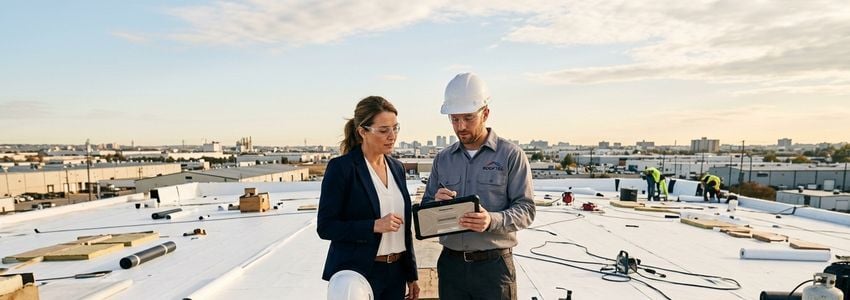
- Step 1: Get a roofing assessment and quote. A licensed commercial roofing contractor inspects the roof and provides a detailed estimate for repair or full replacement.
- Step 2: Determine the financing amount and timeline. Decide whether you need funds for the full project or a phased approach, and how quickly the work needs to start.
- Step 3: Apply with supporting documentation. Most lenders will ask for basic business financials, recent bank statements, and the roofing contractor's estimate or invoice.
- Step 4: Receive approval and funding. Depending on the lender and product, approval can take anywhere from a few hours to a few business days, with funding following shortly after.
- Step 5: Pay the contractor and begin work. Funds are typically disbursed directly to your business, allowing you to pay the roofing contractor according to their payment schedule.
- Step 6: Repay on a fixed schedule. Most commercial roof financing products use fixed monthly payments over a set term, making it easy to budget for.
Types of Financing for a Commercial Roof Replacement
There is no single "roof loan" product at most lenders. Instead, business owners typically choose from a handful of financing structures depending on project size and urgency:
- Unsecured working capital loan. A lump-sum loan based on business revenue and cash flow, well suited to mid-size roofing projects that need to move quickly without pledging the building as collateral. Learn more about unsecured working capital loans.
- Business line of credit. A revolving credit line is a strong fit if you expect ongoing property maintenance needs beyond just the roof, or if the scope of the project may change once the contractor opens up the roof deck. See how a business line of credit works.
- SBA loans. For business owners who own their building and are planning a larger renovation that includes the roof alongside other capital improvements, an SBA loan can offer longer terms and lower monthly payments, though the approval process takes longer than alternative financing.
- Commercial real estate financing. If the roof replacement is part of a larger property improvement or acquisition, commercial real estate financing can bundle the roof, structural repairs, and other capital improvements into a single loan secured by the property.
- Short-term bridge financing. When a roof failure is urgent, such as active water intrusion threatening inventory or equipment, short-term bridge financing can get funds in place within days while a longer-term solution is arranged.
By the Numbers
Commercial Roof Replacement, By the Numbers
$4-$16
Typical cost per square foot for a commercial roof replacement
20-30 Yrs
Average lifespan of most commercial roofing systems
$7.5B+
Funded annually through SBA 504 loans for commercial property projects
10%
Typical down payment on an SBA 504 loan for an established business
What Does a Commercial Roof Replacement Cost?
Commercial roof replacement costs vary widely based on material, roof size, and the condition of the deck underneath. As a general guide, most projects fall between $4.00 and $16.00 per square foot, with many landing between $5.50 and $12.00 per square foot. For a standard 10,000 square foot commercial building, that translates to a total project cost commonly ranging from roughly $55,000 to $80,000, though larger or more complex roofs can run considerably higher.
Material choice plays a large role in the total cost:
- TPO (single-ply membrane): roughly $4.50 to $14.50 per square foot, popular for its energy efficiency and heat-welded seams.
- EPDM (rubber membrane): roughly $4.00 to $12.50 per square foot, known for affordability and a long track record.
- PVC membrane: roughly $6.00 to $14.50 per square foot, valued for chemical resistance and fire ratings.
- Metal roofing systems: roughly $10.00 to $25.00 or more per square foot, but often lasting 40 years or longer.
Beyond material, tear-off and disposal of the old roof, repairs to a damaged deck, insulation upgrades, and the complexity of rooftop equipment like HVAC units all add to the final bill. This is why most business owners find it more practical to finance the project rather than pay the full amount out of pocket, particularly when the roof failure was unplanned.
Pro Tip: Get quotes from at least two licensed commercial roofing contractors before applying for financing. A detailed, itemized quote helps you request the right loan amount and avoids being underfunded midway through the project.
Who Should Consider Financing a Roof Replacement
Roof financing is a fit for a wide range of business owners, but it tends to make the most sense in specific situations:
- Business owners who own their building and are facing a roof at or near the end of its expected lifespan, especially after a failed inspection or insurance flag.
- Landlords and property owners managing commercial tenants who need the roof addressed to retain tenants or meet lease obligations.
- Restaurant, retail, and manufacturing operators whose roof protects expensive equipment, inventory, or perishable goods from water damage.
- Businesses that just experienced a roof emergency, such as storm damage or a sudden leak, and need funding faster than a traditional bank loan can provide.
- Businesses planning a broader property upgrade that includes the roof alongside HVAC, parking lot, or structural improvements.
Financing vs. Paying Cash: Which Makes Sense?
| Factor | Paying Cash | Financing the Roof |
|---|---|---|
| Impact on cash reserves | Significant, ties up a large lump sum | Minimal, spreads cost over time |
| Speed to start repairs | Delayed until funds are saved | Can start as soon as approved and funded |
| Budgeting | One large, unplanned expense | Predictable fixed monthly payment |
| Flexibility for other needs | Reduced, less capital for payroll or inventory | Preserved, capital remains available elsewhere |
Choosing the Right Roofing Contractor for a Financed Project
The financing decision is only half of the equation. Selecting the right commercial roofing contractor has a direct impact on how smoothly your project goes and how long the new roof actually lasts. A rushed choice, made under pressure from an active leak, can lead to a poor installation that shortens the roof's expected lifespan and puts your financing dollars at risk.
- Verify licensing and insurance. Confirm the contractor carries general liability and workers' compensation coverage, and ask for proof before signing any contract.
- Get a detailed, itemized quote. A quote should break out material costs, labor, tear-off and disposal, and any deck repair contingencies separately, not as a single lump sum.
- Ask about warranty terms. Commercial roofing warranties typically range from 10 to 30 years, and a full system warranty covering both materials and labor is generally worth the added cost over a materials-only warranty.
- Check references from similar commercial projects. A contractor experienced with your building type, whether a restaurant, retail center, or industrial facility, is more likely to anticipate project-specific complications.
- Confirm the project timeline in writing. If your financing has a defined draw or repayment schedule, aligning the contractor's timeline with your loan terms avoids cash flow surprises mid-project.
Once you have a vetted contractor and a firm, itemized quote, you are in a much stronger position when applying for financing. Lenders generally move faster and offer better terms when the loan request is backed by a clear, professional estimate rather than a rough guess.
How Crestmont Capital Helps
Crestmont Capital works with business owners across the country to fund property improvements, including commercial roof replacements, without the long wait times often associated with traditional bank financing. Depending on your situation, our team can help structure an unsecured working capital loan for a fast-moving repair, set up a business line of credit for ongoing property maintenance, or connect you with SBA loan options if your roof project is part of a larger capital improvement plan.
We also work with business owners financing larger property-wide renovations through our commercial real estate financing programs. If you're weighing a roof replacement against other property improvements, our related guide on commercial real estate loans walks through additional financing structures for business owners who own their building.
Our application process is built around speed and simplicity. Most business owners can get a decision quickly, and funding often follows within one to two business days, well within the window most roofing contractors need to schedule and begin work.
Ready to Protect Your Property?
Crestmont Capital funds commercial property improvements fast. Apply in minutes and see your options.
Apply Now →Real-World Scenarios
Scenario 1: The restaurant owner with an active leak. A restaurant owner notices water stains spreading across the ceiling tiles above the kitchen line during a busy Friday dinner service. A roofer confirms the membrane has failed in multiple spots and recommends a full replacement before the next storm. With inventory and expensive kitchen equipment at risk, the owner secures an unsecured working capital loan within a day and has the roofing crew on-site within the week.
Scenario 2: The manufacturer planning ahead. A small manufacturer owns its 25,000 square foot facility and learns during a routine insurance inspection that the roof, installed 22 years ago, is nearing the end of its expected lifespan. Rather than wait for a failure, the owner uses an SBA loan to fund the roof replacement alongside an HVAC upgrade, locking in a longer repayment term and lower monthly payment.
Scenario 3: The landlord retaining a tenant. A commercial landlord's largest tenant threatens to relocate after repeated roof leaks damage inventory in the leased space. The landlord uses a business line of credit to fund an immediate repair, retaining the tenant and avoiding a costly vacancy while preserving the flexibility to draw on the line again for future maintenance.
Scenario 4: The retailer after storm damage. A hailstorm damages the roof of a retail strip center location. While the insurance claim is processed, which can take weeks, the business owner uses short-term financing to start emergency repairs immediately, preventing further water intrusion and protecting merchandise on the sales floor.
Frequently Asked Questions
What is commercial roof financing?
Commercial roof financing is a business loan or credit product used to fund the repair or replacement of a commercial building's roof. It allows a business owner to pay a roofing contractor over time instead of in a single lump sum, using products such as working capital loans, business lines of credit, SBA loans, or commercial real estate financing.
How much does it cost to replace a commercial roof?
Most commercial roof replacements cost between $4.00 and $16.00 per square foot, with many projects falling between $5.50 and $12.00 per square foot. For a 10,000 square foot building, total costs commonly range from $55,000 to $80,000, though the exact price depends on material, roof condition, and building complexity.
How fast can I get financing for an emergency roof repair?
Working capital loans and business lines of credit can often be approved within one business day, with funding following shortly after. This makes them well suited to urgent situations, such as an active leak threatening inventory or equipment.
Do I need to own my building to qualify for roof financing?
No. Products like unsecured working capital loans and business lines of credit are based on business revenue and cash flow, not property ownership, so tenants and landlords alike can qualify. Ownership matters more for larger, property-secured options like SBA loans or commercial real estate financing.
What documents do I need to apply?
Most lenders ask for recent business bank statements, basic financial information, and a detailed quote or invoice from your roofing contractor. SBA and commercial real estate options typically require additional documentation, such as tax returns and property records.
How long does a commercial roof last before it needs replacing?
Most commercial roofing systems last between 20 and 30 years, with metal roofing often exceeding 40 years. Actual lifespan depends heavily on installation quality, maintenance history, and local climate conditions.
Should I repair or fully replace an aging roof?
A licensed roofing contractor can assess whether isolated repairs will hold or whether the underlying membrane and insulation have degraded enough to warrant full replacement. As a general rule, if a roof has multiple active leaks or is past 80 percent of its expected lifespan, full replacement is usually more cost-effective than repeated patch repairs.
Can I finance a roof replacement if I have less than perfect credit?
Yes. Many alternative lenders, including Crestmont Capital, weigh business revenue and cash flow alongside credit history, which means businesses with less than perfect credit can often still qualify for working capital loans or lines of credit.
What is the difference between an SBA loan and a working capital loan for a roof project?
SBA loans typically offer longer repayment terms and lower monthly payments but take longer to approve and require more documentation. Working capital loans fund faster, with fewer requirements, but usually carry a shorter repayment term. Businesses facing an emergency generally choose working capital financing, while those planning ahead often prefer an SBA loan.
Will my insurance cover a commercial roof replacement?
Insurance may cover storm or sudden damage, but coverage often excludes wear-and-tear failures related to age or deferred maintenance. Many business owners use financing to cover an insurance deductible or to move forward with repairs while a claim is still being processed.
Can I bundle a roof replacement with other property improvements in one loan?
Yes. Commercial real estate financing and larger SBA loans can often bundle a roof replacement with other capital improvements, such as HVAC upgrades, parking lot repairs, or structural work, into a single loan with one monthly payment.
How much can I borrow for a commercial roof project?
Loan amounts vary by product and lender, but working capital loans and lines of credit typically scale with monthly business revenue, while SBA and commercial real estate loans can fund larger projects into the hundreds of thousands of dollars, particularly when the roof is part of a broader renovation.
What happens if I keep delaying a needed roof replacement?
Deferred roof maintenance tends to accelerate deterioration. Minor leaks can lead to structural damage, mold, and higher energy costs, while lenders and insurers may view visible neglect as a risk factor, potentially resulting in higher premiums or stricter loan terms down the road.
Will I need to pay the roofing contractor a large deposit upfront?
Deposit requirements vary by contractor, but many commercial roofing companies ask for a percentage upfront before scheduling work. Financing the full project cost, rather than paying that deposit from cash reserves, lets you fund the entire job through one predictable monthly payment instead of splitting the expense across your operating budget.
How do I apply for commercial roof financing with Crestmont Capital?
You can apply online in minutes by submitting basic business information and recent bank statements. A funding specialist will review your roofing contractor's quote and walk you through the financing options that best fit your timeline and budget.
A New Roof Shouldn't Wait on Your Cash Flow
Get the funding you need to protect your building, your equipment, and your tenants. Apply now and get a decision fast.
Apply Now →Next Steps
Have a licensed commercial roofing contractor inspect the roof and provide a written estimate.
Determine whether you need emergency funding or can plan a longer-term financing structure.
Submit basic business information and recent bank statements through a quick online application.
Receive funds and pay your roofing contractor according to their project schedule.
Conclusion
An aging or failing commercial roof is not a problem that improves with time. The longer a leak or worn membrane goes unaddressed, the more it threatens your inventory, equipment, tenants, and the structural integrity of your building. Commercial roof financing gives business owners a practical way to fund a repair or full replacement on their own timeline, without draining the working capital their business needs to run day to day. Whether the situation is an emergency repair or a planned upgrade as part of a larger property improvement, matching the right financing product to your timeline and budget makes the process far less stressful than facing the bill alone.
Business owners who take a proactive approach, lining up financing before a small leak becomes a structural emergency, tend to get better terms and more contractor options than those forced into a rushed, reactive decision. If your roof is showing early warning signs such as ponding water, cracked flashing, or rising energy bills, it is worth exploring financing options now rather than waiting for a failure to force the issue. A well-timed roof replacement, backed by the right financing structure, protects both your building and your bottom line for decades to come.
Disclaimer: The information provided in this article is for general educational purposes only and is not financial, legal, or tax advice. Funding terms, qualifications, and product availability may vary and are subject to change without notice. Crestmont Capital does not guarantee approval, rates, or specific outcomes. For personalized information about your business funding options, contact our team directly.