
 (800) 949-0401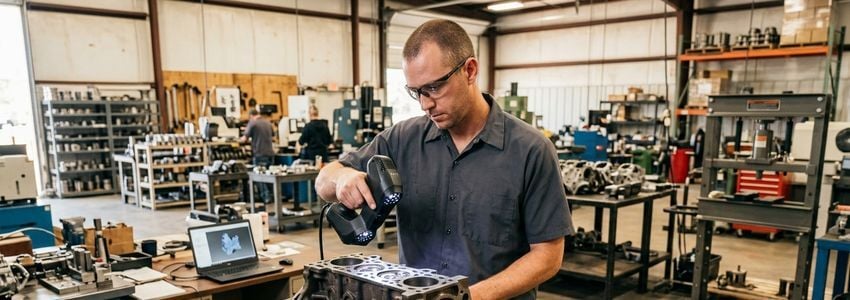
3D Scanning Equipment Financing for Reverse Engineering Shops: The Complete Guide for Business Owners
Reverse engineering shops depend on precision 3D scanning hardware to digitize legacy parts, reproduce discontinued components, and build accurate CAD models from physical objects. 3D scanning equipment financing gives shop owners a way to acquire structured light scanners, laser scanners, and metrology-grade systems without draining the cash reserves needed for payroll, materials, and day-to-day operations. Whether you are outfitting a new reverse engineering lab or upgrading from a consumer-grade scanner to an industrial system, the right financing strategy can put advanced equipment to work generating revenue immediately.
In This Article
- What Is 3D Scanning Equipment Financing?
- Why Reverse Engineering Shops Need Financing
- How 3D Scanning Equipment Financing Works
- Types of Scanning Equipment and What They Cost
- Who Qualifies for This Financing?
- Comparing Your Financing Options
- How Crestmont Capital Helps
- Real-World Scenarios
- Frequently Asked Questions
- How to Get Started
- Conclusion
What Is 3D Scanning Equipment Financing?
3D scanning equipment financing is a form of equipment financing designed specifically to help reverse engineering shops, machine shops, and product design firms purchase 3D scanning hardware and software. Rather than paying the full cost of a scanner upfront, a shop owner borrows the purchase amount and repays it in fixed monthly installments over an agreed term, while the scanner itself typically serves as collateral for the loan.
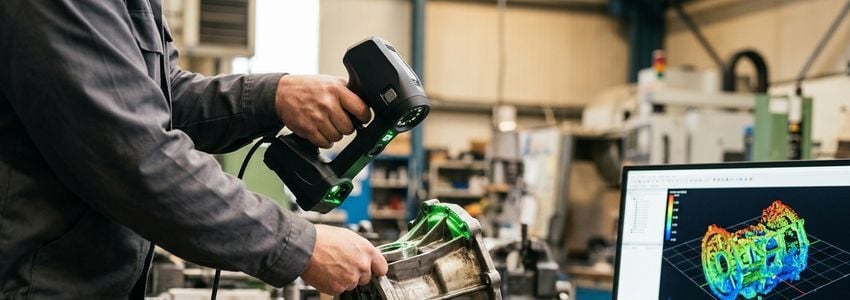
Reverse engineering shops use 3D scanning to capture the exact geometry of a physical part and convert it into a digital CAD model. This process, often called scan-to-CAD, is essential for replicating discontinued parts, verifying manufacturing tolerances, and documenting legacy tooling that no longer has original design files. Because these workflows require capital-intensive hardware, financing is often the fastest way to add scanning capability without disrupting cash flow.
Common uses for 3D scanning equipment financing include:
- Purchasing a structured light or laser triangulation handheld scanner
- Upgrading from a consumer-grade scanner to a metrology-grade industrial system
- Financing scan-to-CAD software licenses bundled with hardware
- Adding a coordinate measuring machine (CMM) or fixed-arm scanning system
- Purchasing supporting workstations with the processing power to handle large scan datasets
- Expanding scanning capacity to take on additional reverse engineering contracts
Why Reverse Engineering Shops Need Financing
The reverse engineering and 3D scanning market has grown rapidly as manufacturers, machine shops, and product developers look for faster ways to digitize physical parts. The global 3D scanning market was valued at roughly $5.1 billion in 2024 and is projected to more than double by the mid-2030s, driven largely by demand from manufacturing, automotive, and industrial service providers. That growth means opportunity for reverse engineering shops, but it also means shops without current-generation scanning equipment risk losing contracts to better-equipped competitors.
Key reasons reverse engineering shop owners turn to equipment financing:
- High upfront hardware costs: Professional handheld scanners suitable for demanding reverse engineering work generally run from $3,000 to $20,000, while metrology-grade industrial systems from brands like Artec 3D, Creaform, and Hexagon can exceed $50,000 to $100,000.
- Rapid technology turnover: Scanning accuracy, speed, and software capabilities improve quickly. Shops that finance equipment can upgrade on a predictable cycle instead of being locked into aging hardware.
- Preserving working capital: Paying cash for a $30,000 scanner ties up funds that could otherwise cover payroll, materials, or marketing to win new reverse engineering contracts.
- Winning larger contracts: Many aerospace, automotive, and industrial clients require metrology-grade accuracy certifications. Financing allows a smaller shop to bid on contracts that would otherwise require equipment it cannot afford outright.
- Bundling software and hardware: Scan-to-CAD software subscriptions and workstation upgrades add real cost on top of the scanner itself. Financing can often bundle the full package into one manageable payment.
Key Stat: The reverse engineering tools market was valued at approximately $375 million in 2025 and is projected to grow at a compound annual growth rate of 9.3% through 2032, reflecting steady demand for scan-to-CAD and part-replication services across manufacturing and industrial sectors.
How 3D Scanning Equipment Financing Works
Financing a 3D scanner works similarly to financing any other piece of business equipment. Here is the typical process:
- Select your equipment: Choose the scanner, software, and any supporting hardware (like a rugged laptop or dedicated workstation) you need for your reverse engineering workflow.
- Get a vendor quote: Most lenders require a formal quote or invoice from the equipment vendor showing the exact make, model, and total cost.
- Apply for financing: Submit an application with basic business information, financial documents, and the equipment quote. Many alternative lenders can process applications same-day.
- Underwriting review: The lender evaluates your credit profile, time in business, and revenue to determine loan terms, rate, and approval amount.
- Approval and funding: Once approved, the lender pays the equipment vendor directly or reimburses you, and you take delivery of your new scanning system.
- Repayment: You repay the loan in fixed monthly installments, typically over 24 to 84 months depending on the equipment's useful life and the loan structure.
Because the scanner itself typically secures the loan, equipment financing tends to carry more favorable rates than unsecured working capital products. This is one reason equipment financing is often the first stop for reverse engineering shops adding new scanning capacity.
Lenders generally structure equipment financing around the expected useful life of the asset. A handheld scanner with a shorter technology refresh cycle may be financed over 24 to 36 months, while a durable metrology-grade system or CMM with a longer service life can be financed over 60 to 84 months. Matching the loan term to the equipment's realistic useful life helps you avoid still making payments on a scanner that has already been replaced by newer technology, while also keeping monthly payments manageable relative to the revenue the equipment generates.
Some lenders also offer seasonal or step-payment structures, which can be useful for shops whose reverse engineering contract volume fluctuates throughout the year. Instead of a flat payment every month, a step structure might start with lower payments during a ramp-up period and increase once the new scanning capacity is fully utilized and generating revenue.
Ready to Add Scanning Capacity?
Get fast, flexible financing from the #1 business lender in the U.S. No obligation - apply in minutes.
Apply Now →Types of Scanning Equipment and What They Cost
Reverse engineering shops choose scanning hardware based on the accuracy, speed, and part size their work demands. Here is a realistic breakdown of what to expect at each tier:
Entry-Level and Prosumer Scanners
Entry-level handheld scanners generally range from $400 to $5,000. These units work well for general-purpose part digitization, prototyping support, and lower-tolerance reverse engineering tasks. They are a reasonable starting point for a shop testing the waters with scan-to-CAD services, though they typically lack the accuracy required for aerospace or medical device work.
Professional Handheld Scanners
Professional-grade handheld scanners typically cost between $3,000 and $20,000. These systems offer higher point-capture speeds, better accuracy in the 0.02mm to 0.05mm range, and more robust software for aligning and cleaning scan data. Most independent reverse engineering shops operate in this tier.
Metrology-Grade Industrial Scanners
High-end industrial and metrology-grade scanners from brands like Artec 3D, Creaform, ZEISS, and Hexagon start around $20,000 and can exceed $100,000 for the most advanced systems. These scanners deliver the highest precision and are typically required for quality control, aerospace, automotive, and other applications with tight tolerance requirements.
Coordinate Measuring Machines (CMM) and Fixed-Arm Systems
For shops that need repeatable, highly controlled measurement environments, a CMM or fixed articulating arm scanner can range from $30,000 to well over $150,000 depending on measurement volume and accuracy class. These systems are common in shops serving aerospace and medical device manufacturers.
Software and Workstation Costs
Scan-to-CAD software licenses (for reverse engineering surface modeling) can add $2,000 to $10,000 per year depending on the package, while a workstation capable of processing large point-cloud datasets typically costs $2,500 to $8,000. Many lenders will finance software and workstation costs alongside the scanner itself as part of a single equipment package.
By the Numbers
3D Scanning and Reverse Engineering - Key Statistics
$5.1B
Global 3D scanning market value (2024)
11.4%
Projected CAGR of 3D scanning market through 2034
61K+
Firms globally adopting reverse engineering services (2023)
9.3%
CAGR of reverse engineering tools market (2026-2032)
Who Qualifies for This Financing?
Qualification requirements for 3D scanning equipment financing vary by lender, but most alternative lenders evaluate similar core criteria:
Established Reverse Engineering Shops
- Time in business: 1+ years generally preferred, though some lenders accept less with strong credit
- Credit score: 600+ typically qualifies for standard rates; higher scores unlock better terms
- Revenue: Most lenders look for at least $50,000 to $100,000 in annual revenue
- Collateral: The scanner and supporting equipment usually secure the loan
Startups and New Shops
Newer reverse engineering businesses face additional scrutiny since lenders cannot rely on historical revenue. Applicants should be prepared to show a detailed business plan, industry or engineering experience, and a personal credit score of 680 or higher. Because the scanner itself acts as collateral, equipment financing is often more accessible to startups than unsecured working capital loans.
Shops with Less-Than-Perfect Credit
If your credit history is not pristine, options still exist. Alternative lenders that work with a broader range of credit profiles can approve equipment financing with scores as low as 550 to 600, though rates will be higher to reflect the added risk. Building a track record of on-time payments on a smaller equipment loan can improve future borrowing terms.
Comparing Your Financing Options
Several financing products can fund a 3D scanner purchase, each with tradeoffs. Use this table to compare:
| Financing Type | Amount Range | Term | Speed | Best For |
|---|---|---|---|---|
| Equipment Financing | $5K - $2M | 2 - 7 years | 24-72 hours | Scanner, software, workstation purchase |
| Equipment Leasing | $5K - $1M | 2 - 5 years | 24-72 hours | Shops that want to upgrade often |
| SBA 7(a) Loan | Up to $5M | Up to 10 years (equipment) | 4-12 weeks | Large equipment packages, low rates |
| Business Line of Credit | $5K - $500K | Revolving | 24-72 hours | Software subscriptions, smaller add-ons |
| Working Capital Loan | $5K - $500K | 3 months - 5 years | Same day - 48 hours | Bundling equipment with training/marketing costs |
For most reverse engineering shops, dedicated equipment financing or equipment leasing offers the best combination of speed, favorable rates, and structure tailored to hardware purchases. Shops planning a larger buildout that includes a CMM, multiple workstations, and facility upgrades may benefit from pairing equipment financing with an SBA loan for the largest capital needs.
How Crestmont Capital Helps Reverse Engineering Shops
Crestmont Capital is the #1 business lender in the United States, and our team has funded manufacturing, fabrication, and technical service businesses across the country, including shops that rely on precision measurement and scanning equipment. We understand that reverse engineering work depends on having the right hardware to win and deliver on contracts, and we structure financing to match that reality.
What sets Crestmont Capital apart for reverse engineering shop owners:
- Fast decisions: Get a credit decision in as little as 4 hours, with funding often available in 24 to 48 hours.
- Flexible use of funds: Finance the scanner, CAD/scan-to-CAD software, and a compatible workstation together in one application.
- Wide range of loan amounts: From $5,000 for a professional handheld scanner to $2 million or more for a full metrology lab buildout.
- All credit profiles considered: Whether you have excellent credit or a more challenging history, our team works to find a structure that fits.
- Industry-aware underwriting: We evaluate your business based on contract pipeline and industry demand, not just a generic credit score.
According to the U.S. Small Business Administration, access to timely capital remains one of the top factors determining whether a small manufacturing or technical services business can compete for larger contracts. For reverse engineering shops, that often comes down to whether you have the scanning accuracy a client requires on the day you need to bid.
If you are already investing in broader shop capabilities, our guides on fabrication equipment financing and 3D printing farm equipment financing cover complementary equipment many reverse engineering shops also rely on.
Bid on the Next Contract with Better Equipment
Crestmont Capital helps reverse engineering shops finance the scanning technology clients demand. No obligation - see your options in minutes.
Apply Now →Real-World Scenarios: 3D Scanning Financing in Action
Here are five illustrative scenarios that reflect the types of situations Crestmont Capital regularly encounters with reverse engineering and technical shop owners.
Scenario 1: Upgrading from Consumer to Professional Grade
Dana runs a small reverse engineering shop that started with a $1,200 consumer scanner. As demand grew for tighter-tolerance work from a local automotive supplier, Dana needed a professional handheld scanner priced at $8,500 plus a $3,000 workstation upgrade. Using equipment financing, Dana spread the $11,500 cost over 48 months, keeping cash reserves intact while immediately taking on the new automotive contract.
Scenario 2: Winning an Aerospace Subcontract
Marcus owns a machine shop that wants to add reverse engineering services to win aerospace subcontracting work. The client requires metrology-grade accuracy, so Marcus needs a $45,000 industrial scanner. He uses equipment financing with a 60-month term, securing the loan against the scanner itself, and lands the contract within three months of installation.
Scenario 3: Bundling Hardware and Software
Priya operates a two-person reverse engineering consultancy and needs both a $6,000 handheld scanner and a $4,000 annual scan-to-CAD software license. Rather than paying the software fee in cash, she finances the full $10,000 package together, simplifying her monthly budgeting into one predictable equipment payment.
Scenario 4: Adding a Second Scanning Station
Tyler's reverse engineering shop has grown to the point where a single scanner creates a bottleneck. Backlogged orders convince him to add a second $12,000 professional scanner and a matching workstation. With strong revenue history from his first two years in business, Tyler is approved for a term loan within 48 hours and doubles his scanning throughput within weeks.
Scenario 5: Startup Shop with Limited Credit History
Elena is launching a reverse engineering startup after years working as an engineer for a larger manufacturer. Her personal credit score is 640, and she has no business revenue history yet. She works with Crestmont Capital to secure equipment financing for a $7,500 handheld scanner, using her engineering background and a detailed business plan to support the application. The scanner itself serves as collateral, helping offset her limited credit history.
Industry Classification Note
Reverse engineering and 3D scanning service providers are commonly classified under NAICS code 541990 (All Other Professional, Scientific, and Technical Services), though shops operating primarily as machining or fabrication businesses may fall under a manufacturing NAICS code instead. Knowing your correct NAICS classification matters when applying for SBA loans, as lenders use these codes to help assess industry risk.
Frequently Asked Questions
Get the Scanning Technology Your Shop Needs
No hard credit pull to see your options. Apply in minutes and get a decision fast.
Apply Now →How to Get Started
Complete our quick application at offers.crestmontcapital.com/apply-now. It takes just a few minutes and does not affect your credit score.
A Crestmont Capital specialist will review your application, discuss the scanning equipment you need, and help you find the right financing structure.
Once approved, funds are released to purchase your scanning equipment, often within 24 to 48 hours, so you can start scanning parts right away.
Conclusion
Modern reverse engineering work depends on having scanning equipment that matches the accuracy and speed clients demand. 3D scanning equipment financing gives shop owners a practical way to acquire that hardware, whether it is a first professional-grade scanner, a metrology system for aerospace-level tolerances, or a bundled hardware and software package, without depleting the working capital needed to run day-to-day operations.
The right financing structure depends on your equipment cost, credit profile, and how quickly you need to deploy new scanning capability. From equipment financing and leasing to SBA loans for larger buildouts, there is a product suited to nearly every reverse engineering shop's situation.
Crestmont Capital has helped manufacturing and technical service business owners across the country access the capital they need to grow. Apply online today and get a decision in as little as 4 hours.
Disclaimer: The information provided in this article is for general educational purposes only and is not financial, legal, or tax advice. Funding terms, qualifications, and product availability may vary and are subject to change without notice. Crestmont Capital does not guarantee approval, rates, or specific outcomes. For personalized information about your business funding options, contact our team directly.








