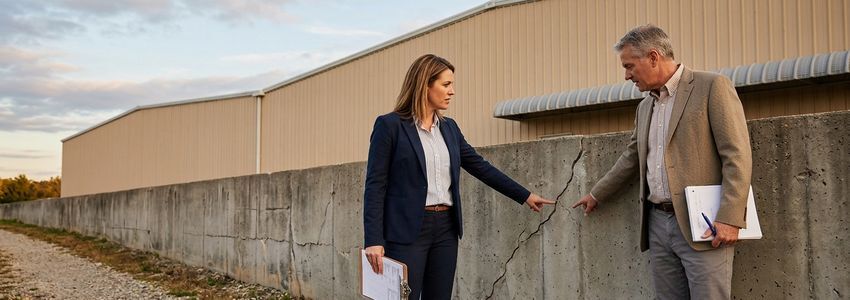
When a retaining wall starts to lean, bulge, or crack, or when standing water refuses to drain off your commercial property no matter how many times your maintenance crew clears the grates, the repair bill rarely arrives on a convenient schedule. Retaining wall repair financing and site drainage repair funding give business owners a way to cover these urgent, often five- and six-figure property fixes without draining operating cash or waiting weeks for a traditional bank loan to clear underwriting.
Retaining walls and drainage systems are unglamorous infrastructure. Nobody notices them until they fail, and when they fail, they tend to fail in a way that threatens the safety of employees, customers, tenants, or the structural integrity of the building itself. A bulging retaining wall behind a warehouse loading dock, a parking lot that floods every time it rains, or a French drain that has silted over and is now pushing water toward a foundation wall are the kinds of problems that move from "add it to the punch list" to "fix this now" almost overnight.
In This Article
- What Retaining Wall and Drainage Repair Financing Is
- Key Benefits of Financing the Repair
- How the Financing Process Works
- Types of Retaining Wall and Drainage Failures
- Who This Financing Is Best For
- Comparing Your Financing Options
- How Crestmont Capital Helps
- Real-World Scenarios
- Frequently Asked Questions
- Next Steps
What Retaining Wall and Drainage Repair Financing Is
Retaining wall repair financing is business funding used specifically to cover the cost of repairing, rebuilding, or reinforcing a retaining wall, and by extension, the surrounding grading and drainage systems that keep water from undermining that wall in the first place. It is not a specialized loan product in the way an SBA 7(a) loan or an equipment lease is a defined category. Instead, it is a practical application of general business financing tools, working capital loans, business lines of credit, equipment and property improvement financing, or short-term loans, applied to a specific, urgent capital expense.
The same logic applies to site drainage repair financing. When a catch basin collapses, a French drain clogs and backs up, a swale erodes, or a stormwater detention system stops functioning, the fix is rarely cheap and almost never optional. Left alone, water intrusion problems compound. A minor drainage issue this quarter becomes a foundation crack, a sinkhole, or a full retaining wall failure a year later. Financing lets a business owner address the root cause immediately rather than deferring maintenance until the problem becomes a genuine safety hazard or a liability exposure.
Because these repairs sit at the intersection of property maintenance, structural engineering, and site civil work, the invoices tend to be large. A modest segmental block retaining wall repair on a commercial lot can run $15,000 to $40,000. A larger reinforced wall failure, especially one requiring engineering review, soil stabilization, or tieback anchors, can exceed $100,000. Drainage system overhauls, including regrading, new catch basins, and pipe replacement, commonly land in the $10,000 to $75,000 range depending on the scope. Business loans exist to bridge exactly this kind of gap between an unavoidable capital expense and the cash a business has sitting in its operating account.
Key Stat: According to the U.S. Census Bureau's Survey of Business Owners data on commercial property maintenance spending, unplanned structural and site repairs are among the top three unbudgeted capital expenses reported by small commercial property occupiers and owners each year.
Key Benefits of Financing the Repair
Business owners weighing whether to finance a retaining wall or drainage repair, versus paying out of pocket or simply delaying the work, generally find that financing offers several concrete advantages:
- Preserves working capital. A $40,000 wall repair paid in cash is $40,000 that is no longer available for payroll, inventory, or marketing. Financing spreads that cost over time instead of creating a single large cash outflow.
- Prevents the problem from getting worse (and more expensive). Retaining walls and drainage systems degrade on their own timeline, not yours. Financing lets you act on the engineer's or contractor's recommended timeline instead of your cash flow's timeline.
- Protects against liability exposure. A collapsing retaining wall or a flooded parking lot with standing water can create real premises liability risk. Fast access to capital reduces the window during which that hazard exists.
- Fast approval and funding compared to traditional bank loans. Many alternative lenders, including Crestmont Capital, can approve and fund a working capital loan or line of credit in as little as 24 to 72 hours, versus weeks for a conventional bank term loan.
- Flexible use of funds. Unlike a construction loan tied to a specific draw schedule, a working capital loan or line of credit can cover the repair itself plus any related costs, such as temporary fencing, engineering reports, or permit fees.
- Keeps your existing bank relationship and credit lines untouched. Many business owners prefer to reserve their bank line of credit for core operations and use an alternative lender for a one-time capital repair.
How the Financing Process Works
The process of financing a retaining wall or site drainage repair generally follows the same path as financing any other urgent business expense. Here is what it typically looks like from the moment the problem is discovered to the moment the repair is complete:
Quick Guide
How Retaining Wall Repair Financing Works
A licensed contractor or structural engineer inspects the wall or drainage system and provides a written repair estimate, which lenders will typically want to see.
Submit a short application along with 3-6 months of business bank statements. Most lenders do not require the estimate itself, just proof of revenue and time in business.
Working capital loans and lines of credit through alternative lenders are typically decided within 24 to 48 hours, sometimes same-day.
Once funded, capital typically hits your business bank account within 24 hours, ready to pay a deposit or the full contractor invoice.
Repayment terms range from a few months for short-term working capital to several years for larger term loans, depending on the amount and product.
Most business owners are surprised at how little documentation is actually required. Unlike a construction loan or an SBA loan for a real estate improvement, a working capital loan or short-term business loan used for a retaining wall or drainage repair generally does not require the lender to review engineering plans, permits, or contractor licensing. The lender is underwriting the business's ability to repay, not the repair project itself, which is why funding moves so much faster.
Don't Let a Property Repair Drain Your Cash Reserves
Get fast, flexible financing from the #1 business lender in the U.S. No obligation, apply in minutes.
Apply Now →Types of Retaining Wall and Drainage Failures That Prompt Financing
Not every retaining wall or drainage problem is the same, and the financing amount and urgency usually track the type and severity of the failure. Common scenarios that lead business owners to seek financing include:
- Bulging or leaning segmental block or timber walls. Often caused by hydrostatic pressure buildup behind the wall when drainage behind it has failed. This is one of the most common commercial retaining wall issues and frequently requires full wall reconstruction, not just a patch.
- Cracked or shifted poured concrete or masonry walls. Structural cracking is a red flag that requires an engineer's assessment and, in many cases, tieback anchors, underpinning, or a full rebuild.
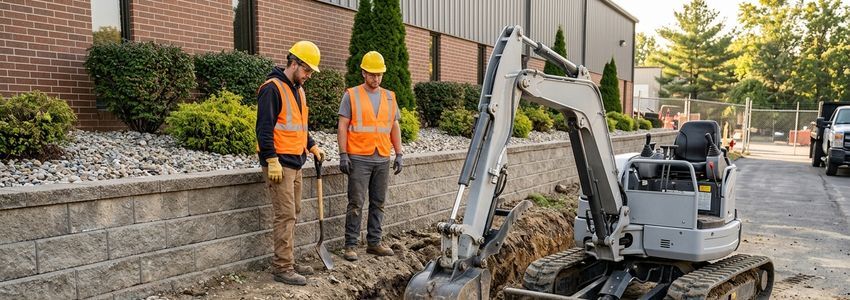
- Failed or undersized French drains and footing drains. When perforated drain pipe behind a wall silts up or was undersized to begin with, water has nowhere to go except through or over the wall.
- Collapsed or crushed catch basins and storm drain inlets. Heavy vehicle traffic in a parking lot or loading area can crush older catch basins, backing up the entire site drainage system.
- Eroded swales and site grading failures. Improper grading, or grading that has eroded over years of storm events, can redirect water toward a building foundation instead of away from it.
- Detention and retention pond system failures. Commercial sites with stormwater detention requirements can face costly repairs if the outlet structure, liner, or pumps fail, sometimes triggering a municipal compliance deadline.
- Erosion undermining a wall's footing. Soil erosion at the base of a wall compromises its structural support and is often discovered only after visible tilting has already begun.
Each of these failure types carries a different price tag and a different urgency level, but they share one thing in common: putting off the repair almost always increases the eventual cost. A drainage fix that costs $8,000 today can become a $60,000 retaining wall reconstruction in two years if the underlying water problem is never addressed.
Who This Financing Is Best For
Retaining wall and drainage repair financing is most commonly used by:
- Commercial property owners and landlords who need to fix a site issue affecting a leased building, warehouse, or retail plaza before it triggers a tenant complaint or a code violation.
- Owner-occupied businesses, such as manufacturers, distributors, and contractors, whose own facility sits on a lot with a failing retaining wall or drainage system.
- Property management companies overseeing multiple commercial sites who need to move quickly on a safety-related repair without waiting on a capital reserve fund vote.
- Restaurants, hotels, and hospitality businesses where a flooded parking lot or a crumbling retaining wall along a walkway is a direct threat to the customer experience and to premises liability exposure.
- Construction and contracting companies that store equipment or materials on a yard where a retaining wall or grading failure threatens the usability of the site.
Businesses in earlier growth stages, or those with seasonal revenue, tend to prefer a working capital loan or short-term loan with fixed daily, weekly, or monthly payments, since the total cost is known upfront. More established businesses with predictable cash flow often prefer a business line of credit, since it can be drawn on for this repair and then left available for the next unplanned expense.
By the Numbers
Commercial Site Repair Financing: Key Figures
$15K-$100K+
Typical range for commercial retaining wall repair or reconstruction
24-72 Hrs
Typical time to approval and funding through an alternative lender
33M+
Small businesses in the U.S., per the SBA, many managing their own commercial property
6-24 Mo
Common repayment term range for a working capital repair loan
Comparing Your Financing Options
There is no single "retaining wall loan" product on the market. Instead, business owners typically choose from a handful of general financing tools, each with different tradeoffs for speed, cost, and flexibility:
| Financing Option | Typical Speed | Best For |
|---|---|---|
| Working Capital Loan | 24-72 hours | A single, defined repair cost with a fixed term |
| Business Line of Credit | 1-5 days | Ongoing or unpredictable property maintenance needs |
| SBA 7(a) or SBA 504 Loan | 30-90 days | Larger structural rebuilds bundled with other property improvements |
| Traditional Term Loan | 2-6 weeks | Established businesses with strong credit and time to wait |
| Equipment/Capital Improvement Financing | 2-5 days | Repairs bundled with a larger capital improvement project |
For most emergency or semi-urgent retaining wall and drainage repairs, an SBA loan is simply too slow. The SBA loan process, even the streamlined 7(a) Express option, involves collateral documentation, use-of-funds verification, and often a multi-week wait, none of which lines up with a contractor who needs a deposit this week to get on the schedule before the next storm season. This is why most business owners in this situation turn to a working capital loan or business line of credit instead.
How Crestmont Capital Helps
Crestmont Capital, rated the #1 business lender in the country, works with business owners across the country to fund exactly this kind of unplanned, high-priority property repair. Rather than forcing every applicant through a single rigid product, Crestmont evaluates the business and matches it to the financing structure that fits the repair timeline and budget.
For a business that needs to move fast on a single retaining wall repair, an unsecured working capital loan is often the simplest path: no collateral requirement, a straightforward application, and funding that can land in a business bank account within a day or two of approval. For businesses that expect ongoing property maintenance needs, or that want a reusable pool of capital rather than a single lump sum, a business line of credit provides funds on demand without reapplying every time a new issue surfaces.
Larger drainage overhauls or full retaining wall reconstructions that also involve structural upgrades sometimes fall under commercial financing, particularly when the repair is part of a broader property improvement plan. And for businesses that own their commercial building and are financing the repair alongside other real estate-related costs, real estate business loans can be structured to cover both.
Crestmont also regularly funds related property emergencies. If a retaining wall failure was triggered or worsened by a larger event, a business dealing with a fire or flood recovery situation can often roll site repair costs into the same financing conversation. Businesses facing multiple simultaneous property issues, such as a retaining wall problem alongside an aging roof that needs replacement or a structural foundation issue, can discuss a combined funding package rather than applying separately for each repair.
Every application starts with a simple conversation about the repair, the estimate, and the timeline, followed by a review of recent business bank statements. There is no requirement to submit engineering reports, permits, or contractor licensing documentation for approval, which is part of why funding moves so much faster than a construction-specific loan product.
Get Ahead of a Structural or Drainage Problem
Waiting rarely makes a site repair cheaper. See what financing you qualify for today, no obligation.
Apply Now →Pro Tip: Get at least two contractor estimates before applying for financing. A second opinion often reveals whether the wall genuinely needs full reconstruction or whether a targeted drainage fix behind the wall can resolve the pressure issue at a fraction of the cost.
Real-World Scenarios
Scenario 1: The warehouse loading dock wall. A regional distribution company noticed a visible bulge in the concrete retaining wall behind its loading dock after a wet spring. An engineer determined the wall's drainage system had failed years earlier, and hydrostatic pressure had built up steadily until the wall began to fail. The repair, including new drain tile and partial wall reconstruction, was quoted at $62,000. The company used a working capital loan to cover the repair in full, with a 12-month repayment term, avoiding a shutdown of the loading dock during peak shipping season.
Scenario 2: The retail plaza parking lot. A shopping plaza owner discovered that a collapsed catch basin was causing standing water across a third of the parking lot after every rain, creating a slip-and-fall risk and driving away customers. The $22,000 drainage repair was financed through a short-term business loan, funded within 48 hours, and completed before the next scheduled tenant walkthrough.
Scenario 3: The manufacturing facility's eroding embankment. A manufacturer's rear property line included a retaining wall separating the facility yard from a lower grade. Years of erosion had undermined the wall's footing, and a structural engineer flagged it as an active safety concern requiring immediate stabilization. The $145,000 project, including soil nails and a new drainage system, was financed through a combination of a business line of credit for the initial mobilization deposit and a commercial financing package for the balance.
Scenario 4: The restaurant's flooded outdoor patio. A restaurant with a popular outdoor patio saw repeated flooding after the site's original grading proved inadequate for heavier storm patterns in recent years. The $18,500 regrading and drainage upgrade was financed with a working capital loan, allowing the restaurant to complete the work during a scheduled slow season closure rather than losing patio revenue during peak months.
Scenario 5: The property management company's multi-site issue. A property management firm overseeing six commercial properties identified similar retaining wall drainage issues at two sites during a routine inspection. Rather than budgeting separately for each, the firm secured a business line of credit sized to cover both repairs as needed, drawing on it as each contractor's invoice came due.
Frequently Asked Questions
What is retaining wall repair financing?
Retaining wall repair financing is business funding, typically a working capital loan, business line of credit, or term loan, used to pay for repairing, rebuilding, or reinforcing a failing retaining wall on a commercial property. It is not a distinct loan category but rather a general business financing product applied to this specific expense.
How much does a commercial retaining wall repair typically cost?
Commercial retaining wall repairs typically range from $15,000 for a smaller segmental block wall patch to over $100,000 for a full reconstruction involving structural engineering, soil stabilization, and drainage work. Cost depends on wall height, material, extent of failure, and whether soil or foundation issues are also present.
How fast can I get financing for an urgent drainage repair?
Working capital loans and business lines of credit through alternative lenders like Crestmont Capital are often approved within 24 to 48 hours, with funds available shortly after approval. This is significantly faster than a traditional bank loan or SBA loan, which can take several weeks.
Do I need collateral to finance a retaining wall repair?
Not necessarily. Unsecured working capital loans do not require collateral and are underwritten primarily on business revenue and time in business. Larger loan amounts, or loans structured through SBA or commercial real estate financing, may require the property or other business assets as collateral.
What documents do I need to apply?
Most lenders require 3-6 months of recent business bank statements, a basic business application, and sometimes a driver's license or business tax ID. A contractor estimate is helpful but often not required for approval, since the lender is evaluating the business's ability to repay rather than the repair project itself.
Can I finance the repair if I lease my commercial space rather than own it?
Yes. Working capital loans and business lines of credit are based on your business's revenue and creditworthiness, not property ownership. Many tenants finance site repairs that fall under their lease responsibility, or advance funds for repairs their landlord is slow to address, using this type of financing.
What happens if I ignore a failing retaining wall or drainage problem?
Deferred maintenance on retaining walls and drainage systems almost always compounds. Water intrusion problems worsen over time, hydrostatic pressure continues building behind a wall, and what starts as a minor drainage fix can escalate into a full wall failure, foundation damage, or a safety incident that carries far higher repair and liability costs.
Should I use a business line of credit or a one-time working capital loan?
If you have a single, clearly defined repair with a known cost, a working capital loan with a fixed term is often simpler and can offer a lower total cost. If you anticipate ongoing property maintenance needs or expect to discover additional issues during the repair, a business line of credit offers more flexibility since you only draw and pay interest on what you use.
Is an SBA loan a good option for a retaining wall repair?
SBA loans can work for larger structural repairs bundled with other property improvements, but the approval timeline of several weeks to a few months makes them a poor fit for an urgent or safety-related repair. Most business owners facing an active retaining wall or drainage failure choose faster working capital or line of credit financing instead.
Can bad credit disqualify me from getting financing for this type of repair?
Not necessarily. Many alternative lenders weigh business revenue and cash flow more heavily than personal credit score for working capital products. Businesses with lower credit scores can often still qualify, though terms and rates may reflect the additional risk.
How long does repayment typically take?
Repayment terms vary by product and loan size. Short-term working capital loans often run 6 to 18 months, while larger loans or commercial financing packages can extend to several years. Terms are typically matched to the size of the repair and the business's cash flow.
Can I finance a drainage repair alongside other property improvements?
Yes. It is common to bundle a drainage or retaining wall repair with related capital improvements, such as roof replacement, parking lot resurfacing, or foundation work, into a single commercial financing package rather than applying separately for each project.
Will my insurance cover a retaining wall or drainage failure?
Standard commercial property insurance policies frequently exclude gradual water damage, soil movement, and structural failures caused by wear or lack of maintenance, since these are treated as maintenance issues rather than sudden covered events. Many business owners discover this exclusion only after filing a claim, which is why financing is often the faster and more reliable path to getting the repair done.
How do I get started with financing for my repair?
Start by getting a written estimate from a licensed contractor or engineer, then complete a short application with a lender such as Crestmont Capital, providing recent business bank statements. Most applicants receive a decision within 24 to 48 hours and can have funds available shortly after approval.
Protect Your Property Before the Problem Gets Worse
Crestmont Capital funds emergency property repairs fast, so you can act on the contractor's timeline, not your cash flow's.
Apply Now →Next Steps
Confirm the scope and cost of the repair from a licensed contractor or structural engineer.
Most lenders ask for 3-6 months of business bank statements to evaluate your application.
Complete a short application to see what financing options and terms you qualify for.
Once approved, funds are typically available within 24 hours, ready to pay a deposit or the full invoice.
Conclusion
A failing retaining wall or a broken drainage system is not the kind of problem that improves with time. Whether it is hydrostatic pressure slowly bulging a warehouse wall, a collapsed catch basin flooding a customer parking lot, or an eroding embankment threatening a facility's structural safety, the underlying issue tends to get more expensive the longer it sits unaddressed. Retaining wall repair financing and site drainage repair financing give business owners a practical way to act on the contractor's or engineer's recommended timeline rather than waiting until enough cash accumulates in the operating account.
Because these repairs are financed through general-purpose business lending products, working capital loans, business lines of credit, and commercial financing, rather than a specialized construction loan, the application and approval process moves quickly. For most businesses facing an urgent or safety-related site repair, that speed matters as much as the financing itself. If your business is facing a costly retaining wall or drainage repair, Crestmont Capital can help you find the right financing structure and get funded fast.
Disclaimer: The information provided in this article is for general educational purposes only and is not financial, legal, or tax advice. Funding terms, qualifications, and product availability may vary and are subject to change without notice. Crestmont Capital does not guarantee approval, rates, or specific outcomes. For personalized information about your business funding options, contact our team directly.