
 (800) 949-0401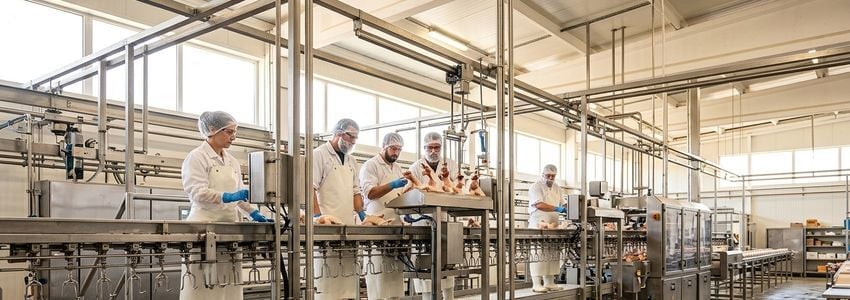
Poultry Processing Equipment Financing: The Complete Guide for Business Owners
Poultry processing equipment financing is the fastest way for poultry processors, integrators, and value-added protein businesses to acquire the stainless steel processing lines, chilling systems, and USDA-compliant equipment needed to run a modern facility without draining cash reserves.
In This Article
What Is Poultry Processing Equipment Financing?
Poultry processing equipment financing is a specialized form of commercial equipment financing that provides poultry processors and integrators with capital to purchase or lease the machinery required to slaughter, eviscerate, chill, cut, package, and inspect poultry products. This includes everything from automated evisceration lines and mechanical pluckers to chill tanks, portioning equipment, metal detectors, and vacuum packaging systems.
Unlike a general business loan, equipment financing is secured by the equipment itself, which typically results in lower rates, faster approvals, and more flexible qualification standards than unsecured working capital products. The lender advances the funds (or purchases the equipment directly and leases it to you), and you repay over a fixed term that is usually matched to the expected useful life of the machinery.
For poultry operations specifically, this financing model matters because processing equipment is capital-intensive and highly regulated. USDA Food Safety and Inspection Service (FSIS) requirements mean equipment must meet strict sanitation and construction standards, which often makes new or certified equipment significantly more expensive than in less-regulated industries. Financing spreads that cost over time instead of requiring a single, disruptive cash outlay.
Poultry processing is also one of the more capital-intensive segments of the broader food manufacturing sector. According to the U.S. Census Bureau, the food manufacturing sector generated over $1 trillion in total shipment value in a recent year, with more than 1.7 million workers employed across the industry. Processing equipment, sanitation systems, and cold chain infrastructure represent a meaningful share of the capital investment behind that output, which is why so many processors rely on financing rather than cash reserves to keep pace with demand.
It is also worth understanding the difference between financing and leasing at the outset, since the two terms are often used interchangeably but carry different implications for ownership, tax treatment, and end-of-term flexibility. With financing, you are essentially taking out a secured loan to purchase the equipment outright, and you own it once the loan is paid off. With leasing, the finance company retains ownership and you pay for the right to use the equipment, often with an option to purchase it at the end of the term for a nominal amount or fair market value. Poultry processors choose between the two based on how quickly the equipment is expected to become obsolete, how important outright ownership is for resale or refinancing purposes, and how each structure affects their balance sheet and tax position.
Key Stat: The combined value of U.S. poultry production, including broilers, eggs, and turkeys, reached $81.7 billion in 2025, a 16% increase from the prior year, according to USDA data. That growth is fueling continued investment in processing capacity nationwide.
Key Benefits of Financing Your Processing Equipment
Financing poultry processing equipment instead of paying cash outright offers several advantages that matter to operators running on thin margins in a volume-driven business.
- Preserve working capital. Keep cash on hand for feed costs, labor, and day-to-day operating expenses instead of tying it up in a single equipment purchase.
- Match payments to revenue. Structure terms so monthly payments align with the productivity gains the new equipment generates.
- Access newer technology sooner. Upgrade to automated evisceration lines, higher-throughput chillers, or advanced portioning systems without waiting years to save up.
- Potential tax advantages. Many equipment financing structures allow businesses to deduct financed equipment costs under applicable federal depreciation rules, though you should always confirm specifics with your accountant.
- Predictable budgeting. Fixed monthly payments make it easier to forecast cash flow across seasonal production cycles.
- Faster approvals than traditional bank loans. Because the equipment secures the financing, approval decisions can often be made in 24 to 48 hours rather than weeks.
- Lower risk of obsolescence exposure. Leasing structures in particular let you avoid being stuck with outdated equipment as automation and food safety technology continue to evolve.
- No need to tap existing credit lines. Keeping equipment purchases separate from your business line of credit preserves that credit for inventory, payroll, or unexpected expenses.
Beyond the direct financial benefits, financing also gives poultry processors more control over the timing of equipment upgrades. Rather than waiting until enough cash has accumulated to make a large purchase outright, a processor can move as soon as a growth opportunity, food safety requirement, or new customer contract calls for additional capacity. In an industry where contracts with retailers and distributors often come with tight onboarding timelines, that speed can be the difference between winning new business and losing it to a competitor who can scale faster.
Financing also creates a paper trail of consistent, on-time payments that can strengthen your business credit profile over time. Processors who plan to pursue larger financing, such as an SBA loan for a facility expansion or real estate purchase, often find that a track record of well-managed equipment financing makes future underwriting smoother.
Ready to Upgrade Your Processing Line?
Get fast, flexible financing from the #1 business lender in the U.S. No obligation. Apply in minutes.
Apply Now →How Poultry Processing Equipment Financing Works
The process is straightforward compared to a traditional commercial real estate or SBA loan, and most processors can move from application to funded equipment within a week or two.
Step 1: Identify the equipment. Get a quote from your equipment vendor for the processing line, chill system, portioning equipment, or packaging machinery you need. Financing can typically cover new equipment, used equipment, and sometimes installation costs.
Step 2: Submit an application. Most lenders require basic business information, time in business, revenue figures, and recent bank statements. Equipment financing applications are generally simpler than applications for unsecured loans because the equipment itself provides collateral.
Step 3: Receive underwriting and terms. The lender evaluates your business's financial health, the value and useful life of the equipment, and your industry's risk profile. You'll receive a proposed term length, interest rate, and payment structure.
Step 4: Sign and fund. Once you accept terms, the lender either pays the vendor directly or reimburses you for equipment already purchased. Funding can happen in as little as one to three business days for straightforward transactions.
Step 5: Repay over the term. Terms for poultry processing equipment typically range from 24 to 84 months, depending on the type of equipment and its expected useful life. Heavy-duty stainless steel processing lines with longer lifespans often qualify for longer terms.
Throughout this process, the equipment vendor plays a bigger role than many first-time borrowers expect. Established equipment vendors in the poultry industry often have existing relationships with financing companies and can help streamline the paperwork, provide accurate valuations for used equipment, and coordinate delivery and installation timelines around your funding schedule. It is worth asking your vendor directly whether they have preferred financing partners, since that can sometimes speed up the entire process by a few days.
It is also common for processors to finance more than one piece of equipment in a single transaction. If you are building out a new line or upgrading multiple stations at once, for example a chiller, a portioning system, and new packaging equipment, most lenders will bundle these into a single financing agreement with one monthly payment rather than requiring separate applications for each item. This simplifies both the application process and your ongoing bookkeeping.
By the Numbers
Poultry Processing Equipment Financing — Key Statistics
$81.7B
Value of U.S. poultry production in 2025, up 16% year over year
9.40B
Broilers produced in the U.S. in 2025, a 1% annual increase
$1.3T
Estimated annual economic activity generated by the U.S. equipment finance industry
1-3 Days
Typical time to funding for straightforward equipment financing transactions
Types of Poultry Processing Equipment You Can Finance
Poultry processing facilities require a wide range of specialized machinery, and most equipment financing companies will finance any of the following categories:
- Slaughter and evisceration lines. Automated or semi-automated systems that handle killing, scalding, plucking, and evisceration at scale.
- Chilling and cooling systems. Immersion chillers, air chill tunnels, and blast freezers that bring product to safe temperatures quickly.
- Cutting and portioning equipment. Automated deboning machines, breast cutters, and portion-control systems that improve yield and consistency.
- Packaging and labeling systems. Vacuum packaging machines, tray sealers, modified atmosphere packaging (MAP) equipment, and automated labeling lines.
- Metal detection and X-ray inspection systems. Food safety equipment required to catch foreign material before product ships.
- Conveyor and material handling systems. Overhead rail systems, conveyor belts, and automated transport equipment that move product through the facility.
- Wastewater treatment and rendering equipment. Systems that process byproducts and meet environmental compliance standards.
- Refrigeration and cold storage. Walk-in coolers, freezers, and warehouse refrigeration systems sized for finished product storage.
Financing is also available for facility-related equipment like generators, boilers, and HVAC systems that support continuous, sanitary operation.
Beyond the core processing line, many facilities also finance ancillary systems that keep operations running smoothly and compliantly. Water treatment and filtration systems ensure a consistent, safe water supply for washing and chilling. Backup power generators protect against costly downtime during outages, which is especially critical for facilities running continuous chill chains. Sanitation equipment, including automated cleaning-in-place (CIP) systems, helps meet increasingly strict food safety audits without adding significant labor hours. Rounding out a facility, forklifts, pallet jacks, and other material handling equipment used to move finished product to shipping docks can typically be bundled into the same financing package as your core processing equipment.

Who This Financing Is Best For
Poultry processing equipment financing works well for a range of business types across the supply chain:
- Independent poultry processors upgrading or expanding an existing USDA-inspected facility.
- Vertically integrated poultry companies adding processing capacity to reduce reliance on third-party processors.
- Specialty and organic poultry producers investing in smaller-scale, custom processing equipment to serve niche markets.
- Co-packers and contract processors that need flexible, scalable equipment to serve multiple poultry brands.
- Growing operations that have outgrown manual processing and need to automate to keep pace with order volume.
Businesses with less-than-perfect credit or limited time in business often still qualify, since the equipment itself serves as collateral. This makes equipment financing more accessible than an unsecured working capital loan for many first-time processors.
This financing path is also a strong fit for processors going through a transition, such as a family-owned operation passing to a second generation, or a farm business incorporating processing for the first time as a way to capture more margin per bird sold. In both cases, the ability to secure financing based on the equipment's value, rather than purely on years of tax returns or an established credit history, opens the door to modernization that might otherwise be delayed for years.
Comparing Your Financing Options
Poultry processors typically have four financing paths available. Understanding the tradeoffs helps you choose the right one for your situation.
| Option | Best For | Typical Terms | Speed |
|---|---|---|---|
| Equipment Financing | New or used equipment purchases | 24-84 months | 1-3 business days |
| Equipment Leasing | Frequently upgraded technology | 12-60 months | 2-5 business days |
| SBA 7(a) Loan | Large facility buildouts | Up to 25 years (real estate) / 10 years (equipment) | 30-90 days |
| Business Line of Credit | Smaller or supplemental purchases | Revolving | 1-5 business days |
For most poultry processors, dedicated equipment financing offers the best balance of speed and structure. SBA loans can offer longer terms and lower rates but come with a much longer approval process, which can delay production expansion by months.
Business lines of credit are best reserved for smaller, incremental purchases, such as replacing a single pump or motor, or covering a smaller ancillary equipment need that does not justify a dedicated financing agreement. For processors who anticipate ongoing, recurring equipment needs as they scale, some lenders also offer a pre-approved equipment financing facility that allows for faster draws on future purchases without having to reapply from scratch each time.
Pro Tip: If you need equipment fast to meet a seasonal demand spike (holiday turkey or chicken volume, for example), equipment financing's 1-3 day funding window is usually a better fit than an SBA loan's multi-month process.
How Crestmont Capital Helps Poultry Processors
Crestmont Capital works with poultry processors and food manufacturers nationwide to structure equipment financing and equipment leasing around the realities of the industry: seasonal cash flow, regulatory equipment requirements, and the need to move quickly when a processing line needs an upgrade.
Our underwriting takes a practical view of your business, not just a credit score. If your business has strong revenue and cash flow but a less-than-perfect credit history, our bad credit equipment financing options can still get you approved. For processors looking to control upfront costs, our used equipment financing program covers certified pre-owned processing lines and chillers at a lower total cost than new equipment.
We've also worked with poultry farmers building out their own processing capacity as an extension of their farming operations. If you're expanding beyond processing equipment into broader farm infrastructure, our related guide on poultry farm loans covers financing for housing, feeding systems, and farm equipment. For businesses processing other food categories alongside poultry, our food processing equipment financing guide is a useful companion resource.
Our application process is simple: submit basic financial documentation, get a decision typically within 24 to 48 hours, and receive funding directly to your equipment vendor once approved. No lengthy in-person meetings and no unnecessary paperwork.
Expand Your Processing Capacity Today
Crestmont Capital has helped thousands of food and agriculture businesses secure the equipment financing they need. See your options in minutes.
Get Started →Real-World Scenarios
Scenario 1: Regional processor adding a second shift. A mid-size poultry processor in Arkansas needed a second evisceration line to add a night shift and meet growing retail contract demand. Equipment financing covered 100% of the $340,000 line, with payments structured over 60 months to match the incremental revenue from the new shift.
Scenario 2: Specialty processor upgrading for food safety compliance. A small organic poultry processor needed to add an X-ray inspection system to meet a new retail buyer's food safety requirements. A 36-month equipment lease let the business meet the deadline without disrupting cash flow needed for feed and labor costs.
Scenario 3: Co-packer scaling for multiple clients. A contract poultry processor serving three regional brands needed additional portioning and packaging equipment to take on a fourth client. Used equipment financing let them acquire certified pre-owned machinery at a lower cost, preserving capital for the additional staffing the new contract required.
Scenario 4: First-time processor building from scratch. A poultry farmer transitioning from selling live birds to direct-to-consumer processed product needed a full small-scale processing setup, including a chill tank, cutting stations, and vacuum packaging. Equipment financing with a limited credit history was approved based primarily on the business's farm revenue and the resale value of the equipment as collateral.
Scenario 5: Facility replacing aging equipment after a breakdown. When a processor's 15-year-old chiller failed unexpectedly during peak production season, fast equipment financing allowed the business to replace it within days rather than weeks, preventing a costly production shutdown.
Don't Let Equipment Slow Down Your Production
Whether you're upgrading, expanding, or replacing equipment, Crestmont Capital can help you move fast. Apply now with no obligation.
Apply Now →Frequently Asked Questions
Next Steps
Identify the specific equipment you need and request a formal quote from your vendor.
Pull together recent bank statements and basic business information.
Submit your application through Crestmont Capital's simple online process.
Receive a decision within 24-48 hours and get your equipment ordered fast.
Conclusion
Poultry processing equipment financing gives processors, integrators, and co-packers a practical path to the machinery they need without disrupting cash flow or waiting months for approval. Whether you're adding a second processing line, replacing an aging chiller, or building your first small-scale operation, matching the right financing structure to your equipment and timeline makes the difference between a smooth expansion and a costly delay.
With demand for U.S. poultry production continuing to climb, processors who invest in modern, compliant equipment now are better positioned to capture that growth. Crestmont Capital's straightforward application process and industry-informed underwriting make it easier to get the equipment financing you need, when you need it.
Take the Next Step Today
See your poultry processing equipment financing options in minutes, with no obligation and no impact to your credit to check.
Apply Now →Disclaimer: The information provided in this article is for general educational purposes only and is not financial, legal, or tax advice. Funding terms, qualifications, and product availability may vary and are subject to change without notice. Crestmont Capital does not guarantee approval, rates, or specific outcomes. For personalized information about your business funding options, contact our team directly.








