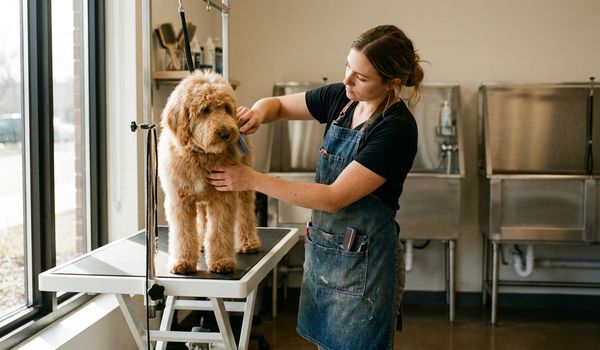
Pet grooming business financing statistics tell a story that every current and aspiring grooming business owner needs to hear before signing a lease, ordering a tub package, or converting a van into a mobile salon. The United States pet grooming services market is on track to generate roughly $13 billion in revenue by the end of 2026, up from about $11.5 billion in 2025, yet access to capital remains the single biggest barrier between a skilled groomer and a profitable business of their own. Whether you are launching a home-based grooming studio, buying a mobile grooming van, opening a storefront salon, or replacing a high-velocity dryer that just died mid-appointment, the numbers behind pet grooming business financing in 2026 reveal both the size of the opportunity and the realities of the lending market.
This guide compiles the most important pet grooming business financing statistics for 2026: startup costs by business model, average loan amounts, approval rates by lender type, typical interest rates, equipment price benchmarks, and the funding trends shaping how grooming businesses get financed this year. The figures below are drawn from government data, industry research, and small business lending market reports so you can benchmark your own plans against what is actually happening in the market, not what a sales brochure claims.
If you are planning a grooming salon purchase, van conversion, or expansion in the next twelve months, use these statistics to set a realistic budget, choose the right financing product for each need, and walk into lender conversations with the confidence of an owner who knows the numbers.
In This Article
- The State of the Pet Grooming Industry in 2026
- Key Pet Grooming Financing Statistics for 2026
- How Much Does It Cost to Start a Pet Grooming Business?
- Types of Pet Grooming Business Financing Available
- How Pet Grooming Financing Works: Step by Step
- Who Qualifies for Pet Grooming Financing?
- Pet Grooming Financing Compared to Other Funding Options
- How Crestmont Capital Helps Grooming Business Owners
- Real-World Pet Grooming Financing Scenarios
- Tips for Getting Approved
- Frequently Asked Questions
- How to Get Started
The State of the Pet Grooming Industry in 2026
The pet grooming industry has become one of the most resilient corners of the small business economy. The global pet grooming market, covering both products and services, reached approximately $19.5 billion in 2026, up from $17.87 billion in 2025, and is projected to expand at a compound annual growth rate of roughly 9.1 percent through 2036. The services side of the market alone, meaning salons, mobile vans, and spa-style grooming, is valued at about $9.1 billion globally in 2026 and is growing at close to 7.8 percent per year.
The United States is the largest single market in the world for grooming services. American pet grooming services revenue is projected to reach approximately $13 billion by the end of 2026, growing at an annual rate of 7 to 9 percent. Roughly 50,000 professional groomers now operate in the United States, more than any other country, and dogs account for about 58.4 percent of total grooming demand, making dog grooming business owners the core of the industry.
Two structural trends explain most of this growth. The first is pet humanization: roughly two-thirds of U.S. households now own at least one pet, and owners increasingly treat grooming as routine healthcare rather than an occasional luxury. The second is premiumization. Specialized services such as breed-specific cuts, deshedding treatments, skin therapy, and spa packages carry higher price tags, and mobile grooming vans now command 20 to 40 percent price premiums over traditional storefront salons because of the convenience they offer.
For business owners, the key takeaway is that this is a fragmented industry built almost entirely of small, independent operators. There are no dominant national grooming chains controlling the market. Data from the U.S. Census Bureau's Annual Business Survey confirms that pet care services remain overwhelmingly owned by small, independent operators rather than national chains. That fragmentation is precisely why pet grooming business financing matters so much: growth is available to independent owners, but capturing it requires capital for vehicles, equipment, buildouts, and marketing that most groomers cannot fund from savings alone.
Key Pet Grooming Financing Statistics for 2026
The statistics below define the financing landscape for grooming businesses this year. Each figure tells you something practical about what lenders expect, what equipment costs, and how owners are funding growth.
Startup costs vary dramatically by business model. A home-based grooming setup typically requires $3,000 to $10,000 to launch. A storefront salon runs $15,000 to $75,000 or more depending on buildout needs. A mobile grooming business sits at the top of the range: a used converted van costs $15,000 to $40,000, a new custom-outfitted grooming van runs $70,000 to $120,000 or more, and total mobile startup costs commonly land between $30,000 and $80,000.
Equipment is the most common financing use. A professional grooming equipment package, including a hydraulic or electric table ($300 to $1,000), a stainless steel tub ($500 to $1,500), high-velocity dryers ($200 to $600 each), clippers, blades, and shears ($500 to $1,200), and crates or cages ($300 to $1,000), typically totals $2,500 to $8,000 for a single station. Multi-station salons and mobile van conversions multiply that figure quickly, which is why equipment financing transactions for grooming businesses most commonly fall between $10,000 and $75,000.
Approval rates depend heavily on lender type. According to small business lending statistics compiled by Forbes Advisor, big banks approve only about 1 in 7 loan applications, while alternative lenders approve roughly 1 in 4. For grooming business owners, that gap is one of the most important statistics in this report: starting your search with the right lender category can more than double your probability of approval.
Key Stat: Only about 1 in 7 small business loan applications at big banks is approved, compared with roughly 1 in 4 at alternative lenders. For grooming business owners, that gap means the lender you choose matters as much as the numbers you present. Starting your search with the right lender category more than doubles your probability of a yes.
Government-backed lending remains a major channel. The SBA 7(a) program, the largest government-backed small business lending channel in the country, backed more than 57,000 loans totaling roughly $27.5 billion in a recent fiscal year, putting the average 7(a) loan near $480,000. Grooming businesses routinely use SBA loans for salon acquisitions, buildouts, and multi-station equipment packages because of their long terms and relatively low rates.
Speed has become a competitive weapon. The fastest financing decisions in 2026 come from alternative lenders, many of which deliver answers within 24 hours and funding within one to three business days. Traditional bank and SBA loans still take two weeks to three months from application to funding, which is why owners replacing broken equipment almost never wait for the bank channel.
Interest rates span a wide band. Well-qualified grooming business owners with strong credit and established revenue can access bank and SBA financing in the 6 to 13 percent range. Alternative lenders price grooming business loans higher, commonly in the mid-teens to mid-twenties depending on credit, time in business, and revenue consistency. Equipment financing for grooming tools typically prices between those two bands because the equipment itself serves as collateral.
By the Numbers
Pet Grooming Business Financing in 2026: Key Statistics
$13B
Projected US pet grooming services revenue in 2026
50,000
Professional groomers operating in the United States
1 in 4
Approval rate at alternative lenders vs 1 in 7 at big banks
24 hrs
Fastest decision time for grooming business financing in 2026
How Much Does It Cost to Start a Pet Grooming Business?
Startup cost is the first number every aspiring grooming business owner needs, and it is also the number most people get wrong. The total depends almost entirely on which of the three business models you choose: home-based, mobile, or storefront. The table below shows realistic 2026 ranges for each model based on current equipment prices, vehicle costs, and lease markets.
| Cost Category | Home-Based | Mobile Van | Storefront Salon |
|---|---|---|---|
| Vehicle or space conversion | $500 - $3,000 | $15,000 - $120,000 | $5,000 - $40,000 |
| Grooming equipment package | $2,500 - $8,000 | $3,000 - $9,000 | $6,000 - $25,000 |
| Licenses, permits, and insurance | $500 - $2,500 | $800 - $3,000 | $1,000 - $3,500 |
| Initial supplies and inventory | $300 - $1,000 | $400 - $1,200 | $800 - $2,500 |
| Branding, website, and software | $500 - $2,000 | $1,000 - $3,000 | $1,500 - $4,000 |
| Working capital reserve | $2,000 - $5,000 | $5,000 - $10,000 | $6,000 - $15,000 |
| Total typical range | $3,000 - $10,000 | $30,000 - $80,000+ | $15,000 - $75,000+ |
A few patterns stand out in the data. Home-based grooming is the only model that can realistically be self-funded from savings, which is why it is the most common entry point for new groomers. Mobile grooming carries the highest startup cost of the three models but also commands the highest per-appointment pricing, with mobile groomers routinely charging 20 to 40 percent more than storefront competitors. Storefront salons sit in the middle on cost but offer the most scaling potential because they can support multiple grooming stations and employees.
Whichever model you choose, treat the working capital reserve as non-negotiable. Three to six months of operating expenses in reserve is the buffer that keeps a slow first quarter from becoming a failed business. Most lenders want to see that reserve in your plan, and many will fund it as part of a startup financing package.
Types of Pet Grooming Business Financing Available
Grooming business owners in 2026 have more financing options than any previous generation of pet care entrepreneurs. Each product fits a specific need, and the strongest funding plans usually combine two or three of them.
Equipment financing is the workhorse of the grooming industry. Tables, tubs, dryers, clippers, kennels, and even mobile grooming van conversions can be financed with the equipment itself serving as collateral. Because the lender's risk is secured by a resalable asset, approval standards are more flexible than unsecured products, and terms typically run 24 to 72 months. Owners can explore dedicated equipment financing programs built for exactly these purchases, and our companion guide on dog grooming equipment financing and leasing breaks down the category in detail.
Working capital loans cover the expenses equipment financing cannot: payroll, rent, shampoo and supply inventory, marketing, and the cash-flow gaps between busy seasons. These are typically short-term products, 6 to 24 months, sized against your monthly revenue. An unsecured working capital loan requires no collateral and can fund in days rather than weeks.
Business lines of credit give grooming businesses a revolving pool of capital they can draw from as needed and repay on flexible schedules. A line of credit is the right tool for unpredictable expenses: a dryer that dies without warning, a slow January after a busy holiday season, or a last-minute opportunity to buy a competitor's client list. Unlike a term loan, you pay interest only on what you draw, making a business line of credit the cheapest safety net in the financing toolkit.
SBA loans remain the gold standard for large, long-term financing needs: buying an existing salon, funding a full storefront buildout, or acquiring a commercial property for a grooming facility. The SBA loan programs offer terms up to 10 years for working capital and equipment and up to 25 years for real estate, with rates among the lowest available to small businesses. The tradeoff is speed and paperwork: SBA applications routinely take 30 to 90 days. Our SBA loans page explains eligibility and the application process.
Revenue-based financing advances capital against future sales, with repayment flexing up and down with your monthly revenue. For grooming businesses with strong card sales but limited credit history or collateral, it is often the fastest path to five-figure funding, though total costs run higher than bank products.
Traditional term loans from banks and online lenders provide a lump sum repaid over one to ten years. They suit groomers with established revenue who want predictable payments for a defined project such as a second station buildout or a salon refresh.
Ready to Fund Your Grooming Business?
Join thousands of pet care business owners who chose fast, flexible financing from the #1 business lender in the U.S. Apply in minutes with no obligation.
Apply Now →How Pet Grooming Financing Works: Step by Step
The mechanics of getting financed are simpler than most owners expect, especially outside the traditional banking channel. Here is the process from start to funded.
Step 1: Define the Need and the Number
Before any application, write down exactly what you are funding and exactly what it costs. Lenders approve specific, well-defined requests far more readily than vague ones. "A $32,000 used mobile grooming van with a $9,000 conversion package" gets a yes faster than "about $40,000 for a van setup."
Step 2: Know Your Credit and Cash Flow
Pull your personal credit reports and gather your last three to six months of business bank statements. Alternative lenders weigh recent cash flow as heavily as credit score, so clean statements with consistent deposits and no overdrafts materially improve both your approval odds and your pricing.
Step 3: Match the Product to the Purpose
Use the framework from the previous section: equipment financing for tables, tubs, and vans; working capital for supplies and payroll; a line of credit for emergencies; SBA or term loans for acquisitions and buildouts. Applying for the wrong product is one of the most common reasons good businesses get declined.
Step 4: Apply with the Right Lender Tier
If your credit is above 680, your business has two or more years of history, and your timeline is flexible, start with bank or SBA channels for the best pricing. If you need speed, have newer revenue, or have credit below 650, go directly to an alternative lender rather than collecting bank rejections that generate hard inquiries on your credit file.
Step 5: Review the Offer and Fund
Compare the total payback amount, not just the rate. A 12-month working capital loan with a factor rate can cost more in dollars than a higher-rate loan with a longer term. Once you accept, alternative lenders typically fund within one to three business days, and equipment financing can often pay your vendor directly.
Who Qualifies for Pet Grooming Financing?
Qualification standards vary by product and lender, but the 2026 market has clear tiers. Understanding which tier your business fits saves you from wasted applications and unnecessary hard credit pulls.
Established businesses with strong profiles (two or more years in operation, personal credit above 680, clean financials, and consistent monthly revenue) qualify for the full product menu: bank loans, SBA loans, prime equipment financing, and large lines of credit at the lowest available rates.
Newer businesses with decent credit (six months to two years in operation, credit in the 600 to 680 range, revenue flowing but limited history) qualify readily with alternative lenders. Expect approvals in the $10,000 to $150,000 range with pricing in the mid-teens to low-twenties. Mobile groomers leaving employment to launch their own van often land in this tier.
Owners with challenged credit can still access grooming business financing through revenue-based products and equipment financing with larger down payments. Minimum scores in this tier commonly run 500 to 550 with strong revenue. Pricing is higher, but many owners use an initial higher-cost facility, build six to twelve months of perfect payment history, and refinance into cheaper money.
Pro Tip: Underwriters read bank statements the way lenders read credit reports. Six months of statements showing consistent deposits, healthy average balances, and zero overdrafts will outperform a higher credit score attached to messy cash flow. Clean up your account 90 days before you apply.
Pet Grooming Financing Compared to Other Funding Options
Not every funding source fits every need. The table below compares the five most common options grooming business owners evaluate in 2026 on the dimensions that matter most: typical amounts, cost, speed, and qualification difficulty.
| Funding Option | Typical Amounts | Typical Cost | Speed to Fund | Credit Needed |
|---|---|---|---|---|
| Bank term loan | $25,000 - $500,000 | 6% - 10% APR | 2 - 8 weeks | 680+ |
| SBA loan | $50,000 - $5,000,000 | 10% - 13% APR | 30 - 90 days | 650+ |
| Equipment financing | $5,000 - $250,000 | 8% - 20% APR | 2 - 5 days | 550+ |
| Business line of credit | $10,000 - $250,000 | 10% - 25% APR | 1 - 7 days | 600+ |
| Revenue-based financing | $5,000 - $150,000 | Factor rates vary | 1 - 3 days | 500+ |
The pattern in the data is consistent: cost and speed move in opposite directions. Bank and SBA money is the cheapest but slowest and hardest to get. Alternative products fund in days at higher cost. The smartest grooming business owners match the urgency of the need to the cost of the capital, reserving bank channels for planned expansions and using fast products for time-sensitive opportunities and emergencies.
How Crestmont Capital Helps Grooming Business Owners
Crestmont Capital is the #1 rated business lender in the United States, and pet care businesses are one of the industries we fund most often. Grooming business owners come to us for three reasons: speed, flexibility, and a product menu deep enough to fund every stage of the business lifecycle.
Our equipment financing programs cover everything from a single high-velocity dryer to a complete mobile grooming van conversion, with terms up to 72 months and decisions in as little as 24 hours. Our working capital loans and business lines of credit keep salons running through seasonal slowdowns and supply restocks. And for owners buying an existing salon or building out a storefront, our team structures term loans and SBA-backed financing sized to the full project rather than forcing you to piece together multiple small approvals.
We also work with the full credit spectrum. Many of our grooming business clients arrived after a bank decline, and we routinely approve owners with scores in the 550 to 650 range based on the strength of their revenue and the quality of their plan. If you are earlier in your research, our complete guide to pet grooming business loans walks through the application process in detail.
Get Your Grooming Business Funded This Week
Fast approvals, flexible requirements, and funding in as little as 24 hours from America's #1 rated business lender. See your options with no obligation.
Apply Now →Real-World Pet Grooming Financing Scenarios
Statistics become useful when you can see yourself in them. These five scenarios show how the products above combine to solve the most common grooming business funding situations in 2026.
Scenario 1: The Mobile Van Launch
Dana spent six years grooming in someone else's salon and decided to go mobile. She found a used Sprinter van for $28,000 and budgeted $14,000 for the conversion: tub, table, dryer, water tanks, generator, and interior buildout. With a 640 credit score and limited savings, a bank was not an option. She financed the full $42,000 package through equipment financing over 60 months at payments of roughly $890 per month. Her mobile pricing premium of 30 percent over local salons covered the payment within the first two months of operation.
Scenario 2: The Storefront Buildout
Marcus and Elise leased a 1,200-square-foot retail space in a growing suburb to open a four-station grooming salon. Their all-in budget was $95,000: $40,000 in buildout and plumbing, $22,000 in equipment, $8,000 in signage and marketing, and a $25,000 working capital reserve. They combined a $60,000 term loan for the buildout with $24,000 in equipment financing and a $20,000 line of credit for the reserve, keeping their own $15,000 in savings untouched as a safety buffer. They opened with four months of breathing room and hit breakeven in month five.
Scenario 3: The Home-Based Startup
Priya converted her garage into a grooming studio for $6,500 total: $4,200 in equipment, $900 in plumbing and electrical work, $600 in licenses and insurance, and $800 in initial marketing. She self-funded $3,000 and put the remaining $3,500 on a small working capital facility repaid over 12 months. Within a year, her client list outgrew the garage, and her clean payment history qualified her for a $45,000 expansion package to move into a storefront.
Scenario 4: The Emergency Equipment Replacement
On a Tuesday morning, Jerome's primary high-velocity dryer and his backup both failed with a full week of appointments booked. A replacement dryer package cost $2,800, and his salon could not operate without it. He applied online at 10 a.m., was approved by 2 p.m., and had the equipment paid for by Thursday. Total cost of the short-term facility was a few hundred dollars, far less than the revenue he would have lost canceling a week of grooming appointments.
Scenario 5: The Second Location Expansion
After four profitable years, Alicia wanted a second salon across town. She found an existing grooming business for sale at $120,000, including equipment, client list, and a trained staff. With strong financials and a 710 credit score, she qualified for an SBA 7(a) loan covering 85 percent of the purchase price over 10 years. The seller carried a small note for the remainder. The acquired salon's existing cash flow covered the loan payment from day one, turning the expansion into an immediately accretive move.
Tips for Getting Approved for Grooming Business Financing
The approval statistics in this report are averages, and averages hide a wide range of outcomes. Owners who prepare properly beat the averages consistently. These are the practices that move applications from maybe to yes.
Clean up your bank statements first. Three to six months of consistent deposits, stable balances, and zero overdrafts is the single most powerful approval asset you can build, and it costs nothing but discipline.
Write down the exact use of funds. Lenders fund plans, not wishes. An itemized budget showing exactly what you will buy and what it costs signals a borrower who will repay.
Apply to the right lender tier on the first try. Every bank rejection generates a hard inquiry and delays your funding by weeks. If your profile fits alternative lending, start there.
Separate personal and business finances. A dedicated business bank account with clean separation makes underwriting faster and your revenue easier to verify.
Time your application to your revenue cycle. Apply after a strong quarter, not during a slow January. Your most recent statements carry the most weight.
Consider a smaller first facility if needed. Building six to twelve months of perfect payment history on a modest loan is a proven path to larger approvals at better pricing.
Pro Tip: If a lender offers you less than you requested, treat it as data, not rejection. Accepting a smaller first facility, repaying it cleanly for six months, and re-applying is one of the most reliable paths to the full amount, often at better pricing.
Your Grooming Business's Next Step Starts Here
Whether you are opening, expanding, or upgrading equipment, Crestmont Capital moves at the speed of your business. Apply in minutes today.
Apply Now →Frequently Asked Questions
How much does it cost to start a pet grooming business in 2026? +
It depends on the business model. A home-based grooming setup typically costs $3,000 to $10,000, a storefront salon runs $15,000 to $75,000 or more, and a mobile grooming business commonly lands between $30,000 and $80,000 depending on whether you buy a used van or a new custom-outfitted unit. The biggest line items are the vehicle or space conversion, the equipment package, and three to six months of working capital reserves.
What credit score do you need for pet grooming business financing? +
It depends on the product. Traditional bank and SBA loans generally look for personal credit scores of 650 to 680 or higher. Alternative lenders and equipment financing companies routinely approve grooming business owners with scores in the 500 to 650 range, pricing the deal to match the risk. A stronger score still earns you lower rates and longer terms, so it pays to clean up your credit before applying.
Can I get a pet grooming business loan with bad credit? +
Yes. Revenue-based financing and equipment financing are both accessible with credit scores in the 500 to 550 range when your business shows consistent monthly revenue. Expect higher pricing and possibly a larger down payment on equipment deals. Many owners use a smaller first facility, build six to twelve months of perfect payment history, and then refinance into lower-cost money.
How much can I borrow for a grooming business? +
Loan amounts range from a few thousand dollars for a home-based equipment package to $5 million for an SBA-backed salon acquisition. Most grooming equipment financing transactions fall between $10,000 and $75,000, and working capital facilities for grooming businesses commonly run $10,000 to $150,000. The right amount is the one that funds your specific plan with a comfortable repayment margin.
Are there loans specifically for mobile pet grooming vans? +
Yes. Mobile grooming van purchases and conversions are typically funded through equipment financing, because the van and its installed equipment serve as collateral for the loan. Lenders can finance the vehicle, the conversion buildout, or both together in a single package, usually over 36 to 72 months. Used converted vans in the $15,000 to $40,000 range are the most commonly financed purchases in this category.
How fast can I get funded for grooming equipment? +
Alternative equipment financing is the fastest channel: many applications receive a decision within 24 hours and funding within one to three business days, with the lender often paying your equipment vendor directly. Bank and SBA equipment loans take significantly longer, typically two weeks to three months, so they fit planned purchases rather than emergency replacements.
What documents do I need to apply for pet grooming financing? +
For most alternative lenders, you need three to six months of business bank statements, a government-issued ID, and basic business information such as your EIN and business address. Equipment financing also requires a quote or invoice for the equipment being purchased. Bank and SBA loans require substantially more: tax returns, financial statements, a business plan, and detailed use-of-funds documentation.
Do I need collateral for a grooming business loan? +
Not always. Equipment financing is self-collateralized by the equipment itself. Unsecured working capital loans and business lines of credit require no specific collateral, though most lenders take a general lien on business assets and a personal guarantee. SBA loans above certain thresholds may require available collateral, but a lack of collateral alone does not disqualify an otherwise strong application.
Can a brand-new grooming business get financing with no revenue? +
It is harder but possible. Startups without revenue are usually limited to equipment financing with a meaningful down payment, SBA microloans, or personal credit-based products. Lenders substitute a strong personal credit profile, industry experience, and a detailed business plan for the revenue history an established business would show. Many groomers launch home-based first, build six to twelve months of revenue, and then qualify for much larger facilities.
What is the difference between grooming equipment financing and leasing? +
With equipment financing, you own the equipment at the end of the term and build equity with every payment. With a lease, you pay for the use of the equipment and either return it, renew, or buy it at the end of the lease. Financing generally costs less over the full life of durable equipment like tubs and tables, while leasing can make sense for technology or equipment you expect to upgrade frequently.
Are SBA loans available for pet grooming businesses? +
Yes. Pet grooming businesses are an eligible industry under SBA lending programs, and grooming businesses routinely use SBA 7(a) loans for salon acquisitions, storefront buildouts, and large equipment packages. Terms run up to 10 years for working capital and equipment and up to 25 years for real estate, with rates among the lowest available. Expect the process to take 30 to 90 days and require substantial documentation.
How much does a mobile grooming van cost? +
A used, already-converted mobile grooming van typically costs $15,000 to $40,000 depending on age, mileage, and installed equipment. A new, custom-outfitted grooming van runs $70,000 to $120,000 or more. Total mobile startup costs, including the van, equipment, insurance, branding, and working capital, commonly land between $30,000 and $80,000 for operators buying used.
What are typical interest rates for grooming business loans in 2026? +
Bank term loans for well-qualified borrowers run roughly 6 to 10 percent APR. SBA loans price around 10 to 13 percent. Equipment financing typically falls in the 8 to 20 percent range depending on credit and the equipment type, and alternative working capital products price higher, often in the mid-teens to mid-twenties. Your actual rate depends on credit, time in business, revenue, and the specific product.
Can I use financing to buy an existing grooming salon? +
Yes, and it is one of the strongest uses of business financing because the acquired salon's existing cash flow helps service the debt from day one. SBA 7(a) loans are the most common vehicle for business acquisitions, typically covering 80 to 90 percent of the purchase price over 10 years. Lenders will review the target salon's financials as carefully as your own, so request organized books from the seller early.
How do I improve my chances of getting approved? +
Focus on the four factors underwriters weigh most: three to six months of clean business bank statements, a specific written use of funds, a credit profile free of recent delinquencies, and an application matched to the right lender tier for your profile. Applying after a strong revenue quarter and separating your personal and business finances both measurably improve approval odds.
How to Get Started
Complete our quick application at offers.crestmontcapital.com/apply-now, it takes just a few minutes and does not obligate you to anything.
A funding specialist will walk you through the products and amounts your business qualifies for, with transparent pricing on every option.
Choose the offer that fits your plan and receive funding in as little as 24 hours, with equipment purchases paid directly to your vendor if you prefer.
The Bottom Line on Pet Grooming Business Financing in 2026
The pet grooming business financing statistics for 2026 describe an industry with real tailwinds: a $13 billion U.S. services market growing 7 to 9 percent annually, roughly 50,000 professional groomers serving a pet-owning majority of American households, and a fragmented competitive landscape that leaves room for independent operators to build profitable businesses. The barrier is not demand. The barrier is capital, and capital has never been more accessible to grooming business owners who know where to look.
The owners who succeed are the ones who match the financing product to the specific need, apply to the lender tier that fits their profile, and present clean financials that make approval easy. Whether you need $5,000 for a home studio equipment package, $42,000 for a mobile grooming van, or $500,000 to acquire an established salon, the funding exists. Use the statistics in this guide to set your budget, benchmark your options, and take the next step with confidence.
Disclaimer: The information provided in this article is for general educational purposes only and is not financial, legal, or tax advice. Funding terms, qualifications, and product availability may vary and are subject to change without notice. Crestmont Capital does not guarantee approval, rates, or specific outcomes. For personalized information about your business funding options, contact our team directly.

Allan Garfinkle
Allan Garfinkle is the Chief Revenue Officer at Crestmont Capital, where he has spent more than a decade leading revenue strategy, business development, and operational growth. With 28 years of experience building and advising startups and small businesses, Allan has helped more than 10,000 business owners navigate financing decisions, growth opportunities, and changing economic conditions. He earned a Bachelor of Science in Economics and an MBA with a concentration in Finance from Northeastern University, as well as a Juris Doctor from New England Law, where his studies focused on contracts and business law. His writing draws on extensive practical experience in small-business lending, equipment financing, business credit, and commercial finance.