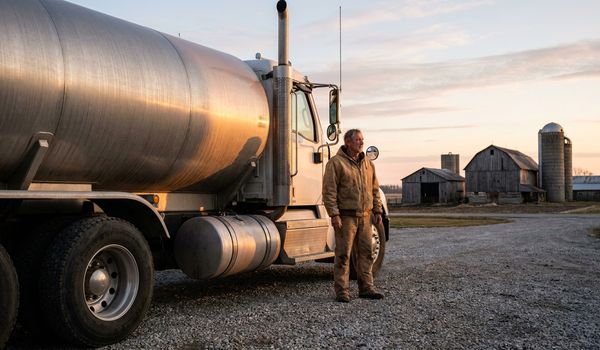
A reliable milk truck is the backbone of any dairy hauling operation. Whether you run a farm-to-plant hauling route, operate a dairy farm with your own pickup truck and bulk tank, or manage a growing fleet of food-grade tankers, the right milk truck keeps product moving safely and on schedule. The challenge is cost: a new milk tanker truck can run well into six figures, and tying up that much cash in a single vehicle can strain even a healthy operation. That is where milk truck financing comes in.
This guide covers everything business owners need to know about financing a milk truck, from how the process works and what trucks qualify, to real costs, loan versus lease tradeoffs, and how to get funded fast. If you are ready to put a new or used milk tanker on the road without draining your working capital, you are in the right place.
In This Article
- What Is Milk Truck Financing?
- Why Finance a Milk Truck? Key Benefits
- How Milk Truck Financing Works
- Types of Milk Trucks You Can Finance
- How Much Does a Milk Truck Cost?
- Who Qualifies for Milk Truck Financing?
- Milk Truck Loan vs. Lease: Which Is Right for You?
- How Crestmont Capital Helps
- Real-World Milk Truck Financing Scenarios
- Frequently Asked Questions
- How to Get Started
What Is Milk Truck Financing?
Milk truck financing is a type of equipment financing designed for the purchase of milk tanker trucks and related hauling equipment. Instead of paying the full purchase price upfront, a lender provides the capital to buy the truck, and you repay the balance over a fixed term, typically 24 to 84 months. The truck itself serves as collateral for the financing, which keeps qualification straightforward and rates lower than unsecured borrowing.
Because a milk truck is a specialized commercial vehicle, financing falls under the broader umbrella of commercial truck financing with some important distinctions. Milk tankers are food-grade equipment. They carry sanitary stainless steel tanks, insulated or refrigerated compartments, pumping and metering systems, and they must meet strict hygiene standards for transporting a perishable food product. Lenders who understand this equipment category can structure terms that match the truck's working life and your revenue cycle.
Milk truck financing covers a wide range of setups:
- Straight trucks with mounted stainless steel bulk tanks for farm pickup routes
- Tractor-trailer milk tankers hauling 5,000 to 8,000 gallons between farms and processing plants
- Used milk trucks purchased from dealers, auctions, or private sellers
- Milk tanker trailers purchased separately from the tractor
- Refurbished or remounted tanks on new chassis
Whether you are an independent hauler buying your first truck or an established dairy logistics company adding a fifth tanker, financing lets you match the cost of the truck to the revenue it generates month by month.
Why Finance a Milk Truck? Key Benefits
Paying cash for a milk truck is possible for some operators, but it is rarely the smartest use of capital. Here is why most dairy haulers and farms choose to finance.
Preserve Working Capital
A new milk tanker truck can cost $90,000 to $180,000 or more. Paying that in cash strips out funds you need for fuel, driver wages, insurance, maintenance, and slow-paying customers. Financing spreads the cost over years, keeping cash available for the expenses that actually run your business day to day.
Start Earning Immediately
Hauling contracts and farm pickup routes generate revenue from day one. Financing lets you put the truck to work now and let the truck's own earnings cover the monthly payment. Many operators find the payment is a fraction of what the truck brings in each month.
Build Business Credit
Consistent on-time payments on an equipment loan strengthen your business credit profile. That makes the next truck, trailer, or facility expansion easier and cheaper to finance.
Predictable Monthly Costs
Fixed payments make budgeting simple. You know exactly what the truck costs each month for the life of the term, which matters in an industry where milk prices and hauling rates can fluctuate.
Upgrade on Your Schedule
Financing, and especially leasing, gives you a path to newer equipment every few years. Newer trucks mean better fuel economy, fewer breakdowns, and easier compliance with food safety standards.
Key Stat: U.S. dairy farms produce more than 226 billion pounds of milk per year, and nearly all of it moves from farm to plant by tanker truck. According to data tracked through the U.S. Census Bureau's Economic Census, truck transportation remains the dominant mode for moving agricultural products to processing facilities.
Ready to Put a Milk Truck on the Road?
Get fast, flexible financing from the #1 business lender in the U.S. Apply in minutes with no obligation.
Apply Now →How Milk Truck Financing Works
The financing process is simpler than most business owners expect, especially compared with a traditional bank loan. Here is how it works from start to finish.
Step 1: Find Your Truck
Identify the milk truck you want to buy. This can be a new truck from a dealer, a used milk truck for sale through an equipment marketplace, an auction unit, or even a private-party sale. Get the year, make, model, mileage or hours, tank capacity, and the seller's asking price.
Step 2: Submit a Short Application
With an online lender like Crestmont Capital, the application takes minutes. You provide basic business information, how long you have been operating, rough annual revenue, and details about the truck. There is no mountain of paperwork and no weeks-long committee review.
Step 3: Get a Decision
Equipment-focused lenders can often return a decision within hours. Because the truck secures the financing, approval standards are more flexible than unsecured loans. Credit score, time in business, and cash flow all factor in, but no single number decides the outcome.
Step 4: Review Terms and Sign
You receive an offer spelling out the amount financed, down payment if any, monthly payment, term length, and rate. Review it, ask questions, and sign electronically.
Step 5: Funding and Pickup
The lender pays the seller directly or funds your account, and you take delivery of the truck. At Crestmont Capital, funding can happen in as little as 24 to 72 hours after approval, so you do not lose a good truck to a faster buyer.
Step 6: Repay Over the Term
You make fixed monthly payments for the agreed term. With a loan, you own the truck outright at the end. With a lease, you can buy it out, return it, or upgrade to a newer unit.
Types of Milk Trucks You Can Finance
Milk hauling is not one-size-fits-all, and neither is the equipment. Financing is available for virtually every configuration used in dairy transport.
Farm Pickup Trucks (Straight Trucks)
These are the workhorses of dairy country: a single chassis with a 1,500 to 3,500 gallon stainless steel tank, used to collect raw milk from individual farms on a route. They are maneuverable enough for farm lanes and small yards. New units typically run $90,000 to $140,000, while solid used models are common in the $30,000 to $75,000 range.
Over-the-Road Milk Tankers
Tractor-trailer combinations hauling 5,000 to 8,000 gallons between collection points, transfer stations, and processing plants. These are long-haul or regional units with food-grade sanitary tanks, often insulated to hold temperature. A new tractor plus tanker trailer can exceed $180,000, and the trailer alone can run $70,000 to $120,000 new.
Milk Tanker Trailers
Many operators already own a reliable tractor and only need the tanker trailer. Trailers are fully financeable as standalone equipment, including used stainless units from brands built to last decades with proper care.
Used Milk Trucks
The used market is deep because well-maintained stainless tanks have very long service lives. Buying a used milk truck three to ten years old is one of the most cost-effective ways to add capacity. Lenders will finance used units based on age, condition, and mileage, often with slightly shorter terms than new equipment.
Refurbished and Remounted Tanks
A common value play is remounting a refurbished sanitary tank on a new or newer chassis. Financing can cover the package when purchased through a dealer or upfitter.
By the Numbers
Milk Truck Financing - Key Statistics
226B lbs
Annual U.S. milk production, nearly all moved by tanker truck
26,000+
Licensed dairy farms in the U.S. relying on bulk milk pickup
$90K-$180K
Typical price range for a new milk tanker truck
24-72 hrs
Crestmont Capital funding window after approval
How Much Does a Milk Truck Cost?
Cost is the first question most buyers ask, and the answer depends on the type of truck, its age, and its specification. Here are realistic price ranges for today's market.
New Milk Trucks
- Farm pickup straight truck with new stainless tank: $90,000 to $140,000
- New over-the-road tanker trailer: $70,000 to $120,000
- New tractor plus new milk tanker trailer package: $160,000 to $220,000 or more
Used Milk Trucks
- Three to seven year old farm pickup truck: $45,000 to $85,000
- Seven to fifteen year old straight truck: $25,000 to $50,000
- Used tanker trailer in good condition: $35,000 to $80,000
What Drives the Price
Several factors move a milk truck's price up or down. Tank capacity and material matter most: food-grade 304 or 316 stainless steel sanitary tanks with proper baffling command a premium. Insulation and refrigeration add cost but protect load quality on long hauls. Pump and metering systems, wash systems, and recording equipment add more. On the chassis side, mileage, engine hours, drivetrain condition, and regional rust exposure all affect value. Finally, documentation of sanitary compliance and maintenance history can add thousands to a used truck's real-world value because it reduces the buyer's risk.
These ranges are exactly why financing is the norm in dairy hauling. Even a modest used truck represents a serious capital outlay, and milk price cycles can make large cash purchases risky. As Reuters commodities coverage regularly shows, dairy markets move with feed costs, weather, and global demand, so keeping cash reserves healthy matters.
Who Qualifies for Milk Truck Financing?
Milk truck financing serves a wider range of buyers than most people assume. If your business earns revenue by hauling milk or producing it, there is likely a program that fits.
Independent Milk Haulers
Owner-operators running one or two trucks on contract routes are the classic borrower. Lenders look at your hauling contracts, time in business, and cash flow. A signed contract with a creamery or cooperative strengthens an application significantly.
Dairy Farms with Their Own Trucks
Many larger farms haul their own milk to the plant rather than paying a third party. Farms qualify based on milk production revenue and overall operation strength. Farms can also explore agricultural equipment financing for other needs like tractors, parlors, and bulk tanks. If your operation also needs parlor upgrades, our guide to milking equipment financing covers that side of the barn.
Dairy Logistics and Hauling Companies
Fleet operators running regional routes can finance single trucks or multiple units at once. Fleet financing lets you add capacity in step with new contracts instead of one truck at a time.
Newer Businesses and Startups
Time in business helps, but it is not an absolute barrier. Newer operations may qualify with a larger down payment, a strong hauling contract, or additional documentation. Expect more questions and slightly higher rates, but financing is achievable.
Credit Expectations
Most equipment lenders look for credit scores in the mid-600s or higher for the best terms, but approvals happen across a broad range because the truck secures the deal. Lower scores typically mean a larger down payment or a higher rate rather than an automatic decline.
Pro Tip: Before you apply, pull together three to four months of business bank statements, your hauling contracts or milk check statements, and the truck's spec sheet. Having these ready can cut days off the funding timeline.
Milk Truck Loan vs. Lease: Which Is Right for You?
The two main structures for milk truck financing are equipment loans and equipment leases. A third option, a business line of credit, can fill gaps around the purchase. Each has a place depending on how long you plan to keep the truck and how you want costs to land on your books.
| Feature | Equipment Loan | Equipment Lease | Line of Credit |
|---|---|---|---|
| Ownership at end | You own the truck | Buyout, return, or upgrade | N/A (revolving funds) |
| Typical down payment | 0% to 20% | Often first and last payment | None |
| Monthly cost | Higher (building equity) | Lower (paying for use) | Interest only on what you draw |
| Typical term | 36 to 84 months | 24 to 60 months | Revolving, renews annually |
| Best for | Long-term owners, high-mileage routes | Operators who upgrade often | Repairs, fuel gaps, deposits |
When a Loan Makes Sense
Choose a loan if you plan to run the truck for a long time. Stainless steel milk tanks routinely stay in service for 15 years or more, so ownership builds real equity. Loans also suit high-mileage operations because there are no mileage caps or wear charges. If you want to understand how the broader category works, our tanker truck financing guide walks through loan structures for liquid bulk haulers in detail.
When a Lease Makes Sense
Choose a lease if you want the lowest possible monthly payment, plan to upgrade every few years, or want to conserve cash for other parts of the business. Leases can also simplify replacement cycles for fleets that standardize on a truck spec. Crestmont Capital offers flexible equipment leasing programs alongside traditional loans.
Where a Line of Credit Fits
A line of credit will not usually fund an entire truck purchase, but it pairs well with financing: covering the down payment, a surprise repair, insurance premiums, or fuel during a slow-pay month. Many haulers keep one open as a working capital buffer.
How Crestmont Capital Helps
Crestmont Capital is the #1 business lender in the U.S. for a reason: we specialize in fast, practical financing for real businesses, including dairy haulers, farms, and food-grade transport operators. Here is what working with us looks like.
Speed That Matches the Market
Good used milk trucks sell fast. Our application takes minutes, decisions often come back the same day, and funding can land in 24 to 72 hours after approval. When you find the right truck, you can actually buy it before someone else does.
Programs for Every Buyer
We finance new and used milk trucks, tanker trailers, and remounted equipment. Whether you want a straightforward equipment financing loan, a lease with a buyout option, or used truck financing for an auction find, we structure the deal around your cash flow.
Flexible Qualification
Because the truck secures the financing, we can look beyond a single credit score. Time in business, revenue, hauling contracts, and down payment all play a role. We work with established fleets, first-time buyers, and everything in between.
Real People, Real Answers
You work with a funding specialist who understands commercial vehicles, not a generic call center. Have questions about a specific truck, a lease versus loan tradeoff, or timing a purchase around a new contract? Call us or reach out through our contact page and we will walk you through it.
Get Your Milk Truck Financed Fast
One simple application. Multiple financing options. Funding in as little as 24 hours after approval.
Apply Now →Real-World Milk Truck Financing Scenarios
Every operation is different, but these scenarios show how milk truck financing plays out in practice.
Scenario 1: The Owner-Operator Landing a Co-op Contract
A hauler in Wisconsin signs a three-year pickup contract with a dairy cooperative but needs a second truck to cover the route. He finds a five-year-old straight truck with a 2,800 gallon sanitary tank for $62,000. With 10% down and a 60-month equipment loan, his payment lands near $1,100 per month. The contract covers the payment many times over, and he owns the truck free and clear before the contract renews.
Scenario 2: The Dairy Farm Bringing Hauling In-House
A 400-cow dairy farm in Idaho has been paying a third-party hauler per hundredweight. Running the numbers, owning a truck cuts hauling cost substantially. The farm finances a used milk truck for $48,000 through an agricultural-friendly program, keeps the milk check deduction it used to pay out, and gains full control over pickup timing during peak production.
Scenario 3: The Fleet Adding Capacity for a Plant Expansion
A regional dairy logistics company wins new business when a processing plant expands. It needs three more over-the-road tanker trailers fast. Rather than draining reserves, the company leases three trailers on 48-month terms, preserves cash for drivers and insurance, and plans to buy out the units at term end if the plant volume holds.
Scenario 4: The First-Time Buyer with Thin Credit History
A young entrepreneur with two years driving for someone else wants his own truck and route. His credit file is thin but clean, and he has a signed letter of intent from a creamery. With 20% down on a $40,000 used milk truck, he secures financing at a slightly higher rate, builds two years of payment history, and refinances into better terms as his business matures.
Scenario 5: The Auction Find
An experienced hauler spots a well-maintained tanker trailer at an equipment auction ending in four days. Because fast funding matters more than haggling over rate, he applies online, gets approved the same day, and has funds ready before the auction closes. Speed wins the deal.
Frequently Asked Questions
What is milk truck financing? +
Milk truck financing is a type of equipment financing used to purchase milk tanker trucks, tanker trailers, and related dairy hauling equipment. A lender funds the purchase and you repay over a fixed term, usually 24 to 84 months, with the truck itself serving as collateral.
How much does a milk truck cost? +
A new farm pickup milk truck typically costs $90,000 to $140,000, while a new over-the-road tanker trailer runs $70,000 to $120,000. Used milk trucks range from about $25,000 for older straight trucks to $85,000 for late-model units in good condition.
Can I finance a used milk truck? +
Yes. Used milk trucks are financed every day because stainless steel sanitary tanks have very long service lives. Lenders base terms on the truck's age, mileage, condition, and maintenance records, often with slightly shorter terms than new equipment.
What credit score do I need for milk truck financing? +
The best rates usually go to borrowers with scores in the mid-600s or higher, but approvals happen across a broad range because the truck secures the financing. Lower scores typically mean a larger down payment or a higher rate rather than an automatic decline.
How much down payment is required? +
Down payments range from 0% to 20% depending on your credit, time in business, and the truck's age. Stronger profiles often qualify for little or no money down, while newer businesses or older trucks may require 10% to 20%.
What loan terms are available for milk trucks? +
Equipment loans for milk trucks commonly run 36 to 84 months. Leases typically run 24 to 60 months. Longer terms lower the monthly payment but increase total interest paid over the life of the financing.
Is it better to lease or buy a milk truck? +
It depends on your plans. Buying with a loan builds equity and suits high-mileage, long-term ownership. Leasing lowers the monthly payment and works well if you upgrade equipment every few years or want to preserve cash.
Can a dairy farm finance its own milk truck? +
Yes. Dairy farms regularly finance trucks to haul their own production to processing plants. Farms qualify based on milk revenue and overall operation strength, and agricultural-friendly lenders understand farm cash flow cycles.
What documents do I need to apply? +
Most lenders need a short application, three to four months of business bank statements, and details about the truck such as year, make, model, mileage, and price. Hauling contracts or milk check statements strengthen the file.
How fast can I get funded? +
Online equipment lenders move quickly. With Crestmont Capital, decisions often come back the same day and funding can happen in as little as 24 to 72 hours after approval, which matters when a good used truck will not wait.
Are milk tanker trailers eligible for financing? +
Yes. Tanker trailers are financeable as standalone equipment, whether new or used. Many operators finance the trailer separately and pair it with a tractor they already own.
Can I finance multiple milk trucks at once? +
Yes. Fleet financing lets you add several trucks or trailers under one arrangement, which is common when a hauling company wins a new contract or a plant expands capacity.
What interest rates should I expect? +
Rates vary with credit, time in business, down payment, and equipment age. Well-qualified buyers see single-digit rates, while newer businesses or older equipment price higher. The truck's collateral value keeps rates below most unsecured options.
Do I need a CDL to finance a milk truck? +
The lender finances the business, not the driver. You do not personally need a commercial driver's license to qualify, but your operation needs properly licensed drivers and insurance in place before the truck goes to work.
Can a startup get milk truck financing? +
Yes, though expect closer review. Startups typically qualify with a larger down payment, a signed hauling contract, or additional documentation of industry experience. Many first-time buyers start with a used truck to keep the amount financed lower.
Start Your Milk Truck Application Today
Join the thousands of business owners who chose Crestmont Capital for fast, flexible equipment financing.
Apply Now →How to Get Started
Complete our quick application at offers.crestmontcapital.com/apply-now - takes just a few minutes.
A Crestmont Capital advisor will review your needs and match you with the right financing option for your truck and your routes.
Receive your funds and put your milk truck to work - often within days of approval.
Conclusion
A milk truck is more than a vehicle. It is the revenue engine of a dairy hauling business, and the right financing turns a six-figure purchase into a manageable monthly cost that the truck pays for itself. Whether you are buying your first used farm pickup truck, adding an over-the-road tanker to a growing fleet, or bringing hauling in-house on your dairy farm, milk truck financing gives you a practical path to ownership on terms that match how your business actually earns.
The keys are simple: know your truck, know your numbers, and work with a lender that understands commercial equipment. Crestmont Capital has funded thousands of business owners across the country with fast decisions, flexible programs, and funding in as little as 24 hours. When the right milk truck shows up on the market, you will be ready to buy it.
Disclaimer: The information provided in this article is for general educational purposes only and is not financial, legal, or tax advice. Funding terms, qualifications, and product availability may vary and are subject to change without notice. Crestmont Capital does not guarantee approval, rates, or specific outcomes. For personalized information about your business funding options, contact our team directly.

Allan Garfinkle
Allan Garfinkle is the Chief Revenue Officer at Crestmont Capital, where he has spent more than a decade leading revenue strategy, business development, and operational growth. With 28 years of experience building and advising startups and small businesses, Allan has helped more than 10,000 business owners navigate financing decisions, growth opportunities, and changing economic conditions. He earned a Bachelor of Science in Economics and an MBA with a concentration in Finance from Northeastern University, as well as a Juris Doctor from New England Law, where his studies focused on contracts and business law. His writing draws on extensive practical experience in small-business lending, equipment financing, business credit, and commercial finance.