
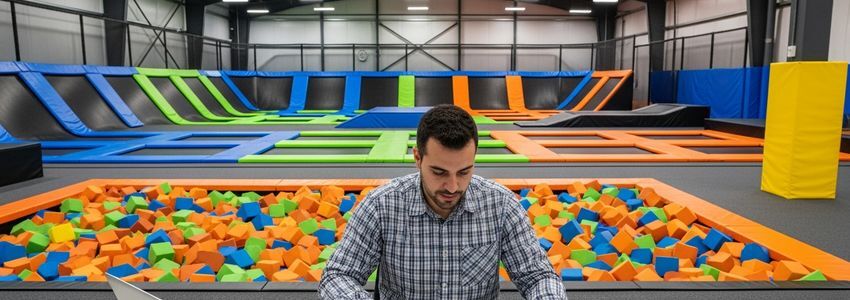
Indoor trampoline parks and family entertainment centers represent one of the most capital-intensive entrepreneurial opportunities in the recreation sector. A single trampoline park requires $500,000 to $3,000,000+ in startup investment — covering leasehold improvements, specialized trampoline systems, safety padding and flooring, party room buildout, café or concession equipment, and significant upfront marketing. But successful parks generate strong revenue, high margins on party bookings, and loyal repeat customers that justify the investment. The challenge is accessing the capital needed to transform a large industrial space into a world-class jump park. This guide covers every financing option available to trampoline park and family entertainment center owners.
In This Article
- Why Trampoline Parks Need Business Financing
- Types of Trampoline Park Business Loans
- Trampoline Park Startup and Expansion Costs
- SBA Loans for Trampoline Parks
- How to Qualify for a Trampoline Park Loan
- Trampoline Park Loan Rates, Terms, and Amounts
- Best Uses for Trampoline Park Financing
- Trampoline Park and FEC Industry Statistics
- How to Apply and What to Prepare
- Why Park Owners Choose Crestmont Capital
- Frequently Asked Questions
Why Trampoline Parks Need Business Financing
Indoor trampoline parks and family entertainment centers have unusually high capital requirements compared to most service businesses. The physical infrastructure — specialized trampoline systems, foam pit installations, safety padding, structural reinforcement, and dedicated electrical systems — cannot be replicated with off-the-shelf equipment. Custom trampoline park installations from vendors like Jumpking, ProSlide, and FUNZ require months of lead time and millions in installation costs. The space requirements (typically 15,000 to 30,000+ square feet) mean significant lease commitments and leasehold improvements. And unlike most businesses, you are largely constructing the attraction from scratch in an industrial or big-box retail space.
Common financing needs for trampoline park owners:
- Trampoline system installation — custom-engineered trampoline courts, foam pits, slam dunk zones, dodgeball courts, ninja courses ($300,000–$1,500,000+)
- Leasehold improvements — structural upgrades, electrical systems, HVAC, flooring, walls, restrooms ($150,000–$600,000)
- Party rooms and event spaces — party room buildout, furniture, A/V systems ($50,000–$150,000)
- Café and concessions — commercial kitchen equipment, POS systems, food service buildout ($30,000–$100,000)
- Safety and compliance — medical crash pads, safety netting, fall-zone padding, liability assessments ($50,000–$200,000)
- Technology — online booking systems, waivers, membership management, monitoring cameras ($15,000–$50,000)
- Working capital — pre-opening payroll, initial marketing, inventory, first months of operation before revenue ramps
- Second location expansion — opening a new park location in a new market
Financing Reality: Most trampoline park startups require a combination of financing sources — SBA loans for the primary capital stack, equipment financing for specific systems, and investor or owner equity for the remaining portion. Single-source financing that covers the full $1–3 million startup cost is uncommon for first-time operators. Planning your capital stack before approaching lenders significantly improves your prospects. For working capital solutions, see our When to Use a Working Capital Loan: The Complete Guide for Small Business Owners.
Types of Trampoline Park Business Loans
SBA 7(a) Loans
SBA 7(a) loans are the most commonly used financing vehicle for trampoline park and family entertainment center development. With loan amounts up to $5 million and terms up to 10 years, SBA 7(a) loans can cover the largest portion of a park's capital stack. Trampoline parks qualify as recreational service businesses under SBA guidelines. Approval requires 2+ years of business history for existing operators or strong personal credit, business experience, and a detailed business plan for startups. See our SBA Loan Alternatives for Faster Funding: The Complete Guide for Business Owners for comprehensive SBA guidance.
SBA 504 Loans
SBA 504 loans are designed for fixed-asset purchases — including commercial real estate and major equipment. For trampoline park owners who plan to purchase their facility building or need financing for large equipment packages, SBA 504 loans offer below-market fixed rates and long terms (20–25 years for real estate, 10 years for equipment). The 10% down payment structure preserves cash for working capital.
Equipment Financing
Specialized trampoline park equipment — trampoline systems, foam pit infrastructure, ninja course elements, and party room equipment — may qualify for equipment financing using the equipment as collateral. Equipment lenders familiar with the entertainment industry can finance trampoline systems as custom installations. Useful for financing specific attraction additions after the initial park build.
Conventional Bank Term Loans
Established trampoline park operators with strong financial performance (2+ years of operation, $500,000+ in annual revenue) may access conventional bank term loans for expansion, equipment upgrades, or second location development at competitive rates (8%–15%). Banks familiar with the entertainment industry underwrite these loans based on demonstrated operating performance.
Business Lines of Credit
Operating lines of credit address seasonal cash flow management for parks with significant seasonal revenue variation. Holiday parties and school breaks drive peak revenue; summer weekdays may be slower. A revolving line of credit ($50,000–$200,000) smooths the peaks and valleys without requiring new loan applications for each seasonal cycle.
CDFI and Specialty Entertainment Lenders
Some Community Development Financial Institutions and specialty entertainment industry lenders have experience financing family entertainment centers. These lenders understand the FEC business model better than generalist lenders and may offer financing with terms specifically structured for pre-opening and ramp-up periods.
Ready to Open or Expand Your Trampoline Park?
Get fast, flexible financing from the #1 business lender in the U.S. No obligation — apply in minutes.
Apply Now →Trampoline Park Startup and Expansion Costs
Understanding the full capital requirement before approaching lenders is essential. Here is a representative breakdown for a mid-size indoor trampoline park (15,000–20,000 sq ft):
| Cost Category | Typical Range | Notes |
|---|---|---|
| Trampoline System + Installation | $300K–$900K | Custom-engineered systems with foam pits, courts, ninja elements |
| Leasehold Improvements | $200K–$600K | HVAC, electrical, structural, flooring, restrooms, lobby |
| Party Rooms + Event Space | $50K–$150K | Tables, chairs, A/V, décor, furniture packages |
| Café / Concessions | $30K–$100K | Commercial kitchen, POS, display cases, equipment |
| Safety and Compliance | $50K–$200K | Padding, netting, safety systems, inspections |
| Technology + Systems | $15K–$50K | Booking, waivers, POS, cameras, access control |
| Pre-Opening Marketing | $20K–$75K | Grand opening, social media, local advertising, partnerships |
| Working Capital Reserve | $50K–$150K | 6 months operating expenses while revenue ramps |
Total estimated startup capital: $715,000 to $2,225,000 for a typical 15,000–20,000 sq ft trampoline park. Larger parks or premium buildouts can exceed $3,000,000.
SBA Loans for Trampoline Parks
SBA 7(a) and SBA 504 programs are the most commonly used government-backed financing for trampoline parks. Key program parameters:
| Program | Max Amount | Best Use for Parks | Min. Credit | Approx. Timeline |
|---|---|---|---|---|
| SBA 7(a) | $5 million | Leasehold improvements, equipment, working capital, expansion | 650+ | 60–90 days |
| SBA 504 | $5.5M (CDC portion) | Facility real estate purchase, large equipment packages | 680+ | 60–120 days |
| SBA Microloan | $50,000 | Supplemental working capital or small equipment | 560+ | 30–60 days |
SBA and startup trampoline parks: The SBA does finance new (startup) businesses through the 7(a) program, but startup applications require a stronger business plan, detailed financial projections, personal credit score of 680+, industry experience, and more borrower equity (typically 20–30% of total project cost). Working with an experienced SBA lender who has financed FEC or entertainment businesses is recommended for trampoline park startup applications.
How to Qualify for a Trampoline Park Loan
For Established Park Operators
Existing parks with 2+ years of operation and documented financial performance are the strongest candidates for conventional financing:
- Credit score: 650+ for SBA; 700+ for bank loans; 600+ for online lenders
- Annual revenue: $500,000+ (parks with $750,000+ in annual revenue and positive EBITDA are most competitive)
- Debt service coverage: Net operating income should cover new debt payments at 1.25x or better
- Documentation: 2 to 3 years of tax returns, P&L, balance sheet, monthly bank statements
For New Park Startup Financing
Startup trampoline parks require more equity and stronger personal profiles:
- Credit score: 680+ (some SBA lenders prefer 700+)
- Owner equity contribution: 20–30% of total project cost ($150,000–$600,000 depending on project scale)
- Industry experience: Prior experience in entertainment, hospitality, or recreation management strongly preferred
- Detailed business plan: Financial projections based on comparable park performance, market analysis, demographic study, and competitive landscape
- Signed lease: Most lenders require a signed facility lease before approving construction/buildout financing
Entertainment Industry-Specific Considerations
- Insurance: Trampoline parks require significant liability coverage ($2–5M+ per occurrence). Insurers specializing in recreational facilities must be engaged before opening. Lenders will verify insurance coverage.
- ASTM standards compliance: Adherence to ASTM F2970 safety standards for trampoline court facilities demonstrates risk management to lenders and insurers.
- Demographic analysis: Market area population, household income, and proximity to competitive facilities should be documented in your business plan.
Trampoline Park Loan Rates, Terms, and Amounts
| Loan Type | Typical Rate | Term | Amount Range | Speed |
|---|---|---|---|---|
| SBA 7(a) Loan | 10%–13% | Up to 10 years | $150K–$5M | 60–90 days |
| SBA 504 (real estate) | Below-market fixed (CDC) | 20–25 years | $500K–$5.5M | 60–120 days |
| Bank Term Loan | 8%–15% | 3–7 years | $100K–$2M | 2–8 weeks |
| Equipment Financing | 7%–22% | 3–7 years | $50K–$1M+ | 1–14 days |
| Online Term Loan | 15%–45% | 3 months–5 years | $10K–$500K | 1–5 days |
| Business Line of Credit | 8%–35% | Revolving | $25K–$250K | 1–7 days |
Best Uses for Trampoline Park Financing
Opening a New Trampoline Park (Startup)
Most new trampoline parks are financed through a combination of owner equity (20–30%), SBA 7(a) loan (50–60%), and in some cases seller financing, investor equity, or equipment financing for specific systems. Total project costs of $1–3 million are most effectively structured with SBA 7(a) as the primary debt component, covering leasehold improvements, equipment, pre-opening costs, and working capital reserves.
Adding Attractions to an Existing Park
Established parks that want to add new attractions — ninja warrior courses, virtual reality stations, laser tag, climbing walls, or additional trampoline courts — can finance these additions through equipment financing, term loans, or SBA 7(a) expansion financing. Adding attractions increases revenue per customer visit and drives repeat business, creating measurable ROI.
Opening a Second Location
Parks with 2+ years of strong operating performance are well-positioned to pursue second-location expansion through SBA 7(a) or conventional bank financing. Lenders evaluate first-location performance as a proxy for management capability and market understanding. A second park built in a market with similar demographics and no competitive park can replicate first-location performance.
Refinancing Construction Debt
Parks that opened using higher-cost construction financing or bridge loans can refinance into permanent SBA 7(a) or conventional bank financing once the park reaches stabilized operations (typically 12–18 months post-opening). Refinancing at lower long-term rates reduces debt service and improves cash flow.
Trampoline Park and FEC Industry Statistics
- The indoor trampoline park industry grew from approximately 35 facilities in 2011 to over 700+ facilities in the United States by 2023, representing one of the fastest-growing recreational entertainment concepts over that period
- The U.S. family entertainment center (FEC) industry generates approximately $3–4 billion in annual revenue, with indoor trampoline and active adventure parks representing the fastest-growing segment
- Average revenue for a well-operated mid-size trampoline park ranges from $800,000 to $2,500,000 annually, with larger parks or parks with strong party programs exceeding $3 million
- Birthday party packages represent approximately 30–40% of trampoline park revenue — the highest-margin revenue category — making party room capacity a critical ROI driver
- Peak demand periods — holiday school breaks, birthdays, and weekends — drive approximately 65–70% of annual revenue, while weekday non-school hours remain the primary low-occupancy challenge
- Industry membership programs have demonstrated ability to smooth seasonal revenue and increase customer lifetime value at parks that implement them effectively
How to Apply and What to Prepare
For Startup Park Financing
- Comprehensive business plan with market analysis, competitive overview, financial projections, and management team profiles
- Personal credit report and financial statement
- Evidence of owner equity available (bank statements showing liquid assets)
- Signed letter of intent or lease agreement for the facility
- Vendor quotes for trampoline system and construction costs
- Demographic study of market area
- Management team résumés showing relevant experience
For Established Park Expansion
- 2 to 3 years of business tax returns
- Year-to-date profit and loss statement
- Current balance sheet
- 12 months of business bank statements
- Current facility lease agreement
- Insurance certificates
- Details on proposed expansion (vendor quotes, contractor estimates)
- Personal financial statement
Tips for Trampoline Park Loan Applicants
- Work with SBA lenders experienced in FEC: Not all SBA lenders have experience with family entertainment centers. Seek lenders with prior FEC or entertainment business loan experience — they understand the revenue model and won't require excessive education during underwriting.
- Demonstrate party program performance: Birthday party booking rates and party room revenue are the strongest indicators of park health. If you have operating data, include party package performance metrics in your application.
- Provide demographic support: Market area population, household income, children per household, and competitive facility mapping help lenders understand your market opportunity.
Why Park Owners Choose Crestmont Capital
Crestmont Capital is the #1 rated business lender in the United States. We work with entertainment business owners at every stage — from startup park operators assembling their first capital stack to established multi-location FEC operators financing expansion. We understand the high capital requirement, the seasonal revenue dynamics, and the financing structures that work for entertainment venues.
- Entertainment industry expertise: We understand the FEC business model and capital structure
- Multiple financing products: SBA programs, term loans, equipment financing, and working capital solutions
- High loan amounts: Financing up to $5 million for qualified entertainment businesses
- Transparent terms: No hidden fees, complete cost disclosure before you sign
Get Your Trampoline Park Business Loan Today
Apply in minutes. No obligation. We'll help you find the right financing structure for your park.
Apply Now →Frequently Asked Questions
Frequently Asked Questions: Trampoline Park Business Loans
Disclaimer: This article is provided for general educational purposes only and does not constitute financial, legal, or safety advice. Loan rates, terms, and requirements vary by lender and are subject to change. Cost estimates are representative ranges and may vary significantly by market and project scope. ASTM standards and industry insurance requirements may change — verify current standards with ASTM and your insurance broker. Consult a qualified financial advisor before making business financing decisions.



