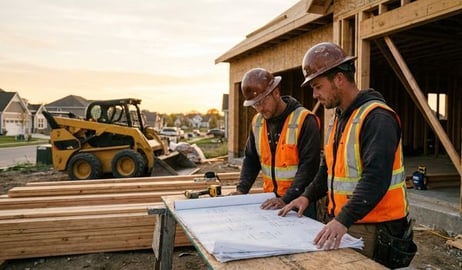


The general contracting industry sits at the center of the American construction economy, coordinating the residential, commercial, and infrastructure projects that physically build the country. The 2026 data shows an industry that is large, resilient, and steadily modernizing, even as it wrestles with a persistent labor shortage and thin profit margins. Whether you already run a general contracting company or you are researching the trade, understanding current general contractor statistics gives you a factual foundation for decisions about hiring, pricing, expansion, and financing.
This report compiles the most important general contractor industry statistics for 2026, drawing from the U.S. Census Bureau, the Bureau of Labor Statistics, industry associations, and market research firms. Where figures vary by source, we present the range so you can see the full picture rather than a single cherry-picked number.
In This Article
- General Contractor Industry Overview
- How Many General Contractors Operate in the U.S.?
- Employment and Wage Statistics
- Revenue, Profit Margins, and Business Economics
- Startup Costs and Business Formation Statistics
- Residential vs. Commercial General Contracting
- Technology Adoption Among General Contractors
- Labor Shortage and Workforce Statistics
- Growth Trends and 2026 Outlook
- Financing Options for General Contractors
- Frequently Asked Questions
General Contractor Industry Overview
General contractors are the project managers of the construction world. They bid on projects, hire and supervise subcontractors, order materials, pull permits, schedule inspections, and carry ultimate responsibility for delivering a finished building on time and on budget. The business model exists in every state and nearly every community, which is why general contracting remains one of the most common paths into construction business ownership.
The scale of the industry that general contractors operate in is enormous. Total U.S. construction spending has been running at an annualized pace of roughly $2.1 trillion to $2.2 trillion, according to the U.S. Census Bureau's construction spending reports. Residential construction accounts for close to half of that total, with nonresidential building and public works making up the balance. Construction activity overall contributes approximately 4 to 4.5 percent of U.S. gross domestic product, and general contractors touch a substantial share of that spending because nearly every significant project has a GC at the top of the contracting chain.
Market research firms that track general contracting specifically as an industry segment estimate the U.S. general contractors market in the range of $900 billion to $1.1 trillion in annual revenue, depending on how the segment is defined and whether design-build and construction management revenue is included. The wide range reflects the reality that many general contractors also operate as developers, construction managers, or specialty trades, and different analysts draw the line differently.
Key Stat: U.S. construction spending has held above a $2 trillion annualized rate for three consecutive years, and industry surveys consistently show a majority of general contractors reporting steady or growing backlogs heading into 2026.
What distinguishes 2026 from earlier cycles is the mix of work. Single-family residential construction has recovered unevenly from the interest rate shock of 2022 and 2023, while manufacturing facilities, data centers, energy projects, and infrastructure work funded by federal legislation have provided a strong counterweight. General contractors with diversified project mixes have generally fared better than those concentrated in rate-sensitive residential segments.
How Many General Contractors Operate in the U.S.?
Counting general contractors precisely is harder than it sounds, because the category overlaps with home builders, remodelers, design-build firms, and construction managers. The most authoritative source, the Census Bureau's Statistics of U.S. Businesses program, tracks establishments under NAICS code 236, Construction of Buildings. That category, which covers residential and nonresidential general contractors, contains roughly 230,000 to 250,000 business establishments in the most recent data releases.
The broader construction sector, including specialty trade contractors such as electricians, plumbers, and framers who work under general contractors, encompasses approximately 3.8 million to 3.9 million business establishments nationwide. When self-employed individuals operating as independent general contractors without a formal payroll are included, estimates of the total number of businesses performing general contracting work climb higher still, with some industry analyses placing the figure above 700,000 when all nonemployer firms are counted.
Several structural facts about the business population stand out:
- The vast majority of general contracting firms are small. Roughly 8 out of 10 construction establishments have fewer than 10 employees, and general contracting follows the same pattern.
- Self-employment is unusually common in construction. About one in four construction workers is self-employed, one of the highest rates of any major industry, and many of those self-employed workers operate as small general contractors or remodelers.
- The industry is fragmented. The largest national home builders and commercial contractors capture meaningful share in their niches, but no single firm holds even 1 percent of the overall general contracting market.
- Barriers to entry are relatively low in states with light licensing requirements, which keeps new business formation high but also contributes to the industry's elevated failure rates.
Geographically, general contractor density tracks population and construction activity. California, Texas, and Florida consistently lead in the number of licensed contractors and construction establishments, followed by New York, Pennsylvania, and the fast-growing Southeast and Mountain West states. On a per-capita basis, states with rapid housing growth such as Idaho, Utah, and the Carolinas show some of the highest concentrations of general contracting businesses.
By the Numbers
General Contractor Industry - Key 2026 Statistics
$2.1T+
Annual U.S. construction spending (Census Bureau, annualized)
~240,000
General contractor establishments (Census, NAICS 236)
$106,980
Median annual wage, construction managers (BLS)
9%
Projected job growth, construction managers 2024-2034 (BLS)
Employment and Wage Statistics
Construction is one of the largest employment sectors in the American economy, with roughly 8.2 million to 8.3 million wage and salary workers on payrolls in recent Bureau of Labor Statistics readings, plus millions more self-employed workers. General contractors draw from nearly every occupation in that workforce, either as direct employees or as subcontractors.
The occupation most closely associated with general contracting is construction manager. The Bureau of Labor Statistics reports approximately 520,000 to 560,000 construction manager jobs, with a median annual wage of $106,980. The lowest 10 percent of earners make less than about $65,000, while the top 10 percent earn more than $176,000, reflecting the wide spread between small residential contractors and managers running large commercial projects. Employment of construction managers is projected to grow about 9 percent from 2024 to 2034, much faster than the average for all occupations.
Wages across the trades that general contractors supervise have risen sharply since 2020. Average hourly earnings for construction workers have climbed roughly 20 to 25 percent over the past five years, outpacing overall private-sector wage growth, as contractors compete for a limited pool of skilled labor. Journeyman carpenters, electricians, and plumbers in major metro markets now commonly command $35 to $55 per hour, and total compensation packages including benefits run significantly higher.
For general contracting business owners, compensation varies enormously with firm size and project mix. Owner earnings at small residential GC firms frequently fall in the $70,000 to $120,000 range, while owners of established mid-size commercial firms can earn several times that. Industry salary surveys place the average general contractor owner income in the broad range of $80,000 to $150,000, with the understanding that top performers in strong markets earn well above the average.
Ready to Grow Your Contracting Business?
Get fast, flexible financing from the #1 business lender in the U.S. No obligation - apply in minutes.
Apply Now →Revenue, Profit Margins, and Business Economics
General contracting is a high-revenue, thin-margin business. Industry benchmarking surveys and financial ratio studies consistently place average net profit margins for general contractors in the range of 2 percent to 6 percent of revenue, with residential remodelers and custom home builders often achieving gross margins of 15 percent to 25 percent before overhead, and commercial general contractors typically operating on gross margins of 5 percent to 12 percent on pass-through-heavy project work.
Revenue per firm varies with size. A one-person residential general contracting operation might bill $300,000 to $800,000 per year, while a mid-size commercial GC with 20 to 50 employees commonly generates $20 million to $75 million in annual revenue. At the top of the industry, the largest national contractors each report annual revenue in the billions, though as noted earlier, even the biggest firms hold a small share of the total market.
Several economic realities shape general contractor finances in 2026:
- Material costs remain elevated. Construction input prices are roughly 35 to 40 percent higher than pre-2020 levels, even after the sharp declines in lumber and steel from their pandemic peaks.
- Labor is the fastest-growing cost line. Wage pressure has squeezed margins for contractors working under fixed-price contracts signed before recent wage increases.
- Payment cycles are long. Commercial general contractors routinely wait 60 to 90 days for progress payments, which makes working capital management one of the most important financial skills in the business.
- Bonding and insurance costs have risen, with general liability premiums for contractors increasing at a high single-digit annual rate in many states.
Key Stat: Cash flow, not profitability, is the number one financial challenge reported by general contractors. Industry surveys show that more than half of contractors have experienced a project delay or cancellation tied to financing or payment issues in the past two years.
The firms that consistently outperform on margin tend to share a few traits: disciplined estimating, change-order management, negotiated rather than hard-bid work, and access to flexible working capital that lets them take discounts on materials and keep crews scheduled tightly. That last factor is where financing becomes a competitive tool rather than just a safety net.
Startup Costs and Business Formation Statistics
Starting a general contracting business in 2026 requires less capital than buying into many franchise or equipment-heavy industries, but more than launching a pure service business. A realistic startup budget for a small residential general contracting company breaks down roughly as follows:
- Licensing, registration, and exam fees: $300 to $2,000 depending on the state
- General liability insurance and initial bond premiums: $2,500 to $8,000 per year for a small operation
- Tools and equipment: $5,000 to $25,000, with many new GCs starting with owned tools and renting specialty equipment
- Vehicle (often already owned): $0 to $40,000 if a dedicated work truck is purchased
- Office setup, software, and marketing: $2,000 to $10,000
- Initial working capital to cover payroll, materials deposits, and the gap before first draws: $15,000 to $100,000 or more
All in, most new general contractors launch with total startup investment in the range of $25,000 to $150,000, with the wide spread driven mainly by how much working capital cushion the founder carries. Undercapitalization is consistently cited by lenders and industry advisors as the leading cause of early failure, ahead of lack of technical skill.
On business formation, the construction sector is consistently one of the top industries for new business applications in the Census Bureau's business formation data. Construction regularly accounts for roughly 10 to 12 percent of all new U.S. business applications, a striking figure given the industry's size, and a reflection of both low entry barriers and the constant churn of the contractor population. Anyone researching how to start a business will find the SBA's business launch guide a useful checklist for the registration, licensing, and planning steps that apply in every state.
Survival statistics tell the sobering side of the story. Bureau of Labor Statistics business survival data shows that roughly 20 percent of new construction businesses fail within their first year, about half close within five years, and only about one-third remain operating at the ten-year mark. Construction has one of the higher failure rates of any major industry, which is precisely why experienced operators emphasize financial discipline and adequate capitalization from day one.
Residential vs. Commercial General Contracting
The general contracting industry splits into two broad segments with very different economics, and the 2026 statistics show them moving on different cycles.
Residential General Contracting
Residential general contractors build custom homes, manage renovations and additions, and coordinate remodeling projects. The residential remodeling market alone is estimated at $500 billion to $600 billion annually, while new single-family construction contributes several hundred billion more. Residential GCs are typically smaller, more local businesses, often with the owner still walking job sites daily. Margins on custom residential work run higher than commercial work, commonly 15 to 25 percent gross, because projects are smaller, contracts are often cost-plus, and the customer relationship is direct.
The residential segment is interest-rate sensitive. Elevated mortgage rates in recent years suppressed existing-home sales, which pushed more homeowners toward renovating rather than moving. That dynamic has kept remodeling backlogs healthier than new-construction backlogs in many markets, and remodelers report some of the strongest demand readings in industry surveys heading into 2026.
Commercial General Contracting
Commercial general contractors manage offices, retail, industrial, healthcare, and institutional projects. Project sizes are larger, contracts are more complex, and prequalification, bonding capacity, and safety records matter as much as price. Commercial GC revenue is more concentrated, with the top 400 contractors capturing a meaningful share of large-project work, though thousands of small and mid-size commercial GCs thrive in regional markets.
The commercial segment in 2026 is being reshaped by two forces. On the upside, manufacturing construction, data centers, and energy infrastructure have grown at double-digit rates, and contractors positioned in those niches report strong backlogs. On the downside, traditional office construction remains well below pre-2020 levels, and retail is flat outside of grocery-anchored and mixed-use formats.
Need Working Capital for Your Next Project?
Crestmont Capital funds contractors fast - cover payroll, materials, and equipment without waiting on draws.
Apply Now →Technology Adoption Among General Contractors
General contracting has historically been a paper-and-phone industry, but adoption statistics show that changing quickly. Surveys of contractors in 2024 and 2025 indicate that roughly 70 to 80 percent of general contractors now use dedicated construction project management software, up from under half a decade earlier. Platforms for scheduling, document management, and client communication have become table stakes even for firms with fewer than 10 employees.
Other technology adoption markers worth noting:
- Building information modeling (BIM) is used by a majority of mid-size and large commercial GCs on at least some projects, though adoption among small residential contractors remains below 20 percent.
- Drone usage for site surveys and progress documentation has moved from novelty to routine on larger commercial sites, with adoption estimates in the 40 to 60 percent range among mid-size and large firms.
- Digital estimating and takeoff tools are now used by roughly two-thirds of contractors, cutting estimating time and improving bid accuracy.
- AI-assisted tools for scheduling, document review, and proposal drafting are the newest category, with early-adopter surveys showing roughly one in five contractors experimenting with AI tools in 2025.
The productivity stakes are high. Construction productivity growth has lagged the overall economy for decades, and industry analysts widely view technology adoption as the most realistic path to closing that gap. For individual GC firms, the practical benefit is simpler: better software means fewer estimate errors, tighter schedules, faster invoicing, and cleaner documentation when disputes arise.
Labor Shortage and Workforce Statistics
If there is one statistic that defines the general contracting industry in 2026, it is the labor gap. Industry association surveys have found for several consecutive years that roughly 88 to 94 percent of contractors report open positions they are trying to fill, and a majority describe the labor market as their single biggest business challenge, ahead of material costs, regulation, and interest rates.
The numbers behind the shortage are structural. The construction workforce is aging, with a median age in the low 40s and a large share of skilled tradespeople approaching retirement. Industry estimates suggest the sector needs to attract roughly 450,000 to 500,000 new workers per year on top of normal hiring to meet demand and replace retirements. Meanwhile, only about one in ten construction workers is under 25, and women represent roughly 11 percent of the construction workforce, concentrated in management and office roles rather than the trades, which suggests large untapped labor pools.
Key Stat: Industry surveys consistently show about 9 in 10 general contractors have open craft or salaried positions, and more than half report that project schedules have been delayed specifically because of labor shortages.
For general contractors, the labor shortage has practical consequences beyond hiring difficulty. Wage inflation compresses margins on fixed-price work, schedule slippage triggers liquidated damages on commercial contracts, and firms that cannot staff projects are forced to decline work. The contractors navigating this best are investing in training pipelines, raising wages proactively rather than reactively, and using technology to get more output from the crews they have.
Growth Trends and 2026 Outlook
The outlook for general contractors in 2026 is cautiously positive, with meaningful variation by segment and region. Forecasts from industry economists generally project total U.S. construction spending to grow in the low-to-mid single digits in nominal terms, with the strongest segments being manufacturing facilities, data centers, power and energy infrastructure, healthcare, and public works. Single-family residential construction is expected to improve gradually if mortgage rates ease, while multifamily construction works through an oversupply hangover in some Sun Belt markets.
Longer term, the demand drivers for general contracting remain strong. The national housing shortage is commonly estimated at 3 million to 5 million units, infrastructure spending from federal legislation continues to flow into projects, and the reshoring of manufacturing has created a pipeline of industrial construction that will take years to complete. Industry forecasters project the construction manager occupation to add tens of thousands of jobs over the coming decade, and business formation in construction shows no signs of slowing.
The risks to that outlook are equally clear: interest rates staying higher for longer, continued labor scarcity, potential tariff-driven material cost spikes, and the ever-present possibility of a broader economic slowdown. General contractors entering 2026 with strong balance sheets, diversified project mixes, and access to credit are positioned to take share if conditions soften, because construction downturns historically reward well-capitalized firms that survive them.
Financing Options for General Contractors
The statistics throughout this report point to a common theme: general contracting is a business where cash flow timing matters as much as profitability. Progress payments lag expenses, payroll runs weekly, and material suppliers want deposits before delivery. That is why access to the right financing is a competitive advantage for GCs, not just a fallback.
The financing tools most commonly used by general contractors include:
- Working capital loans to bridge the gap between paying crews and suppliers and collecting progress payments. Our guide to general contractor loans covers these options in detail.
- Business lines of credit that let a contractor draw only what is needed for a specific project and repay it when the draw comes in.
- Construction equipment financing for excavators, loaders, lifts, trucks, and trailers, preserving cash by spreading equipment costs over the asset's useful life.
- Construction company business loans structured around the realities of contract-based revenue.
- SBA loans for larger, longer-term needs such as buying a shop, acquiring a competitor, or refinancing expensive debt, with the tradeoff of a longer application process.
Because margins are thin, the cost and speed of capital matter enormously. A contractor who can take a 2 percent early-payment discount on materials, or mobilize a crew immediately instead of waiting 60 days for a bank decision, often earns more from the speed than the financing costs. For a deeper look at how funding fits the contractor business model, see our complete contractor financing guide.
Get Funding Built for Contractors
Fast approvals, flexible terms, and a team that understands construction cash flow. See what your business qualifies for.
Apply Now →Frequently Asked Questions
How big is the general contracting industry in 2026? +
Total U.S. construction spending is running at an annualized pace of roughly $2.1 trillion to $2.2 trillion, and market research firms estimate the general contracting segment specifically at $900 billion to $1.1 trillion in annual revenue, depending on how the category is defined.
How many general contractors are there in the United States? +
The Census Bureau tracks roughly 230,000 to 250,000 establishments under NAICS code 236, Construction of Buildings, which covers residential and nonresidential general contractors. Including self-employed nonemployer firms performing GC work, broader estimates exceed 700,000 businesses.
What is the average revenue of a general contracting business? +
It varies widely by size. A solo residential GC might bill $300,000 to $800,000 per year, a mid-size commercial GC with 20 to 50 employees commonly generates $20 million to $75 million, and the largest national contractors report billions in annual revenue.
What profit margin do general contractors typically make? +
Industry benchmarking studies place average net profit margins at roughly 2 to 6 percent of revenue. Residential remodelers and custom builders often achieve 15 to 25 percent gross margins before overhead, while commercial GCs commonly operate on 5 to 12 percent gross margins.
How much does it cost to start a general contracting business? +
Most new general contractors launch with $25,000 to $150,000 in total startup investment, covering licensing, insurance and bonding, tools, a vehicle, software, and initial working capital. The working capital cushion is the largest and most commonly underestimated line item.
What percentage of general contracting businesses fail? +
Bureau of Labor Statistics survival data shows roughly 20 percent of new construction businesses close within the first year, about half within five years, and only about one-third remain operating at ten years. Construction has one of the higher failure rates of any major industry, with undercapitalization cited as a leading cause.
How much do general contractors earn per year? +
The BLS reports a median annual wage of $106,980 for construction managers. Business owner income varies more widely, with industry surveys placing average GC owner compensation around $80,000 to $150,000, and top performers in strong markets earning well above that range.
Is the general contracting industry growing? +
Yes. Construction spending has held above a $2 trillion annualized rate for three consecutive years, employment of construction managers is projected to grow about 9 percent from 2024 to 2034, and demand drivers such as the housing shortage, infrastructure spending, and manufacturing reshoring support long-term growth.
Which states have the most general contractors? +
California, Texas, and Florida consistently lead in licensed contractors and construction establishments, followed by New York and Pennsylvania. On a per-capita basis, fast-growing states such as Idaho, Utah, and the Carolinas show some of the highest concentrations of general contracting businesses.
What is the biggest challenge facing general contractors in 2026? +
The labor shortage. Industry surveys show roughly 88 to 94 percent of contractors have open positions they cannot fill, and the sector needs an estimated 450,000 to 500,000 new workers per year on top of normal hiring to meet demand and replace retiring workers.
Do general contractors need a license? +
In most states, yes, though requirements vary significantly. Some states license GCs at the state level with exams and financial requirements, others delegate licensing to counties or cities, and a few have minimal requirements. Bonding and general liability insurance are effectively mandatory everywhere for commercial work.
How is technology changing general contracting? +
Roughly 70 to 80 percent of GCs now use construction project management software, digital estimating tools are used by about two-thirds of contractors, drones are routine on larger commercial sites, and early surveys show about one in five contractors experimenting with AI-assisted tools for scheduling, document review, and proposals.
How do general contractors get paid? +
Most GCs are paid through progress payments tied to project milestones or monthly draws, often with 5 to 10 percent retainage held until project completion. Commercial contractors routinely wait 60 to 90 days for payment, which is why working capital management is such a critical skill in the industry.
What is the difference between a general contractor and a subcontractor? +
The general contractor holds the prime contract with the project owner and is responsible for the entire project. Subcontractors are hired by the GC to perform specific scopes of work, such as electrical, plumbing, or framing. A single commercial project may involve a GC coordinating dozens of subcontractors.
How do general contractors finance equipment and growth? +
The most common tools are working capital loans to bridge payment timing, business lines of credit for project-by-project draws, equipment financing that spreads machinery costs over the asset's useful life, and SBA loans for larger long-term investments. Fast, flexible funding matters because margins are thin and speed to mobilize wins jobs.
Disclaimer: The information provided in this article is for general educational purposes only and is not financial, legal, or tax advice. Funding terms, qualifications, and product availability may vary and are subject to change without notice. Crestmont Capital does not guarantee approval for any financing product. Statistics cited are drawn from public sources including the U.S. Census Bureau and Bureau of Labor Statistics, as well as industry association surveys and market research estimates; figures may vary by source and are subject to revision. Consult a qualified professional before making business or financial decisions.

About the author and reviewer
Allan GarfinkleMBA (Finance), JD
Chief Revenue Officer, Crestmont Capital
Allan Garfinkle is the Chief Revenue Officer at Crestmont Capital, where he has spent more than a decade leading revenue strategy, business development, and operational growth. With 28 years of experience building and advising startups and small businesses, Allan has helped more than 10,000 business owners navigate financing decisions, growth opportunities, and changing economic conditions. He earned a Bachelor of Science in Economics and an MBA with a concentration in Finance from Northeastern University, as well as a Juris Doctor from New England Law, where his studies focused on contracts and business law. His writing draws on extensive practical experience in small-business lending, equipment financing, business credit, and commercial finance.