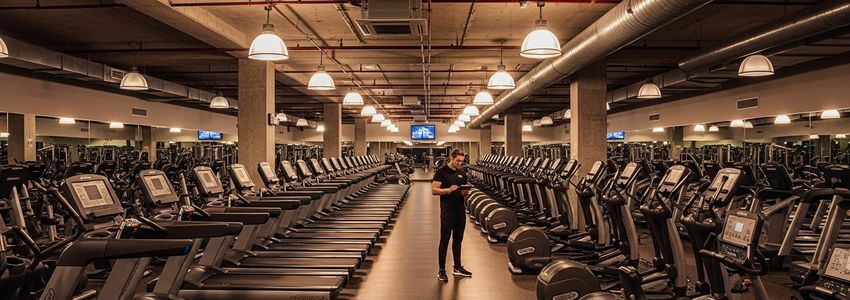
Running a successful fitness center means constantly investing in your facility, your team, and your members' experience. But growth costs money - and most gym owners face a recurring challenge: revenue is strong, but capital for the next phase of expansion is tied up in operations. Fitness center loans give gym owners and studio operators access to the funding they need to upgrade equipment, expand their footprint, hire staff, and compete in an increasingly competitive wellness market.
This guide covers every major financing option available to fitness centers, how the qualification process works, and real-world examples of how gym owners have used business loans to drive measurable growth.
In This Article
What Are Fitness Center Loans?
Fitness center loans are business financing products tailored to gyms, health clubs, boutique studios, and wellness facilities. These funding solutions help gym owners cover capital-intensive investments - from commercial-grade cardio equipment and free weights to locker room renovations and digital member management systems - without draining working capital or waiting for revenue to accumulate slowly over time.
Unlike consumer loans or personal lines of credit, fitness center business loans are structured around business revenue, cash flow, and operational needs. Lenders evaluate your gym's monthly revenue, time in business, and growth trajectory rather than treating the loan like a personal financial decision.
Industry Context: The U.S. fitness industry generates over $35 billion annually, with more than 41,000 health clubs, gyms, and fitness studios operating across the country. According to the International Health, Racquet and Sportsclub Association (IHRSA), the average gym member spends $58 per month on membership - creating predictable recurring revenue that makes fitness businesses attractive borrowers for specialized lenders.
Why Gym Owners Use Business Financing
The fitness business model creates specific financial dynamics that make external financing particularly valuable:
High equipment costs with defined replacement cycles. Commercial-grade treadmills, ellipticals, and strength training equipment cost significantly more than consumer versions and have expected useful lives of 5 to 10 years. A full cardio floor refresh for a mid-size gym can easily run $100,000 to $300,000. Equipment financing spreads these costs over time while keeping the gym competitive.
Facility investments that precede revenue. Renovation projects - new locker rooms, expanded group fitness space, updated reception areas - all require capital before any incremental revenue is generated. Loans bridge this gap between investment and return.
Predictable revenue that supports regular loan payments. Membership-based businesses generate consistent monthly income that aligns well with fixed loan repayment schedules. Lenders view this predictability as a risk mitigator.
Seasonal demand patterns requiring cash flow management. January membership surges fund the spring, but summer and late fall can be slower. Lines of credit help gym owners maintain staffing and marketing spend during slower periods without cutting services that drive long-term retention.
Competitive pressure requiring continuous investment. The fitness industry is increasingly competitive, with new boutique concepts, budget gyms, and digital fitness alternatives all competing for members. Gyms that cannot invest in their facilities and experience risk losing members to better-equipped competitors.
Ready to Finance Your Fitness Center's Growth?
Get fast, flexible financing from the #1 business lender in the U.S. Apply in minutes with no obligation.
Apply Now →Types of Fitness Center Loans
Gym owners have access to multiple financing products, each suited to different needs and financial profiles:
Equipment Financing
The most common financing product for fitness centers. Equipment financing lets you purchase commercial gym equipment - cardio machines, strength training equipment, free weights, flooring, sound systems, and more - using the equipment itself as collateral. This typically results in lower rates than unsecured loans and faster approvals. Loan terms usually align with the expected useful life of the equipment, commonly 3 to 7 years. Explore gym equipment financing options.
Equipment Leasing
Rather than purchasing equipment outright, leasing lets you use it for a fixed monthly payment and return or upgrade it at the end of the term. Leasing is advantageous when equipment becomes outdated quickly (like digital fitness consoles or booking kiosks) or when you want to preserve cash flow with lower monthly payments. Compare equipment leasing options.
Working Capital Loans
Short-term loans of $10,000 to $250,000 for operational needs - payroll, marketing campaigns, utility deposits, insurance, seasonal staffing, and unexpected expenses. Working capital loans are typically unsecured, approved quickly (often within 24 to 48 hours), and carry repayment terms of 3 to 24 months.
Business Line of Credit
A revolving credit facility that lets you draw and repay capital as needed, up to an approved limit. Ideal for managing cash flow variability across seasonal cycles. You only pay interest on what you draw, making it more cost-effective than a term loan for fluctuating operational needs. Learn about business lines of credit.
SBA Loans
Government-backed loans through the U.S. Small Business Administration offer the lowest rates available to qualified gym owners, with repayment terms up to 10 years for business investments and up to 25 years for commercial real estate. The SBA 7(a) program is the most common route. The tradeoff is a longer application process and more documentation. Review SBA loan programs.
Term Loans
Conventional term loans from $25,000 to $500,000+ provide a lump sum for major investments - facility expansions, location acquisitions, or complete gym buildouts. Repayment terms typically range from 1 to 5 years with alternative lenders and up to 10 years through SBA programs.
Revenue-Based Financing
An advance against future revenue, repaid as a percentage of monthly sales. Payments automatically flex with your gym's income, which can simplify cash flow management during slower months. Best suited for gyms with consistent monthly recurring revenue from memberships.
By the Numbers
Fitness Center Financing - Key Statistics
$35B+
U.S. fitness industry annual revenue
41K+
U.S. health clubs and fitness studios
$58/mo
Average monthly gym membership spend
24-48 hrs
Typical working capital approval time
How Fitness Center Financing Works
The process for securing a fitness center loan varies by lender and product, but most follow a similar path:
Quick Guide
How Fitness Center Loans Work - At a Glance
Submit a short application with basic business and revenue information - typically takes under 15 minutes.
Lender reviews monthly revenues, cash flow consistency, credit profile, and business history.
Lender presents loan amount, term, rate, and payment structure. Compare offers before signing.
Funds deposit to your business account - often within 1 to 3 business days for working capital products.
Application requirements. Most alternative lenders require three to six months of business bank statements, basic business information (EIN, legal business name, ownership), and a government-issued ID. SBA loans require two years of tax returns, a business plan, and a personal financial statement.
Underwriting criteria. Lenders evaluate monthly gross revenue, consistency of cash flow deposits, time in business, personal and business credit scores, and existing debt service obligations. Gyms with strong membership revenue and at least 12 months of operating history have the broadest access to financing options.
Repayment structure. Equipment financing uses fixed monthly payments over 3 to 7 years. Working capital loans may use daily, weekly, or monthly payment schedules over 3 to 24 months. Lines of credit have revolving structures with interest charged only on active balances.
What You Can Fund with Fitness Center Loans
Business loans give gym owners flexibility to invest across multiple growth areas:
Cardio equipment refresh or expansion. Commercial treadmills, ellipticals, and stationary bikes cost $2,000 to $8,000 each. A full cardio floor for a 10,000 square foot gym can require $100,000 to $250,000. Equipment financing makes this manageable with predictable monthly payments.
Strength training equipment and free weights. Plate-loaded machines, cable systems, dumbbells, barbells, and functional training rigs represent major capital investments. Many gyms finance a full strength floor refresh every 7 to 10 years.
Group fitness studio build-outs. Dedicated cycling, yoga, HIIT, or barre studios require specialized flooring, mirroring, sound systems, and sometimes climate control upgrades. These spaces drive premium pricing and membership differentiation.
Locker room and facility renovations. Updated locker rooms, showers, and amenity areas directly impact member retention and the gym's ability to command premium membership rates. Renovation costs typically range from $50 to $200 per square foot.
Technology and software investments. Member management software, digital check-in systems, on-demand workout platforms, and TV/display systems for equipment have become standard expectations. Technology financing spreads these costs over time.
Marketing and member acquisition campaigns. Digital advertising, referral programs, grand opening events for new locations, and brand awareness campaigns all require concentrated capital investment before the revenue return materializes.
Payroll and staffing. Qualified personal trainers, group fitness instructors, and front desk staff are the core of any gym's member experience. Working capital loans help maintain staffing levels during slow seasons or ramp-up periods for new locations.
Second location acquisition. Opening a second facility is the most capital-intensive growth move for gym owners. Financing typically covers the security deposit, leasehold improvements, initial equipment, pre-opening marketing, and early payroll before revenue stabilizes.
Fitness Center Loan Options Compared
| Loan Type | Typical Amount | Term | Best For | Speed |
|---|---|---|---|---|
| Equipment Financing | $10K-$500K | 3-7 years | Cardio, strength equipment | 1-3 days |
| Working Capital Loan | $10K-$250K | 3-24 months | Payroll, marketing, operations | 24-48 hours |
| Business Line of Credit | $10K-$250K | Revolving | Seasonal cash flow | 2-5 days |
| Term Loan | $25K-$500K | 1-5 years | Renovations, expansion | 2-7 days |
| SBA 7(a) Loan | Up to $5M | Up to 10 years | Large investments, 2nd location | 2-8 weeks |
| Revenue-Based Financing | $10K-$500K | 6-36 months | Variable revenue gyms | 24-72 hours |

How to Qualify for Fitness Center Loans
Qualification requirements vary by product and lender, but understanding what underwriters look for helps gym owners prepare strong applications:
Time in business. Most alternative lenders prefer at least 12 months of operating history. SBA loans typically require two or more years. Brand-new gyms have more limited options but can access equipment financing and some SBA startup programs.
Monthly revenue thresholds. Working capital lenders generally require $10,000 to $20,000 in minimum monthly gross revenue. Larger loan amounts require higher revenue benchmarks. Gyms generating $50,000 or more per month have the broadest access to competitive financing.
Credit score requirements. Personal credit scores of 580 to 620 may qualify for some products. Scores of 650 or above open up more options and better rates. SBA loans typically require 680 or higher. Business credit scores (Dun and Bradstreet, Experian Business) also factor into underwriting for larger loans.
Cash flow consistency. Lenders want to see regular, predictable deposits - not just high-volume months followed by gaps. If your gym has seasonal patterns, be ready to provide context (e.g., January surge, summer dip, fall recovery).
Debt service coverage. Lenders evaluate whether your gym generates enough free cash flow to cover existing debt payments plus the new loan. A general benchmark is that free cash flow should cover debt service by at least 1.25 times.
Pro Tip: Gym owners who apply for financing during a revenue peak - like January or September - present the strongest application profile. Applying when monthly revenues are naturally high shows lenders your gym's true earning potential. Avoid applying immediately after a slow summer if possible.
How Crestmont Capital Helps Fitness Centers
Crestmont Capital is the #1 rated business lender in the United States, with extensive experience financing gyms, health clubs, boutique studios, and wellness facilities. Here is what distinguishes Crestmont's approach for fitness businesses:
Industry-aware underwriting. Crestmont understands the fitness business model - predictable membership revenue, seasonal patterns, high equipment costs, and the specific growth trajectory of gym businesses. That context shapes more relevant, competitive financing offers than generic small business lenders provide.
Multiple products under one roof. Whether your gym needs equipment financing for a cardio floor refresh, a working capital loan to fund a marketing campaign, or an SBA loan to open a second location, Crestmont matches you with the right product for your situation.
Fast approvals and funding. Working capital approvals within 24 to 48 hours. Equipment financing in 1 to 3 business days. Even for more complex SBA deals, Crestmont's process moves faster than traditional banks.
Flexible qualification standards. Crestmont evaluates the full picture of your gym's financial health rather than relying on credit score alone. Strong monthly revenue and growth momentum count for a lot.
Gym owners can start by exploring fitness company business loans or reviewing small business financing options for a broader view of available programs. For equipment-specific needs, gym equipment financing is available through dedicated programs built for the fitness industry.
See What Your Gym Qualifies For
No obligation. Crestmont advisors work with gyms at every stage - from single locations to multi-site operators.
Check Your Options →Real-World Fitness Center Loan Scenarios
Understanding how other gym owners have used financing can clarify which products fit your situation:
Scenario 1: Independent gym - cardio floor refresh. A 12-year-old independent health club in suburban Ohio had aging treadmills and ellipticals that members were complaining about. The owner used equipment financing to replace 28 cardio machines for $187,000, spread over 60 months. The new equipment drove a 15% reduction in membership cancellations and a 9% increase in new member sign-ups over the following six months - generating more than enough incremental revenue to offset the monthly loan payment.
Scenario 2: Boutique gym - second location expansion. A strength and conditioning gym in Austin had a strong membership base and a waitlist. The owner secured an SBA 7(a) loan for $340,000 to fund leasehold improvements, equipment, and six months of pre-revenue operating costs for a second location. The second location reached break-even membership revenue within four months of opening.
Scenario 3: Studio - summer payroll bridge. A CrossFit affiliate in the Pacific Northwest experienced a 35% revenue drop every July and August as members traveled. The owner established a $75,000 business line of credit in April, drawing on it during summer to maintain full staffing. The line was fully repaid within 60 days of the September membership surge.
Scenario 4: Multi-location gym - technology upgrade. A regional health club chain with four locations needed to deploy new member management software, digital check-in kiosks, and on-demand fitness displays across all facilities. The total technology investment was $110,000. Equipment financing covered the hardware, while a working capital loan funded the software subscriptions and staff training costs during the rollout period.
Scenario 5: New gym - grand opening marketing. A new functional fitness gym in Denver allocated $45,000 in working capital financing to a concentrated 90-day pre-opening and launch marketing campaign. The campaign delivered 280 founding memberships before the doors opened - providing immediate revenue to support early loan payments and reducing the financial ramp-up period significantly.
Frequently Asked Questions
What are fitness center loans?
Fitness center loans are business financing products - including equipment financing, working capital loans, business lines of credit, term loans, and SBA loans - designed to help gym owners and studio operators fund equipment, renovations, marketing, payroll, and expansion. These products are available through traditional banks, SBA-approved lenders, and alternative lenders like Crestmont Capital.
How much can I borrow for my gym?
Loan amounts depend on your gym's revenue, credit profile, and the type of financing. Working capital loans typically range from $10,000 to $250,000. Equipment financing can reach $500,000 or more for major equipment packages. SBA loans can reach up to $5 million. Most gym owners seeking their first loan qualify for $25,000 to $200,000 depending on monthly revenue.
What credit score do I need?
Most alternative lenders accept credit scores of 580 to 620 for basic products. Scores of 650 or above qualify for a wider range of options and better rates. SBA loans typically require 680 or higher. Strong monthly revenue can partially offset lower credit scores with certain lenders. Crestmont evaluates overall business health, not just credit scores.
How quickly can I get funded?
Working capital loans can be approved within 24 to 48 hours and funded within one to three business days. Equipment financing typically takes one to three days. SBA loans require two to eight weeks. For urgent operational needs, working capital products offer the fastest path to capital.
Can a new gym get financing?
New gyms face more limited options but are not excluded from financing. Equipment financing is typically the most accessible product for newer businesses, especially when the owner has good personal credit. SBA startup loans are another option. Most working capital products require at least 6 to 12 months of operating history. Having a detailed business plan strengthens any startup loan application significantly.
What documents do I need to apply?
Standard requirements include three to six months of business bank statements, government-issued ID, basic business information (EIN, legal name, address), and documentation of monthly revenue. SBA loans require two years of tax returns, a business plan, personal financial statement, and sometimes equipment quotes or lease agreements for the intended use of funds.
Can I use a loan to cover payroll during slow months?
Yes. Working capital loans and business lines of credit are regularly used to maintain staffing through seasonal slowdowns. Retaining experienced trainers and staff through a slow summer is almost always more cost-effective than losing them and recruiting replacements in the fall. A line of credit is ideal for this because you only pay interest on what you draw.
Should I finance or lease gym equipment?
Financing (purchasing with a loan) builds equity in the equipment and is generally more cost-effective over the full useful life. Leasing offers lower monthly payments and the option to upgrade equipment at lease-end, which can be advantageous for technology-dependent gear that becomes outdated. For durable physical equipment like strength machines and cardio equipment, financing to own often makes better financial sense than leasing.
What interest rates should I expect?
Interest rates vary significantly by product and borrower profile. SBA loans typically range from 6% to 12% APR. Equipment financing from 5% to 18% depending on credit and equipment type. Working capital loans from alternative lenders may carry higher effective rates (12% to 35% APR) due to shorter terms and faster processing. Always compare the total cost of financing, not just the stated rate.
Can I get financing with bad credit?
Yes, though options may be more limited and rates higher. Alternative lenders like Crestmont Capital focus on overall business health - gyms with strong monthly revenues of $15,000 or more often qualify even with credit scores in the 550 to 620 range. Revenue-based financing and merchant cash advances are the most accessible products for lower-credit borrowers.
How do I choose between a term loan and a line of credit?
Use a term loan for a specific, defined investment with a known cost - like a renovation project or equipment purchase. Use a line of credit for ongoing needs that vary in size - like seasonal payroll, marketing expenses, or emergency repairs. Many gym owners benefit from having both: a term loan for specific growth projects and a line of credit as a standing operational safety net.
Will applying for a loan affect my credit score?
Initial pre-qualification applications typically use a soft credit pull, which does not affect your score. A hard credit inquiry, which may temporarily reduce your score by a few points, usually happens only when a lender proceeds to full underwriting. When shopping multiple lenders in a short window, credit scoring models typically treat multiple inquiries as a single rate-shopping event.
Can Crestmont help with both equipment and working capital?
Yes. Crestmont Capital offers a full suite of financing products - equipment financing, working capital loans, lines of credit, SBA loans, and more - under one roof. Gym owners can work with a single advisor who evaluates their complete financing picture and recommends the right combination of products for their growth goals.
What is the best loan for opening a second gym location?
An SBA 7(a) loan is usually the best option for a second location due to lower rates and longer repayment terms that ease the cash flow pressure during the ramp-up period. If SBA timelines are too slow, a conventional term loan from an alternative lender can fund faster. Many gym owners use a combination: a term loan for leasehold improvements and equipment, plus a working capital line for early operational expenses while the new location builds membership.
How do gym owners build business credit for better loan terms?
Building a strong business credit profile involves establishing trade lines with vendors, opening a dedicated business bank account, getting a business credit card and paying it on time, registering with business credit bureaus (Dun and Bradstreet, Experian Business, Equifax Business), and taking on and repaying smaller financing obligations before applying for larger loans. Gym owners who invest in their business credit profile early access significantly better terms when it matters most.
How to Get Started
Complete our quick application at offers.crestmontcapital.com/apply-now - takes just minutes with no obligation.
A Crestmont Capital advisor will review your gym's needs and match you with the right financing product for your growth stage.
Receive your funds and put them to work - often within 24 to 72 hours of approval for working capital products.
Fund Your Gym's Next Chapter
Crestmont Capital is the #1 rated business lender in the U.S. Join thousands of fitness business owners who have funded their growth with us.
Apply Now - No Obligation →Conclusion
Fitness center loans are a critical tool for gym owners who want to grow without waiting years for cash to slowly accumulate. Whether you need to refresh aging cardio equipment, bridge a seasonal cash flow gap, fund a second location, or simply maintain the staffing and marketing investment that keeps your membership base strong, the right financing product can unlock the next phase of your business.
The key is matching the right loan type to the right need - equipment financing for major gear purchases, working capital loans for operational flexibility, lines of credit for seasonal management, and SBA loans for large-scale expansion. Crestmont Capital helps gym owners navigate all of these options and find the products that make the most sense for their specific situation.
Start by exploring fitness business loans or contacting our team at Crestmont Capital to discuss your gym's financing needs directly.
Disclaimer: The information provided in this article is for general educational purposes only and is not financial, legal, or tax advice. Funding terms, qualifications, and product availability may vary and are subject to change without notice. Crestmont Capital does not guarantee approval, rates, or specific outcomes. For personalized information about your business funding options, contact our team directly.