Running a logistics operation is capital-intensive by design. Whether you manage a single distribution hub or a growing network of regional warehouses, every expansion requires significant equipment investment - from material handling systems and dock equipment to conveyor systems, forklifts, and fleet vehicles. Equipment financing for logistics companies gives you a clear path to acquiring what you need without draining the working capital that keeps daily operations moving.
This guide covers everything logistics business owners need to know: what equipment financing covers in the logistics sector, how to structure financing across multiple locations, what lenders actually look for, and how Crestmont Capital helps logistics operators secure fast, flexible funding.
What Is Equipment Financing for Logistics Companies?
Equipment financing for logistics companies is a loan or lease product specifically designed to fund the acquisition of tangible assets used in warehousing, distribution, transportation, and fulfillment operations. Unlike general business loans, equipment financing is asset-backed - the equipment itself typically serves as collateral, which often results in lower interest rates and faster approvals compared to unsecured financing products.
For logistics operators, this matters because the equipment is not optional overhead. Forklifts, conveyor systems, dock levelers, rack systems, refrigerated units, and delivery fleet vehicles are operational necessities. Every day a piece of critical equipment is delayed is a day revenue is at risk.
Equipment financing for logistics typically covers terms from 24 to 84 months, with financing amounts ranging from $10,000 for small equipment needs up to $5 million or more for large-scale distribution infrastructure. Down payments can range from zero to 20 percent depending on credit profile and equipment type, and many lenders will finance 100 percent of the equipment cost for qualified buyers.
Equipment Types Covered by Logistics Financing
One of the most common questions logistics operators ask is: what exactly can I finance? The short answer is that virtually any tangible equipment used in your logistics operation qualifies for financing. Lenders categorize logistics equipment broadly, which works in your favor when assembling a multi-item financing package for an expansion or new facility.
Material Handling Equipment
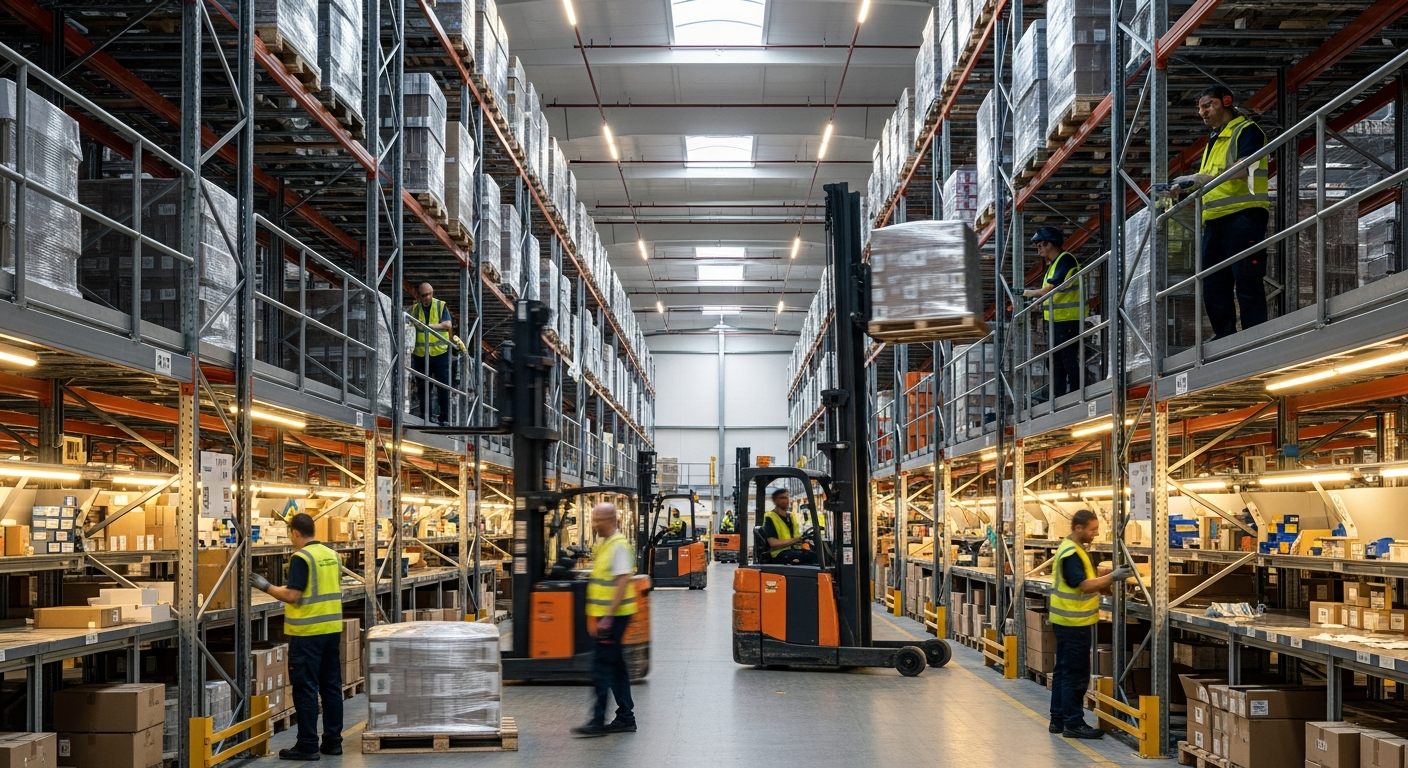
Material handling represents the largest single category of logistics equipment financing. This includes electric and propane forklifts (typically $25,000 to $100,000 per unit), reach trucks, order pickers, pallet jacks, automated guided vehicles (AGVs), and conveyor systems. A mid-size distribution center might carry $500,000 to $2 million in material handling equipment alone.
Forklifts are particularly common as standalone financing requests because they have strong secondary market values, which makes lenders comfortable. A fleet of 10 forklifts at $45,000 each can typically be financed with minimal credit documentation if the business has 2 or more years of operating history.
Dock and Loading Equipment
Dock levelers, dock seals, trailer restraints, dock boards, and edge-of-dock levelers are often overlooked in logistics equipment financing discussions, but they represent significant capital investment at any multi-bay warehouse. A standard dock leveler runs $3,000 to $10,000 installed, and a 20-door facility needs the full configuration. Equipment loans for these items often bundle with broader warehouse fit-out financing.
Racking, Shelving, and Storage Systems
Selective pallet racking, drive-in racking, push-back systems, and mezzanine floors are fixed-location assets that many logistics operators finance as part of a facility buildout. A full rack system for a 100,000-square-foot warehouse can run $500,000 to $1.5 million. These systems have long useful lives (15 to 20 years), making them well-suited to longer financing terms of 60 to 84 months.
Fleet and Transportation Equipment
Box trucks, semi-trailers, refrigerated vehicles, and last-mile delivery vans are core logistics assets that qualify for equipment financing. Commercial vehicle loans are a mature product category with strong lender competition, often resulting in competitive rates. A Class 8 semi-truck runs $150,000 to $200,000 new; a box truck runs $50,000 to $100,000 depending on configuration.
Warehouse Technology and Automation
Warehouse management systems (WMS), barcode and RFID scanning equipment, automated sortation systems, robotic picking solutions, and conveyor systems all qualify for financing. As warehouse technology becomes more critical to operational efficiency, lenders have become more comfortable financing these assets - though technology equipment typically carries shorter financing terms (36 to 48 months) due to depreciation concerns.
Refrigeration and Cold Storage Equipment
For cold chain logistics operators, refrigeration systems, blast freezers, walk-in coolers, and refrigerated dock enclosures represent major capital expenditures. A commercial blast freezer can cost $80,000 to $250,000; a full cold storage buildout can exceed $1 million. Equipment financing for cold chain assets typically runs 48 to 72 months given the long asset life.
Financing Multi-Location Logistics Growth Without Slowing Operations
Expanding a logistics network from one location to two, three, or more facilities is one of the most capital-intensive moves a business owner can make. Not only do you need to finance new equipment at each site, but you need to do so without starving existing operations of the working capital they need to run. This tension - between growth investment and operational stability - is where equipment financing for logistics companies becomes a strategic tool, not just a convenience.
The fundamental advantage of equipment financing over using cash for growth is capital preservation. When you finance a $400,000 racking and forklift package for a new facility, you spread that $400,000 over 48 to 60 months of payments. That leaves your existing cash reserves intact to cover payroll, fuel, freight contracts, and the inevitable operational surprises that come with opening a new location.
Structuring Financing Across Multiple Locations
Multi-location logistics operators have several structural options when financing expansion equipment. The most common approaches are:
Single master credit facility: Work with a single lender to establish a credit facility that covers equipment across all locations. This simplifies administration and often results in better overall terms because the lender sees your full collateral picture. Facilities can range from $500,000 to $10 million for larger logistics networks.
Individual location-based loans: Finance each location separately, which gives you flexibility to choose the best lender for each transaction. This approach works well when locations have different equipment needs and timelines. The downside is more paperwork and potentially higher administrative burden.
Equipment leasing programs: For companies that prioritize flexibility and want to avoid ownership obligations (particularly for technology equipment that may need upgrading), equipment leasing programs allow you to return or upgrade equipment at lease end. Monthly payments are typically lower than loan payments, preserving more operating cash.
Timing Logistics: When to Finance vs. When to Buy
The right time to finance logistics equipment is not always at the moment of maximum need - it is when your financial position supports the best possible terms. Lenders look for 2+ years in business, $150,000 or more in annual revenue, and credit scores above 650 for the most competitive rates. If your business meets these benchmarks, financing should almost always be the preferred approach over using cash, simply because the cost of capital (your interest rate) is lower than the opportunity cost of the cash you would otherwise deploy.
Conversely, if your business is under 2 years old or has recent credit challenges, the calculation changes. Lenders will work with you, but rates will be higher. In those cases, evaluate whether the revenue the new equipment will generate justifies the financing cost, or whether a leaner approach (used equipment, phased buildout) better suits the current risk profile.
Financing Options for Logistics Hubs
Logistics operators have more financing options than most industries because of the tangible, high-value equipment involved. Here are the primary options and when each makes the most sense.
Traditional Equipment Loans
A traditional equipment loan is a fixed-term, fixed-rate loan where the equipment serves as collateral. You own the equipment from day one, payments are predictable, and at the end of the term you hold clear title. For core logistics assets like forklifts, racking systems, and fleet vehicles - equipment you plan to keep for 5 to 10 years - an equipment loan is typically the optimal structure. Rates for qualified borrowers run from 6% to 18% annually depending on credit profile and equipment type.
Equipment Leasing
Leasing is a strong option for logistics technology, warehouse management systems, and equipment categories where you anticipate needing upgrades within 3 to 5 years. Operating leases offer the lowest monthly payments and the ability to return or upgrade equipment at lease end. Finance leases offer the tax advantages of ownership at the end of the term. The key tradeoff versus an equipment loan is that you do not build equity in leased equipment, but for technology assets that depreciate quickly, that is often irrelevant.
For a deeper look at how leasing stacks up against financing, explore Crestmont Capital's equipment leasing options to understand which structure suits your operational model.
SBA 7(a) Loans
For logistics companies acquiring significant equipment as part of a broader business expansion, an SBA 7(a) loan can provide longer terms (up to 10 years for equipment, 25 years for real property) and lower down payments than conventional financing. SBA loans are government-backed, which means lenders can offer more favorable terms to businesses that might not qualify for conventional loans. The tradeoff is a longer application and approval process - SBA loans typically take 30 to 90 days to close versus days to weeks for conventional equipment financing.
Business Lines of Credit
A business line of credit is not typically the right tool for large equipment purchases, but it is an excellent complement to equipment financing for logistics companies. While your forklift fleet is financed on a term loan, a credit line gives you immediate access to funds for maintenance, repairs, parts, emergency replacements, and the ongoing working capital needs that accompany a growing logistics operation.
Working Capital Loans
For logistics operators who need cash quickly to cover operational costs while equipment financing closes, or who need to bridge a short-term cash gap, working capital loans provide fast access to unsecured funds. Terms are typically 6 to 18 months with faster approval than equipment loans. These are not designed for large equipment purchases but work well for the operational costs that accompany any expansion.
What Lenders Look for in Logistics Equipment Loans
Understanding the qualification criteria for logistics equipment financing helps you approach lenders from a position of strength. While specific requirements vary by lender, the following factors consistently determine approval odds and pricing.
Time in Business
Most equipment lenders require at minimum 1 to 2 years of operating history. Startups face significantly higher rates and often need to provide larger down payments (20 to 30%) to offset the absence of operating history. If your logistics company is under 2 years old, focus on lenders who specialize in early-stage businesses rather than traditional equipment lenders.
Annual Revenue and Cash Flow
Lenders want to see that your business generates enough revenue to service the loan payments. A general rule of thumb is that the business should generate annual revenue of at least 3 to 4 times the annual loan payment. For a $300,000 equipment loan with $6,000 monthly payments, you would want to demonstrate $216,000 or more in annual revenue - though most lenders prefer higher coverage ratios for comfortable approval.
Credit Score (Personal and Business)
Personal credit scores above 650 typically qualify for equipment financing. Scores above 700 open access to more competitive rates and programs. Business credit scores (Dun and Bradstreet, Experian Business) matter increasingly for larger loans but may be less critical for smaller transactions with strong personal credit backing. If your personal credit is below 620, expect higher rates and potentially lower advance rates (lenders finance a smaller percentage of the equipment cost).
Equipment Type and Resale Value
Lenders consider the resale value of the equipment being financed. Forklifts, semi-trucks, and refrigerated vehicles have strong secondary markets and are highly financeable. Custom-built or highly specialized equipment with limited resale value may face lower advance rates or higher rate premiums because the collateral is harder for lenders to liquidate if the loan defaults.
Industry and Business Model
Logistics is generally considered a favorable industry by commercial lenders because equipment is essential and the business model - moving goods from point A to B - is fundamentally sound. Lenders look unfavorably at concentration risk (90%+ of revenue from one client), highly seasonal operations with no demonstrated ability to manage through slow periods, or businesses with recent significant losses.
Real-World Scenarios: How Logistics Operators Use Equipment Financing
Abstract financing concepts become clearer when viewed through specific operational scenarios. Here are realistic examples of how logistics companies use equipment financing to grow.
Scenario 1: The Regional 3PL Opening a Second Location
A third-party logistics provider in the Mid-Atlantic region has operated a 150,000-square-foot distribution center for 6 years. They have won a new contract with a consumer goods manufacturer that requires a second, dedicated facility in the Midwest. Total equipment need for the new facility: $1.2 million (racking system, 8 forklifts, conveyor, dock equipment).
Rather than draw down the credit line they use for working capital, they finance the $1.2 million over 60 months at 8.5% annually. Monthly payment: approximately $24,500. The new contract generates $85,000 per month in gross margin. Net: the equipment financing payment represents less than 30% of the new contract's margin, leaving substantial cash flow for operations and profit.
Scenario 2: Cold Chain Operator Upgrading Refrigeration Technology
A food-grade cold storage company needs to replace aging refrigeration units across three locations. Each facility needs $200,000 in new equipment, totaling $600,000. The old units are at end-of-life and causing temperature excursion events that risk product integrity.
Because the company has 10+ years of operating history and strong credit, they qualify for a 72-month equipment loan at 7% annually. Monthly payment: approximately $9,200. Critically, replacing the failing equipment stops the $15,000 per month in product loss claims they had been absorbing - making the equipment financing cash-flow positive from month one.
Scenario 3: E-Commerce Fulfillment Startup Scaling Operations
A 3-year-old e-commerce fulfillment company has grown rapidly and needs to upgrade from a manual operation to a semi-automated system with conveyor sorters, barcode scanners, and updated racking. Total equipment need: $450,000. The company has $2.2 million in annual revenue but thin profit margins due to growth investment.
They qualify for an equipment lease program with a 48-month term and $0 down. Monthly payment: approximately $10,800. The leasing structure preserves $450,000 in cash for hiring, software systems, and the working capital demands of a growing business. At lease end, they evaluate whether to upgrade to the next generation of automation or purchase the equipment outright for a residual value.
Scenario 4: Last-Mile Delivery Company Fleet Expansion
A last-mile delivery company serving grocery and pharmacy clients needs to expand its fleet by 15 vehicles to handle new contract wins. Each electric delivery van costs $65,000, totaling $975,000. The company wants to transition to electric vehicles to reduce fuel costs and qualify for certain client contracts that require zero-emission fleet commitments.
They finance the fleet through commercial vehicle equipment loans at 7.9% over 60 months. Monthly payment: approximately $19,600. The 15 new vehicles generate $45,000 per month in new route revenue. Fuel savings over the electric fleet add another $8,000 per month compared to diesel equivalents. The financing structure makes the fleet expansion accretive to cash flow within the first month of operation.
How Crestmont Capital Helps Logistics Companies
Crestmont Capital is one of the top-rated business lenders in the United States, with a track record of funding logistics and distribution companies ranging from regional 3PLs to national freight networks. Our approach to equipment financing for logistics operators focuses on speed, flexibility, and structuring loans that match how logistics businesses actually operate.
We work with logistics companies across the full equipment spectrum - from single forklift purchases to multi-million dollar distribution center fit-outs. Our team understands the operational timelines that logistics operators face: when you win a new contract, the equipment needs to be in place before the first truck arrives. We move faster than traditional banks while offering rates and terms that compete with any lender in the market.
What Sets Crestmont Apart for Logistics Equipment Financing
Same-day decisions: Most equipment financing applications receive a credit decision within 24 hours. For time-sensitive logistics expansions, faster decisions mean faster equipment delivery and faster revenue generation from new contracts.
Multi-equipment packages: We finance complete warehouse fit-outs under a single credit decision, not one item at a time. If you need racking, forklifts, dock equipment, and technology systems, we review the full package together rather than requiring separate applications for each item.
Strong relationships with used and new equipment vendors: Whether you're purchasing new forklifts from a dealer or buying used racking from a liquidation sale, Crestmont can finance the transaction. We work with the equipment vendor directly when needed to accelerate closing.
Flexible payment structures: For seasonal logistics operations, step-up payment structures allow lower payments during slow seasons and higher payments during peak periods. For equipment with long lead times, deferred payment start dates allow you to begin payments only after the equipment is operational.
The Application Process: What to Expect
The logistics equipment financing application process is more straightforward than most business owners expect. Here is what the process typically looks like with Crestmont Capital.
Step 1: Initial Application (15 Minutes)
The application captures basic business information, equipment details, financing amount requested, and financial summary. For equipment loans under $150,000, documentation requirements are minimal - often just the completed application and basic business verification. For larger financing requests, lenders typically require 3 to 6 months of bank statements and, for transactions over $500,000, business tax returns.
Step 2: Credit Review and Decision (24-48 Hours)
Crestmont reviews the application, verifies business information, and evaluates the equipment collateral. For standard logistics equipment (forklifts, racking, trucks), this process is well-established and typically resolves quickly. For larger, more complex multi-location packages, the review may take 2 to 3 business days.
Step 3: Term Sheet and Documentation (1-2 Days)
Approved applications receive a detailed term sheet outlining loan amount, rate, term, monthly payment, and any conditions to funding. Accepting the term sheet triggers the documentation phase, where you sign the loan agreement and equipment security agreement. Most logistics equipment loans can be fully documented electronically.
Step 4: Funding (1-2 Days After Documentation)
Once documentation is complete and verified, funding typically occurs within 1 to 2 business days. For purchases from dealers, funds go directly to the vendor. For equipment you have already acquired or own, funds are disbursed directly to your business account.
Documents Typically Required
- Completed equipment financing application
- Government-issued ID for all owners with 20%+ ownership
- Voided business check or banking information
- 3-6 months of business bank statements (for loans over $50,000)
- Equipment invoice, quote, or description
- Business tax returns (for loans over $250,000)
- Accounts receivable aging (for logistics companies with freight factoring arrangements)
The cleaner and more organized your documentation package, the faster your approval. Logistics operators who prepare a clear picture of their business financials and equipment needs consistently experience faster closings.
Frequently Asked Questions
How much can I borrow for logistics equipment financing?
Equipment financing amounts for logistics companies typically range from $10,000 to $5 million or more per transaction. The specific amount you can borrow depends on the value of the equipment being financed, your business revenue, credit profile, and time in operation. Larger requests (over $500,000) typically require more documentation and slightly longer review timelines. Multi-location logistics operators sometimes establish master credit facilities that cover equipment across all locations under a single agreement.
What credit score do I need for logistics equipment loans?
Most equipment lenders prefer personal credit scores above 650. Scores above 700 qualify for the most competitive rates and terms. Scores below 620 are still workable but typically come with higher interest rates, lower advance rates, and sometimes larger down payment requirements. For logistics companies with strong revenue and business credit history, personal credit score is one factor among several - not an absolute qualifier on its own.
Can I finance used logistics equipment?
Yes. Most equipment lenders, including Crestmont Capital, finance used logistics equipment including used forklifts, used racking systems, used trucks, and used cold storage units. Advance rates on used equipment are typically 80-90% of the appraised or purchase value versus 100% for new equipment. For used equipment from private sellers rather than dealers, lenders may require an independent appraisal. Used equipment financing is particularly common in warehouse racking, where quality used systems can be purchased at 40-60% below new cost.
How is equipment financing different from a working capital loan for logistics companies?
Equipment financing is secured by a specific asset - the equipment being purchased. Because it is collateral-backed, it typically offers lower interest rates and longer repayment terms than unsecured working capital loans. Working capital loans are better suited for operational expenses, payroll, fuel costs, and short-term cash flow needs. For significant equipment purchases (forklifts, trucks, racking, automation), equipment financing is almost always the more cost-effective option. Many logistics operators use both simultaneously - equipment loans for capital assets and a credit line or working capital loan for operational flexibility.
How long does equipment financing take to close for a logistics company?
Standard logistics equipment loans under $250,000 typically close within 2 to 5 business days from application submission. Larger transactions ($250,000 to $1 million) typically close in 5 to 10 business days. Multi-million dollar packages or SBA-backed equipment loans take longer - typically 30 to 60 days. If you are financing equipment to meet a contract start date, communicate your timeline clearly during the application process so lenders can expedite review where possible.
Can a startup logistics company qualify for equipment financing?
Yes, though startup logistics companies (under 2 years in business) face more limited options than established operators. Startups typically need to provide a larger down payment (20-30%), demonstrate strong personal credit (680+), and may face higher interest rates. Some lenders specialize in startup equipment financing for logistics companies entering growth markets. If your startup is backed by contracts from established shippers, presenting those contracts during the application can significantly strengthen your case with lenders.
What is the difference between an equipment loan and equipment leasing for logistics?
With an equipment loan, you own the equipment from day one and build equity in the asset over the loan term. At payoff, you hold clear title. With a lease, you use the equipment for a defined period without ownership - at lease end, you can return, renew, or purchase at residual value. Equipment loans are typically better for assets you intend to keep long-term (racking systems, facility-specific infrastructure). Leasing is often better for technology-intensive equipment (WMS systems, sorters, AGVs) where you want flexibility to upgrade as the technology evolves.
Next Steps
Conclusion
Equipment financing for logistics companies is one of the most powerful tools available to operators who want to grow without compromising the cash flow that keeps day-to-day operations running. Whether you are opening your second distribution hub, upgrading aging cold chain infrastructure, expanding a delivery fleet, or automating a fulfillment center, financing the equipment - rather than buying it outright - preserves the working capital you need for everything else that growth demands.
The logistics sector is well-suited to equipment financing because the assets are tangible, valuable, and essential. Lenders are familiar with the equipment types and understand how logistics businesses generate revenue. That familiarity translates to faster decisions, competitive rates, and flexible structures that accommodate the realities of running a distribution operation.
Crestmont Capital has helped hundreds of logistics operators fund their growth. If you are ready to explore equipment financing for your logistics company, start your application today and receive a decision within 24 hours.
Apply in minutes and get a decision in as little as 24 hours. Crestmont Capital funds logistics companies from single-location operators to nationwide distribution networks.
Apply for Equipment Financing NowDisclaimer: The information provided in this article is for general educational purposes only and is not financial, legal, or tax advice. Funding terms, qualifications, and product availability may vary and are subject to change without notice. Crestmont Capital does not guarantee approval, rates, or specific outcomes. For personalized information about your business funding options, contact our team directly.