
 (800) 949-0401
Commercial Binding Machine Financing: The Complete Guide
For businesses that rely on producing professionally bound documents, from marketing proposals and legal briefs to educational materials and annual reports, a commercial-grade binding machine is an essential asset. Acquiring this specialized equipment often involves a significant capital investment, which is where commercial binding machine financing becomes a critical strategic tool. This guide provides a comprehensive overview of how financing can help your business acquire the necessary equipment to enhance productivity and professionalism without depleting your cash reserves.
In This Article
- What Is Commercial Binding Machine Financing?
- Why Finance a Binding Machine Instead of Buying Outright?
- Types of Binding Machines You Can Finance
- Financing Options for Binding Equipment
- How Commercial Binding Machine Financing Works
- Loan Amounts, Rates, and Terms
- Who Qualifies for Binding Machine Financing?
- How Crestmont Capital Can Help
- Real-World Scenarios
- Frequently Asked Questions
- How to Get Started
- Conclusion
What Is Commercial Binding Machine Financing?
Commercial binding machine financing is a category of business funding specifically designed to help companies purchase or lease professional-grade binding equipment. Instead of paying the full cost of the machine upfront, a business can secure funding from a lender like Crestmont Capital and pay for the equipment over a set period through regular installments. This process is a form of equipment financing, where the binding machine itself typically serves as collateral for the loan.
This type of financing covers a wide range of equipment, from compact desktop units for small offices to heavy-duty, automated systems used in commercial print shops and publishing houses. The core purpose is to make essential technology accessible to businesses of all sizes, allowing them to improve their document finishing capabilities, increase efficiency, and present a more professional image to clients and stakeholders. By spreading the cost over time, companies can align the expense of the equipment with the revenue it helps generate, creating a more sustainable financial model for growth.
Financing is not a one-size-fits-all solution. It encompasses various products, including traditional equipment loans where you own the machine at the end of the term, and equipment leases, which offer lower monthly payments and the flexibility to upgrade to newer technology when the lease ends. The right option depends on your business's financial situation, long-term goals, and how you plan to use the equipment.
Ready to Upgrade Your Equipment?
Get the binding machine you need now with flexible financing. See your options in minutes.
Apply Now →Why Finance a Binding Machine Instead of Buying Outright?
While paying cash for a new binding machine might seem like the simplest approach, it is often not the most financially prudent decision for a business. Financing offers several strategic advantages that can protect your capital, improve financial metrics, and provide operational flexibility. According to the U.S. Census Bureau, there are over 33 million small businesses in the United States, and for many of them, managing cash flow is the key to survival and growth. Financing directly supports this critical objective.
1. Preserve Working Capital and Cash Flow
The most significant benefit of financing is cash flow preservation. A high-capacity commercial binding machine can cost anywhere from a few thousand to tens of thousands of dollars. Paying this amount in a lump sum can drain your working capital, leaving you with less cash for other critical business needs like payroll, marketing, inventory, or unexpected opportunities. Financing converts a large, prohibitive capital expenditure into a manageable, predictable monthly operating expense, keeping your cash free for day-to-day operations and strategic investments.
2. Access to Better, More Advanced Equipment
Financing allows you to acquire the exact machine you need for optimal performance, rather than settling for a cheaper, less-efficient model that fits your immediate cash budget. This means you can invest in a machine with higher capacity, more features, and better automation. Superior equipment can lead to increased productivity, higher quality output, and a stronger competitive edge. You can offer better products and services to your clients, which ultimately drives revenue.
3. Potential Tax Advantages
Financing and leasing equipment often come with significant tax benefits. Under Section 179 of the IRS tax code, businesses may be able to deduct the full purchase price of qualifying equipment in the year it is put into service. This can substantially lower your taxable income. Additionally, lease payments are often treated as operating expenses and can be fully deducted. It is essential to consult with a tax professional to understand how these benefits apply to your specific financial situation.
4. Flexible and Predictable Budgeting
With a financing agreement, you have a fixed monthly payment over a predetermined term. This predictability makes budgeting and financial forecasting much simpler. You know exactly how much to allocate for your equipment expense each month, eliminating the financial uncertainty that comes with large, unplanned purchases. Lenders like Crestmont Capital often offer flexible terms to match your business's revenue cycle.
5. Easy Technology Upgrades
The document finishing industry is constantly evolving. A machine that is state-of-the-art today might be outdated in a few years. Equipment leasing is particularly advantageous for staying current. At the end of your lease term, you can simply return the old machine and lease a new one with the latest technology. This prevents you from getting stuck with obsolete equipment and ensures your business remains efficient and competitive.
6. Build Business Credit
Successfully managing and paying off an equipment loan or lease demonstrates financial responsibility and can help build a strong credit history for your business. A positive credit profile makes it easier and more affordable to secure other types of financing in the future, such as a business line of credit or expansion loans.
Types of Binding Machines You Can Finance
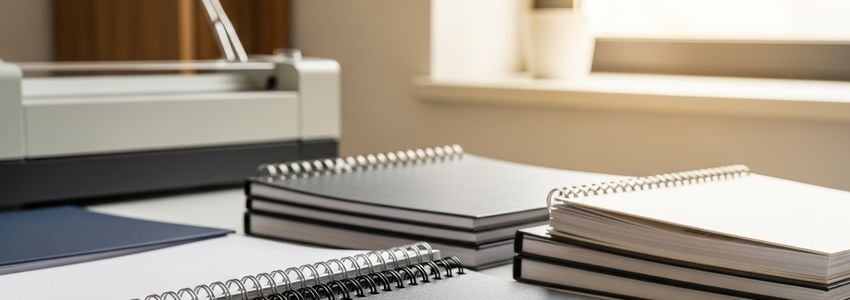
Commercial binding machine financing can be used to acquire a wide variety of equipment, each suited for different applications, volumes, and document types. Understanding the different types of machines available will help you select the right one for your business needs.
Coil or Spiral Binding Machines
Coil binding uses a continuous plastic or metal spiral that is spun through a series of holes punched along the edge of the document. This method is popular for notebooks, manuals, and presentations because the pages can be opened a full 360 degrees. Commercial-grade coil binders often feature electric punching and an electric coil inserter to handle high volumes quickly.
- Best for: Reports, notebooks, calendars, manuals.
- Price Range: $1,500 to $10,000+ for high-volume systems.
Comb Binding Machines
Comb binding is one of the most common and affordable methods. It uses a plastic spine with rectangular "fingers" that are inserted into rectangular holes. A key advantage is that the comb can be reopened to add or remove pages. Commercial comb binders are built for durability and can punch through large stacks of paper at once.
- Best for: Internal reports, school projects, presentations.
- Price Range: $1,000 to $7,000.
Thermal Binding Machines
Thermal binding uses heat to activate a pre-applied adhesive strip in the spine of a specially designed cover. This creates a clean, "perfect-bound" look similar to a paperback book. It requires no punching and is very fast for binding multiple documents at once. These are ideal for creating a sleek, professional finish.
- Best for: Proposals, annual reports, high-end presentations.
- Price Range: $500 to $5,000.
Wire-O or Twin-Loop Binding Machines
Similar to coil binding, Wire-O binding uses a pre-formed series of double wire loops. It provides a more professional and secure finish than plastic coil or comb. Documents bound with Wire-O can also open 360 degrees and lay completely flat. These machines are common in marketing agencies, architectural firms, and corporate environments.
- Best for: High-end proposals, marketing materials, architectural plans.
- Price Range: $2,000 to $15,000+.
Hardcover Binding and Casing-In Machines
For the ultimate professional finish, hardcover binding systems create durable, library-quality books. These systems can be complex, involving steps like crimping, gluing, and "casing-in" the book block into a hard cover. They are a significant investment and are typically found in on-demand book printers and specialized binderies.
- Best for: Yearbooks, photo books, case-bound books, theses.
- Price Range: $10,000 to $50,000+.
Commercial Booklet Makers
These are highly automated, all-in-one systems that can take a stack of printed sheets and staple (saddle-stitch), fold, and trim them to create finished booklets. They are essential for businesses that produce large quantities of catalogs, magazines, newsletters, and event programs. They drastically reduce manual labor and increase production speed.
- Best for: Catalogs, magazines, event programs, newsletters.
- Price Range: $5,000 to $75,000+.
Key Stat: According to a Forbes Advisor analysis, approximately 8 out of 10 U.S. companies use some form of financing to acquire the equipment they need to operate and grow.
Financing Options for Binding Equipment
When you decide to pursue commercial binding machine financing, you will encounter several different funding products. Each has its own structure, benefits, and ideal use case. Here is a breakdown of the most common options.
| Financing Option | How It Works | Best For |
|---|---|---|
| Equipment Loan | A lender provides funds to purchase the equipment. You make regular payments of principal and interest. You own the machine outright at the end of the term. | Businesses that want to own the asset long-term and build equity. Ideal for equipment with a long useful life. |
| Equipment Lease | You pay a monthly fee to use the equipment for a set period. At the end of the lease, you can return it, purchase it, or upgrade to a new model. | Companies that need the latest technology and want lower monthly payments. Good for equipment that becomes obsolete quickly. |
| Business Line of Credit | A flexible credit line you can draw from as needed. You only pay interest on the amount you use. Can be used for equipment or other business expenses. | Businesses needing flexibility for multiple purchases or who want a cash cushion for unexpected equipment needs. |
| SBA Loans | Government-backed loans offered through banks and lenders. Often have long terms and low interest rates, but a more intensive application process. | Well-established businesses with strong financials that can navigate a longer application process to secure favorable terms. |
Equipment Loans
This is a straightforward financing product. A lender like Crestmont Capital provides up to 100% of the cost of the binding machine, which you then repay over a term of 2 to 7 years. The machine itself serves as collateral, which often makes these loans easier to qualify for than other types of small business loans. Once the loan is paid off, you own the equipment free and clear. This is a great choice if you plan to use the machine for many years.
Equipment Leasing
Leasing is essentially a long-term rental agreement. It typically offers lower monthly payments than a loan because you are only paying for the depreciation of the equipment during the lease term, not its full value. There are two main types of leases:
- Operating Lease: Offers the lowest payments and is treated like a rental for accounting purposes. At the end of the term, you simply return the equipment. This is ideal for technology that changes rapidly.
- Capital Lease (or Finance Lease): This functions more like a loan. It often includes a purchase option at the end of the term (frequently for $1), and the asset is recorded on your balance sheet.
Business Line of Credit
A business line of credit provides access to a revolving pool of funds up to a certain limit. You can draw from it whenever you need capital and repay it over time. Once repaid, the funds become available to use again. While not specifically for equipment, a line of credit offers maximum flexibility. You could use it to purchase a binding machine, buy supplies, and cover shipping all from the same credit facility.
SBA Loans
The U.S. Small Business Administration (SBA) guarantees a portion of loans made by approved lenders, reducing the lender's risk. This allows them to offer favorable terms, including lower interest rates and longer repayment periods (up to 10 years for equipment). The most common programs are the SBA 7(a) and 504 loans. While the terms are excellent, the application process for SBA loan programs is notoriously rigorous and time-consuming, requiring extensive documentation and a strong financial history.
How Commercial Binding Machine Financing Works (Step-by-Step)
Securing financing for your binding equipment is a structured process. While specifics can vary by lender, the general steps are consistent. Working with an experienced lender like Crestmont Capital can make the process smooth and efficient.
- Determine Your Equipment Needs: First, identify the exact type, make, and model of the binding machine that best suits your business. Research vendors, compare features, and get a formal price quote. This quote is essential for your financing application as it specifies the exact amount you need to borrow.
- Gather Your Documents: Lenders will need to assess the financial health of your business. Be prepared to provide documents such as recent bank statements, tax returns (business and personal), a profit and loss statement, and a balance sheet. For newer businesses, a detailed business plan may also be required.
- Complete the Application: The next step is to fill out the lender's application form. At Crestmont Capital, we offer a simple online application that can often be completed in minutes. You will provide basic information about your business, its owners, and the equipment you wish to finance.
- Underwriting and Review: Once your application is submitted, the lender's underwriting team will review your financial documents, check your credit history, and evaluate the overall risk. They will assess your ability to make the required payments. Lenders specializing in fast business loans, like Crestmont, often use technology to expedite this process, providing a decision within hours.
- Receive and Review Offers: If approved, you will receive one or more financing offers. These documents will detail the loan amount, interest rate, term length, and monthly payment. Carefully review the terms and conditions of each offer. Pay close attention to any fees, prepayment penalties, or end-of-lease options.
- Sign the Agreement and Fund the Purchase: Once you have selected the best offer, you will sign the financing agreement. The lender will then typically pay the equipment vendor directly. The vendor will then arrange for the delivery and installation of your new binding machine. Your repayment schedule begins shortly after you receive the equipment.
By the Numbers
Commercial Binding Machine Financing - Key Statistics
$5k - $75k+
Typical cost range for commercial binding machines and booklet makers.
24 Hours
Average time to funding for equipment loans from alternative lenders like Crestmont Capital.
100%
Financing available for qualified buyers, often including soft costs like tax and installation.
$179,000
Potential Section 179 tax deduction on a $50,000 machine (assuming a 35% tax bracket).
Loan Amounts, Rates, and Terms
The specific details of your financing offer will depend on several factors, including your business's financial health, the cost of the equipment, and the lender you choose. However, there are typical ranges you can expect.
- Loan Amounts: Lenders can finance anywhere from $5,000 to over $500,000 for equipment. Most commercial binding machine financing deals fall between $10,000 and $100,000. It is common for lenders to finance 100% of the equipment cost, and some will even roll in "soft costs" like taxes, shipping, and installation into the loan amount.
- Interest Rates: Rates can vary widely. For a strong, well-established business, rates on an equipment loan can be as low as 6-8%. For newer businesses or those with less-than-perfect credit, rates might range from 10% to 30% or higher. The rate reflects the lender's perceived risk.
- Terms: Repayment terms for equipment loans typically range from 24 to 84 months (2 to 7 years). Leases often have terms of 24, 36, 48, or 60 months. Longer terms result in lower monthly payments but higher total interest paid over the life of the loan. The best term length aligns with the expected useful life of the binding machine.
Who Qualifies for Binding Machine Financing?
Qualification criteria for commercial binding machine financing are generally more flexible than for other types of business loans, primarily because the equipment itself serves as collateral. This secured nature reduces the lender's risk. However, lenders will still evaluate several key aspects of your business.
Minimum Credit Score
While requirements vary, most lenders look for a personal credit score of 620 or higher from the business owner(s). Some alternative lenders like Crestmont Capital may be able to work with scores as low as 550, though this will likely result in higher interest rates. A stronger credit score (700+) will give you access to the most competitive rates and terms.
Time in Business
Lenders prefer to work with established businesses. A minimum of two years in operation is a common requirement. This history demonstrates stability and a track record of generating revenue. However, many lenders, including Crestmont, have programs specifically for startups and businesses that have been operating for as little as six months, provided they can show strong bank statements or a solid business plan.
Annual Revenue
Your business's annual revenue is a key indicator of your ability to repay the loan. A typical minimum revenue requirement is around $100,000 to $250,000 per year. Lenders will look at your recent bank statements to verify consistent cash flow and ensure that the new monthly payment will not over-leverage your business.
Industry and Equipment Type
The industry you operate in can also play a role. Industries like printing, legal services, education, and marketing, which have a clear and consistent need for binding equipment, are generally viewed favorably. The value and resale potential of the specific binding machine can also impact the lending decision. A popular, well-regarded brand may be easier to finance than an obscure or highly specialized one.
Expert Tip: Even if you have cash on hand, financing can be a smart move. Using the lender's capital for depreciating assets like equipment allows you to reserve your own cash for appreciating or revenue-generating activities like marketing or hiring top talent.
How Crestmont Capital Can Help
Navigating the world of commercial equipment financing can be complex, but you do not have to do it alone. At Crestmont Capital, we specialize in providing fast, flexible, and transparent funding solutions for businesses across the United States. We understand the unique challenges and opportunities that come with acquiring specialized assets like commercial binding machines.
Here is how we stand out:
- Speed and Efficiency: We know that business opportunities are time-sensitive. Our streamlined online application takes just a few minutes to complete, and we often provide approvals within hours. Funding can be available in as little as 24 hours, so you can get your new equipment to work for you immediately.
- Flexible and Inclusive Criteria: We look beyond just credit scores. Our underwriting process takes a holistic view of your business's health, including cash flow and industry experience. We proudly work with businesses of all sizes, from startups to established corporations, and have programs for a wide range of credit profiles.
- Expert Guidance: Our dedicated funding specialists are experts in commercial equipment financing. They will work with you one-on-one to understand your specific needs and guide you to the best financing product, whether it is a loan, a lease, or a line of credit. We are committed to finding a solution that fits your budget and your goals.
- Transparency: With Crestmont Capital, there are no hidden fees or surprises. We provide clear, easy-to-understand terms so you can make an informed decision with confidence. Our goal is to build long-term partnerships with our clients based on trust and mutual success.
Partner with a Trusted Lender
Experience the Crestmont Capital difference. Let our experts find the perfect financing for your new binding machine.
Get Started Today →Real-World Scenarios
To better understand how commercial binding machine financing works in practice, let's look at a few hypothetical examples across different industries.
Scenario 1: The Expanding Print Shop
Business: "Speedy Prints," a local print shop in business for five years. They are getting more requests for high-volume booklet and catalog printing.
Need: A $45,000 automated booklet maker to increase production speed and take on larger jobs.
Challenge: Paying $45,000 in cash would wipe out their operating reserves.
Solution: Speedy Prints applies for an equipment loan with Crestmont Capital. With a strong credit history and consistent revenue, they are approved for a 5-year (60-month) loan at a 7% interest rate. Their monthly payment is approximately $891. This manageable payment allows them to acquire the machine immediately. The new booklet maker enables them to land a large monthly catalog contract, generating an additional $4,000 in monthly revenue, easily covering the loan payment and significantly boosting their profits.
Scenario 2: The Modern Law Firm
Business: "Miller & Associates," a law firm specializing in litigation. They need to produce numerous copies of large, professionally bound legal briefs and discovery documents.
Need: A high-quality Wire-O binding machine costing $8,000 to bring document production in-house, improving confidentiality and turnaround time.
Challenge: As a partnership, they prefer to keep capital expenditures off their balance sheet.
Solution: The firm opts for a 36-month operating lease. The monthly lease payment is only around $250. This is treated as a simple operating expense. At the end of three years, they can upgrade to a newer model with better features, ensuring their client-facing documents always look pristine and modern.
Scenario 3: The Educational Publisher
Business: "Scholar Press," a startup publisher creating short-run educational workbooks and course packets for universities.
Need: A versatile coil binding system costing $15,000.
Challenge: As a one-year-old business, they do not meet the "two years in business" requirement of most traditional banks.
Solution: They work with Crestmont Capital, which has programs for newer businesses. By showing six months of strong bank statements and a solid business plan, they qualify for a 48-month equipment loan. This allows them to fulfill their initial orders and build a reputation for quality, setting them up for long-term growth.
Frequently Asked Questions
Have More Questions?
Our financing experts are ready to help. Get personalized advice for your business needs.
Talk to an Expert →How to Get Started
Acquiring the right binding equipment is a crucial step in elevating your business's professional output. With the right financing partner, the process is straightforward and empowering. Follow these steps to get started on your path to new equipment.
Identify Your Machine & Get a Quote
Research and select the perfect binding machine for your needs. Contact the vendor and obtain a formal, detailed price quote. This document is the foundation of your financing application.
Complete a Simple Application
Fill out our secure online application. It takes just a few minutes and requires only basic information about your business. This will allow our team to quickly assess your qualifications and begin finding the best financing options for you.
Review Your Offers & Get Funded
A dedicated funding specialist will contact you to discuss your approval and present clear, transparent financing offers. Once you select the best option and sign the documents, we will coordinate payment directly with your vendor so you can get your new equipment delivered.
Conclusion
Investing in a high-quality commercial binding machine is an investment in your business's efficiency, professionalism, and growth potential. Commercial binding machine financing makes this critical investment accessible and affordable by preserving your working capital and converting a large upfront cost into a manageable monthly payment. Whether you are a print shop looking to scale production, a law firm aiming to improve document presentation, or any business that values polished, professional materials, financing provides the strategic pathway to acquiring the tools you need to succeed. By partnering with an experienced and agile lender like Crestmont Capital, you can navigate the process with ease and secure the funding you need to take your business to the next level.
Disclaimer: The information provided in this article is for general educational purposes only and is not financial, legal, or tax advice. Funding terms, qualifications, and product availability may vary and are subject to change without notice. Crestmont Capital does not guarantee approval, rates, or specific outcomes. For personalized information about your business funding options, contact our team directly.
```







