
Water is the single most persistent threat to a building's foundation, and nowhere is that more visible than in the basement. Industry estimates suggest that the vast majority of homes with below-grade space will deal with some form of moisture intrusion over their lifetime, and the financial consequences range from a few hundred dollars for a minor crack repair to tens of thousands for structural remediation. For homeowners, property investors, and the contractors who serve them, understanding the numbers behind this industry has never been more valuable.
This roundup of basement waterproofing statistics for 2026 brings together the most important market data, cost figures, water damage trends, and demand indicators shaping the industry right now. Whether you own a home with a basement, run a waterproofing or restoration business, or are evaluating the sector as a growth opportunity, these statistics give you a clear, data-driven picture of where the industry stands and where it is heading.
In This Article
- What Is Basement Waterproofing?
- Basement Waterproofing Market Overview
- Key Basement Waterproofing Statistics for 2026
- Water Damage and Flooding Statistics
- Basement Waterproofing Costs and Pricing Data
- Common Waterproofing Methods and Their Effectiveness
- How Basement Waterproofing Works
- Who Needs Basement Waterproofing?
- Interior vs. Exterior Waterproofing Compared
- How Crestmont Capital Helps Waterproofing Businesses
- How to Get Started
- Frequently Asked Questions
What Is Basement Waterproofing?
Basement waterproofing is the set of techniques, materials, and systems used to prevent water from entering the below-grade portions of a building, or to manage and remove water that does get in before it can cause damage. It spans a wide range of solutions, from simple interior sealants and crack injections to full exterior excavation, membrane application, French drain installation, and sump pump systems.
The need for waterproofing comes down to basic physics. Soil surrounding a foundation absorbs rainwater and snowmelt, and that saturated soil exerts hydrostatic pressure against basement walls and floors. Concrete is porous, mortar joints age, and tiny cracks form as a house settles. Over time, water finds those pathways. Waterproofing interrupts that cycle either by blocking water at the exterior surface, channeling it away before pressure builds, or collecting and pumping it out from the interior.
The industry that delivers these services sits at the intersection of home improvement, construction, and property protection. It includes dedicated waterproofing contractors, foundation repair companies, restoration firms, plumbers, and general contractors. Many of these businesses are small and mid-sized operations, which is why access to fast, flexible construction company business loans and equipment financing plays such an important role in the sector's growth.
Basement Waterproofing Market Overview
The basement waterproofing industry has grown steadily over the past decade, propelled by an aging housing stock, heavier rainfall patterns in many regions, rising home values that make protection investments worthwhile, and greater homeowner awareness of mold and indoor air quality risks. Industry analyses place the broader North American waterproofing and foundation services market in the multi-billion-dollar range, with the basement-specific segment representing a substantial share of total revenue.
Housing stock fundamentals strongly support continued demand. According to U.S. Census Bureau housing data, the United States has well over 140 million housing units, and a large share of single-family homes in the Midwest, Northeast, and parts of the South were built with full or partial basements. Millions of those homes are now 40, 50, or even 80 years old, an age at which original damp-proofing coatings have long since degraded and drainage systems have failed or were never installed.
New construction adds to the picture as well. The Census Bureau's new residential construction data shows that hundreds of thousands of new single-family homes are completed each year, and a meaningful percentage of them include basements, particularly in colder climate regions. Every new basement is a future waterproofing customer, whether at the build stage or decades later when settlement and hydrostatic pressure begin to take their toll.
On the business side, the industry remains highly fragmented. Thousands of small and regional contractors compete alongside a handful of national franchise brands. That fragmentation creates opportunity: established local operators with strong reputations can grow quickly when they have the capital to add crews, buy equipment, and market aggressively. It also means pricing power tends to stay local, with costs varying significantly by region, soil conditions, and the severity of the water problem being solved.
Own a Waterproofing or Foundation Repair Business?
Get fast, flexible financing from the #1 business lender in the U.S. No obligation, apply in minutes.
Apply Now →Key Basement Waterproofing Statistics for 2026
The numbers below capture the scale of the basement waterproofing industry in 2026, from overall market size to homeowner behavior and project demand. Together they paint a picture of a mature but still-growing home services sector with strong fundamentals.
- The U.S. waterproofing services market is valued in the multi-billion-dollar range. Industry analyses consistently place the broader waterproofing and foundation services sector at several billion dollars in annual revenue, with basement-specific work accounting for one of the largest service categories. Growth is projected to continue at a steady mid-single-digit annual pace through the end of the decade.
- Roughly 60 percent of U.S. homes with basements experience below-grade moisture problems. This widely cited industry estimate reflects how common seepage, condensation, and hydrostatic pressure issues are in below-grade spaces, even in homes that have never experienced a dramatic flood event.
- Industry data suggests up to 98 percent of basements will experience some form of water damage during their usable lifetime. Given that tens of millions of American homes have basements, the long-term service pipeline for waterproofing contractors is enormous.
- Millions of new basements are added to the housing stock every decade. New residential construction data shows sustained annual completion volumes for single-family homes, and basements remain standard in much of the Midwest and Northeast, continually expanding the addressable market.
- A large majority of homeowners rank water intrusion among their top maintenance concerns. Surveys of homeowner priorities consistently place roof leaks and basement water problems at the top of the list of feared home repairs, ahead of HVAC failure and electrical issues.
- Most waterproofing projects fall in the $2,000 to $8,000 range. Project severity drives price: a simple interior crack injection might cost a few hundred dollars, while full exterior excavation with membrane installation can exceed $15,000.
- Demand for waterproofing services spikes after heavy-rainfall years and major storm events. Contractors in affected regions routinely report call volumes doubling or tripling in the months following significant flooding, creating both revenue opportunity and capacity strain.
- Basement finishing trends amplify waterproofing demand. With more homeowners converting basements into living space, home offices, and rental units, the financial exposure from water damage is higher than ever, and pre-finishing waterproofing has become a standard line item in remodel budgets.
Key insight: With an estimated 60 percent of below-grade spaces experiencing moisture issues at some point, basement waterproofing is not a niche service. It is a mainstream home protection category with recurring, weather-driven demand that keeps contractors busy in nearly every region of the country.
Water Damage and Flooding Statistics
Water damage is one of the most common and most costly categories of property damage in the United States, and basements bear the brunt of it. Understanding these numbers explains why waterproofing has evolved from an optional upgrade into a standard protective measure for below-grade space.
Water damage claims are among the most frequent homeowners insurance claims. Insurance industry data consistently shows that about 1 in 60 insured homes files a water damage or freezing claim each year, with average claim severity commonly estimated in the $11,000 to $13,000 range. A significant share of those claims originate in or involve the basement, where water naturally migrates.
Flooding is the most common natural disaster in the United States. Federal emergency data has long established floods as the country's most frequent and costly natural hazard. Notably, roughly a quarter of flood insurance claims come from properties outside designated high-risk flood zones, which means homeowners who believe they are safe from flooding often carry the most financial risk when water does arrive.
Even minor basement water events are expensive. A few inches of water in a finished basement can destroy flooring, drywall, furniture, and mechanical systems, with restoration costs quickly reaching five figures. In unfinished basements, standing water still threatens stored belongings, mechanicals, and the long-term integrity of the foundation itself.
Mold begins growing fast. Under the right conditions, mold colonies can establish themselves within 24 to 48 hours of water intrusion. That short timeline is why water damage restoration professionals emphasize immediate mitigation, and why preventive waterproofing is so much more cost-effective than remediation. For a deeper look at the numbers on the remediation side, see our companion report on water damage restoration statistics.
Sump pump failure is a leading cause of basement flooding. Industry professionals report that a large share of basement flood events involve a sump pump that failed due to power loss, mechanical wear, or lack of maintenance. Battery backup systems and water-powered backups have become standard recommendations, and their installation represents a growing revenue line for waterproofing contractors.
Basement Waterproofing Costs and Pricing Data
Cost is the first question most homeowners ask, and the statistics show a wide but predictable range. The average basement waterproofing project in 2026 lands somewhere between $2,000 and $8,000, with the national midpoint often cited around $4,500. Where a specific project falls within that range depends on the method used, the severity of the water problem, basement size, foundation type, and regional labor rates.
Interior solutions sit at the lower end of the cost spectrum. Interior crack injections typically run a few hundred dollars per crack. Interior sealant applications range from roughly $500 to $1,500 for a typical basement. Interior drainage channel systems with a sump pump installation generally fall between $2,000 and $7,000 depending on linear footage and pump quality.
Exterior waterproofing carries higher price tags but addresses the problem at its source. Excavating around the foundation, applying waterproof membranes, and installing exterior footing drains commonly costs $8,000 to $15,000 or more for a full perimeter job. The higher cost reflects excavation labor, landscaping restoration, and the materials involved, but the result is a comprehensive barrier that stops water before it ever touches the foundation wall.
Sump pump installation remains one of the most common project line items. A quality sump pump with professional installation typically costs $600 to $2,500, with battery backup systems adding several hundred dollars more. Given that pump failure causes a large share of basement floods, contractors report strong attach rates for backup systems on initial pump installations.
Cost per square foot benchmarks help homeowners sanity-check quotes. Industry pricing data suggests interior waterproofing solutions often run $3 to $9 per square foot of basement space, while exterior excavation approaches can reach $10 to $35 or more per linear foot of foundation wall, depending on depth and site conditions.
Pro tip: The cheapest quote is rarely the best value in waterproofing. Statistics on callback rates show that incomplete interior-only fixes often lead to repeat water events. Ask every bidder to explain exactly where the water is coming from and how their solution addresses that specific entry point.
Common Waterproofing Methods and Their Effectiveness
The waterproofing industry offers a toolbox of methods, and the statistics on usage patterns reveal clear preferences among contractors and homeowners. Interior drainage systems are the most frequently installed professional solution, prized for their balance of effectiveness and cost. They capture water at the footing level and route it to a sump pump before it can rise into the living space.
Exterior membrane waterproofing is considered the gold standard for comprehensive protection because it stops water at the outside face of the foundation. Its adoption is limited mainly by cost and site access rather than performance. Crack injection with polyurethane or epoxy resins is the go-to repair for isolated foundation cracks and represents one of the highest-volume, lowest-ticket services in the industry.
Sealants and waterproof coatings occupy the DIY-friendly end of the market. While they can reduce minor dampness and efflorescence, professionals caution that interior paints and sealers do not address hydrostatic pressure and should not be treated as permanent fixes for active leaks. Grading correction, downspout extension, and gutter maintenance round out the picture: they are the least expensive interventions and, statistically, the first recommendations most contractors make during an inspection.
How Basement Waterproofing Works
A professional waterproofing project follows a predictable sequence, whether the job is a single crack repair or a full perimeter system.
Step one is inspection and diagnosis. The contractor identifies where water is entering, whether through wall cracks, floor joints, window wells, or the cove joint where wall meets floor. Moisture readings, exterior grading review, and sometimes camera inspection of drainage lines inform the diagnosis.
Step two is the written proposal. Reputable contractors document the recommended method, materials, linear footage, warranty terms, and total price. This is the stage where homeowners should gather two or three competing quotes to compare scope, not just price.
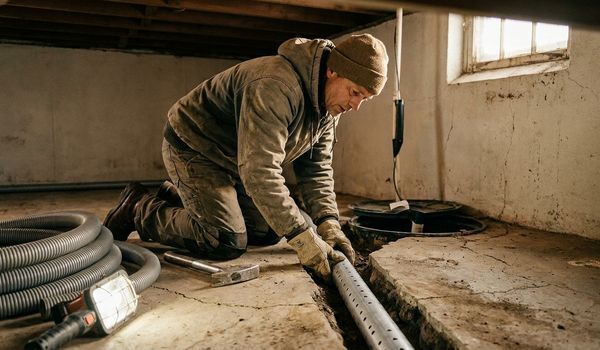
Step three is preparation and installation. Interior drainage jobs involve jackhammering a channel around the basement perimeter, laying drain tile and gravel, installing the sump basin and pump, and re-pouring concrete. Exterior jobs involve excavation to the footing, wall cleaning and repair, membrane application, and drain installation. A typical interior system takes one to three days; exterior excavation can take a week or more.
Step four is testing and warranty registration. The system is water-tested, discharge lines are verified, and the homeowner receives warranty documentation. Transferable lifetime warranties have become an industry standard for major systems and add measurable resale value to the home.
By the Numbers
Basement Waterproofing - Key Statistics
60%
of U.S. homes with basements experience below-grade moisture problems
$4.5K
national midpoint cost for a typical basement waterproofing project
48 hrs
window in which mold can begin growing after water intrusion
1 in 60
insured homes file a water damage or freezing claim each year
Who Needs Basement Waterproofing?
The statistics point to several groups who benefit most directly from waterproofing work. Homeowners with older basements top the list: homes built before modern drainage codes often have no exterior membrane, deteriorating damp-proofing, and clay tile footing drains that have long since collapsed or clogged. If a home is more than 30 years old and has never had waterproofing work, the probability of moisture issues rises sharply with each decade.
Homeowners planning to finish or remodel a basement are the second major group. Industry professionals consistently advise waterproofing before finishing, because drywall, flooring, and furnishings dramatically multiply the cost of any future water event. A pre-finishing waterproofing investment of a few thousand dollars protects a remodeling investment that commonly runs $30,000 to $75,000 or more.
Real estate investors and landlords form a third key audience. Water problems discovered during inspection routinely derail transactions or force price reductions far larger than the cost of the repair itself. A documented waterproofing system with a transferable warranty, by contrast, becomes a selling point. Property managers with multi-unit buildings face similar math at larger scale, where a single below-grade water event can displace tenants and trigger expensive emergency restoration.
Finally, homeowners in high-water-table regions, clay soil areas, and regions with heavy spring snowmelt face elevated risk regardless of home age. For these properties, waterproofing is less an optional upgrade and more a standard component of responsible ownership, much like roof maintenance or HVAC service.
Interior vs. Exterior Waterproofing Compared
The two dominant professional approaches solve the same problem from opposite sides of the foundation wall. The comparison below summarizes how they stack up on the factors homeowners ask about most.
| Factor | Interior System | Exterior System |
|---|---|---|
| Typical cost | $2,000 to $7,000 | $8,000 to $15,000+ |
| How it works | Captures water at footing level, routes it to a sump pump | Blocks water at the outside face of the foundation with membranes and drains |
| Installation time | 1 to 3 days | 5 to 10 days |
| Disruption | Interior dust and noise, no landscaping impact | Excavation disturbs landscaping, driveways, and decks |
| Best for | Hydrostatic pressure and cove-joint seepage | Severe wall deterioration and persistent exterior moisture |
| Typical warranty | Transferable lifetime warranties common | Long-term warranties, often 20 years to lifetime |
Many contractors recommend a hybrid approach: exterior work on the most exposed wall combined with an interior drainage system elsewhere. The statistics on project scopes reflect this, with combination jobs representing a substantial share of full-system installations.
How Crestmont Capital Helps Waterproofing Businesses
Behind every statistic in this report is a business opportunity. Waterproofing and foundation repair companies operate in a demand-rich niche, but growth requires capital: trucks and trailers, excavation equipment, sump pump and material inventory, marketing spend to capture post-storm demand surges, and payroll for additional crews during the busy season.
Crestmont Capital is the #1 business lender in the U.S., and we work with home services contractors every day. Our equipment financing programs let waterproofing companies acquire mini-excavators, skid steers, and spray rigs with predictable monthly payments instead of large cash outlays. For working capital needs like payroll, materials, and marketing, a business line of credit gives contractors on-demand access to funds that flex with seasonal demand.
Contractors expanding into complementary trades can also benefit from our industry-specific programs, including financing built for plumbing companies, which often overlap with waterproofing work on sump pump and drainage jobs. And if you are researching the business side of this trade, our guide to waterproofing contractor business loans breaks down the most common financing structures for this exact industry. Federal resources like the SBA loan programs are another option worth understanding as you map out your growth plan.
What sets Crestmont Capital apart is speed and simplicity. Our online application takes minutes, approvals often come back within hours, and funding can arrive as fast as the same day. There are no lengthy bank visits and no weeks-long underwriting queues, which matters when a storm just flooded half your service area and you need crews and equipment now.
Ready to Grow Your Waterproofing Business?
Join thousands of contractors who trust Crestmont Capital for fast, flexible funding. Apply in minutes.
Apply Now →How to Get Started
Homeowners should document where and when water appears. Contractors should map their service area, capacity gaps, and equipment needs before the next demand spike.
Complete Crestmont Capital's simple online application in minutes. No obligation and no impact on your credit to see your options.
A Crestmont Capital advisor will review your needs and match you with the right financing option for your situation and goals.
Once approved, funds can arrive in as fast as one business day, so you can act on the opportunity in front of you.
Frequently Asked Questions
How common are basement water problems? +
Very common. Industry estimates suggest that around 60 percent of U.S. homes with basements experience below-grade moisture problems at some point, and some industry data indicates that up to 98 percent of basements will deal with some form of water damage during their usable lifetime. Wet basements are the rule rather than the exception for older housing stock.
What is the average cost of basement waterproofing in 2026? +
Most professional basement waterproofing projects fall between $2,000 and $8,000, with a national midpoint frequently cited around $4,500. Small jobs like a single crack injection can cost a few hundred dollars, while full exterior excavation and membrane systems can exceed $15,000 depending on foundation size, depth, and site conditions.
What percentage of homeowners insurance claims involve water damage? +
Insurance industry data consistently shows that about 1 in 60 insured homes files a water damage or freezing claim each year. Water damage is one of the most frequent claim categories, and average claim severity is commonly estimated in the $11,000 to $13,000 range. Basements account for a significant share of that activity.
How big is the basement waterproofing industry? +
The broader waterproofing and foundation services market in North America is valued in the multi-billion-dollar range, with basement waterproofing representing one of the largest service categories. Analysts project steady mid-single-digit annual growth through the end of the decade, driven by aging housing stock and heavier rainfall patterns in many regions.
How quickly does mold grow after a basement water event? +
Under favorable conditions, mold can begin colonizing damp surfaces within 24 to 48 hours of water intrusion. That extremely short window is why restoration professionals emphasize immediate drying and mitigation, and why preventive waterproofing is far more cost-effective than mold remediation after the fact.
Does homeowners insurance cover basement waterproofing? +
Generally no. Standard homeowners policies treat waterproofing as preventive maintenance, which is the homeowner's responsibility. Policies may cover sudden and accidental water damage, but they typically exclude damage from gradual seepage, deferred maintenance, and external flooding. Flood insurance is a separate policy, and even it excludes many below-grade finishes.
What is the most common cause of basement flooding? +
Contractors most frequently cite hydrostatic pressure pushing groundwater through floor and cove joints, followed by surface water from poor grading, clogged gutters, and short downspouts. Sump pump failure is another leading cause, which is why battery backup systems have become a standard recommendation on new installations.
Is interior or exterior waterproofing more effective? +
Both work, but they solve the problem differently. Exterior waterproofing stops water before it reaches the foundation wall and is considered the most comprehensive solution. Interior drainage systems manage water after it enters and pump it back out. Interior systems cost significantly less and are the most commonly installed professional solution.
How long does a basement waterproofing system last? +
A professionally installed interior drainage system or exterior membrane can last decades, and most reputable contractors back major systems with transferable lifetime warranties. Sump pumps themselves are mechanical devices with a typical service life of 7 to 10 years, so they should be tested regularly and replaced proactively.
Can I waterproof my basement myself? +
Minor issues like extending downspouts, regrading soil, and applying interior sealant are reasonable DIY projects. Active leaks, structural cracks, and hydrostatic pressure problems are not. DIY sealants do not address exterior water pressure, and misdiagnosing the entry point often leads to repeat failures that cost more to fix later.
When is the best time of year to waterproof a basement? +
Contractors can install interior drainage systems year-round, which makes winter a smart time to book before the spring rush. Exterior excavation requires workable ground conditions, so it is typically scheduled in warmer, drier months. Statistically, demand peaks in spring and after major storm events, which can lengthen wait times.
Does waterproofing increase home value? +
Yes, in several ways. A dry basement protects finished square footage, a documented waterproofing system with a transferable warranty is a genuine selling point, and unresolved water problems routinely force price reductions during a sale that exceed the cost of the repair. Appraisers and buyers both treat water history seriously.
How long does a professional waterproofing installation take? +
A typical interior drainage system with a sump pump takes one to three days to install. Exterior excavation and membrane projects usually take five to ten days depending on perimeter length, soil conditions, and weather. Simple crack injections can often be completed in a single visit of a few hours.
What are the warning signs that a basement needs waterproofing? +
Watch for efflorescence, the white chalky mineral deposit left when water evaporates through concrete, along with musty odors, peeling paint, rust on appliances or supports, damp spots at the wall-floor joint, and visible cracks. Any one of these signals that moisture is migrating through the foundation and deserves a professional inspection.
How do waterproofing contractors finance equipment and expansion? +
Most waterproofing companies use a mix of equipment financing for excavators, trucks, and spray rigs, plus business lines of credit for materials, payroll, and marketing. Online lenders like Crestmont Capital offer fast applications and same-day funding, which is especially valuable when a storm event suddenly spikes demand in a contractor's service area.
The Bottom Line on Basement Waterproofing in 2026
The statistics tell a consistent story. Basement water problems are not edge cases: they affect the majority of below-grade spaces at some point, they generate some of the most frequent and expensive insurance claims in the country, and they create steady, weather-resilient demand for professional waterproofing services. With millions of aging basements in the housing stock and more being added every year, the need for waterproofing is not shrinking. It is growing.
For homeowners, the takeaway is straightforward: moisture warning signs deserve prompt attention, preventive waterproofing costs far less than remediation and mold cleanup, and a documented system with a transferable warranty protects both your living space and your resale value. For contractors and investors, the 2026 data describes a fragmented, demand-rich market where well-capitalized operators can build durable, growing businesses.
Ready to Take the Next Step?
Get fast, flexible financing from the #1 business lender in the U.S. No obligation, apply in minutes.
Apply Now →Disclaimer: The information provided in this article is for general educational purposes only and is not financial, legal, or tax advice. Funding terms, qualifications, and product availability may vary and are subject to change without notice. Crestmont Capital does not guarantee approval, rates, or specific outcomes. For personalized information about your business funding options, contact our team directly.

About the author and reviewer
Allan GarfinkleMBA (Finance), JD
Chief Revenue Officer, Crestmont Capital
Allan Garfinkle is the Chief Revenue Officer at Crestmont Capital, where he has spent more than a decade leading revenue strategy, business development, and operational growth. With 28 years of experience building and advising startups and small businesses, Allan has helped more than 10,000 business owners navigate financing decisions, growth opportunities, and changing economic conditions. He earned a Bachelor of Science in Economics and an MBA with a concentration in Finance from Northeastern University, as well as a Juris Doctor from New England Law, where his studies focused on contracts and business law. His writing draws on extensive practical experience in small-business lending, equipment financing, business credit, and commercial finance.