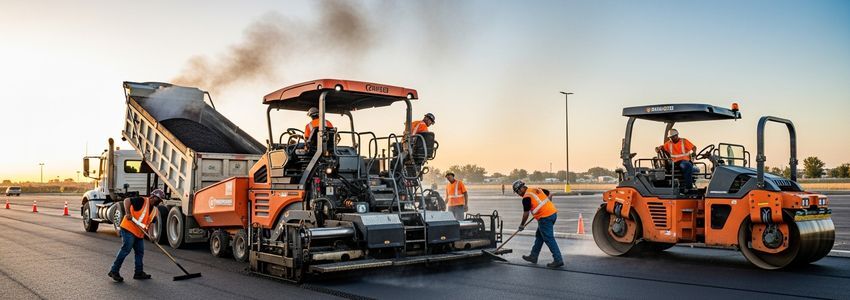
Asphalt paving contractors serve one of the most capital-intensive segments of the construction and infrastructure industry. Paving equipment — hot mix asphalt pavers, rollers, milling machines, dump trucks, and tack coaters — represents millions of dollars in fleet investment. Projects require purchasing hot mix asphalt from batch plants before installation begins, creating significant materials pre-payment. And commercial and municipal paving contracts typically pay net-30 to net-60 after project completion, creating working capital gaps that constrain how many projects can be run simultaneously. For paving contractors, the right financing structure unlocks the equipment capacity and working capital needed to grow from a small residential paving operation to a commercial and municipal paving company. This guide covers every financing option available to asphalt paving business owners.
In This Article
- Why Paving Businesses Need Financing
- Types of Paving Business Loans
- Equipment Financing for Paving Contractors
- SBA Loans for Paving Companies
- How to Qualify for a Paving Business Loan
- Paving Business Loan Rates, Terms, and Amounts
- Best Uses for Paving Business Financing
- Asphalt Paving Industry Statistics
- How to Apply and What to Prepare
- Why Paving Contractors Choose Crestmont Capital
- Frequently Asked Questions
Why Paving Businesses Need Financing
Asphalt paving is one of the most equipment-intensive specialty trades. The core equipment — a commercial asphalt paver alone — costs $150,000 to $800,000 new. Steel drum rollers and vibratory plate compactors add another $50,000 to $300,000. Milling machines for asphalt removal cost $200,000 to $1,000,000+. Dump trucks for material delivery run $80,000 to $180,000 each. A fully equipped paving crew capable of bidding commercial and municipal contracts typically requires $500,000 to $2,500,000+ in equipment investment.
Beyond equipment, paving contractors face the classic construction contractor cash flow challenge: materials must be purchased before projects begin, and payment arrives after completion. Hot mix asphalt for a 50,000 square foot commercial parking lot might cost $75,000 in materials alone — purchased before the crew sets foot on site.
Common financing needs for asphalt paving businesses include:
- Asphalt pavers — self-propelled commercial pavers from $150,000 (small) to $800,000+ (large commercial/highway class)
- Compaction equipment — double drum vibratory rollers ($100,000–$300,000), rubber tire rollers ($80,000–$200,000)
- Milling machines (cold planers) — for existing asphalt removal ($200,000–$1,000,000+)
- Dump trucks — for hot mix asphalt delivery and debris hauling ($80,000–$180,000 each)
- Tack coat distributors — for asphalt bonding agent application ($30,000–$80,000)
- Working capital — materials (hot mix asphalt, aggregate base) pre-purchased before project start; payroll during commercial project payment gaps
- Acquiring a paving company — purchasing an established contractor with fleet, bonding history, and municipal contract relationships
Contractor Financing Context: Paving equipment is among the most financeable assets in construction — major brands (Caterpillar, Vogele, BOMAG, Dynapac, Volvo) have established resale markets and equipment lenders who actively finance paving fleets. For broader construction contractor financing context, see our Construction Business Loans: The Complete Financing Guide for Contractors and Builders. For equipment financing structures, see our Construction Equipment Financing: The Complete Guide for Contractors and Construction Companies.
Types of Paving Business Loans
Equipment Financing
Equipment financing is the primary capital vehicle for paving fleet investment. Pavers, rollers, milling machines, and dump trucks all qualify with the assets serving as collateral. Major construction equipment brands have established resale markets that support strong equipment collateral valuations. Terms run 36 to 84 months at rates of 5%–22% depending on equipment age, credit score, and lender type.
Small Business Term Loans
Term loans provide lump-sum capital for working capital, multi-unit equipment packages, and business scaling. Online alternative lenders fund in 1 to 5 days; banks take 2 to 8 weeks at lower rates. Most appropriate for $50,000–$500,000 investments in fleet additions or working capital reserves.
Business Lines of Credit
A revolving line of credit addresses the paving contractor's most common challenge — the gap between purchasing materials and receiving project payment. Draw to purchase hot mix asphalt and aggregate at project start, repay when the GC or property owner pays, draw again for the next project. Lines of $50,000–$250,000 eliminate working capital constraints for growing operations.
SBA 7(a) Loans
SBA loans offer the lowest rates for qualified paving contractors. Best for established businesses ($300,000+ revenue) pursuing significant expansion — multiple equipment additions, facility purchase, or company acquisitions. Approval takes 60 to 90 days.
Invoice Financing
Invoice financing advances 80%–90% of outstanding commercial invoices immediately. For paving companies with large commercial or municipal projects on net-30 to net-60 terms, invoice financing directly eliminates the payment gap. Costs 1%–5% per month on invoice value.
Ready to Grow Your Paving Business?
Get fast, flexible financing from the #1 business lender in the U.S. No obligation — apply in minutes.
Apply Now →Equipment Financing for Paving Contractors
Paving equipment represents the largest single capital category for asphalt contractors. Key equipment and typical costs:
| Equipment | New Cost | Used Cost | Function |
|---|---|---|---|
| Asphalt Paver (small, 6–8 ft) | $150K–$300K | $50K–$150K | Driveways, parking lots, smaller commercial |
| Asphalt Paver (commercial, 10–16 ft) | $300K–$800K | $100K–$400K | Roads, highways, large commercial projects |
| Double Drum Vibratory Roller | $120K–$300K | $40K–$150K | Asphalt compaction |
| Cold Planer / Milling Machine | $200K–$1M+ | $60K–$400K | Existing asphalt removal |
| Tri-Axle Dump Truck | $120K–$180K | $40K–$90K | Hot mix delivery and debris hauling |
| Tack Coat Distributor | $40K–$80K | $15K–$40K | Bonding agent application |
Equipment financing for paving assets typically requires:
- Equipment invoice or appraisal (appraisal required for used equipment over $100K)
- 6+ months in business
- Credit score 580–620+
- Revenue documentation (bank statements, tax return)
- Contractor license and insurance certificates
SBA Loans for Paving Companies
Asphalt paving companies qualify for SBA programs as specialty trade contractors:
| SBA Program | Max Amount | Best Use | Min. Credit | Time to Fund |
|---|---|---|---|---|
| SBA 7(a) | $5 million | Equipment, working capital, acquisition | 650+ | 60–90 days |
| SBA 504 | $5.5M (CDC portion) | Facility real estate, large equipment packages | 680+ | 60–120 days |
| SBA Express | $500,000 | Working capital, equipment, LOC | 650+ | 30–45 days |
How to Qualify for a Paving Business Loan
Credit Score Requirements
- Bank term loans: 700+
- SBA 7(a) loans: 650–680+
- Online alternative term loans: 600–650+
- Equipment financing (new): 620–650+
- Equipment financing (used): 580–620+
- Business lines of credit: 600–650+
- Invoice financing: Based on client creditworthiness
Time in Business
- Banks and SBA: 2 years preferred
- Equipment financing: 6 months (manufacturer programs for new equipment)
- Online alternative lenders: 6 months to 1 year
Annual Revenue
- SBA and bank loans: $200,000+ annually (paving projects tend to be large)
- Online term loans: $100,000+ annually
- Equipment financing: Revenue secondary to equipment collateral value
Paving Industry-Specific Considerations
- Contractor licensing: Paving contractors require state contractor licenses. Some states require specific asphalt/paving contractor certifications. Verify all licenses are current before applying.
- CDL requirements: Dump trucks over 26,000 lbs GVWR require CDL drivers. Verify your drivers hold appropriate licenses.
- Bonding: Commercial and municipal paving contracts typically require performance and payment bonds. Bonding capacity (determined by your financial strength) is a gating factor for municipal contract growth.
- Seasonal concentration: Paving is highly seasonal — spring through fall in most markets, with winter shutdowns in cold climates. Provide 12 months of bank statements so lenders see your full annual cycle rather than slow-season data.
Paving Business Loan Rates, Terms, and Amounts
| Loan Type | Typical Rate | Term | Amount Range | Speed |
|---|---|---|---|---|
| Equipment Financing (new) | 5%–18% | 3–7 years | $50K–$3M+ | 3–14 days |
| Equipment Financing (used) | 7%–22% | 2–5 years | $25K–$1.5M | 3–14 days |
| SBA 7(a) Loan | 10%–13% | Up to 10 years | $100K–$5M | 60–90 days |
| Bank Term Loan | 8%–15% | 2–7 years | $50K–$2M | 2–8 weeks |
| Online Term Loan | 15%–45% | 3 months–5 years | $10K–$500K | 1–5 days |
| Business Line of Credit | 8%–35% | Revolving | $25K–$500K | 1–7 days |
Best Uses for Paving Business Financing
Purchasing a First Commercial Paver
The most transformative single investment for a residential paving company looking to scale is acquiring a commercial-class asphalt paver capable of bidding larger lots, commercial projects, and eventually municipal contracts. A used commercial paver ($80,000–$200,000) financed over 5 years while bidding larger commercial projects can increase average project revenue from $5,000–$15,000 (residential driveways) to $50,000–$500,000+ (commercial parking lots and roads).
Adding Milling Capability
Paving contractors who own milling machines can self-perform the full asphalt replacement cycle — mill existing surface, prepare base, pave new surface — rather than subcontracting milling. Owning milling capability improves project margins by 10–20% on replacement projects and eliminates subcontractor scheduling dependency. Cold planers ($60,000–$300,000 used) are financed through equipment loans using the machine as collateral.
Material Working Capital
Large paving projects require significant hot mix asphalt purchased from batch plants before installation — a 100,000 square foot commercial parking lot might require $150,000 in material costs days before the project starts. A business line of credit covers material purchases, enabling work to begin while awaiting GC authorization and mobilization payments.
Acquiring a Paving Company
Acquiring an established paving company — with fleet, bonding history, municipal relationships, and trained crews — is often more efficient than organic growth, particularly for accessing municipal contracts that require years of performance history. SBA 7(a) acquisition financing covers purchase price plus working capital.
Asphalt Paving Industry Statistics
- The U.S. asphalt paving and highway maintenance industry generates approximately $50–60 billion in annual revenue, with residential, commercial, and municipal segments all contributing significantly
- The federal Bipartisan Infrastructure Law allocated $110 billion for roads and bridges through 2026, sustaining strong demand for paving contractors in municipal and state highway markets
- Approximately 94% of U.S. roads are surfaced with asphalt, creating an enormous ongoing maintenance market — pavements have 15 to 25 year lifespans, requiring regular overlay, resurfacing, and replacement
- The commercial parking lot paving segment generates average project revenues of $50,000 to $500,000+ depending on lot size and specifications
- Paving industry employment exceeds 450,000 workers, with the specialty trade classified under highway, street, and bridge construction
- Asphalt prices are directly tied to crude oil prices — when oil prices rise, hot mix asphalt costs increase, creating working capital pressure for contractors between bid and material purchase
How to Apply and What to Prepare
For Equipment Financing
- Equipment invoice or appraisal (appraisal required for used equipment over $100K)
- 3 to 6 months of business bank statements
- Most recent business tax return
- Paving contractor license
- CDL documentation for applicable drivers
- Insurance certificates (GL, workers' comp, commercial auto)
For SBA and Bank Loans
- 2 to 3 years of business and personal tax returns
- Year-to-date profit and loss statement
- Current balance sheet (with equipment values)
- 12 months of business bank statements
- All applicable contractor licenses
- Bonding documentation (current bonds, surety capacity letter)
- Insurance certificates
- Awarded or signed commercial/municipal contracts (if available)
- Personal financial statement
Application Tips
- Provide 12 months of statements: Paving is highly seasonal. Show lenders your full annual cycle — don't apply only with winter slow-season data.
- Document commercial relationships: Signed commercial paving contracts or municipal awards demonstrate revenue stability that lenders value highly.
- Highlight bonding history: Existing performance bonds with municipal clients demonstrate financial strength and compliance track record.
Why Paving Contractors Choose Crestmont Capital
Crestmont Capital is the #1 rated business lender in the United States. We work with paving contractors at every scale — from residential asphalt driveway operations to regional commercial and municipal paving companies. We understand the equipment-intensive capital structure, seasonal cash flow dynamics, and working capital needs specific to asphalt paving.
- Heavy equipment financing expertise: We understand pavers, rollers, milling machines, and dump trucks as loan collateral
- Fast decisions: Approvals in as little as 24 to 72 hours depending on loan complexity
- High loan amounts: Financing up to $5 million+ for established paving fleets
- Transparent terms: No hidden fees, complete cost disclosure before you sign
Get Your Asphalt Paving Business Loan Today
Apply in minutes. No obligation. Funding as fast as 24 hours.
Apply Now →Frequently Asked Questions
Frequently Asked Questions: Asphalt Paving Business Loans
Disclaimer: This article is provided for general educational purposes only and does not constitute financial, legal, or regulatory advice. Loan rates, terms, and requirements vary by lender and are subject to change. Equipment pricing and margin figures are estimates based on publicly available industry data and may vary significantly by market, equipment condition, and project type. Consult a qualified financial advisor before making business financing decisions.