
 (800) 949-0401
10 Predictable-Repayment Loans for Business Renovation in 2026
Planning a business renovation in 2026 means juggling contractor bids, timelines, and cash flow all at once. The last thing you want is a financing product with unpredictable payments that throws off your monthly budget mid-project. That is why smart business owners are zeroing in on loans with fixed, structured repayment schedules so they know exactly what they owe every month from the day they sign.
In this guide, we break down the ten best loan types for business renovation that offer predictable repayment, covering everything from government-backed SBA programs to equipment financing and invoice-based options. Whether you are remodeling a retail storefront, upgrading a restaurant kitchen, or overhauling a medical office, there is a predictable financing path built for your situation.
1. SBA 7(a) Loans: The Gold Standard for Business Renovation
The SBA 7(a) loan is the most widely used government-backed financing product in the United States, and for good reason. With loan amounts up to $5 million, fixed or variable rates capped by the SBA, and repayment terms up to 25 years for real estate or 10 years for working capital and equipment, this program is purpose-built for large renovation projects that demand long-horizon, predictable payments.
For a business renovation loan, SBA 7(a) funds can cover construction costs, contractor fees, new fixtures, HVAC systems, plumbing, electrical upgrades, and even permitting costs. Because the SBA guarantees up to 85% of the loan amount (for loans up to $150,000) or 75% (for larger amounts), lenders are more willing to offer competitive rates to businesses that might not qualify for conventional bank financing.
Why repayment is predictable: Fixed-rate SBA 7(a) loans lock your interest rate for the entire loan term. Even variable-rate versions are capped at Prime + 2.75% for loans over $50,000, so your maximum payment exposure is clearly defined from the start. Monthly principal-plus-interest payments begin 30 to 60 days after funding, giving you time to mobilize your renovation project before the first bill arrives.
Typical qualifications: Most lenders look for 2+ years in business, a credit score above 650, and demonstrated ability to repay based on cash flow. Find out more about how SBA loans from Crestmont Capital can work for your renovation project.
Ready to Fund Your Business Renovation?
Get matched with the right loan in minutes. No obligation, no pressure.
Apply Now →2. SBA 504 Loans: Long-Term Fixed Rates for Major Renovations
If your renovation involves acquiring or significantly improving commercial real estate, the SBA 504 loan is worth a close look. This program pairs a private lender with a Certified Development Company (CDC) to fund major capital expenditures at some of the lowest fixed rates available to small businesses. Loan amounts can exceed $5 million in certain industries (manufacturing, energy-efficient projects), and repayment terms run 10, 20, or 25 years.
The 504 structure splits the funding three ways: the private lender covers roughly 50% of project costs, the CDC covers 40% (in the form of an SBA-backed debenture), and the borrower contributes 10% down. The CDC portion carries a fully fixed interest rate tied to U.S. Treasury rates, making your largest payment component completely immune to rate hikes throughout the life of the loan.
Best for: Gut renovations of commercial properties, building additions, significant structural improvements, and energy-efficiency upgrades that qualify for the SBA green energy program (which can increase CDC limits). According to the SBA's official 504 loan page, eligible project costs include acquisition and renovation of existing buildings, grading, street improvements, utilities, parking lots, and landscaping.
Why repayment is predictable: The CDC debenture portion carries a fixed rate for the entire 10, 20, or 25-year term. The private lender portion may be variable, but many lenders offer fixed-rate options for the first portion as well, giving you a blended payment that changes little over time.
3. Traditional Term Loans: Straightforward Fixed Monthly Payments
A conventional business term loan from a bank, credit union, or online lender is the simplest way to achieve totally predictable renovation financing. You borrow a lump sum, agree to a fixed or variable interest rate and a set repayment term (typically 1 to 10 years), and make the same payment every month until the loan is retired. No surprises, no balloon payments hidden in fine print (as long as you read your agreement carefully).
Term loans for renovation range from $25,000 for a minor cosmetic refresh to $2 million or more for a comprehensive commercial build-out. Interest rates for well-qualified borrowers currently range from roughly 7% to 15% depending on the lender, loan size, term, and collateral offered. Online lenders tend to be faster and more flexible, while banks offer lower rates in exchange for stricter underwriting.
What renovation costs qualify: Virtually anything related to your physical business space or operations. Flooring, roofing, HVAC, electrical, plumbing, painting, signage, parking areas, restrooms, kitchen equipment, and technology infrastructure all count as eligible uses for a business term loan.
For larger renovation needs that span several years, long-term business loans from Crestmont Capital offer extended repayment timelines that keep monthly payments manageable even on sizable loan amounts.
For renovation projects, always ask for a fixed-rate term loan. While variable rates may start lower, they introduce payment uncertainty just when you need budget stability most. A fixed rate locks in your monthly cost from day one, which is exactly what renovation planning requires.
4. Equipment Financing: Pay for Renovation Equipment with the Equipment Itself
When your renovation involves purchasing machinery, commercial kitchen equipment, HVAC units, elevators, generators, solar panels, or any other tangible equipment, equipment financing offers a self-collateralizing structure that is inherently predictable. The equipment itself serves as collateral, so lenders can offer fixed monthly payments tied to a schedule that mirrors the useful life of the asset.
Repayment terms typically run 24 to 84 months, and rates are often lower than unsecured term loans because of the built-in collateral. Equipment loans also come with a tax advantage: Section 179 of the Internal Revenue Code allows businesses to deduct the full purchase price of qualifying equipment in the year it was placed in service, rather than depreciating it over many years. This can significantly reduce the net cost of your renovation equipment purchases.
Best renovation scenarios: Restaurant kitchen overhauls, dental or medical office equipment upgrades, manufacturing floor redesigns, commercial laundry equipment replacement, and HVAC or refrigeration system installations all fit the equipment financing model perfectly.
Explore equipment financing through Crestmont Capital to fund the machinery and systems that will power your renovated space for years to come.
5. Business Lines of Credit: Flexible Draw, Predictable Repayment Structure
A business line of credit works differently from a term loan: instead of receiving a lump sum upfront, you draw funds as you need them up to your approved credit limit and only pay interest on the balance you have drawn. This is particularly valuable for renovation projects where costs roll in unpredictably, with contractor invoices, material deliveries, and permit fees hitting at different times over the course of weeks or months.
Many business lines of credit offer fixed repayment schedules on drawn balances. For example, a revolving line might require you to repay drawn funds over 12 months in equal installments, and new draws reset on their own schedule. Some lenders offer non-revolving lines with a single draw period followed by a defined amortizing repayment period, which is very similar to a term loan in its predictability.
Credit limits for business lines of credit typically range from $10,000 to $500,000 for small and mid-sized businesses. Rates run from 8% to 24% depending on your creditworthiness and the lender. Lines secured by accounts receivable or business assets typically carry lower rates than unsecured revolving credit.
A business line of credit from Crestmont Capital gives you the flexibility to draw renovation funds when contractor invoices arrive, while keeping your repayment on a structured, manageable schedule.
Compare Renovation Loan Options in One Place
Our team will match you with the program that fits your project scope, timeline, and budget.
Start Your Application →6. Revenue-Based Financing: Payments That Scale With Your Business
Revenue-based financing (RBF) is a newer model where repayment is structured as a fixed percentage of your monthly gross revenue, not a flat dollar amount. For businesses with predictable revenue streams, RBF can actually be highly predictable: if your revenue is stable, your payments are stable. If revenue drops temporarily, payments decline proportionally, giving you automatic cushion during slow periods.
RBF providers advance a lump sum in exchange for a fixed multiple of that advance (the factor rate), typically ranging from 1.1x to 1.5x. For example, you might receive $100,000 today and agree to repay $140,000 over 12 months via a fixed 8% of monthly gross revenue. If your revenue averages $150,000 per month, you repay $12,000 per month for roughly 11 to 12 months.
While RBF does not carry a traditional interest rate expressed as an APR, the equivalent annualized cost can be significant (often 30% or more), so it is best reserved for renovation projects that will generate a clear and rapid return on investment, such as remodeling a high-traffic retail space or upgrading a restaurant layout to increase table turns.
Best for: Established businesses with 12+ months of revenue history, consistent monthly receipts, and renovation projects with a clear revenue-growth payoff.
Revenue-based financing uses a factor rate, not an APR. Always convert to APR for apples-to-apples comparison. A 1.35 factor rate on a 12-month advance is approximately equivalent to a 60%+ APR in many cases. Use RBF when speed and flexibility matter most, not when lowest cost is the priority.
7. USDA Business and Industry Loans: Low-Rate Renovation Financing for Rural Businesses
If your business is located in a rural area (generally defined as a community with a population under 50,000), the USDA Business and Industry (B&I) Guaranteed Loan Program offers exceptionally competitive renovation financing. Like SBA loans, USDA B&I loans feature government guarantees (up to 80%) that encourage lenders to offer lower rates and longer terms than they might otherwise provide.
Loan amounts under the USDA B&I program can reach $25 million, with repayment terms of up to 30 years for real property. Interest rates are negotiated between the borrower and lender but are subject to USDA approval and tend to be competitive with conventional commercial mortgage rates. For rural businesses planning major facility renovations, this program can dramatically reduce the monthly payment burden compared to conventional bank financing.
Eligible uses include purchasing, constructing, or improving commercial buildings, and acquiring machinery and equipment. The program is designed to create and maintain employment in rural America, so projects that demonstrate economic benefit to the local community receive priority consideration. Visit the USDA Rural Development website for eligibility maps and program details.
8. Commercial Construction Loans: Draw-Based Funding for Major Build-Outs
For renovation projects that rival ground-up construction in scope (full gut rehabs, building additions, structural overhauls), a commercial construction loan may be the most appropriate financing vehicle. These loans fund in draws aligned with construction milestones, meaning you only pay interest on what you have drawn at any given time, keeping costs low during the construction phase.
Once construction is complete, most commercial construction loans convert to a permanent mortgage or term loan through a process called a "construction-to-perm" conversion. At that point, your payments become fixed (or structured as a standard amortizing loan), giving you predictable monthly costs for the long term. The draw-based nature of the construction phase is itself a form of payment predictability: your costs during renovation are interest-only on drawn funds, and you know exactly what the permanent loan terms will be before you close.
Commercial construction loans typically require detailed plans, contractor bids, a project budget, and a timeline from a licensed general contractor. Lenders will also require title insurance and may appoint a third-party construction inspector to approve draws.
According to the U.S. Census Bureau's construction spending data, commercial renovation spending reached record levels in 2024 and 2025, reflecting broad demand for upgraded commercial spaces across retail, hospitality, healthcare, and professional services sectors.
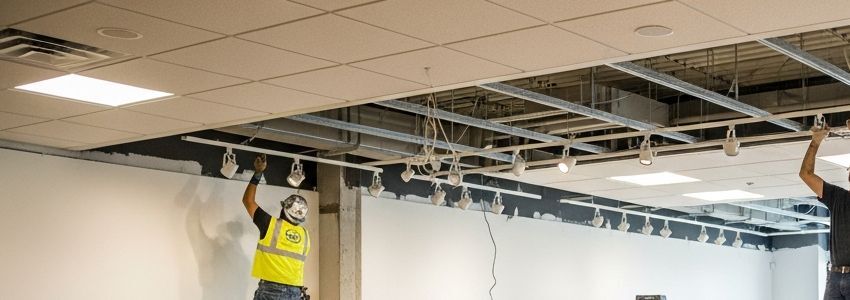
9. SBA Microloans: Small-Scale Renovation for Startups and Small Businesses
Not every renovation project requires hundreds of thousands of dollars. For smaller renovation needs, the SBA Microloan Program provides up to $50,000 through nonprofit community lenders called intermediaries. The average SBA microloan is around $13,000, making this program ideal for cosmetic refreshes, signage upgrades, minor equipment additions, or targeted improvements to specific areas of a business space.
SBA microloan terms run up to 6 years, and interest rates typically range from 8% to 13%. Because the intermediary lenders are mission-driven nonprofits focused on community economic development, they often work with borrowers who have limited credit history or who are in earlier stages of business development. Some intermediaries also provide free business counseling and technical assistance alongside the loan.
Who benefits most: Startups under 2 years old, businesses in underserved communities, minority-owned and women-owned businesses, and businesses needing smaller loan amounts that do not justify the paperwork load of a full SBA 7(a) application.
Important note: SBA microloans cannot be used to pay existing debts or purchase real estate. All other renovation-related costs are generally eligible, including leasehold improvements, equipment, furniture, fixtures, supplies, and working capital to support the renovation period.
Business Renovation Financing: Key Statistics
Sources: SBA.gov, IRS.gov, USDA Rural Development, U.S. Census Bureau
10. Invoice Financing: Unlock Cash Flow to Fund Renovation Costs
Invoice financing (also called accounts receivable financing) is a funding strategy where you use your outstanding customer invoices as collateral to access immediate cash. Rather than waiting 30, 60, or 90 days for clients to pay, you sell or pledge those receivables to a lender who advances you 70% to 95% of the invoice value immediately. When your customer pays, the lender remits the remainder minus fees.
From a repayment predictability standpoint, invoice financing is unique: there are no monthly loan payments because repayment happens automatically when your customers pay their invoices. Your cost is a fee (typically 1% to 5% of the invoice value per month the invoice is outstanding), not a scheduled payment, making the total cost tied directly to your invoice cycle rather than a calendar-based amortization schedule.
For renovation-focused businesses, invoice financing works best when you have significant receivables from ongoing client projects and want to redirect that cash into renovation improvements without taking on traditional debt. It is particularly popular in construction, healthcare, staffing, and professional services firms where large invoices with extended payment terms are common.
Repayment risk to watch: If a customer does not pay (invoice default), you may be responsible for repaying the advance, depending on whether your arrangement is recourse or non-recourse. Always clarify this with your lender before signing.
How to Choose the Right Business Renovation Loan in 2026
With ten solid options on the table, the right choice comes down to four factors: project scope, timeline, your business's financial profile, and how much payment predictability you need. Here is a simple framework to narrow it down:
Start with your project budget. For renovation projects under $50,000, SBA microloans, equipment financing, or a business line of credit are often fastest and simplest. For projects between $50,000 and $500,000, term loans, SBA 7(a), or equipment financing fit best. For projects over $500,000 with real estate components, SBA 504 or USDA B&I loans typically offer the best long-term payment structure.
Consider your timeline. If you need funds in days, revenue-based financing, invoice financing, or an online business term loan is the fastest route. SBA loans take 30 to 90 days to close. USDA loans can take several months. If your renovation is planned for months out, use that lead time to pursue government-backed options with better rates.
Assess your qualifications honestly. Strong credit (700+), 2+ years in business, and solid financials unlock the best SBA rates. Newer businesses or those with credit challenges can still access microloans, invoice financing, or revenue-based financing. Bad credit business loans are also available for businesses that need funding while rebuilding their credit profile.
Match collateral to loan type. If you own equipment, use equipment financing and let the asset secure the loan. If you own real estate, leverage it for better rates on SBA 504 or conventional mortgages. If your collateral is limited, unsecured term loans or revenue-based financing can still get you funded.
When you are ready to explore your options, the team at Crestmont Capital's small business loans can help you compare programs and identify the fastest, most cost-effective path to funding your renovation.
As of early 2026, the Federal Reserve has held rates in a moderately elevated range compared to pre-2022 levels. Locking in a fixed-rate renovation loan now protects you against any future rate movement. According to CNBC's Small Business coverage, fixed-rate borrowing demand among small businesses rose significantly in 2025 as owners sought payment certainty in an uncertain rate environment.
Next Steps: Getting Your Renovation Funded in 2026
Your Renovation Financing Roadmap
- Define your renovation scope and budget — Get at least two contractor bids and add a 15% contingency buffer for unexpected costs.
- Pull your business credit report — Check Dun & Bradstreet, Experian Business, and Equifax Business to know your standing before applying.
- Gather your financial documents — Lenders will want 2 years of business tax returns, 3 months of bank statements, a profit & loss statement, and a balance sheet.
- Choose your loan type — Use the framework above to match your project scope, timeline, and qualifications to the right program.
- Submit your application — Apply through a lender that specializes in business renovation financing to maximize approval odds and speed.
- Close and fund — Review all terms carefully, confirm your rate is fixed (or understand your variable rate cap), and verify repayment dates before signing.
- Launch your renovation — With predictable monthly payments locked in, you can focus on managing your contractor and keeping your project on schedule.








