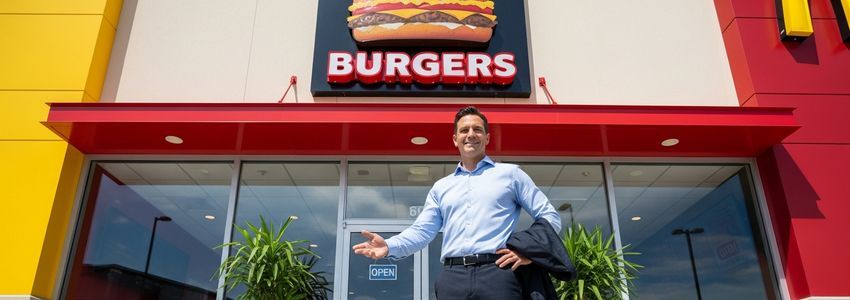
If you are researching the Smashburger franchise cost and wondering how to finance your path to ownership, you have come to the right place. Smashburger is one of the fastest-growing better-burger concepts in the United States, known for its signature smashed-to-order burgers, hand-spun milkshakes, and vibrant store experience. Opening a Smashburger franchise is a compelling business opportunity, but like any franchise investment, it requires serious capital planning and the right lending partner to make your goals a reality.
This comprehensive guide covers everything prospective Smashburger franchisees need to know about financing: initial investment ranges, available loan types, qualification criteria, and how Crestmont Capital can help you secure the funding you need quickly. Whether you are a first-time franchisee or an experienced multi-unit operator, understanding your financing options is the critical first step toward opening your doors.
From SBA loans to equipment financing and working capital solutions, the right funding mix can make the difference between a struggling launch and a thriving operation. Read on for the complete breakdown.
In This Article
What Is Smashburger and What Does It Cost to Open One?
Smashburger was founded in 2007 in Denver, Colorado and quickly built a reputation for delivering a premium fast-casual burger experience at an accessible price point. The concept centers on fresh, never-frozen beef patties smashed onto a flat-top grill, creating a caramelized crust with exceptional flavor. Today, Smashburger operates hundreds of locations across the United States and internationally, with a majority owned by Jollibee Foods Corporation, one of the world's largest food service companies.
The brand has broad consumer appeal, blending the quality of a sit-down burger restaurant with the speed and convenience of a quick-service format. Menu highlights include the Classic Smash, BBQ Bacon Smash, hand-spun Haagen-Dazs milkshakes, crispy smash fries, and a rotating lineup of limited-time offerings that keep regulars coming back. The brand's consistent quality and loyal customer base make it an attractive franchise opportunity for operators who want a proven model with strong brand recognition.
Smashburger Franchise Investment Breakdown
Before pursuing any financing, you need a clear picture of the total capital required to open a Smashburger franchise. While exact figures are governed by the current Franchise Disclosure Document (FDD), the typical investment range based on industry data and public filings includes the following components:
| Investment Item | Estimated Range |
|---|---|
| Initial Franchise Fee | $40,000 |
| Leasehold Improvements / Build-Out | $200,000 - $450,000 |
| Equipment and Fixtures | $100,000 - $200,000 |
| Signage | $10,000 - $25,000 |
| Technology / POS Systems | $15,000 - $30,000 |
| Opening Inventory | $10,000 - $20,000 |
| Training Expenses | $5,000 - $15,000 |
| Working Capital (3 months) | $50,000 - $100,000 |
| Additional / Miscellaneous | $15,000 - $40,000 |
| Total Estimated Investment | $445,000 - $920,000+ |
These numbers confirm that opening a Smashburger franchise is a significant financial commitment. Most franchisees will need to finance a substantial portion of these costs, which is why understanding available loan products and lenders is so critical. According to the SBA's franchise financing guidance, a well-structured loan plan is one of the key differentiators between franchisees who succeed and those who struggle in the first two years.
Why Franchise Financing Matters for Smashburger Operators
Even experienced restaurant operators with substantial savings rarely pay cash for a franchise investment of this magnitude. The reasons to finance your Smashburger location are compelling from both a cash flow and strategic standpoint:
- Preserve working capital: Tying up all your liquid assets in construction and equipment leaves you with no buffer for the ramp-up period when revenue is still building.
- Leverage OPM (Other People's Money): Financing allows you to open one or more locations while keeping your capital available for emergencies, additional units, or growth investments.
- Tax advantages: Business loan interest and certain depreciation strategies can reduce your taxable income. Consult a CPA familiar with restaurant franchises.
- Faster expansion: Franchisees who secure financing early can move quickly on territory agreements and secure prime locations before competitors.
- Align repayment with revenue: Many loan structures allow for flexible repayment that aligns with your restaurant's cash flow cycles, especially during the seasonal peaks and valleys common in the food service sector.
A Forbes analysis of franchise financing trends shows that franchisees who use a diversified mix of loan products tend to have lower default rates and higher unit-level economics in years two through five. The key is matching the right loan type to the right expense category.
Ready to Finance Your Franchise?
Get fast, flexible franchise financing from the #1 business lender in the U.S. Apply in minutes.
Apply Now →Types of Financing Available for Smashburger Franchise Owners
There is no single "best" loan for opening a Smashburger franchise. The right solution depends on your current financial profile, how much equity you have, and which phases of the project need funding. Here is a breakdown of the most commonly used financing products for franchise operators:
1. SBA 7(a) Loans
The SBA 7(a) loan is the most popular financing vehicle for franchisees. Backed by the Small Business Administration, these loans offer long repayment terms (up to 10 years for working capital, up to 25 years for real estate) and competitive interest rates. Loan amounts can reach $5 million, making them suitable for covering a significant portion of your Smashburger startup costs. The SBA maintains a Franchise Registry that pre-approves certain franchise brands, which can accelerate the underwriting process. Many Smashburger franchisees use the SBA 7(a) program as their primary financing vehicle.
2. SBA 504 Loans
The SBA 504 loan is designed for major fixed asset purchases such as commercial real estate and heavy equipment. If you plan to own your Smashburger building rather than lease, the 504 program can provide up to 40% of the total project cost at a fixed interest rate over 20 years, with a Certified Development Company (CDC) acting as the secondary lender. This structure minimizes your down payment and locks in long-term rate certainty.
3. Equipment Financing
Restaurant equipment is one of the largest line items in a Smashburger buildout. Commercial flat-top grills, fryers, refrigeration units, prep stations, and POS systems can easily total $100,000 or more. Equipment financing allows you to spread these costs over 3 to 7 years, using the equipment itself as collateral. This keeps your SBA borrowing capacity available for the build-out and working capital needs. Interest rates for equipment loans are typically lower than unsecured products because of the underlying collateral.
4. Business Lines of Credit
A business line of credit provides flexible, revolving access to capital for ongoing operational needs. Unlike a term loan, you only pay interest on what you draw. For Smashburger operators, a credit line is useful for managing payroll during slower periods, purchasing additional inventory during promotional events, or handling unexpected maintenance costs. Credit lines typically range from $25,000 to $500,000 depending on the lender and your financial profile.
5. Unsecured Working Capital Loans
For franchisees who need quick access to cash without pledging collateral, unsecured working capital loans can bridge funding gaps during the pre-opening period or cover unexpected expenses post-launch. These loans typically have higher interest rates than secured products but can be approved and funded in as little as 24 to 72 hours, which is critical when construction timelines are running tight.
6. Rollover for Business Startups (ROBS)
ROBS arrangements allow individuals to invest their 401(k) or IRA funds into a new franchise business without incurring early withdrawal penalties or taxes. While complex and requiring the assistance of a specialized ERISA attorney, ROBS can provide a substantial equity injection that strengthens your overall loan application. CNBC has covered the growing use of retirement funds in franchise financing, noting that ROBS transactions have seen a significant uptick among first-time franchisees.
7. Commercial Real Estate Loans
If you plan to own your Smashburger property rather than lease, a commercial real estate loan or SBA 504 loan can finance the property purchase and improvements. Owning your real estate builds long-term equity and can significantly boost the resale value of your franchise business.
How to Qualify for a Smashburger Franchise Loan
Lenders evaluate franchise loan applications across several dimensions. Understanding these criteria before you apply will help you build the strongest possible loan package:

Credit Score
Most SBA lenders require a personal credit score of 680 or higher. Scores above 720 typically qualify for the best rates and terms. If your credit score is below threshold, work with a credit counselor to resolve any derogatory items before applying. Even improving your score by 20 to 30 points can meaningfully affect your interest rate.
Net Worth and Liquidity
Smashburger and most lenders require franchisees to demonstrate a minimum net worth and liquid assets. Industry standards suggest having liquid assets of at least $150,000 to $200,000 and a net worth of $500,000 or more. Your liquid assets serve as a signal that you can weather the early months when cash flow is still ramping.
Business Plan
A detailed, professional business plan is non-negotiable for franchise loans. Your plan should include financial projections for years one through three, market analysis for your specific territory, a competitive landscape review, and your management team's background. Lenders want to see that you have thought through both the opportunity and the risks.
Prior Business or Restaurant Experience
While not always required, prior experience in foodservice management or business ownership can significantly strengthen your application. Multi-unit operators with a track record of profitable franchises often receive more favorable terms than first-time buyers.
Collateral
SBA loans require borrowers to pledge available collateral, which may include personal real estate, business assets, or investment accounts. However, the SBA does not decline loans solely for insufficient collateral if the business plan and financials are strong.
Industry Performance
According to Bloomberg's reporting on restaurant lending, lenders in 2024 and 2025 have focused heavily on unit-level economics when evaluating franchise loan applications. Average unit volumes (AUV), same-store sales trends, and franchise system financial health all factor into the underwriting decision.
Smashburger Franchise Financing: Key Stats at a Glance
$445K+
Minimum Total Investment
$5M
Max SBA 7(a) Loan Amount
680+
Recommended Credit Score
24-72h
Working Capital Funding Speed
10-25 yr
SBA Loan Repayment Terms
$40K
Franchise Fee
Ready to Finance Your Franchise?
Get fast, flexible franchise financing from the #1 business lender in the U.S. Apply in minutes.
Apply Now →How Crestmont Capital Helps Smashburger Franchise Owners
Crestmont Capital is America's #1 business lender, and our franchise financing team specializes in helping restaurant franchisees navigate the complex landscape of startup and expansion loans. We work with new franchisees who are opening their first location, as well as seasoned multi-unit operators looking to refinance or expand their portfolio.
Here is what sets Crestmont Capital apart when it comes to Smashburger franchise financing:
- Access to 75+ lending partners: We do not rely on a single bank. Our network of over 75 lenders means we can shop your application across multiple institutions simultaneously, finding the best rates and terms for your specific situation.
- Franchise-focused underwriting: Our underwriters understand the Smashburger model, its unit economics, and how franchise agreements affect loan covenants. You will not spend weeks educating a banker on what a franchise is.
- Full loan stack support: Many franchisees need multiple products working together: an SBA 7(a) for construction, equipment financing for the kitchen buildout, and a line of credit for working capital. We structure these as a coordinated package so nothing falls through the cracks.
- Fast pre-qualification: Our online application takes less than 10 minutes and generates a pre-qualification decision that helps you move quickly when the right location comes available.
- Dedicated franchise advisor: Every Crestmont Capital client is assigned a dedicated franchise lending advisor who guides you from application to funding and beyond.
- Flexible documentation: We work with franchisees at various stages of the process, whether you have an executed franchise agreement or are still in preliminary discussions with Smashburger's development team.
Our small business financing solutions are designed to meet franchisees where they are, not where a rigid bank checklist says they should be. Whether you need $300,000 or $900,000, we have products and partners to get your Smashburger financed.
Real-World Financing Scenarios for Smashburger Franchisees
Abstract loan information is helpful, but concrete examples show how financing actually comes together. Here are four representative scenarios based on real franchisee profiles:
Scenario 1: First-Time Franchisee, Single Unit
Profile: Former restaurant manager, 720 credit score, $120,000 in liquid savings, $350,000 in retirement accounts, no existing business debt.
Challenge: Total estimated project cost is $600,000. Liquid savings alone are not sufficient, and borrower is cautious about depleting emergency reserves.
Solution: Crestmont Capital structured a $480,000 SBA 7(a) loan covering construction and franchise fee, a $90,000 equipment financing package for kitchen equipment, and a $50,000 ROBS arrangement utilizing retirement funds as the equity injection. The borrower retained $60,000 in liquid savings for working capital, well above the three-month reserve recommendation.
Result: Location opened on schedule, reached break-even by month eight, and the franchisee is now evaluating a second territory.
Scenario 2: Multi-Unit Operator Expanding Portfolio
Profile: Existing franchisee with two profitable quick-service locations, 750 credit score, strong business tax returns, $200,000 in accessible capital.
Challenge: Wants to open a third location but needs to preserve capital for ongoing operations at existing units.
Solution: Crestmont Capital leveraged the operator's existing business assets as collateral for a $700,000 SBA 7(a) loan and established a $150,000 revolving business line of credit to cover the new location's first six months of working capital needs.
Result: New location opened 30 days ahead of schedule. The line of credit was drawn and repaid twice in the first year, with no default events.
Scenario 3: Franchisee Seeking Equipment Upgrade
Profile: Two-year Smashburger operator with a profitable unit, 690 credit score, needs to replace aging flat-top grills and refrigeration systems.
Challenge: Unexpected equipment failures are creating service disruptions and customer complaints. Needs $80,000 quickly with minimal paperwork.
Solution: Crestmont Capital approved a $85,000 equipment financing package in 48 hours using the new equipment as collateral. Monthly payments were structured to align with the franchisee's highest-revenue months.
Result: Equipment installed within 10 days of application. Service interruptions eliminated, and average ticket times improved by 22%.
Scenario 4: Franchisee Refinancing High-Interest Debt
Profile: Three-year operator who originally funded the location with a mix of credit cards and a high-rate merchant cash advance during a period of tight bank lending.
Challenge: Monthly debt service on the original high-rate products was consuming 35% of gross revenue, leaving minimal margin for reinvestment.
Solution: Crestmont Capital consolidated $280,000 in high-rate debt into a single SBA 7(a) loan at a significantly lower interest rate and 10-year term. Monthly payments dropped by $4,200, freeing up immediate cash flow.
Result: Franchisee reinvested savings into a local marketing campaign, increasing same-store sales by 18% in year four. Now exploring expansion into a second territory.
Related Franchise Financing Guides
If you are comparing franchise investment opportunities alongside Smashburger, the following resources may be helpful as you evaluate the fast-casual and quick-service landscape:
- Sonic Franchise Loan: The Complete Financing Guide - Compare Sonic's drive-in model and financing requirements against Smashburger's fast-casual approach.
- Culver's Franchise Loan: The Complete Financing Guide - Explore how Culver's premium burger concept compares in cost and financing structure.
- Domino's Franchise Loan: The Complete Financing Guide - Understand how a delivery-focused franchise model affects financing needs.
Frequently Asked Questions About Smashburger Franchise Loans
How much does it cost to open a Smashburger franchise?
What is the Smashburger franchise fee?
Can I get an SBA loan to open a Smashburger franchise?
What credit score do I need to get a franchise loan?
How much liquid capital do I need to open a Smashburger?
How long does it take to get a franchise loan?
Is Smashburger on the SBA Franchise Registry?
What are Smashburger's royalty and ongoing fees?
Can I use my retirement savings to fund a franchise?
What collateral is required for a franchise loan?
How profitable is a Smashburger franchise?
Do I need restaurant experience to get a Smashburger franchise loan?
Can I get financing to open multiple Smashburger locations?
What interest rates can I expect on a franchise loan?
How does Crestmont Capital differ from a traditional bank for franchise loans?
Next Steps: How to Get Your Smashburger Franchise Financed
- Request the FDD: Contact Smashburger's franchise development team to receive the current Franchise Disclosure Document. Review Item 7 (estimated initial investment) and Item 19 (financial performance representations) carefully.
- Check your credit: Pull your personal credit report from all three bureaus (Equifax, Experian, TransUnion) and address any errors or derogatory items before applying for a loan.
- Calculate your equity: Determine how much liquid capital you can contribute to the project as a down payment. Most franchise loans require 10% to 30% equity injection from the borrower.
- Prepare your financial documents: Gather two to three years of personal and business tax returns, bank statements, a personal financial statement, and any relevant business financial statements.
- Pre-qualify with Crestmont Capital: Apply online at Crestmont Capital in less than 10 minutes. Our team will review your profile and present financing options within 24 hours.
- Work with a franchise attorney: Before signing any franchise agreement or loan documents, have a qualified franchise attorney review all contracts to ensure you understand your rights and obligations.
- Close and build: Once financing is secured and your franchise agreement is executed, work with your Smashburger development representative and approved contractors to begin your buildout.
Ready to Finance Your Franchise?
Get fast, flexible franchise financing from the #1 business lender in the U.S. Apply in minutes.
Apply Now →Conclusion
Opening a Smashburger franchise is a significant investment with strong brand recognition, a proven operating system, and a growing consumer base in the fast-casual segment. The total investment can range from $445,000 to over $920,000, making thoughtful financing planning not just helpful but essential to your long-term success. Whether you need an SBA 7(a) loan, equipment financing, a business line of credit, or a combination of products, the right lending partner makes all the difference.
Crestmont Capital has helped hundreds of franchise owners across the country secure the capital they need to open, grow, and thrive. Our franchise-focused team understands the unique requirements of restaurant lending and works tirelessly to structure financing that supports your goals without unnecessary complexity or delay. If you are serious about opening a Smashburger franchise, your next step is simple: apply with Crestmont Capital and get pre-qualified today.
Do not let capital barriers stand between you and your franchise dream. Reach out to our team and take the first step toward owning a Smashburger franchise with the financing confidence you need.
Disclaimer: The information provided in this article is for general educational purposes only and is not financial, legal, or tax advice. Funding terms, qualifications, and product availability may vary and are subject to change without notice. Crestmont Capital does not guarantee approval, rates, or specific outcomes. For personalized information about your business funding options, contact our team directly.