
 (800) 949-0401
Equipment Loans for High-Demand Production Runs: The Complete Guide for Manufacturers
When demand spikes, manufacturers face a critical choice: invest in additional equipment to meet production targets or watch contracts slip to competitors. Equipment loans for production runs give businesses the capital they need to expand capacity quickly, fund new machinery, and maintain the output levels their customers expect. Whether you operate a CNC machining shop, a plastics facility, a food processing plant, or any other production environment, the right financing strategy can mean the difference between capturing growth and missing it.
This guide covers everything manufacturers need to know about equipment loans for high-demand production runs, from how they work to what lenders look for, and how Crestmont Capital helps production businesses get funded fast.
In This Article
- What Are Equipment Loans for Production Runs?
- Key Benefits for Manufacturers
- How Equipment Loan Financing Works
- Types of Production Equipment You Can Finance
- Who Qualifies?
- Rates, Terms, and Loan Amounts
- Equipment Loans vs. Alternative Financing
- How Crestmont Capital Helps Manufacturers
- Real-World Scenarios
- Frequently Asked Questions
- How to Get Started
What Are Equipment Loans for Production Runs?
Equipment loans for production runs are a form of equipment financing specifically used to purchase or upgrade machinery needed to handle increased manufacturing output. Unlike general business loans, these financing solutions are secured by the equipment itself, which typically allows for more competitive rates and longer repayment terms. The equipment acts as collateral, reducing lender risk and making it easier for manufacturers to access substantial capital.
Production-focused equipment loans differ from standard working capital financing in an important way: the funds are tied directly to a tangible asset that generates revenue. When you finance a new CNC machine, injection molding press, or automated assembly line, the equipment pays for itself through increased production capacity and higher revenue output.
According to the Equipment Leasing and Finance Association (ELFA), over 80 percent of U.S. businesses use some form of equipment financing to acquire business assets, making it one of the most widely used capital tools in manufacturing. The average equipment loan for mid-size manufacturers ranges from $150,000 to $500,000 or more, depending on the type of machinery and scale of production needs.
Key Fact: U.S. manufacturers account for $2.3 trillion in annual output, with capital equipment purchases representing one of the largest line items in operational budgets. Equipment financing helps businesses access these assets without depleting working capital reserves.
Key Benefits of Equipment Loans for High-Demand Production
Manufacturers choose equipment loans over cash purchases and other financing options for several compelling reasons. Understanding these benefits helps production businesses make smarter capital decisions when demand spikes and timelines tighten.
- Preserve working capital: Rather than tying up $200,000 or more in a single equipment purchase, financing spreads costs over 36 to 84 months, freeing cash flow for payroll, inventory, and day-to-day operations.
- Fast approvals: Many equipment lenders, including Crestmont Capital, approve financing within 24 to 72 hours, allowing manufacturers to order equipment before a demand window closes.
- Fixed monthly payments: Predictable payments make budgeting easier and protect against cash flow surprises during production ramp-ups.
- 100 percent financing available: Some lenders offer full financing with no down payment, allowing businesses to acquire equipment without any upfront capital outlay.
- Tax advantages: Equipment financing may allow businesses to take advantage of accelerated depreciation under applicable tax provisions, potentially reducing taxable income in the year of purchase. Consult your tax advisor for specifics.
- Build business credit: Consistent, on-time payments on equipment loans help strengthen your business credit profile, improving future financing terms.
- Access to current technology: Rather than waiting years to save for new equipment, financing allows manufacturers to acquire the latest production technology now.
Need Equipment Financing for Your Production Facility?
Get fast, flexible equipment loans from the #1 business lender in the U.S. Approvals in as little as 24 hours.
Apply Now →How Equipment Loan Financing Works
The equipment loan process is more streamlined than many business owners expect. Here is a step-by-step breakdown of how production equipment financing typically works from application to funding:
Step 1 - Identify equipment needs. Start by determining exactly what equipment you need, its total cost, and how it will increase production capacity. Having specific equipment in mind (make, model, vendor) speeds up the approval process significantly.
Step 2 - Apply with a lender. Most equipment lenders require basic financial documentation including recent bank statements, business tax returns, and a brief business history. At Crestmont Capital, applications take just a few minutes to complete at offers.crestmontcapital.com/apply-now.
Step 3 - Underwriting and approval. The lender evaluates your creditworthiness, business revenue, time in business, and the collateral value of the equipment. Strong revenue and consistent business performance typically result in better rates and terms.
Step 4 - Terms review. Once approved, the lender presents a loan offer including the loan amount, interest rate, repayment term, and any associated fees. Review these carefully before accepting.
Step 5 - Funding and equipment purchase. Upon accepting the offer, funds are typically disbursed directly to the equipment vendor. In some cases, funds are sent to your business account for you to complete the purchase. Most manufacturers receive funding within two to five business days of approval.
Step 6 - Monthly repayment. You make fixed monthly payments over the agreed term, while using the equipment to generate the additional revenue needed to service the debt. The equipment works for your business from day one.
By the Numbers
Equipment Financing for Production — Key Statistics
80%+
Of U.S. businesses use equipment financing to acquire assets
$1.9T
Annual value of equipment financing in the U.S. market
24 Hrs
Approval timeline for qualified applicants at Crestmont Capital
100%
Financing available with no down payment for qualified applicants
Types of Production Equipment You Can Finance
One of the greatest advantages of equipment loans for manufacturing is their flexibility. Virtually any production equipment qualifies for financing, from single machines to entire production line buildouts. Below are the most common categories manufacturers finance through Crestmont Capital:
CNC Machining Centers and Precision Equipment
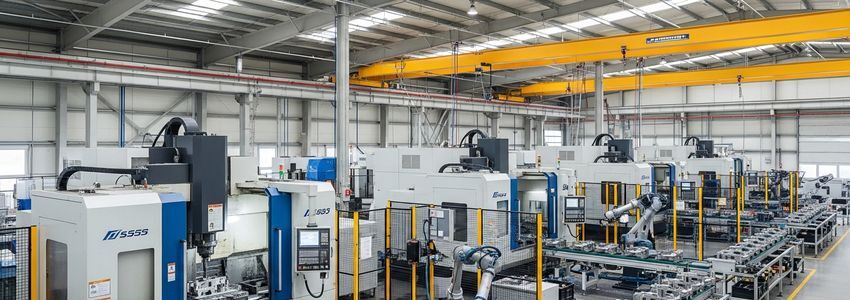
CNC mills, lathes, turning centers, and multi-axis machining equipment represent some of the highest-value assets in modern manufacturing. These machines can run $50,000 to over $500,000 each, making financing essential for most shops looking to add capacity. Equipment loans for CNC machine financing typically come with terms of 36 to 84 months and competitive fixed rates.
Metal Fabrication Equipment
Press brakes, laser cutters, plasma cutters, welding systems, and waterjet cutting machines are critical assets for metal fabricators handling high-demand production runs. As order volume grows, shops often need to add cutting and forming capacity without halting current production. Financing allows fabricators to add equipment on tight timelines.
Injection Molding and Plastics Equipment
Injection molding machines can range from $50,000 for small-tonnage units to several million dollars for large industrial presses. Equipment financing is the standard method for plastics manufacturers to acquire this machinery, with lenders valuing these assets favorably as collateral.
Food Processing and Packaging Equipment
Commercial food processors dealing with peak-season demand spikes frequently turn to equipment loans to add filling lines, pasteurizers, packaging systems, or cold storage infrastructure. Manufacturing equipment financing covers the full spectrum of food and beverage production machinery.
Industrial Automation and Robotics
Robotic arms, automated assembly lines, conveyors, and pick-and-place systems significantly boost production throughput while reducing labor costs. These systems are increasingly affordable to finance, with many manufacturers seeing positive ROI within 12 to 18 months of installation.
Warehouse and Material Handling Equipment
Forklifts, pallet jacks, conveyor systems, and racking infrastructure are often as critical to high-volume production as the manufacturing equipment itself. Forklift financing and warehouse equipment loans help manufacturers handle increased inventory movement without disrupting operations.
Printing and Converting Equipment
Commercial printers, digital printing presses, die-cutting machines, and laminating equipment are commonly financed through equipment loans. Printers handling high-volume contract work rely on financing to scale capacity without exhausting cash reserves.
Who Qualifies for Equipment Loans for Production Runs?
Equipment financing has more flexible qualification standards than traditional bank loans, making it accessible to a wider range of manufacturers. Lenders focus primarily on the value and type of equipment being financed, as well as basic business fundamentals. Here is what most equipment lenders look for:
Time in business: Most lenders require a minimum of one year in business, though some specialty programs accommodate newer manufacturing businesses with strong revenue and a clear production track record.
Business revenue: Lenders want to see sufficient revenue to comfortably service the loan. For a $100,000 equipment loan, a lender might want to see at least $150,000 to $200,000 in annual revenue, though this varies by lender.
Credit profile: Equipment loans are available across a wide range of credit profiles. Strong credit (680 and above) typically unlocks the best rates and terms. However, bad credit equipment financing options exist for manufacturers with challenged credit histories, often at slightly higher rates.
Equipment value: The equipment itself serves as collateral, so lenders evaluate its current and future market value. New, brand-name equipment from recognized manufacturers typically qualifies most easily. Used equipment can also be financed, though lenders may apply a discount to its appraised value.
Business structure: Most business structures qualify, including sole proprietorships, partnerships, LLCs, S-Corps, and C-Corps. The business must be legally registered and operating.
Pro Tip: If your manufacturing business has strong revenue but imperfect credit, lead with your revenue documentation. Lenders who specialize in equipment financing (vs. banks) often weigh revenue and asset value more heavily than credit scores alone.
Rates, Terms, and Loan Amounts for Production Equipment
Understanding the cost of equipment financing helps manufacturers evaluate whether a loan makes financial sense relative to the revenue the equipment will generate. Here is an overview of current market conditions:
Interest Rates
Equipment loan rates for manufacturers typically range from 5 percent to 25 percent annually, depending on creditworthiness, time in business, equipment type, and lender. Well-qualified applicants with strong business credit can secure rates in the 5 to 8 percent range. Businesses with moderate credit profiles may see rates in the 10 to 18 percent range. Rate shopping across multiple lenders is always recommended.
Loan Terms
Production equipment loans typically offer terms from 24 to 84 months. Higher-value equipment like CNC machining centers, injection molding presses, and industrial automation systems often qualify for longer terms (60 to 84 months), reducing monthly payment burden. Short-term equipment loans (24 to 36 months) are also available for businesses that want to minimize total interest cost.
Loan Amounts
Equipment loan amounts generally mirror the value of the equipment being purchased, from $25,000 for smaller machinery to several million dollars for large-scale production line installations. Some lenders offer equipment lines of credit for manufacturers who regularly add or upgrade equipment, providing ongoing access to capital without reapplying for each purchase.
| Credit Profile | Typical Rate Range | Typical Term | Max Loan Amount |
|---|---|---|---|
| Excellent (720+) | 5% - 8% | Up to 84 months | $5M+ |
| Good (680-719) | 8% - 14% | Up to 72 months | $2M+ |
| Fair (620-679) | 14% - 20% | Up to 60 months | $500K |
| Challenged (<620) | 20% - 25% | Up to 48 months | $250K |
These are estimates based on market conditions as of 2026. Actual rates and terms vary by lender, business profile, and equipment type. Always request multiple quotes before committing to a financing agreement.
Equipment Loans vs. Alternative Financing Options
Manufacturers handling high-demand production runs have several financing options beyond traditional equipment loans. Understanding the trade-offs helps businesses select the right tool for their specific situation.
Equipment Loan vs. Equipment Lease
With an equipment loan, you own the equipment outright at the end of the repayment period. With an equipment lease, you make payments to use the equipment but do not own it unless you exercise a purchase option at lease end. Loans are better for equipment you plan to use long-term and want to own. Leasing can make sense for technology that becomes obsolete quickly or when you want lower monthly payments. Learn more in our guide to equipment leasing.
Equipment Loan vs. Working Capital Loan
Working capital loans are unsecured and can be used for any business purpose, but they typically carry higher interest rates and shorter terms than equipment loans. For equipment purchases, a dedicated equipment loan almost always offers better terms because the equipment serves as collateral. A working capital loan is better suited for payroll, inventory, or bridging cash flow gaps rather than major capital equipment purchases.
Equipment Loan vs. SBA Loan
SBA 7(a) and SBA 504 loans often offer the lowest interest rates available, but they require extensive documentation and can take 60 to 90 days or longer to fund. For manufacturers facing urgent production demand, equipment loans typically fund in days rather than months. SBA financing makes sense for planned, non-urgent capital investments where the best possible rate is the priority. For time-sensitive situations, equipment financing is typically the better choice.
Equipment Loan vs. Business Line of Credit
A business line of credit provides revolving access to capital but is generally better suited for managing ongoing operating expenses rather than large, single-asset purchases. Lines of credit may carry variable rates that can increase costs over time. Equipment loans with fixed rates offer more predictability for major capital investments.
Ready to Finance Your Production Equipment?
Crestmont Capital specializes in equipment financing for manufacturers. Compare your options and get pre-qualified today.
Get Pre-Qualified →How Crestmont Capital Helps Manufacturers Finance Production Equipment
Crestmont Capital has built its reputation as the #1 business lender in the United States by providing fast, flexible financing solutions that match the real-world needs of business owners. For manufacturers facing high-demand production runs, Crestmont offers several distinct advantages over traditional lenders.
Speed that matches production timelines. When a major client places a rush order and you need to expand production capacity this week, waiting 60 days for bank approval is not an option. Crestmont Capital approves most equipment loan applications within 24 to 72 hours, with funding available in as little as two business days for qualified applicants.
Flexible qualification requirements. Traditional banks often require two or more years in business, substantial cash reserves, and spotless credit histories. Crestmont works with manufacturers across a wider range of credit profiles and business stages, including businesses with one year of operating history and varying revenue levels.
High loan amounts. Crestmont Capital finances production equipment from $25,000 to multi-million dollar production line installations, accommodating the full range of manufacturing capital needs.
Fixed rates and predictable payments. Every equipment loan from Crestmont Capital comes with a fixed interest rate and consistent monthly payments, so manufacturers can plan cash flow without surprises. Review our guide to equipment financing to learn more about what Crestmont offers.
Expert advisors who understand manufacturing. Crestmont's financing specialists understand the capital intensity of manufacturing operations and can structure loan terms that align with your production cycle, seasonal demand patterns, and cash flow profile.
Real-World Scenarios: Equipment Loans for High-Demand Production Runs
The following scenarios illustrate how equipment loans help manufacturers respond to production challenges in real business situations.
Scenario 1: CNC Job Shop Lands a Major Contract
A precision machining shop in Ohio receives a 12-month contract with a tier-1 automotive supplier. The contract requires twice the current production capacity. The shop owner applies for a $350,000 equipment loan to purchase two additional CNC machining centers. Approved within 48 hours, the machines are ordered within the week and installed within 30 days. The new contract revenue comfortably services the loan while generating substantial profit margin above debt service costs.
Scenario 2: Food Manufacturer Prepares for Holiday Demand
A specialty food manufacturer in Texas experiences a 300 percent spike in demand during the fourth quarter. Rather than turning down orders, the business uses a $175,000 equipment loan to add a second packaging line before the season begins. The new line processes the holiday volume with no delays, and the increased revenue fully covers loan payments with room to spare. The company plans to use the same financing approach in advance of subsequent peak seasons.
Scenario 3: Plastics Manufacturer Enters New Market
A plastics injection molding company in Michigan wins a medical device contract requiring dedicated equipment that cannot be shared with other production runs. The company finances a $425,000 injection molding press through a 60-month equipment loan. The medical device contract covers the monthly payments entirely, effectively creating a self-funding expansion that opens a new revenue stream with higher margins than the company's existing commercial clients.
Scenario 4: Metal Fabricator Responds to Emergency Order
A metal fabrication shop receives an emergency order from a construction client needing 500 custom components within three weeks. The shop's current laser cutting capacity cannot handle the volume. Within 48 hours, the fabricator secures a $90,000 equipment loan for a second laser cutting system, installs it in days, completes the order on time, and establishes an ongoing relationship with the construction firm worth over $500,000 annually.
Scenario 5: Print Shop Scales Digital Production
A commercial print shop in Florida sees increasing demand for large-format digital printing from real estate and retail clients. The owner finances a $150,000 wide-format inkjet printing system through a 48-month equipment loan. The new equipment adds $25,000 in monthly revenue within 90 days of installation, far exceeding the $3,500 monthly loan payment. The shop subsequently finances a second unit to handle continued growth.
Scenario 6: Electronics Manufacturer Adds Automation
An electronics assembly business in California uses a $280,000 equipment loan to add a robotic soldering and assembly system. The automation reduces labor costs by 30 percent while doubling throughput. Within 18 months, the equipment has effectively paid for itself through operational savings and revenue gains, making the total financing cost essentially negligible relative to the business value created.
Frequently Asked Questions
How to Get Started with Equipment Financing
Complete our quick application at offers.crestmontcapital.com/apply-now. Basic business information and equipment details are all you need to get started.
A Crestmont Capital advisor who understands manufacturing businesses will review your application, discuss your equipment needs, and present the best available financing options.
Most applications are approved within 24 to 72 hours. Once approved, funds are disbursed quickly so you can order equipment and begin ramping production capacity without delay.
Conclusion
Equipment loans for high-demand production runs are one of the most powerful capital tools available to manufacturers. By providing access to the machinery needed to handle increased output without depleting working capital, these financing solutions enable production businesses to capture revenue opportunities, fulfill major contracts, and build sustainable competitive advantages through superior capacity and technology.
Whether you are a CNC job shop responding to an automotive contract, a food manufacturer preparing for seasonal volume, or a plastics processor entering a new market, equipment loans provide the financial foundation to scale production on your timeline rather than your cash flow timeline. For most manufacturing businesses, the revenue generated by financed equipment far exceeds the total financing cost, making equipment loans one of the highest-ROI capital decisions a manufacturer can make.
Crestmont Capital is ready to help your manufacturing business access the equipment financing it needs to meet high-demand production runs head-on. Apply today and get a decision within 24 hours from the team that understands the capital intensity and competitive demands of modern manufacturing.
Start Your Equipment Loan Application Today
Fast approvals, flexible terms, and financing up to millions from the #1 business lender in the U.S.
Apply Now →Disclaimer: The information provided in this article is for general educational purposes only and is not financial, legal, or tax advice. Funding terms, qualifications, and product availability may vary and are subject to change without notice. Crestmont Capital does not guarantee approval, rates, or specific outcomes. For personalized information about your business funding options, contact our team directly.








