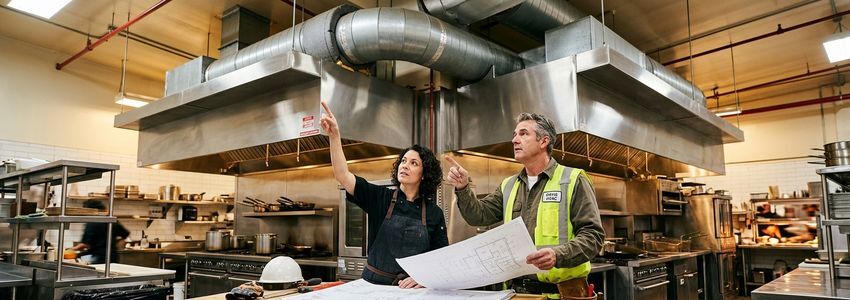
A failed health inspection over a clogged exhaust hood, an insurance carrier flagging an outdated fire suppression tie-in, or a landlord demanding code-compliant ductwork before renewing a lease. These are the moments that push restaurant and food service owners to search for commercial kitchen ventilation system financing instead of waiting months to save up cash. A modern hood, exhaust fan, makeup air unit, and fire suppression system can easily run $15,000 to $60,000 or more once ductwork, electrical work, and permitting are factored in, and most independent operators simply do not have that sitting in a business checking account.
The good news is that ventilation upgrades are exactly the kind of purchase equipment financing was built for. The system itself has real resale value and a long useful life, which means a lender can structure a loan around the equipment rather than requiring the owner to lean on unsecured credit or drain working capital. This guide walks through how commercial kitchen ventilation financing works, what it costs, who qualifies, and how to compare it against other funding options before your next health inspection or fire marshal visit turns into a shutdown notice.
Restaurant and food service operators are also navigating a broader lending environment that has shifted in 2026. According to reporting on small business finance trends covered by Forbes, equipment financing remains one of the more accessible funding categories for small business owners specifically because the equipment itself reduces the lender's risk, which matters more than ever as underwriting standards tighten across other loan products. Understanding how that structure works before you're facing a compliance deadline puts you in a much stronger negotiating position with contractors and lenders alike.
In This Article
What Is Commercial Kitchen Ventilation Financing?
Commercial kitchen ventilation financing is a form of equipment financing used specifically to purchase, replace, or upgrade the exhaust hood, ductwork, makeup air system, fire suppression tie-in, and related components that keep a commercial kitchen compliant with local fire and health codes. Instead of paying the full project cost out of pocket, a business owner borrows against the equipment and repays it over a fixed term, typically three to seven years, with the ventilation system itself serving as collateral.
Ventilation systems are treated by most health departments and fire marshals as essential life-safety equipment, not optional upgrades. NFPA 96 governs the design and maintenance of commercial kitchen exhaust systems in the United States, and local jurisdictions enforce it through routine inspections. When a system fails inspection or an insurer requires an upgrade to keep a policy active, the timeline for fixing it is rarely flexible, which is precisely why financing exists for this category of equipment.
A complete system typically includes several distinct components that all need to work together and pass inspection as a unit. The exhaust hood captures grease-laden vapors and heat directly above cooking equipment. Ductwork routes that exhaust safely out of the building, often through fire-rated shafts. A rooftop or inline exhaust fan pulls air through the system at the required cubic feet per minute (CFM) for the cooking equipment beneath it. A makeup air unit replaces the conditioned air being exhausted so the kitchen does not fall into negative pressure. Finally, a wet chemical fire suppression system, most commonly an Ansul-brand system, ties directly into the hood to automatically extinguish grease fires at the source. Each of these pieces can fail independently, and health and fire inspectors check them separately, which is why a seemingly small issue like a worn suppression nozzle can trigger the same correction notice as a fully collapsed duct run.
Key Stat: According to the U.S. Small Business Administration, restaurants and food service businesses represent one of the largest categories of SBA 7(a) loan recipients each year, reflecting how capital-intensive commercial kitchens are to build, maintain, and keep compliant.
Key Benefits of Financing a Ventilation Upgrade
Financing a hood, exhaust, or fire suppression upgrade instead of paying cash preserves the working capital a restaurant needs for payroll, food cost, and rent. It also lets an owner move on a compliance deadline immediately rather than waiting to save enough cash, which matters when a health department gives a 30 or 60 day correction window.
Restaurant margins are famously thin, and an unplanned five-figure repair can wipe out months of profit if paid in cash. Spreading that cost over a repayment term that roughly matches the equipment's useful life keeps the monthly impact proportional to the value the system delivers, which is a more sustainable way to manage capital-intensive maintenance than treating every major repair as an emergency cash crunch.
- Preserve cash flow: Spread a $20,000-$60,000 project across monthly payments instead of a single large withdrawal.
- Fast approval and funding: Many equipment financing applications are approved in 24-48 hours, far faster than a bank term loan.
- Equipment-secured, not just credit-secured: The ventilation system itself acts as collateral, which can make approval easier than an unsecured loan.
- Predictable monthly payments: Fixed-rate structures make it easy to budget the upgrade into monthly operating costs.
- Avoid a shutdown or citation: Financing lets an owner act on a failed inspection or fire marshal order without delay.
- Potential tax advantages: Equipment purchases financed through a loan may qualify for depreciation treatment; consult a tax professional for specifics to your situation.
How Commercial Kitchen Ventilation Financing Works
The process is similar to financing any other piece of restaurant equipment, but a few details are specific to ventilation and fire suppression projects because they often involve installation labor and permitting alongside the hardware itself.
Most lenders want an itemized quote covering the hood, ductwork, fan, makeup air, and fire suppression scope.
Basic business information, time in business, and recent bank statements are typically all that's needed.
Approval decisions for equipment financing often come back the same day or within 24-48 hours.
Funds are typically disbursed directly to the vendor or contractor once paperwork is signed.
Monthly payments begin on a fixed schedule once the system is installed and passes final inspection.
Underwriters generally look at time in business, personal and business credit, and recent bank statements to gauge cash flow. Because the ventilation system itself has resale value as collateral, approval standards are often more flexible than a general unsecured working capital loan, which is one reason this category of financing is popular with independent restaurant operators.
Down payment requirements for ventilation equipment financing are typically modest compared to real estate or large machinery purchases. Many lenders will finance the full project cost, including installation labor, when the borrower has at least a year or two of operating history and clean recent bank statements. Newer businesses or those with credit challenges may be asked for a down payment in the 10 to 20 percent range, or may need to bring a personal guarantee from an owner with stronger credit. Rates vary based on the lender, the borrower's credit profile, and the term length, but equipment-secured loans generally price more favorably than unsecured working capital products because the lender has a tangible asset to fall back on if the loan defaults.
By The Numbers
Commercial Kitchen Ventilation Financing at a Glance
$15K-$60K
Typical full hood, exhaust, and fire suppression project cost
24-48 Hrs
Typical time to receive an equipment financing decision
3-7 Yrs
Common repayment term for ventilation and hood equipment loans
$1.78B
SBA 7(a) loan approvals to full-service restaurants in 2025
Don't Let a Failed Inspection Shut You Down
Get fast, flexible financing for your ventilation upgrade from the #1 business lender in the U.S. No obligation, apply in minutes.
Apply Now →Types of Commercial Kitchen Ventilation Financing
Not every ventilation project needs the same funding structure. The right fit depends on whether you're replacing an aging hood, adding capacity for a menu expansion, or responding to an urgent citation.
- Equipment financing (term loan): A fixed-rate loan secured by the ventilation system, repaid monthly over three to seven years. This is the most common structure for hoods, exhaust fans, and makeup air units.
- Equipment leasing: Lower monthly payments with the option to buy the system at the end of the term for a set price. Useful for operators who want to preserve credit lines for other purposes.
- SBA 7(a) or 504 loans: Government-backed loans that can bundle a ventilation upgrade into a larger renovation or buildout project, typically with longer approval timelines but competitive rates.
- Working capital loans: Unsecured or lightly secured short-term financing, often used when the ventilation cost is bundled with other urgent repairs and speed matters more than rate.
- Business line of credit: A revolving credit line that can cover a ventilation project alongside other unpredictable maintenance costs, drawn as needed.
Choosing between these structures usually comes down to two questions: how urgent is the timeline, and how much of your existing credit capacity do you want to preserve for other purposes. An operator facing a 30-day health department deadline will almost always prioritize equipment financing or a working capital loan over an SBA application, simply because SBA underwriting timelines rarely align with a hard compliance deadline. On the other hand, an operator planning a full kitchen renovation over the next six months has more flexibility to pursue SBA financing and capture a lower long-term rate on the ventilation portion of the project.
Why Ventilation Compliance Cannot Wait
Local health and fire codes typically require commercial kitchen exhaust systems to comply with NFPA 96, the National Fire Protection Association's standard for ventilation control and fire protection of commercial cooking operations. Inspectors check hood grease buildup, duct cleanliness, fire suppression nozzle alignment, and fan function, often on an annual or semi-annual cycle depending on cooking volume. A single failed item can trigger a correction notice with a strict deadline, and repeat violations can escalate to fines, license suspension, or in serious cases, closure until the system is brought into compliance.
Insurance carriers layer on their own requirements as well. Many commercial property and liability policies for restaurants explicitly condition coverage on maintaining a functioning, code-compliant fire suppression system tied to the exhaust hood. An insurer that discovers an outdated or non-functional suppression system during a routine audit can non-renew the policy or require an upgrade before extending coverage, which puts the operator on an even tighter timeline than a standard health department correction window.
Who This Financing Is Best For
Commercial kitchen ventilation financing tends to make the most sense for a specific set of situations rather than being a universal fit for every kitchen upgrade.
- Independent restaurant, bar, and cafe owners facing a health department or fire marshal correction deadline
- Ghost kitchen and shared commissary operators building out a new location
- Food truck commissaries and catering operations expanding their commercial kitchen footprint
- Hotels and institutional foodservice operations upgrading aging exhaust infrastructure
- Franchise-independent operators who need to move fast without waiting on corporate capital approval
- Any operator whose insurance carrier has flagged an outdated fire suppression tie-in as a renewal condition
Comparing Your Funding Options
Every financing path has tradeoffs. The table below compares the most common ways operators fund a ventilation upgrade.
| Option | Speed | Typical Term | Best For |
|---|---|---|---|
| Equipment Financing | 24-48 hours | 3-7 years | Standard hood/exhaust upgrades |
| Equipment Leasing | 1-3 days | 2-5 years | Lower monthly payments |
| SBA 7(a)/504 | Weeks | 10-25 years | Larger renovation projects |
| Working Capital Loan | Same day-48 hours | 6-24 months | Urgent compliance deadlines |
| Business Line of Credit | 1-5 days | Revolving | Ongoing maintenance costs |
Pro Tip: If your ventilation upgrade is being driven by a compliance citation with a hard deadline, prioritize speed of funding over the lowest possible rate. A slightly higher rate on a fast equipment loan is almost always cheaper than the revenue lost from a forced closure.
How Crestmont Capital Helps
Crestmont Capital works with restaurant and food service operators nationwide to structure commercial kitchen equipment financing around the realities of running a kitchen, not a generic loan template. Whether the project is a full hood and exhaust replacement, a fire suppression upgrade, or a broader restaurant equipment financing need, applications are reviewed with an eye toward speed because compliance deadlines rarely wait.
For operators whose ventilation project is part of a larger renovation, Crestmont also offers SBA loans and business lines of credit that can be layered alongside equipment financing to cover the full scope of a buildout. Our full restaurant business loan programs are designed specifically around the cash flow patterns and capital intensity of commercial kitchens.
For a deeper look at financing the equipment inside your kitchen beyond ventilation, our complete guide to restaurant equipment financing covers ovens, refrigeration, and prep equipment financing in detail, and pairs well with a ventilation upgrade when a kitchen is being brought up to code across the board.
Bring Your Kitchen Up to Code Fast
Crestmont Capital funds ventilation, hood, and exhaust upgrades quickly so a compliance deadline never becomes a shutdown. Apply in minutes, no obligation.
Apply Now →Real-World Scenarios
Scenario 1: The Failed Health Inspection
A family-owned diner fails its annual health inspection because grease buildup in an aging exhaust hood created a fire hazard. The health department gives 30 days to correct it or face closure. The owner secures equipment financing within 48 hours, the contractor installs a new hood and duct run in three weeks, and the diner passes its re-inspection with two days to spare.
Scenario 2: The Insurance Renewal Ultimatum
A catering company's property insurer flags an outdated fire suppression system as a condition of policy renewal. Rather than risk losing coverage, the owner finances a full Ansul system upgrade alongside new ductwork, keeping the policy active without disrupting a single week of bookings.
Scenario 3: The Ghost Kitchen Buildout
An operator converting a warehouse space into a shared commissary kitchen for three delivery-only brands needs a code-compliant ventilation system from scratch. Equipment financing covers the hood, exhaust fan, and makeup air unit as part of the broader buildout, letting the space open on schedule.
Scenario 4: The Menu Expansion
A pizzeria adding a wood-fired grill station discovers its existing hood does not have the CFM capacity for the new equipment. Rather than delay the menu launch, the owner finances an upgraded exhaust system sized for the additional cooking line.
Scenario 5: The Multi-Location Refresh
A three-location bakery chain schedules ventilation upgrades across all locations after a corporate audit flags aging systems. Staggered equipment financing lets the company complete the upgrades one location at a time without disrupting cash flow at any single site.
Scenario 6: The Bar Adding a Full Kitchen
A neighborhood bar that previously served only packaged snacks decides to add a full kitchen to boost revenue per customer. The buildout requires an entirely new Type 1 hood system sized for fryers and a flat-top grill, plus a fire suppression tie-in that did not exist before. Equipment financing covers the ventilation portion of the buildout separately from the kitchen equipment itself, letting the bar phase the project around its busiest revenue periods.
Frequently Asked Questions
What is commercial kitchen ventilation system financing?
It is a type of equipment financing used to purchase, replace, or upgrade a commercial kitchen's exhaust hood, ductwork, makeup air system, and fire suppression components, with the equipment itself typically serving as collateral for the loan.
How much does a commercial kitchen ventilation upgrade cost?
A full hood, exhaust fan, ductwork, and fire suppression project typically ranges from $15,000 to $60,000 depending on kitchen size, ductwork complexity, and whether structural or electrical work is required.
How fast can I get approved for ventilation equipment financing?
Many equipment financing applications are approved within 24 to 48 hours, since underwriting is based largely on business bank statements, time in business, and the value of the equipment being financed.
What credit score do I need to qualify?
Requirements vary by lender and structure, but because equipment financing is secured by the ventilation system itself, approval standards are often more flexible than unsecured working capital loans. Strong recent bank statements and time in business help even with average credit.
Can I finance installation labor along with the equipment?
Yes, most equipment financing structures for ventilation projects can bundle hardware and licensed installation labor into a single itemized quote, so the full project cost is covered under one loan.
What is the typical repayment term for a ventilation system loan?
Terms typically run three to seven years, aligned with the useful life of hood, exhaust, and fire suppression equipment. SBA-backed options used for larger renovation projects can extend to 10-25 years.
Do I need a licensed contractor's quote before applying?
Most lenders want an itemized quote from a licensed HVAC or fire protection contractor before final approval, since it establishes the exact scope, equipment specifications, and total project cost being financed.
Is ventilation financing the same as a working capital loan?
No. Equipment financing is secured directly by the ventilation system and typically carries a lower rate and longer term. A working capital loan is often unsecured or lightly secured, faster to fund, but generally carries a higher cost of capital.
Can a new restaurant with no operating history qualify?
It is more difficult but not impossible. Startups often need a stronger personal credit profile, a larger down payment, or a co-signer, since lenders rely more heavily on personal financial history when business bank statements are limited.
What happens if I fail a health or fire inspection while waiting on financing?
Most jurisdictions issue a correction period rather than an immediate shutdown for a first violation, but timelines are strict. This is exactly why fast-funding equipment financing options exist: to close the gap between citation and installed fix before the deadline expires.
Does financing cover fire suppression systems, not just the hood?
Yes. Ansul-style wet chemical fire suppression systems tied into the hood and exhaust are commonly bundled into the same equipment financing package as the hood, ductwork, and makeup air components.
Will leasing or financing affect my ability to get other business loans?
Any financing adds to your total debt obligations, which lenders factor into future underwriting. However, equipment financing is generally viewed favorably since it is secured by a tangible, revenue-supporting asset rather than unsecured debt.
Can I finance a ventilation upgrade for a ghost kitchen or shared commissary?
Yes, ghost kitchens and shared commissary operators finance ventilation systems the same way traditional restaurants do, and it is often bundled with a broader buildout financing package covering the full commercial kitchen space.
Do I own the ventilation system at the end of a financing term?
With a standard equipment financing loan, yes, the equipment is fully owned once the loan is repaid. With certain lease structures, ownership transfers at the end of the term for a predetermined buyout amount, which should be confirmed before signing.
How do I start the application process?
Gather a contractor quote, your last three to four months of business bank statements, and basic business information, then apply online. Most applications take a few minutes and decisions typically come back within 24 to 48 hours.
Ready to Get Your Kitchen Compliant?
Apply for commercial kitchen ventilation financing today and get a decision in as little as 24 hours. No obligation.
Apply Now →Next Steps
Have a licensed HVAC or fire protection contractor scope the hood, ductwork, and fire suppression project.
Have three to four months of business bank statements ready to speed up underwriting.
Submit your application and review the rate, term, and monthly payment before signing.
Coordinate the installation timeline with your local health department or fire marshal deadline.
Conclusion
Commercial kitchen ventilation system financing exists precisely because hood, exhaust, and fire suppression upgrades are rarely optional and almost never cheap. Whether the trigger is a failed health inspection, an insurance renewal condition, or a menu expansion that outgrew the existing exhaust capacity, financing lets a restaurant or food service operator act on a firm deadline without draining working capital or delaying repairs that keep staff and customers safe. Comparing equipment financing against leasing, SBA options, and working capital loans up front makes it easier to match the funding structure to how urgently the project needs to move.
Disclaimer: The information provided in this article is for general educational purposes only and is not financial, legal, or tax advice. Funding terms, qualifications, and product availability may vary and are subject to change without notice. Crestmont Capital does not guarantee approval, rates, or specific outcomes. For personalized information about your business funding options, contact our team directly.