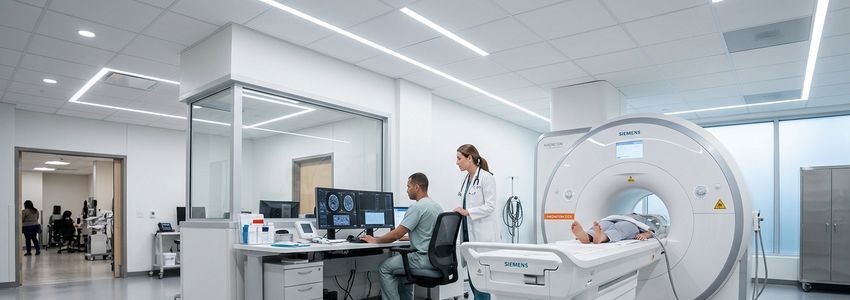
Running a diagnostic imaging center is capital-intensive from day one. Between the cost of a single MRI machine (often $1 million or more), site buildout, staffing, and insurance credentialing, the financial demands of operating a radiology or imaging clinic far exceed most other healthcare businesses. Whether you are opening a new outpatient imaging suite, upgrading aging CT equipment, or acquiring a competing practice, a diagnostic imaging center business loan can bridge the gap between your vision and operational reality.
This guide walks through every financing option available to radiology and MRI clinic owners, qualification requirements, what lenders look for, and how to position your practice for the best possible terms.
In This Article
- The Diagnostic Imaging Industry: Size and Opportunity
- Why Imaging Centers Need Business Financing
- Loan Types for Diagnostic Imaging Centers
- Equipment Financing for MRI, CT, and Radiology
- SBA Loans for Imaging Centers
- Working Capital and Line of Credit Options
- Qualification Requirements for Imaging Center Loans
- Key Financing Stats for Diagnostic Imaging
- How to Apply for a Diagnostic Imaging Center Business Loan
- Why Imaging Centers Choose Crestmont Capital
- Frequently Asked Questions
- Next Steps
The Diagnostic Imaging Industry: Size and Opportunity
The U.S. diagnostic imaging market is one of the most robust segments of outpatient healthcare. According to industry research and data from the U.S. Census Bureau, there are more than 8,700 freestanding imaging centers operating nationwide, with the sector generating over $18 billion in annual revenue. Growth is being driven by an aging population, advances in imaging technology, and the continued shift from hospital-based to outpatient care delivery.
Freestanding imaging centers now perform a substantial share of all MRI, CT, PET, ultrasound, and X-ray procedures in the country. They typically offer lower prices than hospital outpatient departments, faster scheduling, and a more patient-friendly environment - all factors that are accelerating volume growth. For entrepreneurial radiologists, practice owners, and healthcare investors, the market opportunity is real and growing.
But capturing that opportunity requires capital. Lots of it.
Why Imaging Centers Need Business Financing
Diagnostic imaging centers carry some of the heaviest equipment and infrastructure costs in all of healthcare. Unlike a primary care or specialty physician practice that can launch with minimal equipment, an imaging center is defined by its technology. Financing is not optional - it is a fundamental part of the business model.
Here are the most common reasons imaging center owners seek business loans:
- Equipment acquisition: Purchasing or leasing MRI, CT, PET-CT, digital X-ray, or ultrasound systems
- Facility buildout: Site preparation, RF shielding, cryogen plumbing, electrical upgrades, HVAC systems
- Technology upgrades: Replacing aging equipment with higher-field-strength or AI-enabled systems
- Practice acquisition: Buying an existing imaging center or acquiring a competitor
- Working capital: Covering payroll, supplies, and operating expenses while waiting on insurance reimbursements
- Expansion: Adding a second modality or opening a satellite location
- PACS and RIS software: Investing in picture archiving, radiology information systems, and teleradiology infrastructure
- Reaccreditation and compliance: Meeting ACR, Joint Commission, or state radiation safety requirements
Ready to Finance Your Imaging Center?
Crestmont Capital works with radiology practices, MRI clinics, and outpatient imaging centers across the country. Get a decision in as little as 24 hours.
Apply Now - Free, No ObligationLoan Types for Diagnostic Imaging Centers
There is no single "imaging center loan." Depending on what you need the capital for, your time in business, revenue, and credit profile, several different loan structures may be appropriate. Here is a breakdown of the primary options:
Term Loans
A standard small business term loan provides a lump sum of capital that you repay over a fixed period with regular (usually monthly) payments. Term loans work well for large, one-time expenses such as acquiring an existing imaging practice or funding a major facility buildout. Loan amounts can range from $50,000 to $5 million or more through conventional lenders. Interest rates vary based on your credit profile, time in business, and the lender.
You can explore small business loans at Crestmont Capital for term loan options suited to medical practices.
Equipment Financing
Because MRI machines, CT scanners, and digital X-ray systems are physical assets with known resale values, they are ideal candidates for equipment financing. Under this structure, the equipment itself serves as collateral, which can reduce rates and make approval easier than unsecured loans. Financing can typically cover 80% to 100% of the equipment cost, with repayment terms of 3 to 7 years depending on the useful life of the asset.
SBA Loans
Small Business Administration loan programs offer government-backed financing with competitive rates and longer repayment terms. The SBA 7(a) program is well-suited for imaging center acquisitions, refinancing, and working capital, with loan amounts up to $5 million. SBA 504 loans are ideal for real estate and large equipment purchases, offering fixed rates and terms up to 25 years. The tradeoff is that SBA loans require more documentation and take longer to close than alternative lenders.
Business Line of Credit
A revolving business line of credit gives your imaging center access to flexible capital you can draw on as needed and repay over time. This is particularly valuable for managing cash flow gaps created by insurance reimbursement delays, covering unexpected equipment repairs, or funding operational needs between revenue cycles.
Unsecured Working Capital Loans
For imaging centers with strong revenue but limited hard assets to pledge as collateral, unsecured working capital loans are based primarily on your monthly revenue and creditworthiness. These are faster to close - often within 24 to 48 hours - and require less documentation than traditional bank loans.
Fast Business Loans
When an equipment failure requires immediate replacement or an acquisition opportunity has a tight timeline, fast business loans from alternative lenders can fund within 24 to 72 hours. These are typically shorter-term products with higher costs but can be critical when speed matters.
Equipment Financing for MRI, CT, and Radiology
Equipment financing deserves its own deep dive, because for imaging centers it is often the primary financing mechanism. The technology assets that define your practice - MRI scanners, CT systems, PET-CT cameras, fluoroscopy units, digital mammography equipment, ultrasound machines - are all excellent candidates for equipment financing or equipment leasing.
Purchase vs. Lease
Imaging center owners typically have two options when acquiring major imaging systems: purchase (financed) or lease. Each has distinct financial implications:
- Equipment loan (purchase): You own the equipment outright after paying off the loan. You build equity, can depreciate the asset, and have no end-of-lease residual concerns. Best when equipment has a long useful life and you plan to use it for 7 to 10+ years.
- Operating lease: Lower monthly payments, ability to upgrade technology at end of term, and the lease may be kept off-balance-sheet. Best for technology that becomes obsolete quickly, such as PET-CT cameras or high-field MRI systems where software upgrades matter.
- Capital lease / $1 buyout lease: Structured like a loan; you make payments and own the equipment at the end for $1. Economically similar to an equipment loan but structured as a lease.
What Equipment Can Be Financed?
Almost any hard imaging asset can be financed. Common examples include:
- 1.5T and 3T MRI systems (Siemens, GE, Philips, Canon)
- 64-slice, 128-slice, and higher CT scanners
- PET and PET-CT combination systems
- Digital mammography and tomosynthesis (3D mammography)
- Fluoroscopy and interventional radiology suites
- Bone densitometry (DEXA) systems
- Portable ultrasound and cart-based ultrasound systems
- Digital X-ray (DR) and computed radiography (CR)
- PACS (Picture Archiving and Communication Systems)
- Radiation shielding infrastructure
- Cryogen systems and magnet accessories
Used and refurbished equipment can often be financed as well, which can significantly reduce the capital required. A refurbished 1.5T MRI from a reputable vendor might cost $300,000 to $600,000 compared to $1.2 million for a new system.
Diagnostic Imaging Center Financing: Key Stats
Sources: U.S. Census Bureau, SBA.gov, industry reports
SBA Loans for Imaging Centers
The Small Business Administration offers loan guarantee programs specifically designed to help small businesses access capital that might otherwise be difficult to obtain. For imaging centers, two SBA programs are particularly relevant:
SBA 7(a) Loan Program
The SBA 7(a) is the most widely used SBA loan and can be used for virtually any legitimate business purpose, including equipment purchases, practice acquisition, leasehold improvements, working capital, and refinancing existing debt. Key features include:
- Loan amounts: Up to $5 million
- Terms: Up to 10 years for working capital, up to 25 years for real estate
- Rates: Prime + 2.75% for loans over $700,000 (variable), though fixed-rate options exist
- Down payment: Typically 10% to 20% required
- Guarantee: SBA guarantees 85% of loans up to $150,000; 75% for larger loans
SBA 7(a) loans require thorough documentation including business and personal tax returns, financial statements, business plan, and business valuations for acquisitions. Processing time is typically 45 to 90 days, though SBA Express loans (up to $500,000) can close faster.
SBA 504 Loan Program
The SBA 504 program is designed for major fixed assets - specifically commercial real estate and large equipment. For an imaging center purchasing the building it operates in, or acquiring a major imaging system, the 504 program offers outstanding terms:
- Up to 40% of project cost financed through a Certified Development Company (CDC) at a fixed rate
- 50% financed by a conventional lender
- 10% down payment from the borrower (15% for startups or special-purpose properties)
- Terms of 10, 20, or 25 years on the CDC portion
The combination of low down payment, fixed rates, and long amortization makes the 504 program one of the most cost-effective financing tools for imaging centers with real estate or large equipment needs.
Not Sure Which Loan Is Right for Your Imaging Center?
Our financing specialists work with radiology and imaging practices daily. We will help you find the right structure for your specific situation - at no cost.
Talk to a SpecialistWorking Capital and Line of Credit Options
Even well-established imaging centers face cash flow challenges. The reimbursement cycle in medical imaging creates predictable gaps: you perform a scan today, submit the claim, and may wait 30 to 90 days to receive payment from Medicare, Medicaid, or private insurers. During that window, payroll, rent, and supplies must be paid.
A revolving business line of credit is often the most flexible tool for managing these gaps. Unlike a term loan where you borrow a fixed amount, a line of credit lets you draw funds as needed up to a set limit, repay them, and draw again. Interest accrues only on what you have drawn.
When a Line of Credit Makes Sense
- Covering payroll when a large payor delays reimbursement
- Purchasing contrast media, MRI coils, or other consumables in bulk at a discount
- Funding a marketing push to grow referral volume
- Emergency equipment repairs that cannot wait for a term loan to close
- Managing cash flow around your peak and slow seasons (many imaging centers see volume drop in December due to deductible cycles)
Merchant Cash Advances - Understand the Costs
Some imaging centers turn to merchant cash advances (MCAs) for fast funding. An MCA provides a lump sum in exchange for a percentage of future revenue. While MCAs can fund within 24 to 48 hours with minimal documentation, they carry factor rates (not APRs) that can translate to very high effective interest rates. MCAs are best used only for very short-term needs when traditional options are not available.
For most imaging centers, a traditional business line of credit, equipment loan, or term loan from a lender like Crestmont Capital will provide significantly better economics than an MCA. If you currently have a merchant cash advance you want to refinance, consider reading our guide on medical practice business loans for consolidation options.
Qualification Requirements for Imaging Center Loans
Lenders evaluate imaging center loan applications using several key criteria. Understanding what they look for - and preparing accordingly - dramatically improves your approval odds and helps you qualify for better terms.
Time in Business
Most conventional lenders prefer at least 2 years of operating history. SBA lenders typically want to see at least 2 years of tax returns. Alternative lenders may work with businesses as young as 6 to 12 months, though rates and terms will reflect the added risk.
If your imaging center is a startup (less than 12 months old), your options are more limited but not zero. SBA loans are available for startups with strong business plans and owner equity contributions. Equipment financing is also more accessible for new businesses because the equipment itself secures the loan.
Annual Revenue
Revenue requirements vary by lender and loan type. For working capital loans and lines of credit, most alternative lenders require at least $100,000 to $250,000 in annual revenue. For larger term loans and SBA programs, lenders will analyze your revenue relative to the requested loan amount, looking for adequate debt service coverage.
Credit Score
Personal credit score requirements:
- SBA loans: 680+ preferred, some programs accept 650+
- Conventional bank loans: 680 to 720+
- Equipment financing: 600 to 650+ (lower because equipment serves as collateral)
- Alternative lenders / working capital: 550+ in some cases
Business credit history (Dun & Bradstreet, Experian Business) is also reviewed for established practices.
Financial Documentation Typically Required
- Last 2 to 3 years of business tax returns
- Last 2 to 3 years of personal tax returns
- Year-to-date profit and loss statement and balance sheet
- Last 3 to 6 months of business bank statements
- Debt schedule (existing loans and leases)
- Equipment quotes or invoices (for equipment financing)
- Business plan and projections (for startups and SBA loans)
- Payor mix analysis and accounts receivable aging report
Industry-Specific Factors Lenders Consider
Medical imaging businesses have characteristics that sophisticated lenders understand and account for:
- Payor mix: A high percentage of Medicare/Medicaid revenue can affect how lenders view reimbursement stability and rate risk
- Accounts receivable: Days in AR and collection rates are scrutinized - lenders want to see that your billing processes are effective
- ACR accreditation: Centers with current American College of Radiology accreditation are viewed more favorably
- Referral concentration: If 80% of your volume comes from one referring physician group, that is a concentration risk
- Regulatory compliance: State radiation safety licenses, lead lining certifications, and HIPAA compliance matter
How to Apply for a Diagnostic Imaging Center Business Loan
The application process varies depending on the lender and loan type, but the general sequence is as follows:
Step 1: Determine Your Financing Need
Before contacting any lender, be precise about what you need the capital for, how much you need, and how quickly you need it. Equipment purchases, buildouts, acquisitions, and working capital needs each point toward different loan products with different timelines.
Step 2: Review Your Financials
Pull together your last 2 to 3 years of tax returns, recent bank statements, and a current P&L. Identify your current debt obligations and calculate your approximate debt service coverage ratio (DSCR). Most lenders want to see a DSCR of 1.25x or higher, meaning your net operating income covers your total debt payments by at least 25%.
Step 3: Prepare Your Business Story
For larger loans, lenders want to understand your practice beyond the numbers. Prepare a brief narrative covering your specialties, patient volume, referral relationships, and why you need the financing. For equipment purchases, include vendor quotes. For acquisitions, include a purchase agreement and valuation.
Step 4: Apply with Multiple Lenders
Comparing offers from multiple lenders is the single most effective way to get better terms. Crestmont Capital works with a network of lenders and can often present competing offers, saving you the time and credit inquiries of applying one at a time.
Step 5: Evaluate Total Cost, Not Just Rate
The interest rate is only one component of loan cost. Also evaluate: origination fees, prepayment penalties, closing costs, draw fees (for lines of credit), and the total interest paid over the life of the loan. The lender quoting the lowest rate may not always provide the lowest total cost depending on term length and fee structure.
Why Imaging Centers Choose Crestmont Capital
Crestmont Capital has worked with healthcare businesses across the country, including radiology practices, outpatient imaging centers, and specialty clinics. We understand the financial dynamics of the imaging industry - the capital intensity, the reimbursement lags, the equipment lifecycle, and the referral-driven revenue model.
Here is what sets us apart for imaging center financing:
- Speed: Decisions in as little as 24 hours; funding within 1 to 3 business days for qualified applicants
- Flexible credit criteria: We work with credit scores starting at 550 for some products
- Large loan amounts: Up to $5 million and above for qualified practices
- Multiple products: Equipment financing, term loans, lines of credit, SBA-backed options - all through one application
- No franchise or corporate restrictions: We finance independent, physician-owned practices and imaging groups
- Dedicated healthcare financing specialists who understand your industry
Get Your Imaging Center Funded
Apply online in minutes. Our specialists will review your application and present options that fit your imaging center's financial profile.
Start Your ApplicationFrequently Asked Questions
What is a diagnostic imaging center business loan?
A diagnostic imaging center business loan is any form of business financing - term loan, equipment loan, SBA loan, line of credit, or working capital advance - used by radiology clinics, MRI centers, CT scan facilities, and other outpatient imaging businesses. These loans fund equipment acquisition, facility buildout, working capital, practice acquisition, and technology upgrades.
How much can I borrow for an imaging center loan?
Loan amounts vary widely by lender and loan type. Equipment financing can cover up to 100% of the equipment cost, which for an MRI system could be $1 million to $3 million. SBA 7(a) loans go up to $5 million. Alternative lenders and working capital providers typically offer $25,000 to $2 million. Your actual eligibility depends on revenue, creditworthiness, and the nature of the financing request.
What credit score do I need for imaging center financing?
Requirements vary by product. SBA loans generally require 650 to 680+. Equipment financing can be accessible with scores as low as 600. Alternative working capital lenders may approve applicants with scores as low as 550, though better credit always means better rates and terms. If your credit is below 650, you may want to focus on equipment financing first since the equipment serves as collateral.
Can a startup imaging center get a business loan?
Yes, though options are more limited. Equipment financing is the most accessible for new imaging centers because the equipment secures the loan. SBA loans are available for startups with strong business plans and owner equity (typically 20% to 30% down). Alternative working capital lenders generally require at least 6 to 12 months of operating history and demonstrable revenue. Conventional bank loans are typically not available to imaging centers under 2 years old.
Can I finance a used or refurbished MRI machine?
Yes. Many equipment lenders finance refurbished imaging equipment purchased from reputable vendors. The equipment must typically be in good working condition, ideally with a service agreement from the manufacturer or a certified third-party service provider. Refurbished 1.5T MRI systems can cost 50% to 70% less than new systems, making equipment financing an even more powerful tool.
How does the SBA 504 loan work for imaging centers?
The SBA 504 program finances major fixed assets: commercial real estate and large equipment. A typical 504 transaction involves 50% from a conventional lender, 40% from a Certified Development Company (CDC) at a fixed long-term rate, and 10% from the borrower. For an imaging center purchasing a building or a major imaging system, this structure minimizes the down payment and locks in a low fixed rate for up to 25 years.
How long does it take to get an imaging center loan?
Timeline varies by lender and loan type. Alternative lenders and working capital providers can fund within 24 to 72 hours. Equipment financing from specialized lenders typically takes 1 to 5 business days. Conventional bank term loans take 2 to 6 weeks. SBA loans are the slowest, typically requiring 45 to 90 days, though SBA Express loans can close in 2 to 4 weeks.
What documents do I need to apply for an imaging center loan?
Most lenders require: 2 to 3 years of business and personal tax returns, a current profit and loss statement and balance sheet, 3 to 6 months of business bank statements, a debt schedule, and (for equipment purchases) vendor quotes or invoices. SBA loans require additional documentation including a business plan, business valuation for acquisitions, and a resume of key management. Alternative lenders often have lighter documentation requirements.
Can I finance the RF shielding and room buildout along with the MRI equipment?
Yes. Many equipment lenders will include "soft costs" such as installation, shielding, site preparation, and magnet delivery as part of the financed amount - typically up to 20% to 25% of the hard equipment cost. If your soft costs are higher, you may need to complement the equipment loan with a separate term loan or SBA facility loan to cover the remaining construction costs.
Do I need to own the building to get an imaging center loan?
No. Most imaging center financing does not require you to own the property. Equipment loans are secured by the equipment, not the real estate. Working capital loans are secured by business revenue. SBA 7(a) loans can be used for leasehold improvements even in a leased space. If you do own - or want to purchase - commercial real estate, the SBA 504 program becomes an attractive option.
What interest rates should I expect on an imaging center loan?
Rates depend on the loan type, lender, your credit, and current market conditions. Equipment financing typically ranges from 5% to 18% APR depending on credit. SBA 7(a) loans are often Prime + 2.25% to 2.75% for larger amounts. Alternative working capital lenders charge factor rates that may equate to 20% to 60%+ APR, which is why comparing options is critical. Strong credit and solid financials always translate to better rates.
Can I use a business loan to acquire an existing imaging center?
Absolutely. Practice acquisition financing is one of the most common uses of imaging center business loans. SBA 7(a) loans are well-suited for acquisitions because they can finance both the purchase price and working capital in a single loan. Conventional term loans and seller financing (where the seller finances part of the purchase price) are also used frequently. You will typically need a business valuation and purchase agreement as part of the loan application.
How does a business line of credit help with imaging center cash flow?
Imaging centers often face a 30 to 90-day gap between rendering services and receiving insurance reimbursement. A business line of credit allows you to draw funds during that gap to cover payroll, supplies, and operating expenses, then repay when reimbursements arrive. Unlike a term loan, you only pay interest on what you draw, making it a cost-effective cash flow management tool.
Is ACR accreditation required to get an imaging center loan?
ACR accreditation is not typically a formal loan requirement, but it matters indirectly. ACR accreditation is required to receive Medicare reimbursements for advanced imaging services (MRI, CT, PET, nuclear medicine), and nearly every imaging center of any scale maintains it. Lenders evaluating your revenue stream will want to see stable Medicare/Medicaid billing, which presupposes accreditation. Lacking ACR accreditation would raise significant questions about your revenue sustainability.
What is the difference between imaging center equipment financing and a general business term loan?
Equipment financing uses the specific imaging equipment as collateral, which typically results in lower rates, higher approval rates, and less emphasis on credit score compared to unsecured term loans. Equipment loans are also structured to match the useful life of the asset (often 5 to 7 years for imaging equipment). A general business term loan can be used for any purpose - equipment, operations, acquisition, or renovations - but may require stronger credit or additional collateral such as real estate. For large equipment purchases, equipment financing is usually the more efficient choice.
Next Steps: How to Get Financing for Your Imaging Center
Your Action Plan
- Define your financing need - Know exactly what you need funded: equipment, buildout, working capital, or acquisition. Get vendor quotes if applicable.
- Check your credit - Pull your personal credit report from all three bureaus. Resolve any errors before applying. Know your score going in.
- Organize your documents - Gather your last 2 years of tax returns, recent bank statements, and a current P&L. Having these ready speeds up every application.
- Apply with Crestmont Capital - Submit a single application and let our specialists present options from multiple lenders. This saves time and protects your credit from multiple hard inquiries.
- Compare total cost - Evaluate each offer on total cost of financing, not just the monthly payment or stated rate. Factor in all fees and the total interest paid.
- Close and fund - Sign your loan documents and receive funds. For equipment financing, funds are often sent directly to the vendor.
The diagnostic imaging business rewards well-capitalized operators. The right financing at the right time - whether to upgrade aging equipment, add a second MRI suite, or acquire a growing practice - can be the difference between leading your market and watching competitors pull ahead.
Crestmont Capital has worked with imaging center owners and medical practice groups nationwide. Our application takes minutes, decisions are fast, and our team understands the unique financial dynamics of the imaging industry. Whether you need $100,000 for working capital or $3 million to equip a new imaging suite, we have options worth exploring.
You can also explore our broader resources on small business loans, equipment financing, and SBA loans to understand the full range of financing solutions available to your practice. The financial industry and business media have both highlighted the growing importance of access to capital for healthcare practices navigating a rapidly changing reimbursement environment.
Disclaimer: The information provided in this article is for general educational purposes only and is not financial, legal, or tax advice. Funding terms, qualifications, and product availability may vary and are subject to change without notice. Crestmont Capital does not guarantee approval, rates, or specific outcomes. For personalized information about your business funding options, contact our team directly.

Allan Garfinkle
Allan Garfinkle is the Chief Revenue Officer at Crestmont Capital, where he has spent more than a decade leading revenue strategy, business development, and operational growth. With 28 years of experience building and advising startups and small businesses, Allan has helped more than 10,000 business owners navigate financing decisions, growth opportunities, and changing economic conditions. He earned a Bachelor of Science in Economics and an MBA with a concentration in Finance from Northeastern University, as well as a Juris Doctor from New England Law, where his studies focused on contracts and business law. His writing draws on extensive practical experience in small-business lending, equipment financing, business credit, and commercial finance.